
 Worksheets
Geology exam 1
Total questions: 133
Worksheet time: 5hrs 7mins


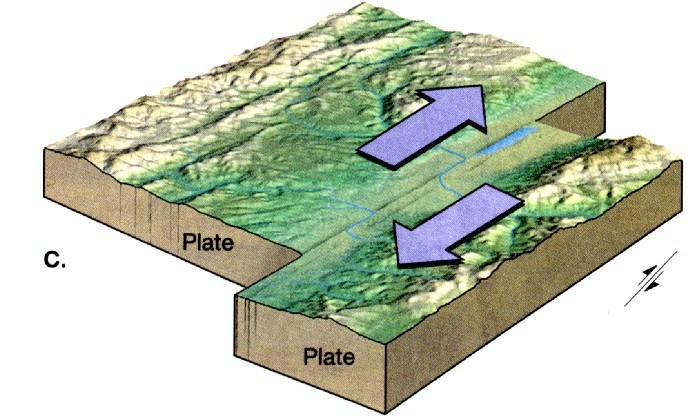


The movement of tectonic plates is due to ____?
convection currents in the mantle
seafloor spreading

What is true about the Earth's plates?
The are made of solid rock that can never be seen.
They are made of solid rock that can be seen if not covered by soil, rock, or water.

As plates pull apart, what happens?
Loose rock material fills the empty space.
New plate material fills the empty space so there is no space left.

What is true about the Earth's plates?
They are separated by oceans.
They fit closely together with each plate touching all the others.

What happens when continental plates press together?
The edges of the plates will push upward and continue to move toward each other.
The edges of the plates will be pushed downward and continue to move toward each other.

Two of Earth's plates pressed together for millions of years. What happened?
The oceanic plate was pushed downward
The continental plate was pushed downward.

What kind of diagram would show how three of the Earth's plates fit together?
They would be next to each other and have a space between them.
They would be next to each other and have no space between them.

What is true about the layer (lower mantle) below the Earth's plates?
It is solid rock.
It is slightly softened rock like clay.
Catastrophism:
The planet was formed by five global disasters right after each other
The planet was formed by six global disasters over a series of 100 years
The planet was formed by six global disasters right after each other
The planet was formed by five global disasters over a series of 100 years
Definition of theory:
an idea that has a lot of data from a lot of people over a long period of time
Definition of Law:
So much evidence backing it up that it is essentially true.
Principle of uniformitarianism
Natural processes that happen on Earth today have always occurred that way
James Hutton, Theory of the Earth
James Peirce,
Theory of natural processes
Processes occur the same way because of human corruption
Actualism definition
Uniformitarianism is fine but it is okay for natural processes to speed up or slow down
Billion years ago =
(a)
Million years ago =
(a)
Thousand years ago =
(a)
Before 6 Ga:
Nothing
No solar system, just a nebula of H atoms
A cloud of helium atoms
Nebular Hypothesis: Gravity
Step A; attraction to the center
Step B; pulled so much H into the middle, it goes flat and starts to rotate
Step C; early version of a start and temp is rising millions of degrees
Step D; atoms start to bond together due to high temps (requires a lot of energy)
Nebular Hypothesis: Solar disk Model
Step C; early version of a start and temp is rising millions of degrees
Step B; pulled so much H into the middle, it goes flat and starts to rotate
Step D; atoms start to bond together due to high temps (requires a lot of energy)
Step E; they strike each other and the mass sticks together
Nebular Hypothesis: Protostar
Step E; they strike each other and the mass sticks together
Step C; early version of a start and temp is rising millions of degrees
Step A; attraction to the center
Step B; pulled so much H into the middle, it goes flat and starts to rotate
Nebular Hypothesis: Fusion
Step A; attraction to the center
Step B; pulled so much H into the middle, it goes flat and starts to rotate
Step E; they strike each other and the mass sticks together
Step D; atoms start to bond together due to high temps (requires a lot of energy)
Nebular Hypothesis: Planetary accretion
Step C; early version of a start and temp is rising millions of degrees
Step D; atoms start to bond together due to high temps (requires a lot of energy)
Step A; attraction to the center
Step E; they strike each other and the mass sticks together
Theia impact aftermath
Molten planet
Density stratification
Eruption of Mount Vesuvius
Creation of mammals

What is the thinnest layer of the Earth?
Crust
Mantle
Outer Core
Inner Core

What is the thickest layer of the Earth?
Crust
Mantle
Outer Core
Inner Core

Which layer of the Earth is a dense solid ball of Iron and Nickle?
Crust
Mantle
Outer Core
Inner Core

Which layer of the Earth is liquid Iron and Nickle?
Crust
Mantle
Outer Core
Inner Core

What layer of the Earth is represented by the letter A?
Crust
Mantle
Outer Core
Inner Core

What layer of the Earth is represented by the letter B?
Crust
Mantle
Outer Core
Inner Core

What layer of the Earth is represented by the letter C?
Crust
Mantle
Outer Core
Inner Core

What layer of the Earth is represented by the letter D?
Crust
Mantle
Outer Core
Inner Core
The layers of Earth are in the order they are in because:
It keeps us safe
It holds the Earth together
Its pretty
The different layers have different densities
The lithosphere combines what two layers?
Athenosphere & Crust
Crust & Upper Mantle
Mantel & Asthenosphere
Which layer of the Earth is in a liquid state of matter?
Crust
Inner Core
Mantle
Outer Core
Which is the best description of the characteristics of the asthenosphere?
Solid, but flowing
Liquid, but dense
Hot, but solid metal
Brittle, but shifting
The lithosphere is composed of rock that can be described as being...
liquid.
solid.
dense.
flowing.
Sea-floor spreading occurs at mid-ocean ridges.
True
False
The pattern of magnetic stripes in rocks on either side of the mid-ocean ridge is the same.
True
False
the farther from a mid-ocean ridge a rock sample is taken, the younger the rock is.
True
False
What is continental drift?
Made of igneous rock
Where two plates collide
Theory that all of earths continents were once joined together in a singe, huge land mass and then started drifting away from each other.
The process by which new oceanic crust forms when when magma rises up.
What are divergent Plate Boundaries?
Where two plates divide
Where two plates collide
Where two plates slide
What are Convergent Plate Boundaries?
Where two plates divide
Where two plates collide
Where two plates slide
What are Transform Plate Boundaries?
Where two plates divide
Where two plates collide
Where two plates slide
What is seafloor spreading?
Large pieces of lithosphere that move.
Layer made up of the crust and uppermost mantle
The super continent that existed millions of years ago
Process by which new oceanic crust forms when magma rises up and solidifies at the mid-ocean ridge.
What is subduction?
where one tectonic plate sinks below another
Where two plates slide
Where two plates divide
Where two plates collide
luster
the way a mineral reflects light (how shiny it is)
the color of a mineral when it is ground to a powder
a mineral that contains a combination of silicone, oxygen, and 1 or more metals (90% of Earth's crust)
a mineral that does not contain compounds of silicon and oxygen
streak
the way a mineral reflects light (how shiny it is)
the color of a mineral when it is ground to a powder
a mineral that contains a combination of silicon, oxygen, and 1 or more metals (90% of Earth's crust)
a mineral that does not contain compounds of silicon and oxygen
silicate mineral
the way a mineral reflects light (how shiny it is)
the color of a mineral when it is ground to a powder
a mineral that contains a combination of silicon, oxygen, and 1 or more metals (90% of Earth's crust)
a mineral that does not contain compounds of silicon and oxygen
non-silicate minerals
the way a mineral reflects light (how shiny it is)
the color of a mineral when it is ground to powder
a mineral that contains a combination of silicon, oxygen, and 1 or more metals (90% of Earth's crust)
a mineral that does not contain compounds of silicon and oxygen
fracture
the splitting of a mineral along smooth, flat surfaces
the way a mineral breaks along irregular surfaces
the ratio of the mass of a substance to the volume of a substance (how much matter is in a given amount of space)
minerals that contain radium or uranium
cleavage
the splitting of a mineral along smooth, flat surfaces
the way a mineral breaks along irregular surfaces
the ratio of the mass of a substance to the volume of a substance (how much matter is in a given amount of space
minerals that contain radium and uranium
Chemistry of Earth's crust: 46.6%
(a)
Chemistry of Earth's crust: 27.7%
(a)
Chemistry of Earth's crust: 8.1%
(a)
Chemistry of Earth's crust: 5%
(a)
Chemistry of Earth's crust: 3.6%
(a)
Chemistry of Earth's crust: 2.8%
(a)
Chemistry of Earth's crust: 2.6%
(a)
Chemistry of Earth's crust: 2.1%
(a)
defining minerals
naturally occuring
inorganic
crystalline
solid at STP
set chemical composition
Hardness
How difficult it is to scratch the surface
How difficult it is to break the mineral
Moes Scale
Mohs Scale
Effervescence
Production of CO2
Bonding tetrahedral together (never share more than one oxygen atom)
(a)
no polymerization, isolated tetrehedral: (a) silicates
bonding together to make a linear chain: (a) silicates
two chains linked together in the center: _____ ____ silicates
(a)
sheets, like a sandwich: (a) silicates
Lithification definition
Sedimentary rocks
metamorphism definition
the rock cycle steps
Magma composition
helium
Dissolved gasses
Silica
dirt
50% silica content, forming in the mantle can rise anywhere, over 1100 degrees celcius, dry magma: (a) magma
Ring of fire, Rare, silica content 60%, 900-1000 degrees celcius, pretty dry: (a) magma
Silica 70%, 700-800 degrees celcius, shallow, wet magma: (a) magma
Freezing of magma
(a)
Crystalization where magma and rock that forms are chemically identical
(a)
Crystalization with changing the chemistry
(a)
Frozen magma below ground
(a)
Pluton cuts vertically through the layers
(a)
Pluton cuts horizontally through layers
(a)
pluton pushing up but can't break through the surface; pimple shaped
(a)
pluton no distinct shape but very large
(a)
Igneous rocks formed above ground
volcanic
extrusive
plutonic
intrusive
Igneous rocks formed below ground
volcanic
extrusive
plutonic
intrusive
2.5 cm
pegmatite
phaneritic
porphyritic
aphanitic
smaller than a penny, large enough to see
pegmatitic
phaneritic
porphyritic
aphanitic
some are big enough to see, some are not
pagmatitic
phaneritic
porphyitic
aphanitic
predominant grain size is too small to see
pegmatitic
phaneritic
porphyritic
aphanitic


What type of plate boundary is represented in the picture?
Athensphere
Divergent
Transform
Convergent

What type of plate boundary is represented in the picture?
Transform
Divergent
Convergent
Lithosphere
Mudslide that moves quicker than lava. Melted ice and snow and small earthquakes cause
(a)

Explosive eruptions occur if a volcano's magma is
high in viscosity
Mafic
Low in viscosity
Extremely hot
Dark colored igneous rocks are:
intrusive
felsic
mafic
extrusive

