
 Worksheets
Earth's Changing Surface Test Reveiw
Total questions: 85
Worksheet time: 53mins

Who is the scientist who proposed Continental Drift Theory?

Alfred Wegener named his single supercontinent ____________, which means "all Earth" in ancient Greek.
Pandora
Gandowandaland
Pangea
Percia

What type of fossils were noticed by Wegener to be found on two different continents?

True or False: The continental plates move so quickly that we can feel them.
True
False

Most geologists think that the movement of Earth's tectonic plates is caused by
the rotation of the Earth.
the Earth's magnetic field.
subduction.
convection currents.

When plates collide we get ________.
crumbles
volcanos
trenches
mountain ranges


Which layer of Earth flows slowly and causes the crust to move?
Crust
Mantle
Inner Core
Outer core

What is the correct order (starting from the surface) of Earth’s layers?
crust, outer core, inner core, mantle
mantle, outer core, inner core, crust
crust, mantle, outer core, inner core
outer core, inner core, crust, mantle

When tectonic plates slide against each other causing the earth to move.

Subduction means.....
one plate goes under another plate
two plates slide past each other
two plate collide and form folded mountains

Sea-floor spreading explains how.....
new crust is created at a divergent boundary
volcanoes are formed on continents
deep sea trenches are formed
An opening on the Earth's crust through which hot molten rock flows out from deep inside the Earth.
Volcano
Fault line
Fold
Crater

Which of the following is the name of the ancient supercontinent formed 280 Million Years ago.
Pangea
Gondwanda
Laurasia
Neverland


A mid-ocean RIDGE is located at the boundary of two tectonic plates. Which diagram correctly models the relative plate motion on each side of a mid ocean ridge?


The diagram shows a model of the movement of two tectonic plates. When the plates collide, on plate often moves below the other plate. The rising magma that can result from this type of plate movement may produce-
fossil layers
volcanic islands
deep-sea sediment
seafloor spreading

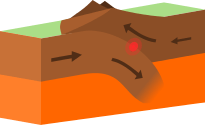
The image shows a plate boundary. Arrows have been added to indicate the movement of the plates.What plate boundary feature is also shown?
A ridge formed by an inactive convergent boundary
A valley forming at an active divergent boundary
A fault forming at an active transform boundary
A volcano formed by an active transform boundary

The model below shows two continental plates. What type of plate boundary is this
Transform boundary
Divergent boundary
Subduction boundary
Convergent boundary

What landform would most likely form at this plate boundary? Choose 2 correct answers.
mountains
volcanoes
trenches
mid-ocean ridges
The North American plate and Pacific plates meet at the San Andres Fault in California causing frequent earthquakes. This fault is located at a _____ boundary.
Ridge
Divergent
Convergent
Transform

Which oceanic plate in the above picture must be more dense? LEFT RIGHT
The plate on the left (the plate with the volcano on it)
The plate on the right (without the volcano)
Which TWO landforms occur when a continental plate and an oceanic plate hit each other?
Volcanoes on land and Volcanic Islands
Volcanoes on land and Deep Sea Trench
Volcanoes on land and Mountains
Rift Valley and Mid Ocean Ridge
How do most mountains form?
Continents collide and fold up on each other
Earth is shrinking and the crust wrinkles up
Ocean plates diverge and fold up on each other
Gravity from the moon pulls sections of the Earth up
Plates are not created or destroyed: They just pass by each other.
Converge
Diverge
Transform
This is where new material is added on to plates.
Converge
Diverge
Transform
This is where plate material may be destroyed (or recycled) and returned to the mantle.
Converge
Diverge
Transform

Study this diagram carefully, noticing the direction of the arrows.The green bars are tectonic plates.What will happen at the place where the star is drawn on this diagram?
The plates will slide past each other (causing a major earthquake)
The plates will hit each other (one will subduct)
The plates will diverge (spread apart)

What are these plates doing?
Converging
Diverging
Forming a transform boundary

What are these plates doing?
Converging
Diverging
Forming a transform boundary
Scientists think that the continents once formed a giant landmass that broke apart, and then slowly drifted apart. What is the name given to this hypothesis?
sea-floor Spreading
plate tectonics
continental drift
Pangaea
Most tectonic plates have both oceanic and continental crust. How are they different?
Oceanic is thinner and less dense than continental.
Continental is thinner than more dense than oceanic.
Continental is thicker and less dense than oceanic.
Oceanic is thicker and more dense than continental.
Why did no one believe Wegener's ideas about continental drift?
He could not successfully explain HOW the continents moved
He didn't have evidence that supported his ideas that the continents had once been connected
They were biased against his ideas because he was German and a meteorologist
He didn't use the right technology to gather data
The Appalachian Mountains in the U.S. match up with a similar mountain ranges in northern Europe. How does this support Wegener's theory of Continental Drift?
The mountains were formed after tectonic plates had moved away from each other
The similarities provide evidence North America & Europe were connected when the mountains formed.
Similar rock samples were found on the ocean floor and at the two mountain ranges indicating that they both formed around the same time.
This evidence does not support the theory of continental drift.

According to the continental drift hypothesis, the presence of similar fossils in South America and Africa supports which scientific idea?
Animals easily and frequently travel from Africa to South America.
Species of animals probably traveled between continents on natural rafts (such as trees destroyed in tsunamis).
Land bridges once existed that connected the continents.
South America and Africa were once connected together.
Where can you find the Ring of Fire?
Pacific Ocean
Black Sea
Europe
Atlantic Ocean


Abrasion
Chemical Weathering
Ice Wedging
Deposition
The breakdown of materials of Earth's crust into smaller pieces.
Erosion
Weathering
Recycling
Erosion
The process by which natural forces move weathered rock and soil from one place to another is called
Deposition
Soil Conservation
Erosion
Abrasion
In the rock cycle, this is when sediments are placed into a new location to eventually become new sedimentary rock.
melting
crystallization
deposition
Abrasion
Which of the following processes within the rock cycle operates at the Earth's surface?
metamorphism
melting
erosion
Heat & Pressure
Which of following is not an example of mechanical/physical weathering?
a gopher burrowing in the ground and loosening rock/soil.
a tree's roots growing in a cracked rock.
iron oxide weakening and breaking down a rock.
ice expanding cracks in a rock.
Chemical weathering
creates sediment by changing the rock physically.
creates sediment by changing the rock without chemical reactions.
creates sediment by changing the rock with chemical reactions.
deposits sediments.
Which of the following are factors that affect the formation of metamorphic rocks?
Heat & Pressure
Compaction & Cementation
Weathering & Erosion
Deposition & Water


Which type of rock is made from magma cooling inside Earth?
igneous
sediment
metamorphic
sedimentary
Which type of rock is formed by extreme heat and pressure?
igneous
hard rock
metamorphic
sedimentary

What Are The Three Main Types Of Rocks?
Igneous, Depository, Metamorphic
Depository, Igneous, Sedimentary
Metamorphic, Igneous, Depository
Igneous, Metamorphic, Sedimentary

