wayground logo

Free Printable Worksheets

Font size

S
M
L
XL
Worksheets

Science Review #2

Total questions: 90

Worksheet time: 1hrs 26mins

Name
Class
Date
1.
How much weight is on this triple beam balance?
a)
272 g
b)
272.5 g
c)
270 g
d)
372 g
2.
How much water is in the graduated cylinder
a)
40
b)
30
c)
35
d)
36
3.
What is this?
a)
Balance
b)
Triple beam balance
c)
Mass
d)
Graduated cylinder
4.
A STUDENT CAUGHT A GRASSHOPPER AND WANTED TO KNOW HOW LONG IT WAS. WHICH TOOL IS BEST TO MEASURE THE LENGTH OF THE GRASSHOPPER?
a)
RULER
b)
PAN BALANCE
c)
ELECTRONIC SCALE
d)
THERMOSTAT
5.
What measurement are we finding when we use a balance?
a)
mass
b)
volume
c)
length
d)
weight
6.
What measurement are we finding when we use a graduated cylinder?
a)
mass
b)
volume
c)
length
d)
weight 
7.

What is the length of the crayon?

a)

4 in.

b)

8 cm.

c)

5 in.

8.
How many inches is the green rectangle?
a)
3 inches
b)
4 inches
c)
5 inches
d)
6 inches
9.
The base unit of metric length.
a)
Meter
b)
Liter 
c)
Kilogram
d)
milligram
10.
Natural disasters such as flooding and tornadoes are linked to ________________.
a)
primary
b)
secondary
c)
old field
d)
ecosystem
11.
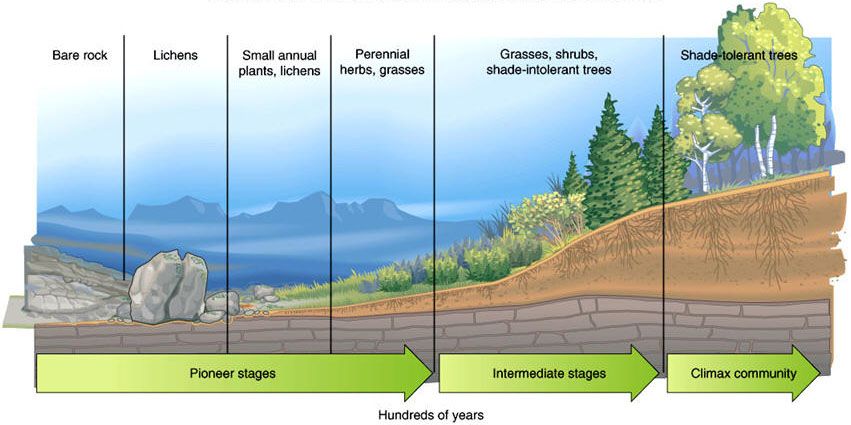
How do lichens contribute to primary succession?
a)
Lichens decompose organic matter from animals and plants
b)
Lichens begin to break down rock to form soil
c)
Lichens are nitrogen fixing bacteria
d)
Lichens convert carbohydrates into fossil fuels.
12.
What is formed during primary succession that doesn't need to be formed during secondary succession?
a)
pioneer species
b)
soil
c)
climax community
d)
lichens
13.
What type of succession is shown going from figure A to figure B?
a)
primary succession
b)
eutrophication
c)
secondary succession
d)
intermediate
14.
After a forest fire, an ecosystem would start regrowth through -
a)
primary succession
b)
secondary succession
c)
climax community
d)
limiting factors
15.
Which catastrophic event will most likely have the effect of returning an ecosystem to primary succession?
a)
A tornado
b)
A volcanic eruption
c)
A flood
d)
A drought
16.
succession that occurs in an area with no soil
a)
ecological succession 
b)
primary succession 
c)
secondary succession
d)
pioneer speciles
17.
succession that occurs in an area where soil is already present
a)
ecological succession 
b)
primary succession 
c)
secondary succession
d)
pioneer speciles
18.
starts with bare rock followed by lichen
a)
primary succession 
b)
secondary succession
c)
both types of succession
19.

Which experiences the least change over time?

a)

Pioneer Species

b)

Primary Succession

c)

Aquatic Succession

d)

Climax Community

20.

What is a common characteristic among pioneer species?

a)

roots that break apart rocks

b)

long thick roots

c)

exposed surface roots

d)

soak up water quickly

21.

What is the role of the pioneer species in Primary Succession?

a)

To kill any remaining organisms from before the disturbance

b)

To break down rock and rebuild soil

c)

To provide food for large animals

d)

To put fresh oxygen into the air

22.

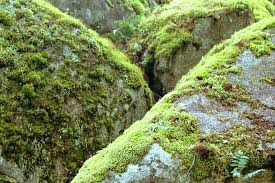
The picture shows what type of succession?

a)

primary

b)

secondary

c)

tertiary

d)

quadanary

23.

What are examples of pioneer species in a primary succession?

a)

Bushes and Shrubs

b)

Oak trees

c)

Mossess and Lichens

d)

A rose Bush

24.
Which of the following symbiotic relationships is considered parasitic?
a)
Ticks feeding on a dog
b)
Bees transporting pollen from flowers
c)
Pilotfish swimming under sharks
d)
Birds eating the insects fromo the back of hippo
25.
Maria and her classmates are observing animals at the pond. They notice that wood storks and ibisies both feed on fish. Which of these describes the relationship between these two birds.
a)
Parasitism
b)
Competition
c)
Predator and prey
d)
Producer and consumer
26.
Which of these describes a mutually beneficial relationship between two organisms?
a)
A dog with worms in its intestine
b)
A turtle and a snail that both eat grass live in a river
c)
A honeybee pollinating a plant and receiving nectar for food
d)
A small fish attached to a shark, eating tiny pieces of the shark's food as it floats
27.
Which pair of organisms listed below are competitors for the same natural resources?
a)
Ticks and dogs
b)
Lions and leopards
c)
Honeybees and flowers
d)
Salmon and brown bears
28.
After walking through a field, you find a tick attached to your leg. What is the tick's relationship to you?
a)
Predator
b)
Decomposer
c)
Producer
d)
Prey
29.
Which of the examples below can BEST be described as mutualism between animals?
a)
A tapeworm lives in the intestine of a bird and consumes the food that the bird has eaten
b)
Mountain lions and wolves fight each other for the same deer
c)
A bird eats parasites off a rhinoceros while the rhinoceros provides protection to the bird
d)
Rats live in the garbage dump of a town and rarely interact with people
30.
An organism that kills and eats another for food
a)
Predator
b)
Prey
c)
Parasite
d)
Plant
31.
An organism that is killed and eaten by another organism
a)
Predator
b)
Prey
c)
Parasite
d)
Host
32.
Occurs when 2 or more organism use the same resource
a)
Competition
b)
Mutualism
c)
Commensalism
d)
Parasitism
33.
A close long term association between 2 or more species
a)
Mutualism
b)
Commensalism
c)
Symbiosis
d)
Parasitism
34.
Relationship where both organism benefit
a)
Competition
b)
Commensalism
c)
Mutualism
d)
Parasitism
35.
Relationship where one organism benefits and the other is neither harmed nor helped
a)
Commensalism
b)
Parasitism
c)
Mutualism
d)
Competition
36.

Clown fish lives among the deadly tentacles of the sea anemone and is protected. The clown fish eats food left over by the anemone keeping the area clean and also acts as “bait”.

a)

mutualism

b)

commensalism

c)

parasitism

37.

Remora eats food left over by the shark. The shark makes no attempt to prey upon the remora.

a)

mutualism

b)

commensalism

c)

parasitism

38.

4. Braconoid wasps lay eggs on the catepillar. They hatch inside the cocoon of the catepillar and eat the developing catepillar.

a)

mutualism

b)

commensalism

c)

parasitism

39.

Fleas on a dog…

a)

mutualism

b)

commensalism

c)

parasitism

40.

Butterfly gets nectar from the flower and transfers pollen to other flowers to allow flowers to reproduce.

a)

mutualism

b)

commensalism

c)

parasitism

41.

What would happen to the bird if the green fish died out?

a)

the bird population would grow

b)

the bird population would die out

c)

the smaller fish will die out

42.

What is the bottom layer of the an energy pyramid?

a)

producer

b)

tertiary consumer

c)

Secondary consumer

d)

primary consumer

43.

the top layer of an energy pyramid a primary consumer?

a)

true

b)

false

44.

What does an energy pyramid show?

a)

Energy flow in a community

b)

Longest lifespans

c)

The stronger animal the higher it is on the pyramid

45.

All tertiary consumers are scavengers

a)

true

b)

false

46.

What would happen if the primary consumers died out?

a)

the producers would grow and the secondary and tertiary consumers would die

b)

producers would die out

c)

consumers would grow

47.

decomposers are producers.

a)

true

b)

false

48.
In the energy pyramid here, which organisms have the most energy available?
a)
Producers
b)
Carnivores
c)
Herbivores
d)
Top Predator
49.
In the energy pyramid below, which organism has the least amount of energy available?
a)
Producers
b)
Herbivores
c)
Carnivores
d)
Top Predator
50.
an organism that makes its own food
a)
producer
b)
consumer
c)
herbivore
d)
scavenger
51.
an animal that eats both plants and animals
a)
carnivore
b)
herbivore
c)
omnivore
d)
consumer
52.
In an energy pyramid, energy_______ as you move up the pyramid.
a)
Increases
b)
Decreases
c)
Stays the same
d)
Changes up and down
53.
In the energy pyramid here, how much of the energy in the producers gets passed to the herbivores?
a)
10%
b)
20%
c)
80%
d)
90%
54.

The smallest biological unit of a living organism is a

a)

cell

b)

compound

c)

element

d)

molecule

55.

Pairs of thread-like molecules, which live in the cell's nucleus, and carries heredity information are called

a)

chromosomes

b)

genes

c)

DNA

d)

mitosis

56.

Made of DNA this is the basic physical and functional unit of heredity.

a)

chromosomes

b)

genes

c)

DNA

d)

nucleus

57.

Fully grown parent cells split into two halves resulting in two daughter cells with the exact DNA as the parent.

a)

Binary Fission

b)

Budding

c)

Fragmentation

d)

Vegetative Reproductions

58.

A parent cell breaks into pieces and each piece becomes a new offspring.

a)

Binary Fission

b)

Budding

c)

Fragmentation

d)

Vegetative Reproductions

59.

Which is not an advantage for asexual reproduction?

a)

Less genetic variation

b)

No need for a mate

c)

Quick

d)

Produces more offspring

60.

Changes in an organism that affect its appearance, how it behaves, and its functions.

a)

Complication

b)

Gamete

c)

Mutation

d)

Zygote

61.

Which female organ is responsible for producing the ova in sexual reproduction?

a)

Gametes

b)

Ovaries

c)

Testes

d)

Uterus

62.

Which male organ is responsible for producing the sperm in sexual reproduction?

a)

Gametes

b)

Penis

c)

Sperm Ducts

d)

Testes

63.

What type of asexual reproduction is taking place?

a)

Binary Fission

b)

Budding

c)

Fragmentation

d)

Regeneration

e)

Vegetative Reproduction

64.

What type of asexual reproduction is taking place?

a)

Binary Fission

b)

Budding

c)

Fragmentation

d)

Regeneration

e)

Vegetative Reproduction

65.

What type of asexual reproduction is taking place?

a)

Binary Fission

b)

Budding

c)

Fragmentation

d)

Regeneration

e)

Vegetative Reproduction

66.

What type of asexual reproduction is taking place?

a)

Binary Fission

b)

Budding

c)

Fragmentation

d)

Regeneration

e)

Vegetative Reproduction

67.

What type of asexual reproduction is taking place?

a)

Binary Fission

b)

Budding

c)

Fragmentation

d)

Regeneration

e)

Vegetative Reproduction

68.

Happens when a single parent cell divides into two daughter cells.

a)

mitosis

b)

meiosis

69.

Happens when the parent's chromosomes are halved.

a)

mitosis

b)

meiosis

70.
Chromosomes are found in the ____________ of the cell
a)
Chloroplast
b)
Nucleus
c)
Cytoplasm
d)
Mitochondria
71.
A heterozygous long-tusked elephant is crossed with a homozygous recessive short-tusked elephant. What is the probability of the offspring having short tusks?
a)
0%
b)
25%
c)
50%
d)
75%
72.
In pea plants, the tall allele is dominant to the short allele. What key would demonstrate this?
a)
Tall = T
Short = S
b)
Tall = T
Short = t
c)
Tall = t
Short = T
d)
Tall = TT
Short = tt
73.
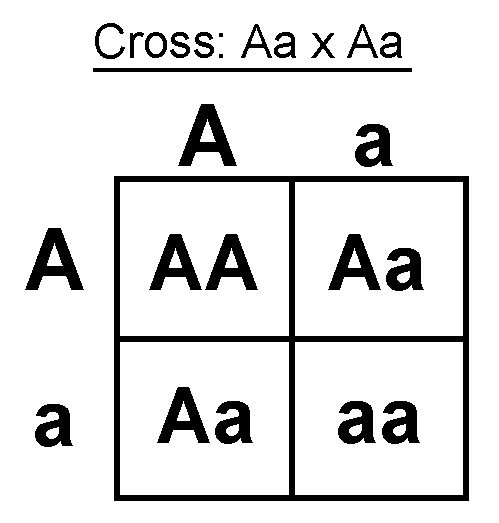
What is the probability of heterozygous offspring?
a)
25%
b)
50%
c)
0%
d)
100%
74.
What allele combination should go in the missing box?
a)
AA
b)
Aa
c)
aa
d)
none of these
75.
What is the phenotype of the offspring? (A-Brown hair; a-blond hair) 
a)
50 % Brown Hair and 50% Blond Hair 
b)
25 % Brown Hair and 75% Blond Hair 
c)
75 % Brown Hair and 25% Blond Hair 
d)
0% Brown Hair and 100% Blond Hair 
76.
Heterozygous is when...
a)
the alleles are the same
b)
the alleles are different
c)
the alleles are absent
d)
the alleles are present
77.
In a heterozygous genotype, the ___________ allele takes over in the phenotype.
a)
recessive
b)
dominant
c)
lower case letter
d)
both 
78.
B = brown fur  b = white fur
In the punnett square, what is the probability for white fur? 
a)
0%
b)
25%
c)
50%
d)
75%
79.
Which of the following alleles is homozygous (purebred) recessive?
a)
Tt
b)
tt
c)
TT
d)
t
80.
What are the 8 levels of classification of living things from most general to most specific?
a)
domain, kingdom, phylum, class, order, family, genus, species
b)
domain, kingdom, class, phylum, order, family, genius, species
c)
domain, kingdom, family, class, order, family, genus, species
d)
domain, king, phillip, class, order, family, genus, species
81.
To what specific taxon would you assign this organism?
a)
Class Insecta
b)
Order Scorpiones
c)
Order Araneae
d)
Order Amblypygi
82.
To what order does the first organism belong? (red)
a)
Order Diptera
b)
Order Odonata
c)
Order Ephemeroptera
d)
Order Coleoptera
83.
What is the science of organizing, classifying and naming living things?
a)
taxonomy
b)
taxadermy
c)
taxicab
d)
toxicology
84.
What animal is most closely related to the American badger?
a)
Coyote
b)
European otter
c)
Gray wolf
d)
Leopard
85.
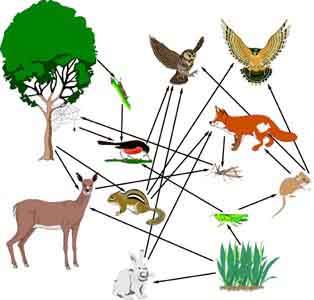
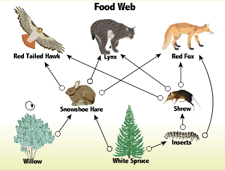
What does a food web represent?
a)
All connections of energy flow throughout all organisms in a habitat.
b)
The specific ways that mutualism is carried out.
c)
A single pathway or energy flow between organisms. 
d)
How carnivores get their food. 
86.
What may happen if the snowshoe hare was removed from the food web pictured?
a)
The insects in the habitat would increase.
b)
The shrew population would decrease due to being only hawk food source.
c)
The willow tree population would decrease.
d)
Foxes would dies due to no food source. 
87.
The rabbit in this food web would be considered a:
a)
Decomposer
b)
Producer
c)
Secondary Consumer
d)
Primary Consumer
88.
The fox in this food web would be considered a:
a)
Tertiary Consumer
b)
Producer
c)
Secondary Consumer
d)
Primary Consumer
89.
The mouse in this food web would be considered a:
a)
Primary Consumer
b)
Producer
c)
Tertiary Consumer
d)
Secondary Consumer
90.
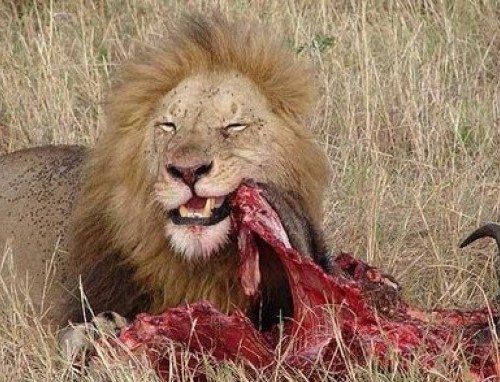
The image provided is an example of a(n):
a)
Carnivore
b)
Herbivore
c)
Producer
d)
Autotroph