
 Worksheets
Energy Flow & Nutrient Cycles
Total questions: 45
Worksheet time: 45mins
What is the original BIOTIC source of almost all energy in most ecosystems?
Producers
What is the original ABIOTIC source of almost all energy in most ecosystems?
Sunlight
An organism that produces its own food supply from inorganic compounds is called a(n):
heterotroph
consumer
detritivore
autotroph
A primary consumer is also known as:
carnivore
herbivore
trophic level
foodie
Only ____ of organism energy is passed on to the next trophic level of an ecosystem as you move up the energy pyramid.
10%
1%
100%
20%
90%
What are the products/outputs of photosynthesis?
water and carbon dioxide
oxygen and glucose
oxygen and carbon dioxide
oxygen and water
Which of the following is the correct equation for PHOTOSYNTHESIS?
CO2 + light + H2O --> O2 + Sugar
CO2 + sugar + H2O --> O2 + light
O2 + light + H2O --> CO2 + Sugar
CO2 + O2 + H2O --> Light+ Sugar
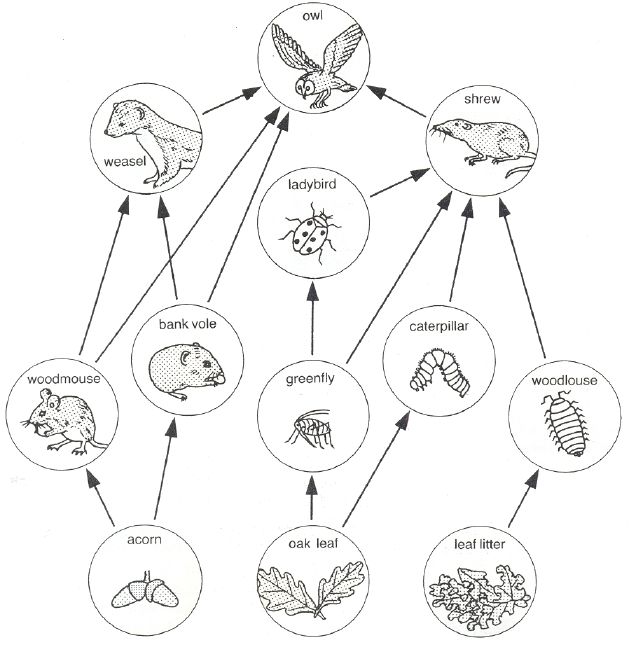
What type of consumer is the shrew?
herbivore
omnivore
carnivore
detritivore

According to this food web, which heterotrophs are secondary consumers?
lion & caracal
lion & mouse
rhino & giraffe
impala & snake
The arrows in a food chain or web represents what?
They point to the organism that is being eaten (from the predator to the prey item)
It shows how sunlight flows within each level of the ecosystem
They show what direction the energy is flowing between organisms. (from prey to predator)
They represent how water molecules are transferred within a habitat.
When an organism's energy source comes from both animals and plants, that organism is considered to be a:

Which organism receives the least amount of energy from the producer?
If 15200 kJ of energy is available at the primary producer level, how much energy is available at thew secondary consumer level?
1520
152
15.2
1.52

The diagram represents a pyramid of energy in an ecosystem. Which level would most likely contain herbivores?

Both ______ and ______ DECREASE as you move up the energy pyramid in an ecosystem.
Sunlight; Nitrates
Energy; Biomass
Biomass; Predation
Heat; Photosynthesis
Which of these shows a possible food chain for an ecosystem?
shark--> fish --> plankton -->sun
sun --> plankton --> fish --> shark
plankton --> sun --> fish --> shark
plankton --> fish --> shark --> sun

Name the detritivore?

Organisms that must consume other organisms to acquire energy are called:
Heterotrophs
Autotrophs
Decomposers
Detritivores
hydrogen (H2)
oxygen (O2)
nitrogen (N2)


A Cactus has 4520 kcal of energy it acquired from photosynthesis. Based on the food chain in the photo, how much energy will the hawk gain?
4520 kcal
452 kcal
45.2 kcal
4.52 kcal
0.452 kcal

What process is happening step A?
transpiration
evaporation
condensation
accumulation
Which factors are ABIOTIC?
sunlight
plants
precipitation
wind
Which factors are BIOTIC?
humans
Insects
rocks
sulight
The Products of Cellular Respiration:
Carbon Dioxide
Oxygen gas
Water
Glucose/sugar
Reactants of Cellular Respiration:
water
carbon dioxide
oxygen gas
Glucose/sugar
Which processes are ANAEROBIC?
Fermentation
Photosynthesis
Cellular Respiration

Which of these organisms produce ATP through cellular respiration?
Plants
Animals
Both
Neither
What is the meaning of PHOTO?
light
to put together
red
green
What is the meaning of SYNTHESIS?
light
to put together
red
green
What is the meaning of trophic?
food/nutrition
carbs/sugar
different
self
What is the meaning of HETERO?
food/nutrition
carbs/sugar
different
self
What is the meaning of AUTO?
food/nutrition
carbs/sugar
different
self


In the food web above, what organism is a tertiary consumer?
Fox
Frog
Vole
Grass

