Wayground logo

Free Printable Worksheets

Font size

S
M
L
XL
Worksheets

G9 ASP Review - Week 7

Total questions: 91

Worksheet time: 8hrs 35mins

Name
Class
Date
1.
If there are two forces going in the same direction how would you find the net force?
a)
Subtract
b)
Add
c)
Neither
d)
Multiply
2.
You and your dad are moving the couch from one side to another. Your dad pushes with a force of 35 N to the right and you push with a force of 25 N right. What is the net force on the couch?
a)
60 N right
b)
10 N left
c)
60 N right
d)
50 N left
3.
What is a force?
a)
the PUSH or PULL on an object 
b)
The MOTION an object creates
c)
The objects HITTING one another
d)
Going REALLY FAST
4.
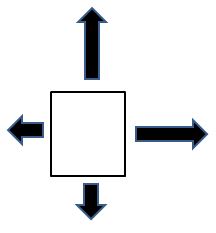
Which one is balanced?
a)
Top
b)
Bottom
c)
Both
d)
Cannot be determined
5.
What is the net force?
a)
17 N Right
b)
3 N Right
c)
3 N Left
d)
17 N Left
6.
What is the force that pulls us towards the Earth?
a)
gravity
b)
weight
c)
friction
d)
mass
7.
Name two quantities that are vectors.
a)
force and speed
b)
speed and acceleration
c)
force and acceleration
d)
mass and weight
8.
What are balanced forces?
a)
forces of the same size, in opposite directions
b)
the same size in the same direction
c)
forces in opposite directions
d)
forces at right angles to each other
9.
Two forces on an object are in the same direction. How do we calculate the resultant force?
a)
take away one from the other
b)
multiply them
c)
divide one by the other
d)
add them together
10.
Two forces on an object are in opposite directions. How do we calculate the resultant force?
a)
divide one by the other
b)
multiply them
c)
find the difference between them
d)
add them together
11.
Is the car
a)
Stationary
b)
Moving at constant speed
c)
Accelerating
d)
Decelerating
12.
Is the car
a)
Stationary
b)
Moving at constant speed
c)
Accelerating
d)
Decelerating
13.
Is the car
a)
Stationary
b)
Moving at constant speed
c)
Accelerating
d)
Decelerating
14.
Is the car
a)
Stationary
b)
Moving at constant speed
c)
Accelerating
d)
Decelerating
15.
In a tug of war the left team pulls with a force of 200N. The right team pulls with a force of 150N.What is the resultant force?
a)
50N to the left.
b)
350N to the left.
c)
350N to the right.
d)
50N to the right.
16.

What is the meaning of force?

a)

The movement of an object between two points.

b)

The magnitude of a push on an object.

c)

Push or pull resulting of the interaction of two objects.

d)

The direction of the movement of an object.

17.

What element(s) of a force is(are) represented by vectors?

a)

Magnitude

b)

Direction

c)

Magnitude and direction

d)

Vectors don't represent forces.

18.

Which is the unit of measurment of a force's strength?

a)

Kelvin

b)

Newton

c)

Meters

d)

Liters

19.

The strength of a force is represented by...

a)

the length of the vector.

b)

the size of the vector.

c)

the point of the vector.

d)

the color of the vector.

20.

Which of the following vectors represent the force done by the volleyball player?

a)
b)
c)
d)
21.
A box is moving to the left up a ramp. Which way is the force of friction pointing?
a)
down the ramp to the right
b)
up the ramp to the left
c)
there is no friction
d)
straight up
22.

This object would be moving (pick all that are correct):

a)

up

b)

down

c)

left

d)

right

23.

Which diagram best shows person pushing a couch (accelerating) across the floor?

a)
b)
c)
d)
24.

Which of the following describes the vector above?

a)

45 cm

b)

45 cm at 30 degrees North of East

c)

45 cm at 30 degrees East of North

d)

45 cm North East

25.

What is the magnitude of the resultant vector, r?

a)

3

b)

4

c)

5

d)

7

26.
How do you combine vectors if they are at a right angle to each other, and you know two sides?
a)
Multiply
b)
Divide
c)
Pythagorean Theorem
d)
Use trigonometry
27.

A man drives 30 km south and 5 km east. What quadrant does the man wind up in?

a)

I

b)

II

c)

III

d)

IV

28.
Friction is a force that acts in an ___________ direction of movement.
a)
similar
b)
opposite
c)
parallel
d)
west
29.
The amount of friction depends on the weight of the objects pressing together.
a)
True
b)
False
30.
How can friction be reduced?
a)
reduce the force acting between the 2 surfaces
b)
reduce the roughness of the 2 surfaces coming in contact
c)
use wax, grease or oil
d)
all of the above are ways of reducing friction
31.
Rougher surfaces have ...
a)
greater friction
b)
less friction
c)
the same level of friction
32.
How does friction affect speed?
a)
more friction decreases speed
b)
more friction increases speed
c)
less friction decreases speed
d)
less friction doesn't affect speed
33.
The rougher the surface, the faster an object will travel over the surface.
a)
True
b)
False
34.
When most objects with smooth surfaces rub, there is less friction.
a)
True
b)
False
35.
Force the opposes motion between 2 surfaces
a)
force
b)
Newton
c)
friction
d)
net force
36.

Smooth surfaces such as ice, usually produce less friction.

a)

true

b)

false

37.

People use rough or sticky things to decrease friction.

a)

true

b)

false

38.
What type of friction is not moving?
a)
static
b)
sliding
c)
fluid
d)
rolling
39.

What are 2 factors that determine the amount of friction between 2 objects?

a)

Normal force and roughness between surfaces

b)

hills and valleys and how smooth or rough the surface is

c)

Amount of force and amount of surface the comes in contact

d)

The force and the weight exerted on the surfaces

40.

A block with a mass m = 5.0 kg slides down a ramp inclined at an angle Ɵ = 30° as shown below. The block accelerates at a rate of 2.0 m/s2.


Find the component of the block’s weight along the ramp.


Find the frictional force between the block and the ramp


Calculate the coefficient of kinetic friction.


a)

Fgx = 25N

Ff = 15N

μ = 0.35

b)

Fgx = 43N

Ff = 33N

μ = 0.35

c)

Fgx = 43N

Ff = 33N

μ = 0.77

d)

Fgx = 25N

Ff = 15N

μ = 0.77

41.

A block with mass 2 kg is on a ramp inclined at 30° to the horizontal. A 5.0 N force of friction, Ff acts on the

block as it is pulled up the ramp at constant velocity with force F, which is parallel to the ramp, as shown in the diagram below.


Find the components of the block’s weight, both parallel to the incline and Perpendicular to the incline.


What is the magnitude of force F?


Sin 30 = 0.50

Cos 30 = 0.87

a)

Fgx = 10 N

Fgy = 17.3 N

F = 15.0 N

b)

Fgx = 17.3

Fgy = 10.0 N

F = 15.0 N

c)

Fgx = 17.3

Fgy = 10.0 N

F = 22.3 N

d)

Fgx = 10 N

Fgy = 17.3 N

F = 22.3 N

42.

A 15 kg mass is sliding along a frictionless floor with an acceleration of 5 m/s2. What is the magnitude of the net force acting on the mass?

a)

15N

b)

10N

c)

20N

d)

75N

43.

The diagram below shows a box held stationary on a ramp by a string connected to a wall.

Which of the following relationship is true?

a)

T = -Ff

b)

T = WCosƟ + Ff

c)

WSinƟ = T + Ff

d)

T + Ff W

44.

The diagram below shows a box held stationary on a ramp by a string connected to a wall.

a)

Normal force = increases

Friction = Increases

Tension = Increases

b)

Normal force = decreases

Friction = decreases

Tension = decreases

c)

Normal force = increases

Friction = Increases

Tension = decreases

d)

Normal force = decreases

Friction = decreases

Tension = Increases

45.
If you throw a baseball straight up, what is its acceleration at the highest point?
a)
9.8 m/s2
b)
9.8 m/s
c)
0 m/s2
d)
0 m/s
46.
What is the horizontal acceleration of a projectile?
a)
0 m/s2
b)
9.8 m/s2
47.
Two objects of the same mass are launched from the ground. Object A has a launch angle of 45, while Object B has a launch angle of 65. Which object will hit the ground first?
a)
A
b)
B
c)
Both objects hit the ground at the same time
d)
unable to determine with the given information
48.
The shape of the path a projectile follows...
a)
circular
b)
linear
c)
wavy
d)
parabolic
49.
What is the vertical acceleration of a projectile?(neglect air resistance) 
a)
0 m/s2
b)
9.8 m/s2
50.

In a projectile motion we always have...

a)

1 component (x)

b)

3 components (x,y, and z)

c)

2 components (x and y)

d)

0 components

51.

What is the direction of the acceleration for any projectile?

a)

The direction the projectile is traveling.

b)

Down

c)

Up

d)

Sideways

52.

Centripetal force is an acceleration of an object moving in circular path whose direction is _________________________of the circular path and whose magnitude is equal to the square of the speed divided by the radius.

a)

towards the tangent

b)

towards the centre

c)

towards the minimum point

d)

towards the maximum point

53.

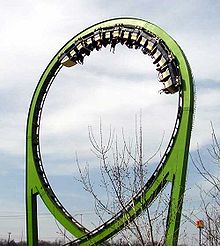
Where is the net force when the rollercoaster is at the top of the loop?

a)

Towards the sky

b)

Towards the Right

c)

Towards the left

d)

Towards the center of the circle

54.

In uniform circular motion, the magnitude of the _______________________of an object is constant but the __________ is continually changing.

a)

speed, acceleration

b)

speed, direction

c)

acceleration, speed

d)

acceleration, velocity

55.
The velocity is always _____ to the line of a circle. 
a)
outwards
b)
towards the center
c)
tangent
d)
faster
56.
Which statement is true about an object that is traveling in uniform circular motion?
a)
The speed of the object varies.
b)
The net force on the object is directed toward the center of the circular path.
c)
The direction of the object's velocity is constant.
d)
The net force on the object is directed away from the center of the circular path.
57.
Centripetal acceleration always points
a)
in the direction of the object's motion
b)
in the opposite direction of the object's motion
c)
towards the center of the circle
d)
towards the outside of the circle
58.

________________________ defined as the number of revolutions (cycles/rotations) completed in one second.

a)

frequency

b)

period

c)

distance

d)

centripetal acceleration

59.
Which of the following is the unit for centripetal force?
a)
J
b)
m/s2
c)
kg⋅m/s
d)
N
60.
The time taken for one complete circuit is called the... 
a)
Period
b)
Frequency 
c)
Angular velocity
61.
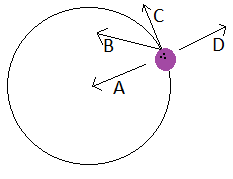
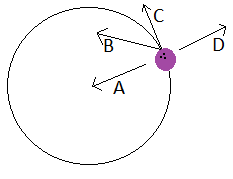
Which represents the acceleration of the ball?
a)
A
b)
B
c)
C
d)
D
62.
Which of the following depict the speed of the blowing ball?
a)
A
b)
B
c)
C
d)
D
63.

If an object is spinning around on a string and the string was suddenly cut, the object would move in a

a)

curved path

b)

straight line

64.

Why does an object experiencing uniform circular motion have an acceleration?

a)

because it ir changing speed

b)

because it is changing direction

c)

because it is moving n a straight line

d)

because it has mass

65.

The _______________________ supplies the centripetal force requirement for the car to move in a horizontal circle. Without it, the car would turn its wheels but would not move in a circle (as is the case on an icy surface).

a)

friction force

b)

centrifugal force

c)

normal force

d)

applied force

66.

In this diagram, what do the red arrows represent?

a)

the acceleration vector

b)

the velocity vector

c)

the centripetal force vector

d)

the force of gravity

67.

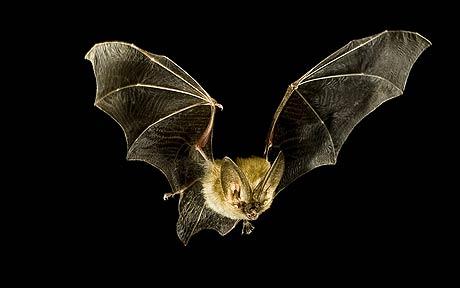
Bentley the bat has a mass of 0.58 kg and flies at a speed of 0.8 m/s in circle of radius 0.5 m. What is his acceleration?

a)

0.25 m/s2

b)

1.3 m/s2

c)

1.6 m/s2

d)

0.74 m/s2

68.
Calculate the centripetal force required to make a 5 kg ball move 4 m/s in a circle with a radius of 2 m.
a)
10 N
b)
20 N
c)
30 N
d)
40  N
69.
Calculate the centripetal force required to make a 5 kg ball move 4 m/s in a circle with a radius of 2 m.
a)
10 N
b)
20 N
c)
30 N
d)
40  N
70.
Calculate the velocity of an object moved around a circle with a radius of 1.65 m and an acceleration of 3.5 m/s2.
a)
2.4 m/s
b)
3.6 m/s
c)
3.9 m/s
d)
4.2 m/s
71.
What is a force?
a)
a push or a pull
b)
a force that slows or stops an object in motion
72.
What is the unit used to measure work?
a)
Joule
b)
Watt
c)
Newton
d)
Pascal
73.
 Work done = Force x _________
a)
a. distance
b)
b. acceleration
c)
c. velocity
d)
d. speed
74.
What kind of energy is in a moving skateboard?
a)
Potential
b)
Kinetic
75.
What kind of energy is in a rock at the edge of a cliff?
a)
Potential
b)
Kinetic
76.
If W=Fd
Then how much work is done if it takes 20N to move a box 10 meters
a)
0
b)
2
c)
20
d)
200
77.
When work is done, there is always a(n) _______.
a)
constant rate
b)
single movement involved
c)
transfer of energy
d)
increase in the mechanical advantage
78.
The ability to do work is....
a)
work
b)
power
c)
acceleration
d)
energy
79.

The gravitational potential energy of a person on a 3.0 m high diving board is 1800 J. What is the person’s mass?

a)

60 kg

b)

25 kg

c)

5400 kg

d)

360 kg

80.

The kinetic energy of a small boat is 15000 J. If the boat’s speed is 5.0 m/s, what is its mass?

a)

1200 kg

b)

11 kg

c)

1560 kg

d)

75000 kg

81.

To move a suitcase up to the check-in stand at an airport, a student pushes with a horizontal force through a distance of 0.90 m. If the work done by the student is 18 J, what is the magnitude of the force he exerts?

a)

F = 20 N

b)

F = 16.2 N

c)

F = 34 N

d)

F = 120 N

82.

You lift a 3kg pumpkin to a height of 0.80 m to check it out. How much work do you do on the pumpkin when you lift it from the ground?

a)

0.24 kg

b)

2.4 kg

c)

24 kg

d)

240 kg

83.
How much work is being done with 200 N of force over 426 meters?
a)
85,200 J
b)
45,620 J
c)
90,480 J
d)
62,329 J
84.
If 150 Joules of work is needed to move a box 10 meters, what force was used? 
a)
1500 N
b)
15 N
c)
1.5 N
d)
150 N
85.

What would you solve for if given time and work?

a)

power

b)

force

c)

distance

d)

work

86.
Power is the RATE at which work is done. 
a)
True
b)
False
87.
You move an 8-newton weight five meters in 4 seconds. How much power have you generated?
a)
160 watts
b)
10 watts
c)
6.4 watts
d)
17 watts
88.
Which of the following would produce the most power?
a)
A mass of 10 kilograms lifted 10 meters in 10 seconds 
b)
A mass of 10 kilograms lifted 10 meters in 5 seconds
c)
A mass of 5 kilograms lifted 10 meters in 5 seconds
d)
A mass of 5 kilograms lifted 5 meters in 10 seconds
89.
You do 90 joules of work in 30 seconds. How much power have you generated?
a)
30 watts
b)
3 watts
c)
120 watts
d)
270 watts
90.
A weightlifter lifts two 300 newton weights 1.5 meters off the ground. How much work has he done?
a)
600 J 
b)
660 J
c)
900 J 
d)
1200 J 
91.
A kid applies a force of 70 N to a ball over 1.1 meters. How much work did he do on the ball? 
a)
77 J
b)
7.7 J 
c)
0.7 J 
d)
770 J