
 Worksheets
Unit 1 Marine Science - QCAA
Total questions: 79
Worksheet time: 1hrs 23mins
What is bathymetry?
The study of plate tectonics.
The topography of the ocean floor.
The topography of the land.
The study of marine science
Which of the following is the process of pulling CO2 from the atmosphere to make food?
Sonar is the use of _____________ to "see" in the ocean.
light
sound
cameras
lasers
According to plate tectonic theory, a shift in tectonic plates will result in which of the following?
Earthquakes
Tsunamis
Volcanoes
All of the above
Where is the majority of Earth's freshwater found?
Rivers
Lakes
Streams
Glaciers
Which of the following statements is true.
70% of Earth's surface is water
The majority of Earth's water is freshwater
Most freshwater is found free flowing on the surface in lakes and streams
Most of the Earth's water is found in icebergs.
What is the average salinity of the ocean in ppt?
(a)
Where does salt in the ocean come from?
Table Salt
Rain
Rocks and the Earth’s mantle.
Fish
What region includes the continental rise, slope and shelf?
The deep ocean-basin floor
The mid-ocean ridge
The continental seamount
The continental margin
Name at least two (2) bathymetric features you may find in the ocean basin.
A surface ocean (a) is the movement of water on the surface of the ocean.
Large systems of circulating (or rotating) ocean currents are called what?
Ekman Spiral
Gyres
Upwelling
Eddies
Density _______ with depth in the ocean.
decreases
increases
is constant
In the ocean, temperature _______ with depth.
decreases
increases
is constant
Salinity is the saltiness of the water and in the ocean it __________ with depth.
decreases
increases
is constant

What is the approximate depth of the theromohaline as shown in the graph? (Tip: Click on the "Zoom in" button below to see clearly)
less than 500 m
500- 1000 m
1000-1500 m
4500 m

This bathymetry measuring device can be towed behind a ship. There are two major types: GLORIA and Sea MARC.
Echo Soundings
Precision Depth Recorder (PDR)
Multibeam Echo Sounders
Side Scan Sonar
The flat zone of the continental margin, that runs from the shore to the shelf break is the...
Continental Shelf
Continental Slope
Continental Rise
Abyssal Plains
This zone contains some of the Earth's deepest and flattest parts. It experiences suspension settling and is well developed in both the Atlantic and Indian Oceans.
Continental Shelf
Continental Slope
Continental Rise
Abyssal Plains
This is a volcanic Peak that is below sea level, and more than 1 km above the sea floor. There may be more than one correct answer.
Volcanic Island
Seaknoll
Seamount
Guyot
Convergent margins create what structures that are generally found in the Pacific Ocean?
Mid-Ocean Ridges
Deep Ocean Rises
Ocean Trenches
Rift Valleys
Which of these are the deepest parts of the oceans?
Continental Shelf
Abyssal Plain
Ocean Trench
Continental Rise

Which part of the ocean floor is labeled "D"?
Mid-Ocean Ridge
Continental Slope
Trench
Abyssal Plain
______ causes surface currents.
The Coriolis Effect
gravity
density differences
wind
Decreasing ocean temperature causes the density of the water to ______.
decrease
increase
stay the same
fluctuate
As plants and animals in the ocean die, the nutrients produced from their decay _____.
are recycled by the Global Conveyor Belt
sink to the bottom
are destroyed by sunlight
become coral reefs
Nutrients are brought to the surface for phytoplankton to use at _______.
gyres
eddies
upwellings
the equator
_______ causes the Coriolis Effect
Earth's rotation
gravity
wind
density
Gyres in the southern hemisphere are surface currents that turn _________ due to the Coriolis Effect.
clockwise
counterclockwise
toward the right
toward the bottom of the ocean
________ and _______ affect the ocean's density and cause the Global Conveyor Belt to travel
gravity and the Coriolis Effect
temperature and salinity
wind and climate
temperature and the Coriolis Effect
The more scientific name of the Global Conveyor Belt is _____.
halinethermal circulation
thermohaline circulation
thermodensity circulation
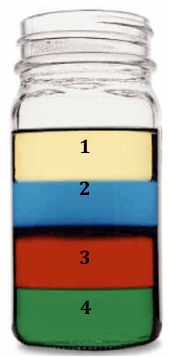
Which is not true about salty water?
Floats on top of freshwater
Higher density
It has more molecules than freshwater
It sinks at the bottom of a container

Based on the graph, which of the following statement is correct?
Warm water sinks to the bottom of the ocean
Cold water flows in the deepest part of the ocean
Warm water flows on the surface of the ocean
Cold water remains stationary in the deepest part of the ocean

At which point of the Earth does warm ocean water rises?
A
B
C
D

What does the blue line represent in the Thermohaline circulation?
Warm salty water
Warm water
Cold water
Cold salty water

What does the red line represent?
Warm water
Warm salty water
Cold water
Cold salty water
The two properties of ocean water that influence density are:
location and precipitation
salinity and speed
speed and temperature
temperature and salinity
Which of the following types of water would SINK the fastest?
warm and salty
cold and salty
warm and fresh
cold and fresh
Thermohaline circulation distributes which of the following?
heat
nutrients
carbon dioxide
all of the above
What is a thermocline?
A rapid change in temperature with depth
A rapid change in temperature with latitude
A rapid change in salinity with depth
A rapid change in density with depth
Warmer water will remain ______ because ________
at the surface; lower density than cool water
at the surface; higher density than cool water
deep; lower density than cool water
deep; higher density than cool water
What is stratification?
Layering of ocean water based on its properties (temperature, salinity, density, etc.)
Temperature differences with depth
Salinity differences with depth
Mixing of ocean water despite its different properties


mid ocean ridge
a divergent plant boundary where ocean spreads
seamount
a volcanic mountain that does not reach sea surface
deep sea trench
steep sided depression in the ocean floor
abyssal plain
underwater desert flat and featureless
continental shelf
drowned edge of continent, relatively shallow
oxygen is cycled through the atmosphere by
animals respiring and plant photosynthesising
through burning of fossil fuels in large amounts on land
is not required
can not be done
upwelling
vertical currents that bring up nutrients rich cold water
down welling
vertical currents that send down water
rip current
large amounts of water returning to the sea after wave action
eddy
circular movement of water due to an obstruction
El Nino
brings dry weather to Australian climate
thermocline
rapid change in temperature of water
halocline
rapid change in salinity in water
pycnocline
rapid change in density
A rapid change in temperature between two layers of water is known as:
halocline
pycnocline
imincined
thermocline

