wayground logo

Free Printable Worksheets

Font size

S
M
L
XL
Worksheets

Practice Topic 4 The Islamic World and South Asia Test

Total questions: 50

Worksheet time: 29mins

Name
Class
Date
1.
The earliest settlements on the Arabian peninsula grew up
a)
between the Tigris and Euphrates rivers.
b)
near oases in the Hijaz.
c)
along the shores of the Indian Ocean.
d)
in the Arabian desert.
2.
What was the goal of the Hijra?
a)
to conquer the city of Mecca
b)
to open up a trade route to the west
c)
to get enough water to survive
d)
to escape persecution
3.
How do Bedouin nomads live?
a)
They move from place to place with their animals.
b)
They raise crops in places where there is water.
c)
They trade along busy land and sea routes.
d)
They manufacture and sell iron tools and weapons.
4.
How did Muhammad change the Kaaba?
a)
He had it torn down to the ground.
b)
He added statues of traditional gods.
c)
He turned it into an Islamic holy site.
d)
He moved it from Mecca to Medina.
5.
According to Muslim belief, Muhammad was praying in a cave when he had a revelation in which he was told to
a)
preach that there was one true God.
b)
found the holy city of Mecca.
c)
conquer the Arabian peninsula.
d)
build a shrine for pilgrims to visit.
6.
Which is Islam’s most sacred text?
a)
the Quran
b)
the Sunnah
c)
the Hadith
d)
the Sharia
7.
What do Muslims do on a hajj?
a)
They fast during the day for a month.
b)
They give wealth to the poor and needy.
c)
They pray five times each day.
d)
They travel to the holy city of Mecca.
8.
The mosque and minaret are mostly closely associated with which Pillar of Islam?
a)
fasting during Ramadan.
b)
giving alms to the poor.
c)
praying five times a day.
d)
making a pilgrimage to Mecca.
9.
What do Muslims believe that the Sharia provides?
a)
the basis for law in Muslim nations
b)
the rules for proper conduct by Muslims
c)
the words and actions of Muhammad
d)
the word of God revealed to Muhammad
10.
The Sunnah is based on accounts by
a)
people who knew Muhammad.
b)
Muslim legal expert.
c)
Muhammad and earlier prophets.
d)
Muslim scholars of the 900s.
11.
Which term refers to the ruler of a Muslim state?
a)
imam
b)
sufi
c)
janissary
d)
caliph
12.
Who did Shias think should succeed Muhammad?
a)
a relative of Muhammad
b)
one of the “rightly guided caliphs”
c)
a member of the Umayyad dynasty
d)
someone who had won many battles
13.
The majority of Muslims are
a)
Shias.
b)
Ottomans.
c)
Safavids.
d)
Sunnis.
14.
Which group established the first Muslim dynasty?
a)
Safavids
b)
Umayyads
c)
Abbasids
d)
Mongols
15.
Which factor helped spread Islam?
a)
People were looking for new beliefs.
b)
Merchants carried the faith to new lands.
c)
Rulers forced all non-Muslims to convert.
d)
Muslims offered complete religious freedom to all.
16.
In Islamic culture, the most important use of calligraphy was to
a)
build mosques and palaces.
b)
create sacred images of Muhammad.
c)
calculate the positions of the stars.
d)
write verses of the Quran.
17.
Why did Arabic numerals replace Roman numerals?
a)
They were more accurate.
b)
They were based on the Quran.
c)
They made it easier to perform calculations.
d)
They were easier to read.
18.
Sufi writers such as Rumi were mainly interested in
a)
passing down traditional folktales.
b)
expressing religious ideas.
c)
recording the history of dynasties.
d)
praising tribal and military leaders.
19.
Which of the following were among the most valuable trade good produced in the Arab world?
a)
cotton textiles
b)
silks
c)
furs
d)
spices
20.
How did Muslim scholars build upon Greco-Roman culture?
a)
They adopted Latin as the language of education.
b)
They translated and studied ancient texts.
c)
They copied Roman architectural styles.
d)
They modeled their universities after medieval schools.
21.
Which Gupta emperor first expanded the empire from northern India to the south?
a)
Chandragupta Maurya
b)
Chandra Gupta I
c)
Samudra Gupta
d)
Chandra Gupta II
22.
Under whose reign did the Gupta empire reach its greatest size?
a)
Chandragupta Maurya
b)
Chandra Gupta I
c)
Samudra Gupta
d)
Chandra Gupta II
23.
Who was Kalidasa?
a)
a poet and playwright
b)
an astronomer
c)
a mathematician
d)
a traveling Buddhist monk
24.
Which game was invented in India?
a)
solitaire
b)
mahjongg
c)
chess
d)
checkers
25.
How did advancements during the Gupta period transform mathematics?
a)
They invented algebra.
b)
They created the concepts of “square numbers” and “square roots.”
c)
They developed a decimal system with a numeral for zero.
d)
They made progress in metallurgy.
26.
Islam emerged in Arabia, a land best known for the
a)

harshness of its hot, dry desert landscape.

b)

relatively small size of its peninsula.

c)

heavy rains that blow in from the surrounding seas.

d)

cold weather on its many high mountain ranges.

27.
Why did Muhammad move from Mecca to the city of Medina?
a)

He had already established a Muslim community in Mecca.

b)

He and his followers faced persecution by opponents in Mecca.

c)

He did not want to interfere with existing worship at the Kaaba in Mecca.

d)

He was a merchant and wanted to trade with the people of Medina.

28.
Muslims are not permitted to gamble or drink alcohol by the legal code known as the
a)

Five Pillars of Islam.

b)

Quran.

c)

Sharia.

d)

Sunnah.

29.
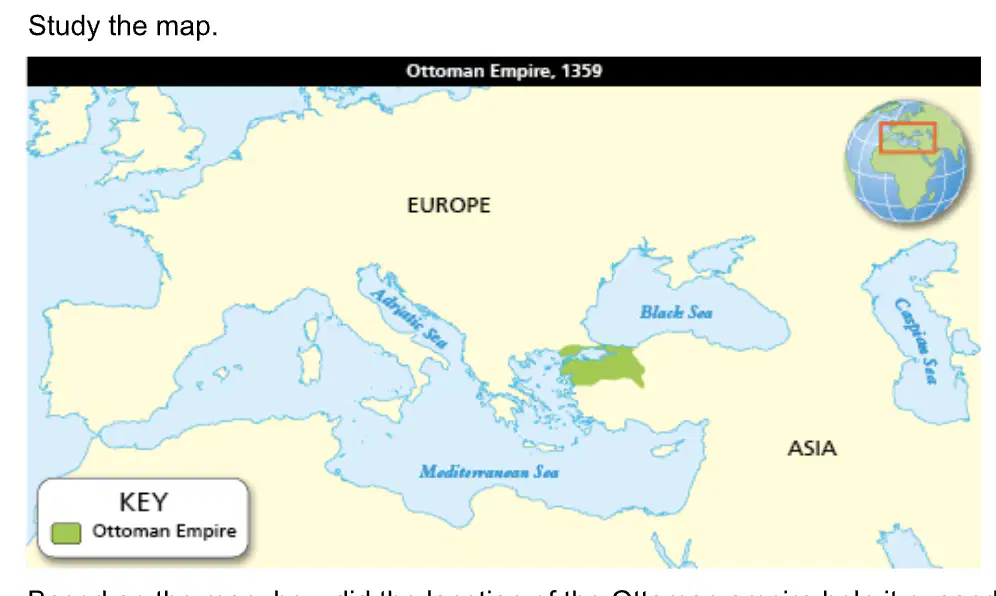
Based on the map, how did the location of the Ottoman empire help it expand?
a)

It was separated from Europe by the Black Sea.

b)

It controlled the water route across the Mediterranean Sea.

c)

Its location protected it from invaders from southwest Asia.

d)

It was located at a meeting point between Asia and Europe.

30.
What empire—famed for its art, culture, and science—was founded in the 1500s in Persia?
a)

Ottoman empire

b)

Safavid empire

c)

Mughal empire

d)

Sasanian empire

31.
What was the MAIN way that Indian cultural ideas and practices spread from the Chola empire to new regions?
a)

through the expansion of the empire to Southwest Asia

b)

through trade networks

c)

through the translation of Sanskrit texts

d)

through the construction of Hindu temples
32.
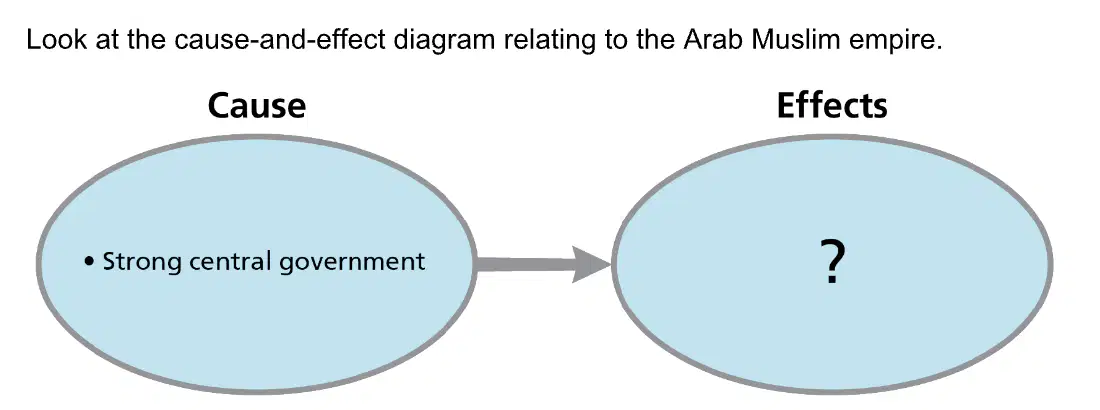
Which results complete the diagram? Choose the TWO correct answers.
a)

the decline of knowledge

b)

the growth of cities

c)

the expansion of trade

d)

the split between Shiite and Sunni Muslims

e)

the return of Muhammad to Mecca

33.
Which of the following statement BEST describes the spread of Islam during the Arab conquests?
a)

Islam spread only within the lands conquered by Arabs.

b)

Everyone in conquered lands was forced to convert to Islam.

c)

Few non-Arabs ever converted to Islam.

d)

Islam spread inside and outside the new Arab Muslim empire.

34.
Which of the following is a central teaching of Islam?
a)

There is one God and Muhammad was his only prophet.

b)

Muslims, Jews, and Christians all worship different gods.

c)

Abraham, Jesus, and Muhammad were all prophets of the same God.

d)

There is one God, but he can be worshiped in many forms.

35.
Which religions first developed in South Asia? Choose the TWO correct answers.
a)

Islam

b)

Buddhism

c)

Christianity

d)

Judaism

e)

Hinduism

36.
The Persian poet Rumi is famous for
a)

practicing and writing about Sufism.

b)

writing a history of the world and its dynasties.

c)

writing a travel account of his journeys to many Muslim lands.

d)

writing the tales in The Thousand and One Nights.

37.
Which statement can replace the question mark?
a)

Expanded the Muslim empire to its greatest extent

b)

Translated the Quran into the most foreign languages

c)

Completed the conquest of the Byzantine empire

d)

Introduced Islam into the Indian subcontinent

38.
The city of Baghdad was economically important in part because it
a)

controlled trade routes between Muslim Spain and Mughal India.

b)

traded with Africa along the famous Silk Road.

c)

was linked to China and other lands by camel caravan routes.

d)

produced all the goods it needed for itself.

39.
Which word belongs in the first of the two blank boxes?
a)

Shia

b)
B Sunni
c)

Sharia

d)

Sunnah

40.
The Muslim scholar known as Avicenna wrote a famous and influential book on which subject?
a)

algebra

b)

astronomy

c)

history

d)

medicine

41.
The term Hijra refers specifically to
a)

the duty of all Muslims to make a pilgrimage to Mecca.

b)

the return of Muhammad to Mecca as ruler.

c)

the revelations to Muhammad in a cave.

d)

the flight of Muhammad from Mecca to Medina.

42.
Read the quote about the life of Muhammad. “[Muhammad] called Ayesha to him, and said, ‘Where is that gold which I gave [you] to keep?’ . . . [S]he placed it in his hand, and counted six dinars. He directed that it should be divided among certain indigent [needy] families; and then . . . he said, ‘Now I am at peace. Verily [truly] it would not have become me to meet my Lord, and this gold in my possession.’” —The Life of Mahomet [Muhammad] and History of Islam Which of the Five Pillars of Islam is related to this quotation?
a)

daily prayer

b)

fasting during Ramadan

c)

charity

d)

the hajj

43.
Which of the following is a feature shared by Islam and Sikhism?
a)

nirvana

b)

caste system

c)

monotheism

d)

reincarnation

44.
Which achievement completes the table?
a)

Invented the telescope

b)

Spread the concept of zero

c)

Invented geometry

d)

Used Roman numerals

45.

First Pillar of Islam is

(a)  

46.

Second Pillar of Islam is

(a)  

47.

Third Pillar of Islam is

(a)  

48.

Fourth Pillar of Islam is

(a)  

49.

Fifth Pillar of Islam is

(a)  

50.

Match the following

a)

Belief in one God

1.

1st Pillar

b)

Prayer

2.

2nd Pillar

c)

Charity

3.

3rd Pillar

d)

Fasting

4.

4th Pillar

e)

Pilgrimage

5.

5th Pillar