
 Worksheets
Science 8 Section 1 and 2 Review
Total questions: 79
Worksheet time: 6hrs 7mins
Which of the following statements is the best example of an organism’s response to stimuli?
A rock rolling down a mountain
The leaves of the mimosa plant close when touched.
Bacteria reproduce by binary fission.
Onion skin cells have a cell wall
Which of the following statements is the best example of an organism’s response to stimuli?
A rock rolling down a mountain
The leaves of the mimosa plant close when touched.
Bacteria reproduce by binary fission.
Onion skin cells have a cell wall
Fire is living because it has 5 of the 6 characteristics of life.
True
False

Which of the following statements about the organism below is NOT correct?
It has many cells of various shapes and sizes.
It has cells which contain nuclei that pass hereditary materials down.
It has different cells to carry out different functions.
It has some cells that are surrounded by cell walls.

Match the letters A, B, C and D to the steps above in order to observe the specimen clearly.
A, D, B, C
A, C, D, B
D, B, A, C
D, B, C, A

Which one of the following sets of eyepieces and objective lens should Natasha choose in order to view the entire specimen?
Eyepiece - A
Objective Lens - P
Eyepiece - A
Objective Lens - Q
Eyepiece - A
Objective Lens - R
Eyepiece - B
Objective Lens - R
What is best used as an adjustment on a microscope to bring a specimen into focus at high power?
Coarse focus knob
Fine focus knob
Objective lens
eyepiece
Which is the correct term for a specialized structure in a cell?
organ
organelle
tissue
system
The control centre for the cell is the
mitochondria
nucleus
cytoplasm
vacuole
The powerhouse of the cell (the part where food is converted into energy) is called the
mitochondria
nucleus
cytoplasm
cell wall
If a cell has chloroplasts, it is a(n)
real cell
animal cell
plant cell
multi-cellular organism

Based on the diagram, which one of these statements is CORRECT?
This is a plant cell since it has a nucleus.
This is an animal cell since there is no chloroplast.
This is an animal cell since there is a cell membrane.
This is a plant cell since it has a cell wall

Identify the part labelled C and its function.
It is the cell membrane. It supports the cell and gives it a regular shape.
It is the cell membrane. It allows only certain substances to pass through.
It is the cell wall. It supports the cell and gives it a regular shape.
It is the cell wall. It allows only certain substances to pass through.

Which of the following parts of the cells have been matched correctly to the information provided in the table below?
Can only be found in plant cells - C
Can be found in both plant and animal cells - A,B,E
Allow some substances to pass through the cell - F, D
Can only be found in plant cells - B, C
Can be found in both plant and animal cells - A,E
Allow some substances to pass through the cell - F, D
an only be found in plant cells - A, F
Can be found in both plant and animal cells - C, D, E
Allow some substances to pass through the cell - D
an only be found in plant cells - A, B
Can be found in both plant and animal cells - C, D, E, F
Allow some substances to pass through the cell - F
Which of the following parts of the cells have been matched correctly to the information provided in the table below?
Can only be found in plant cells - C
Can be found in both plant and animal cells - A,B,E
Allow some substances to pass through the cell - F, D
Can only be found in plant cells - B, C
Can be found in both plant and animal cells - A,E
Allow some substances to pass through the cell - F, D
an only be found in plant cells - A, F
Can be found in both plant and animal cells - C, D, E
Allow some substances to pass through the cell - D
an only be found in plant cells - A, B
Can be found in both plant and animal cells - C, D, E, F
Allow some substances to pass through the cell - F
Osmosis occurs until
all the water has been removed from the cell
the cell runs out of energy
water concentration is equal inside and outside the cell
all the solute has been removed from the cell
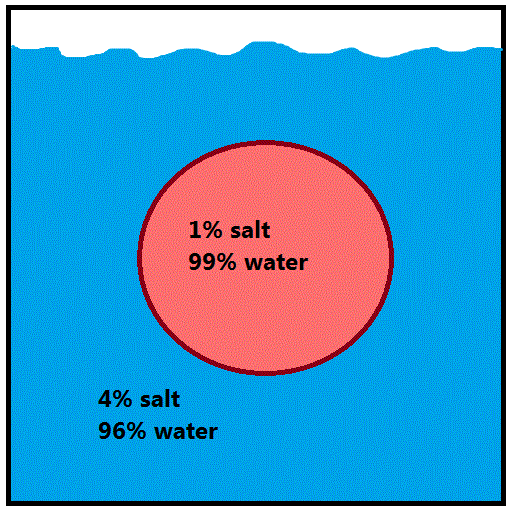
Cells placed in saltwater will
shrink because of osmotic movement of water from the cell to the saltwater
expand because of osmotic movement of water from the saltwater to the cell
shrink because of movement of salt from the cell to the saltwater
expand because of movement of salt from the saltwater to the cell

Which one of the following best explains the above observation?
Only Particle A can move into the cell.
Only Particle B can move into the cell.
Particles A and B can move into the cell.
Particles A and B can move into and out of the cell.

What kind of membrane is shown?
permeable
impermeable
selectively permeable
non-permeable
Which one of the cells resembles a nerve cell?


What type of body tissue is responsible for transferring signals in the body?
Epithelial tissue
Nerve tissue
Muscle tissue
Blood tissue
Which series below shows the levels of organization for an organism from the least complex to the most complex?
systems > cells > tissues > organs > organelles
organelles > cells > tissues > organs > systems
cells > tissues > organelles > organs > systems
organelles > cells > organs > tissues > systems
Which series below shows the levels of organization for an organism from the least complex to the most complex?
systems > cells > tissues > organs > organelles
organelles > cells > tissues > organs > systems
cells > tissues > organelles > organs > systems
organelles > cells > organs > tissues > systems
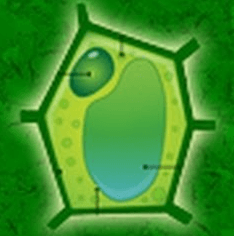
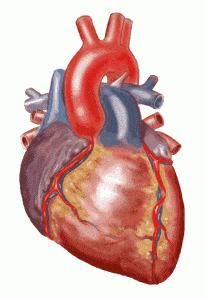
Nucleus
What does the cell membrane monitor?
What comes in and out of the cell.
What leaves the cell.
What is inside the cell.
What is outside the cell.

Which statement below about cells is true?
All things (living and non-living) are composed of cells
All cells come from other cells
All cells have a nucleus
All cells contain organs and tissues
Cell theory has 3 parts: The cell is the basic unit of life in all living things, all cells come from existing cells, and _________________.
Nonliving things are composed of cells
The cell was discovered by Robert Hooke
All organisms are made of one or more cells
All cells are microscopic in size

What serves as the storage center in a cell?
Vacuole
Lysosome
Ribosome
Cytosol
Needed by all organisms; substances that provide energy that organisms need
minerals
vitamins
photosynthesis
nutrients
Ability to reproduce is necessary to be considered a living thing.
True
False
Tissues combine to form
nucleus
cells
organs
organisms
Cells present in living organism differ in
numbers
shape
size
all of these
A group of similar cells combine to form
tissue
organ
organisms
organelles


coarse focus


eye piece/ocular lens

Moves stage up and down for focusing; locates the specimen
Fine Focus Knob
Large Focus Knob
Course Focus Knob
Small Focus Knob
Diffusion is the natural movement of molecules from:
Areas of low concentration to areas of high concentration
Areas of high concentration to areas of low concentration
Cold to hot environments
Gaseous to liquid environments
Diffusion is the movement of particles from an area of _____ concentration to an area of ______ concentration
High, Low
Low, High
Low, Low
High, High
Which type of cell DOES NOT have a nucleus?
Prokaryotic
Eukaryotic
Which type of cell is found in BACTERIA?
Prokaryotic
Eukaryotic
Which type of cell has DNA that is NOT in a nucleus?
Prokaryotic
Eukaryotic
Which type of cell has a cytoplasm?
Prokaryotic
Eukaryotic
Both

What type of cell is this?
Prokaryotic
Eukaryotic

Which type of cell is this?
Eukaryotic
Prokaryotic
A tail like structure that help paramecium move
Hair like fibers that help paramecium move
A fake foot that help amoebas move
Hair like fibers that help amoebas move
A fake foot that helps an amoeba move

Which is this?
Amoeba
Euglena
Water mold
Paramecium

Which is this?

