
 Worksheets
Biomolecule Quiz
Total questions: 25
Worksheet time: 13mins
Name
Class
Date
1.
The monomer of this biomolecule is glucose
a)
Carbohydrate
b)
Lipids
c)
Proteins
d)
Nucleic Acids
2.
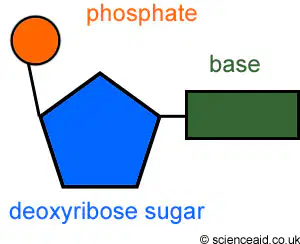
This is the monomer for which Biomolecule?
a)
Carbohydrate
b)
Lipids
c)
Proteins
d)
Nucleic Acids
3.
The monomer of this biomolecule is an amino acid
a)
Carbohydrate
b)
Lipids
c)
Proteins
d)
Nucleic Acids
4.
This biomolecule has the elements Carbon, Hydrogen, and Oxygen in a 1 to 2 to 1 ratio
a)
Carbohydrate
b)
Lipids
c)
Proteins
d)
Nucleic Acids
5.
This biomolecule has the elements Carbon, Hydrogen, Oxygen and Nitrogen (CHON)
a)
Carbohydrate
b)
Lipids
c)
Proteins
d)
Nucleic Acids
6.
This biomolecule comes in hundreds of different shapes - the shape determines its unique function!
a)
Carbohydrate
b)
Lipids
c)
Proteins
d)
Nucleic Acids
7.
Autotrophs make this biomolecule in the process of photosynthesis
a)
Carbohydrate
b)
Lipids
c)
Proteins
d)
Nucleic Acids
8.
The function of this biomolecule is to store information
a)
Carbohydrate
b)
Lipids
c)
Proteins
d)
Nucleic Acids
9.
This biomolecule has 20 different kinds of its monomer that have side chains which can either be polar, non-polar, positively charged or negatively charged
a)
Carbohydrate
b)
Lipids
c)
Proteins
d)
Nucleic Acids
10.
Bread, pasta and fruit MOSTLY contain this biomolecule.
a)
Carbohydrate
b)
Lipids
c)
Proteins
d)
Nucleic Acids
11.
Meat, cheese, beans, and nuts MOSTLY contain this biomolecule.
a)
Carbohydrate
b)
Lipids
c)
Proteins
d)
Nucleic Acids
12.
What is the relationship between monomers and polymers?
a)
monomers are made up of many polymers
b)
polymers are made up of many monomers
c)
monomers are a type of polymer
d)
polymers are a type of monomer
13.
A steroid is what kind of biomolecule?
a)
Carbohydrate
b)
Lipids
c)
Proteins
d)
Nucleic Acids
14.
What kind of biomolecule is non-polar and insoluble in water?
a)
Carbohydrate
b)
Lipids
c)
Proteins
d)
Nucleic Acids
15.
A polypeptide chain is associated with what kind of biomolecule?
a)
Carbohydrate
b)
Lipids
c)
Proteins
d)
Nucleic Acids
16.
Starch, which is stored in roots and seeds, is what kind of biomolecule?
a)
Carbohydrate
b)
Lipids
c)
Proteins
d)
Nucleic Acids
17.
DNA and RNA are examples of which biomolecule?
a)
Carbohydrate
b)
Lipids
c)
Proteins
d)
Nucleic Acids
18.
Cellulose, which makes up wood, is what kind of biomolecule?
a)
Carbohydrate
b)
Lipids
c)
Proteins
d)
Nucleic Acids
19.
This biomolecule provides quick available energy through Cellular Respiration
a)
Carbohydrate
b)
Lipids
c)
Proteins
d)
Nucleic Acids
20.
This biomolecule provides long term storage of energy in heterotrophs
a)
Carbohydrate
b)
Lipids
c)
Proteins
d)
Nucleic Acids
21.

Look at the molecule drawing. What kind of biomolecule is this?
a)
Carbohydrate
b)
Lipids
c)
Proteins
d)
Nucleic Acids
22.
Seals, penguins and narwhals have a thick layer of blubber to keep them warm. Blubber is this kind of biomolecule
a)
Carbohydrate
b)
Lipids
c)
Proteins
d)
Nucleic Acids
23.
Insulin, which helps to regulate blood sugar levels, is this kind of biomolecule
a)
Carbohydrate
b)
Lipids
c)
Proteins
d)
Nucleic Acids
24.
Enzymes, which do work in the body, are this kind of biomolecule
a)
Carbohydrate
b)
Lipids
c)
Proteins
d)
Nucleic Acids
25.
What is the function of hemoglobin?
a)
Hemoglobin regulates blood sugar
b)
Hemoglobin makes up the cell membrane that surrounds all cells
c)
Hemoglobin transports oxygen from the lungs to the body cells
d)
Hemoglobin gives strength and flexibility to skin, bones, and tendons
100 %

