Wayground logo

Free Printable Worksheets

Font size

S
M
L
XL
Worksheets

Atmosphere and Weather Unit Test Review

Total questions: 86

Worksheet time: 1hrs 21mins

Name
Class
Date
1.

Hot chocolate is stirred with a spoon and the spoon gets hot.

a)

Conduction

b)

Convection

c)

Radiation

2.

The Sun warms your skin on a cold day.

a)

Conduction

b)

Convection

c)

Radiation

3.

Macaroni rises and falls in a pot of heated water.

a)

Conduction

b)

Convection

c)

Radiation

4.

You burn your hand by touching a hot stove.

a)

Conduction

b)

Convection

c)

Radiation

5.

Warming your feet in front of a fire.

a)

Conduction

b)

Convection

c)

Radiation

6.

Hot air balloon rises.

a)

Conduction

b)

Convection

c)

Radiation

7.

The air near the ceiling in a room is warmer than the air near the floor.

a)

Conduction

b)

Convection

c)

Radiation

8.

The material in a lava lamp rises and falls.

a)

Conduction

b)

Convection

c)

Radiation

9.

The sidewalk burns your bare feet in the summertime.

a)

Conduction

b)

Convection

c)

Radiation

10.
The way the heat is moving from the hot coffee is called...
a)
convection
b)
radiation
c)
insulation
d)
conduction
11.
What is one role of the ocean in convection?
a)
to provide a home for animals
b)
to absorb & release heat
c)
To surf on
d)
To drink from
12.
In convection, COOL air
a)
Rises
b)
Sinks
13.
The main reason that we have currents in the ocean and air is
a)
the sun heats the air and ocean evenly everywhere
b)
the heat inside the earth heats the ocean and the ocean heats the air
c)
the sun cannot heat both the air and water, so one must heat the other
d)
the sun heats air and water more at the equator because it receives more direct sunlight
14.
Which one heats and cools fastest?
a)
land
b)
sea
c)
both are the same rate
d)
air
15.

Heat transfer by convection is caused by differences in what two things:

a)

Thickness and material

b)

Weight and electricity

c)

Temperature and density

16.
Energy for convection on the Earth comes from...
a)
The sun
b)
The moon
c)
Solar winds
d)
The ocean
17.

The main human activity that releases greenhouse gases is

a)

using public transportation and there by reduce the affects of greenhouse gases.

b)

texting on cellphones

c)

burning fossil fuels

d)

eating meat

18.

What is the greenhouse effect?

a)

The warming of a planet due to trapped radiation.

b)

The heating of a solid, such as a rock.

c)

The cooling of Earth due to air pollution.

19.

What do scientists think the effect will be of having more greenhouse gases in our atmosphere?

a)

More warming of the atmosphere

b)

More air in the atmosphere

c)

More cooling of the atmosphere

d)

Less air in the atmosphere

20.

T/F: Water vapor is a greenhouse gas

a)

true

b)

false

21.

T/F: Some greenhouse gases are naturally present in the Earth's atmosphere

a)

true

b)

false

22.

Increased carbon dioxide may cause global warming by trapping more ____________ in the atmosphere.

a)

heat

b)

water

c)

argon

23.

Which of the following have been linked to climate change?

a)

droughts

b)

melting of polar ice caps

c)

flooding

d)

all of the above

24.

How does carbon dioxide concentration affect temperature?

a)

the higher the carbon dioxide, the lower the temperature

b)

the higher the carbon dioxide, the higher the temperature

c)

carbon dioxide does not affect temperature

25.

True or false, the loss of one species in an ecosystem affects the rest of the community.

a)

true

b)

false

26.
What is the definition of weather?
a)
a period of abnormally dry weather that lasts at least 2 years
b)
the specific condition of the atmosphere at a particular place and time
c)
a complex community of organisms and the community's environment
d)
a release of toxic gas
27.
What is the average weather for a particular time and region called?
a)
drought
b)
weather
c)
emissions
d)
climate
28.
Melting of glaciers and polar ice caps....
a)
will result in cooler temperatures in the Arctic
b)
will result in sea-levels rising
c)
Will have no effect on ecosystems
d)
None of the above
29.
Carbon is stored in
a)
Trees and other living things
b)
Oceans
c)
underground in soil and fossil fuels
d)
All are correct
30.
A front is
a)
where warm air is cooling at earth's surface
b)
a line where hot and cold air are separating
c)
a line where two different air masses meet
d)
where cold air is rising and forming rain clouds
31.
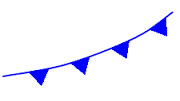
What symbol is this?
a)
warm front
b)
cold front
c)
stationary front
d)
occluded front
32.
What does this symbol indicate on a weather map? 
a)
High pressure system
b)
Low pressure system
c)
Cold front
d)
Warm front
33.

Rain, sleet, hail, and freezing rain are all...

a)

precipitation

b)

condensation

c)

evaporation

d)

percolation

34.

What source creates wind, controls the conveyor of currents, and influences weather & climate?

a)

heat from Earth's core

b)

the sun

c)

the water cycle

d)

geothermal energy

35.

Air pressure differences cause _____________ to form.

a)

tides

b)

salinity

c)

wind

d)

none of the others

36.

What is the Coriolis effect?

a)

wind curves across Earth's surface because of Earth's magnetism

b)

global wind patterns occur because of sinking air

c)

global wind patterns occur because of weather

d)

wind curves across Earth's surface because of Earth's rotation

37.

Air pressure ______ as you go up through the atmosphere because there are less molecules.

a)

increases

b)

decreases

c)

stays the same

d)

triples in pressure

38.

What do thunderstorms, tornadoes and hurricanes have in common?

a)

strong winds

b)

severe storms

c)

no wind

d)

nothing

39.
In what direction do winds always blow?
a)
From areas of high pressure to areas of low pressure
b)
From areas of low pressure to areas of high pressure
40.
The blanket of gases that surrounds the Earth
a)
Lithosphere
b)
Atmosphere
c)
Hydrosphere
d)
Green House Effect
41.
Do sea breezes typically happen during the day or night?
a)
Day
b)
Night
42.
Do land breezes typically happen during the day or night?
a)
Day
b)
Night
43.
During a land breeze which way does the wind blow?
a)
from the sea to the land
b)
from the land to the sea
44.
During a sea breeze which way does the wind blow?
a)
from the land to the sea
b)
from the sea to the land
45.
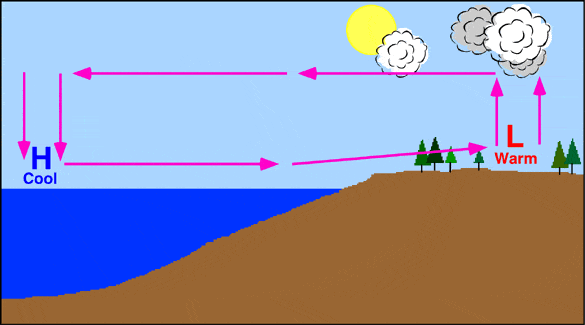
Is this a land or a sea breeze?
a)
land breeze
b)
sea breeze
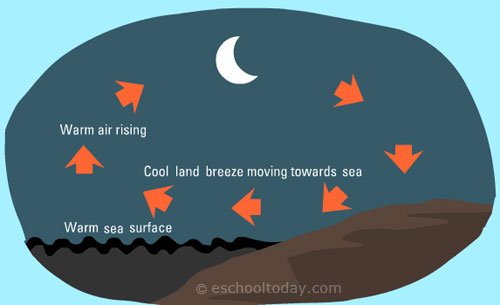
46.
Is this a land or a sea breeze?
a)
land breeze
b)
sea breeze
47.
Why does warm air rise?
a)
Warm air is more dense than cooler air.
b)
Warm air has more pressure than cooler air.
c)
Warm air is less dense than cooler air.
d)
Warm air has a higher dew point than cooler air.
48.
In general, surface currents that flow from the tropics toward the poles carry ______________ water.
a)
warm
b)
cold
c)
fresh
d)
oxbow lake
49.
The Gulf Stream  ____________ nearby land areas.
a)

cools

b)

causes freezing in

c)

warms

d)

causes rain in 

50.

A surface current effects the climate of nearby land.

a)

True

b)

False

51.
____________ are large streams of moving water that flow through the oceans.
a)

La Niña

b)

El Niño

c)

Ocean currents

d)

Climate

52.
What is the Gulf Stream?
a)
a surface current
b)
deep current
c)
a river
d)
a climate event
53.
Which term best describes how the earth's atmosphere is heated?
a)
Spirally
b)
Unevenly
c)
Circularly
d)
Kinetically
54.
What causes warm air to rise?
a)

It's less dense than cold air 

b)

It weighs more than cold air 

c)

It has higher pressure than cold

d)

It's more dense than cold air 

55.
Global winds travel over ____.
a)
Short distances
b)
Long distances
c)
The Southern Hemisphere only
d)
The ocean only
56.
The transfer of heat by the movement of a fluid is called
a)

radiation

b)

conduction

c)

convection

57.
Warm ocean currents generally come from
a)
The North Pole
b)
The South Pole
c)
The Equator
d)
Both A and B
58.
What process brings the deep cold ocean currents up to the surface?
a)
Conduction
b)
Global Wind Patterns
c)
Convection Currents
d)
Temperature and salinity
59.
Choose the best forecast for Seattle on Saturday.
a)
rain
b)
sunny skies
c)
warmer temperatures
d)
snow
60.
Which city is closest to a high pressure system?
a)
New York
b)
Miami
c)
Minneapolis
d)
Boise
61.
Which city has the lowest temperature on the map?
a)
Minneapolis
b)
Seattle
c)
New York
d)
Denver
62.
A cold front is approaching Minneapolis. What will happen to the air temperature?
a)
stay the same
b)
increase
c)
decrease
63.
a)
High Pressure
b)
Warm Front
c)
Cold Front
d)
Mountains
64.
a)
High Air Pressure
b)
High Temperatures
c)
Heavy Rain
d)
Hail
65.
a)
Low Clouds
b)
Low Temperatures
c)
Light Wind
d)
Low Air Pressure
66.
a)
Warm Front
b)
High Air Pressure
c)
Cold Front
d)
High Temperatures
67.

What is the first step in the birth of a tornado?

a)

dark sky

b)

thunderstorm

c)

high wind

d)

rain

68.

What is a tornado?

a)

A long high wave caused by an earthquake.

b)

Rapidly rotating column of air that reaches from a storm cloud to the Earth's surface.

c)

A sudden and violent shaking of the ground, sometimes causing great destruction.

d)

A large, destructive fire that spreads quickly over woodland or brush.

69.

What shape is a tornado?

a)

sphere

b)

prism

c)

funnel

d)

cube

70.

How fast are the winds inside a tornado?

a)

5-10 miles per hour

b)

65-250 miles per hour

c)

500-700 miles her hour

d)

1,000-1,500 miles per hour

71.

Which direction does air move to first form a tornado?

(Before it touches the ground.)

a)

cool air goes from the sky toward the ground

b)

warm air goes from the ground to the sky

c)

both have to happen to make a tornado

72.

What is another name for a tornado?

a)

spinner

b)

twister

c)

dancer

d)

twirler

73.

The most tornadoes in the United States take place in Tornado Alley. Where is Tornado Alley?

a)

Southern US

b)

West Coast of the US

c)

East Coast of the US

d)

Center of the US

74.

Tornadoes are rated by ______.

a)

how fast the winds blow

b)

how far they travel

c)

how large they are

d)

how much damage they cause

75.

to move or turn in a circle

a)

funnel

b)

rotate

c)

supercell

d)

Tornado

76.

a destructive windstorm with a funnel shaped cloud that extends to the ground

a)

tornado

b)

tornado alley

c)

updraft

d)

waterspout

77.

an area of North America that experiences hundreds of tornadoes each year

a)

atmosphere

b)

Fujita Tornado Scale

c)

lift

d)

Tornado Alley

78.

a rating scale developed in 1970 by the scientist T. Theodore Fujita to categorize tornadoes and their relative strength

a)

meteorologist

b)

Fujita Tornado Scale

c)

moisture

d)

Tornado Alley

79.

What is the calmest part of a hurricane?

a)

Eye

b)

Eye Wall

c)

Storm surge

d)

Edge

80.

What is the highest category hurricane?

a)

3

b)

5

c)

6

d)

7

81.

Why does a hurricane slow down when it hits land?

a)

The wind stops it

b)

It stops raining

c)

It loses its energy source

d)

The air is different

82.

What do the wind speeds need to reach for a strom to be classified as a hurricane

a)

40-73 mph

b)

600 mph

c)

23-39 mph

d)

74 mph

83.

Where are hurricanes formed?

a)

On cold water

b)

On Warm water

c)

Anywhere near the ocean

d)

In the clouds

84.
The pressure inside a hurricane is _______.
a)
High
b)
Low
85.
In order for a hurricane to form, the water must be ________.
a)
Cool
b)
Warm
c)
Cold
d)
Hot
86.

The major difference between a tropical storm and a hurricane is __________.

a)

rainfall amounts

b)

wind speed

c)

air temperature