wayground logo

Free Printable Worksheets

Font size

S
M
L
XL
Worksheets

Unit 4 Biology Review Test

Total questions: 65

Worksheet time: 49mins

Name
Class
Date
1.

The original source of energy for a food web is...

a)

plants

b)

sun

c)

producers

d)

decomposers

2.

Decomposers get energy from...

a)

the sun

b)

eating plants

c)

eating animals

d)

dead things and waste

3.

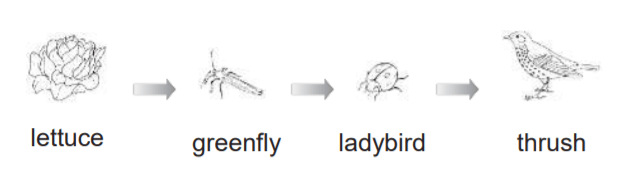
Who is the producer?

a)

lettuce

b)

greenfly

c)

ladybird

d)

thrush

4.

An animal that hunts other animals for food is a ___________

a)

herbivore

b)

predator

c)

prey

d)

omnivore

5.

A connection of food chains with many food energy paths in an ecosystem is a ____________

a)

ecosystem

b)

food web

c)

environment

6.

Which of the following is NOT a consumer

a)

grass

b)

dog

c)

shark

d)

fish

7.

the scientific study of how organisms interact with their environment and all the other organisms that live in that environment

a)

biotic factor

b)

food chain

c)

ecosystem

d)

ecology

8.

a model of the feeding relationships between many different consumers and producers in an ecosystem

a)

food chain

b)

ecosystem

c)

food web

d)

energy pyramid

9.
Living things in the environment are known as _______________.
a)
Biomes
b)
Abiotic Factors
c)
Biotic Factors
d)
Minerals
10.
A single living thing that obtains food, water, and shelter to live, grow, and reproduce in its habitat is _________________.
a)
A population
b)
An organism
c)
A molecule
d)
A community
11.
Which one is NOT an example of a decomposer?
a)
mushroom
b)
leaves
c)
mold
d)
worm
12.
Example of a decomposer
a)
fungus
b)
mouse
c)
plants
d)
frogs
13.
A tree is a ....
a)
composer
b)
decomposer
c)
producer
14.
What is a herbivore?
a)
an animal that gets energy from eating other animals
b)
an organism that gets energy from eating only plants
c)
an animal that gets energy by eating both plants and other animals
d)
an animal that eats only herbs
15.
An animal that gets energy from eating both plants and animals is a 
a)
herbivore
b)
carnivore
c)
omnivore
d)
autotroph
16.
An animal that eats other animals is a....
a)
carnivore
b)
omnivore
c)
herbivore
d)
decomposer
17.
In which type of relationship do both species benefit?
a)
parasitism
b)
mutualism
c)
commensalism
18.
Barnacles grow on whales.  Whales give the barnacles a place to live but the barnacles do not help or harm the whale.  Which type of relationship is this?
a)
commensalism
b)
mutualism
c)
parasitiesm
19.
The rabbit in this food web would be considered a:
a)
Decomposer
b)
Producer
c)
Secondary Consumer
d)
Primary Consumer
20.

the struggle between organisms to survive in a habitat with limited resources

a)

producer

b)

compettion

c)

cunsumer

d)

resperation

21.

An organism that makes its own food

a)

consumer

b)

producer

c)

decomposer

d)

carnivore

22.

Anything that is produced that harms the environment

a)

decomposers

b)

pollution

c)

carbion dioxide

d)

cow manure

23.

a hawk that only eats other animals

a)

omivore

b)

carnivore

c)

herbivore

d)

detritivore

24.

In the punnett square, what percent of offspring will show the dominant trait?

a)

25%

b)

50%

c)

75%

d)

100%

25.

A genotype represents

a)

The two alleles an organism inherits from its parents

b)

The physical appearance of a trait

c)

The full molecule of DNA an offspring will have

d)

How many chromosomes an organism has

26.

In a Punnett Square with a heterozygous father and a heterozygous mother, what percent of offspring will display the dominant phenotype?

a)

0%

b)

25%

c)

50%

d)

75%

27.

In a Punnett Square with a homozygous dominant father and a homozygous recessive mother, what percent of offspring will show the recessive phenotype?

a)

0%

b)

25%

c)

50%

d)

100%

28.
Which of the following describes a phenotype?
a)
having freckles
b)
Gg
c)
heterozygous
d)
homozygous
29.

A tool used by scientists to determine the probability of an offspring inheriting a trait is called a

a)

Punnett Square

b)

Mendelian Square

c)

Textural Triangle

d)

Autoclave

30.

What percentage of peas are homozygous?

a)

10%

b)

30%

c)

50%

d)

75%

31.

Which term applies to the trait of green pods in this punnett square?

a)

Dominant

b)

Recessive

c)

Repeating

d)

Nucleic

32.

In the punnett square, what genotype belongs where the ? is?

a)

tt

b)

Tt

c)

Bb

d)

TT

33.

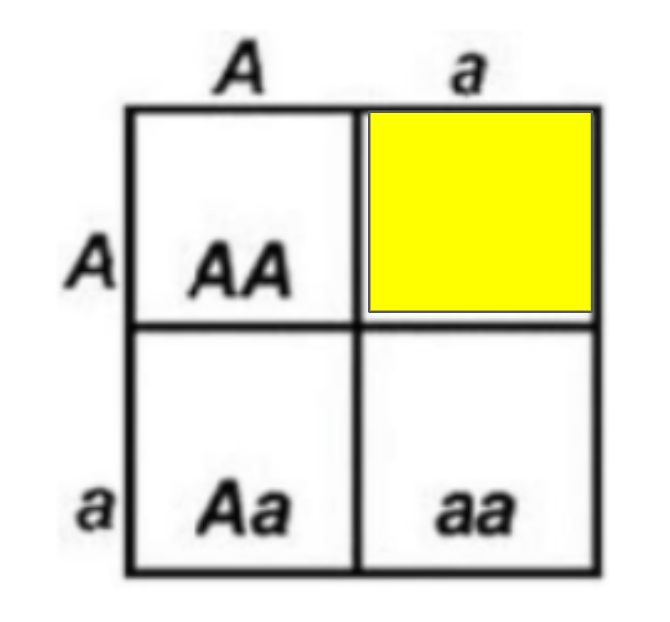
What allele combination should go in the box with the ??

a)

AA

b)

Aa

c)

aa

d)

none of these

34.
Another word for homozygous is...
a)
purebred
b)
hybrid
c)
heterozygous
d)
dominant
35.
The dominant trait in this punnett square is
a)
yellow pea seeds
b)
green pea seeds
c)
there is no dominant seed
36.

Fill in the Yellow Box

a)

AA

b)

Aa

c)

aa

37.

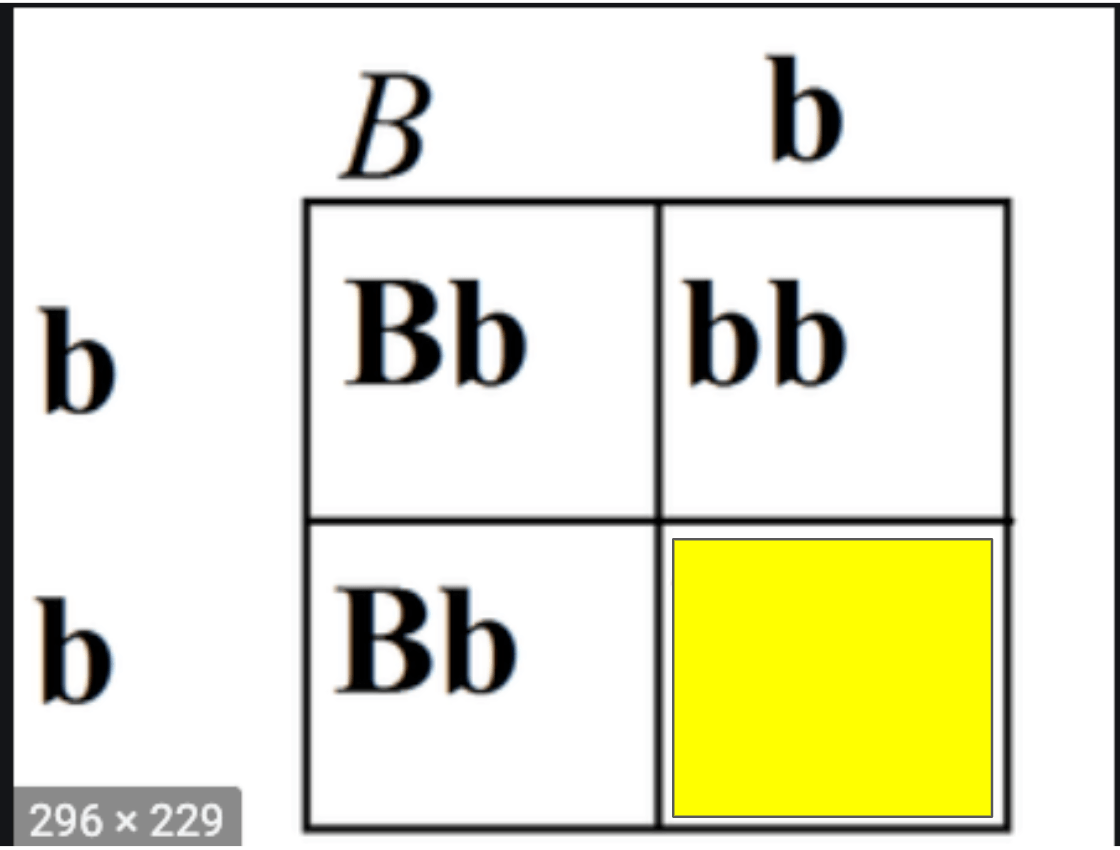
Fill in the Yellow Box

a)

Bb

b)

BB

c)

bb

38.

What you see, or the physical appearance of an organism is its

a)

Genotype

b)

Phenotype

c)

Homozygous

d)

Heterozygous

39.
Which of the following genotypes is homozygous dominant?
a)
A
b)
Aa
c)
AA
d)
aa
40.
Which of the following genotypes is heterozygous?
a)
Bb
b)
BB
c)
bb
d)
B
41.
Which of the following is homozygous recessive?
a)
Tt
b)
tt
c)
TT
d)
T
42.
In pea plants, the tall allele is dominant to the short allele. What key would demonstrate this?
a)
Tall = T
Short = S
b)
Tall = T
Short = t
c)
Tall = t
Short = T
d)
Tall = TT
Short = tt
43.

In unicorns, purple wings are recessive to pink wings. What is the probability of getting a purple-winged unicorn from a cross between two heterozygous pink-winged unicorns?

a)

0%

b)

25%

c)

50%

d)

75%

44.

A brown ewok and a black ewok have 12 baby ewoks. 9 of the baby ewoks have black fur, while 3 ewok babies have brown fur. What are the probable genotypes of the parents?

a)

BB and bb

b)

BB and Bb

c)

Bb and Bb

d)

Bb and bb

45.
Aa, DD, bB, yy are all examples of
a)
genotypes
b)
phenotypes
46.

The genotype TT is

a)

homozygous recessive

b)

heterozygous

c)

homozygous dominant

d)

none of the above

47.
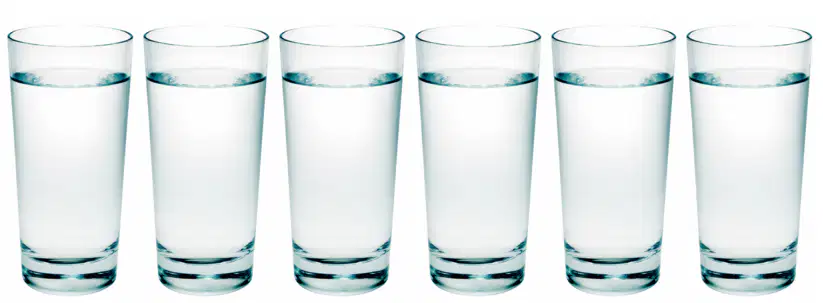
How many glasses of water should you drink a day?
a)
1
b)
6-8
48.
What is the word for the nutrition information printed on the side of a food container?
a)
food label
b)
preservative
c)
additive
49.
Which food group does a banana belong in?
a)
protein
b)
oils
c)
fruits
50.
Which food group does a carrot belong in?
a)
fruit
b)
vegetable
c)
grains
51.
WHAT ARE THE 6 NUTRIENTS?
a)
Carbs, Meats, Fibers, Water, Protein, and Dairy
b)
Fruits, Milk, Fibers, Water, Pork, and Vitamins
c)
Carbs, Fats, Fibers, Water, Protein, and Vitamins
d)
Carbs, Fats, Fibers, Cheese, Protein, and Vegtables
52.
This nutrient makes up 75% of your body:
a)
water
b)
vitamin A
c)
carbohydrates 
d)
protein 
53.
When you don't drink enough water you can become:
a)
silly
b)
hyper
c)
intoxicated 
d)
dehydrated 
54.
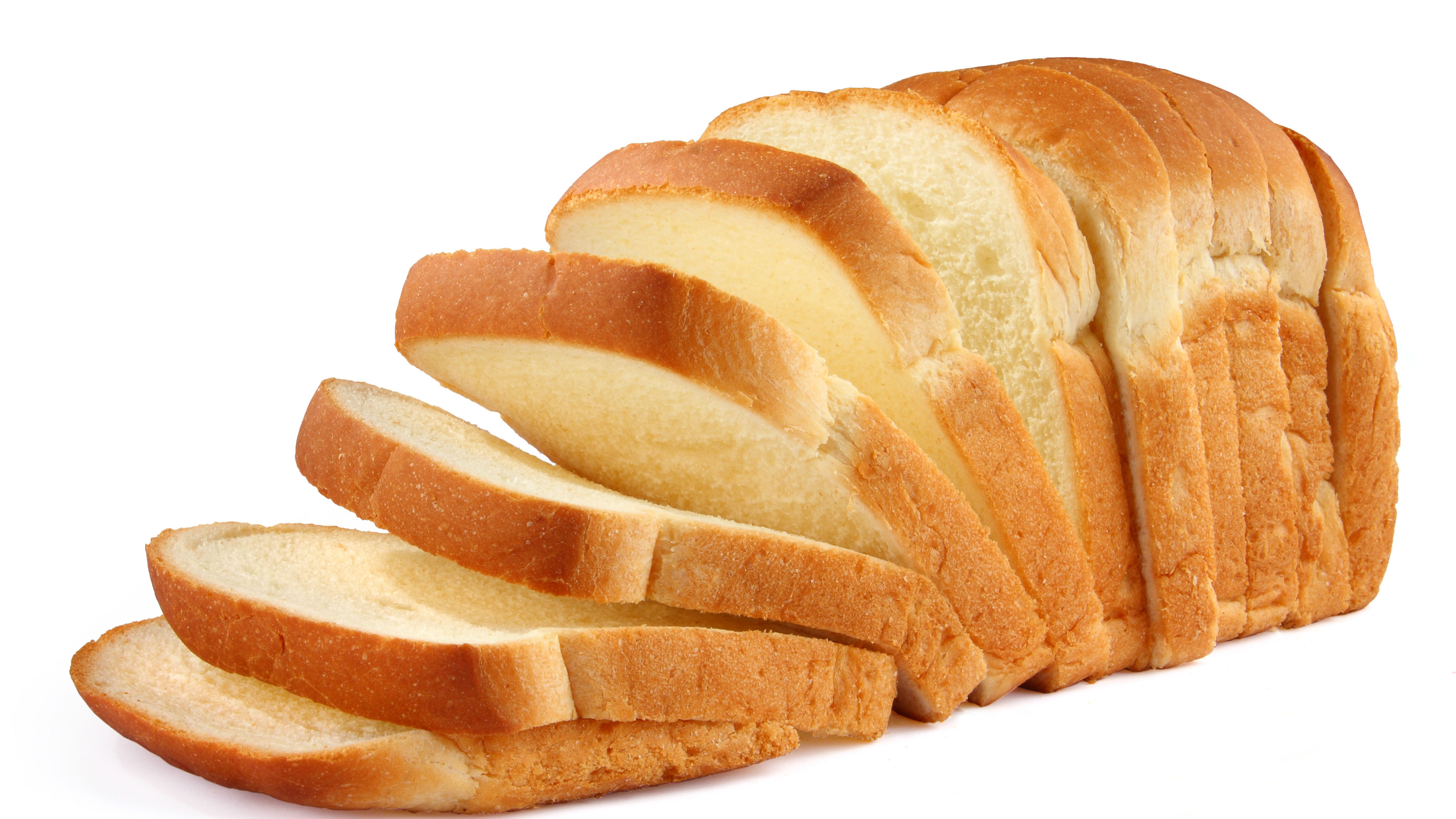
Bread is a great source of which energy nutrient?
a)
Carbohydrates
b)
Fats
c)
Proteins
d)
All of the above
55.
The amount of energy the body gets from food is measured in.
a)
Metabolism
b)
Diet
c)
Calories
d)
Protein
56.
Energy storage nutrients that help the body store some vitamins e.g. oils, butter, margarine
a)
Fats
b)
Carbohydrates
c)
Minerals
d)
Vitamins
57.
The process of converting the energy in food into energy the body can use.
a)
Metabolism
b)
Diet
c)
Digestion
d)
Calories
58.
Elements essential for good health. e.g. Calcium, Iron, Potassium 
a)
Protein
b)
Fat
c)
Minerals
d)
Carbohydrates
59.

what should you always balance with your diet

a)

physical activities

b)

water

c)

calories

60.

what parts of your body do meats and beans help grow

a)

muscles

b)

bones

c)

legs

d)

brain

e)

cells

61.

how much of your plate should be fruits and vegetables

a)

half

b)

all

c)

25%

d)

3/4

62.

3 foods to reduce

a)

sodium

b)

fats

c)

sugar

d)

fruits

e)

things with high calories

63.

are needed to build body tissue and keep the body healthy and strong.

a)

protein

b)

calories

c)

amino acids

64.

a process that takes the fuel in the food we eat and makes it into the energy needed to power everything we do.

a)

metabolism

b)

nutrition

c)

nutrients

d)

getting energy

65.

Process by which your body takes in and uses nutrients in food.

a)

nutrition

b)

metabolism

c)

energy

d)

digesting