wayground logo

Free Printable Worksheets

Font size

S
M
L
XL
Worksheets

AQA biology paper 2 2024

Total questions: 155

Worksheet time: 1hrs 25mins

Name
Class
Date
1.

Homeostasis is maintaining a ___________ internal environment.

a)

reliable

b)

different

c)

constant

d)

heated

2.

Which of these is NOT under the control of homeostasis?

a)

Blood-glucose concentration

b)

Nail growth

c)

Body temperature

d)

Water levels

3.

The CNS consists of the (a)   and spinal cord.

4.

Nerve cells are called (a)   .

5.

The gap between two neurones is called the (a)   .

6.

Label 2

(a)  

7.

Label 4

(a)  

8.

Label 5

(a)  

9.

Which options show the correct order of the nervous system?

a)

stimulus ---> receptor ---> sensory neurone

b)

coordinator ---> motor neurone ---> effector

c)

receptor ---> motor neurone ---> effector

d)

coordinator ---> stimulus ---> response

10.

In a reflex reaction, the electrical impulse does not reach the (a)   .

11.

Name the three different types of neurones:

a)

sensory, generalised and motor neurones

b)

Sensory, relay and motor neurones

c)

Sensory, relay and effector neurones

12.

A sense organ has lots of _________.

a)

effectors

b)

tissue

c)

mitochondria

d)

receptors

13.

Examples of effectors include ________ and ________.

a)

hormones

b)

glands

c)

muscles

d)

brain

e)

spinal cord

14.

A (a)   will contract

15.

A (a)   will secrete hormones or enzymes.

16.

Where are the light receptors located?

a)

Eye

b)

Ear

c)

Mouth

d)

Nose

17.

Where are the sound receptors located?

a)

Eye

b)

Ear

c)

Mouth

d)

Nose

18.

Which of these are examples of reflex reactions?

a)

Pupil in the eye changing size

b)

Eating a cake

c)

Knee jerk response

d)

Sneezing

e)

Breathing

19.

The independent variable is the variable you...

a)

keep the same

b)

change

c)

measure

20.

The dependent variable is the variable you...

a)

keep the same

b)

change

c)

measure

21.

The control variable is the variable you...

a)

keep the same

b)

change

c)

measure

22.
The part of the neuron that insulates the axon and increases the speed of the neural message within the neuron.
a)
Synapse
b)
Dendrite
c)
Myelin Sheath
d)
Axon Terminal Button
23.

This part of the neuron receives chemical messages from the neurotransmitters of other neurons. It is labeled A in the diagram.

a)

Dendrite

b)

Axon

c)

Axon Terminal

d)

Cell Body

24.

The long, fiber like part of a neuron which the cell sends information to receiving neurons. Labelled D in diagram.

a)

Synapse

b)

Axon

c)

Axon Terminal

d)

Dendrite

25.
The nervous system subdivision that is composed of the brain and spinal cord.
a)
Autonomic Nervous Sytem
b)
CNS
c)
PNS
d)
Somatic Nervous System
26.

_____ neurons carry messages away from the central nervous system and out to muscles or glands. The RED neuron in diagram.

a)

sensory

b)

motor

c)

inter

d)

central

27.
What is the central nervous system (CNS) made of?
a)
brain and spinal cord
b)
brain and cranial nerves
c)
spinal cord and spinal nerves
d)
cranial nerves and spinal nerves
28.
What are the 2 major divisions of the peripheral nervous system (PNS)?
a)
Sensory & Motor
b)
Peripheral & Central
c)
Somatic & Autonomic
d)
Brain & Spinal Cord
29.
Label the Neuron-What does the letter "C" represent?
a)
Dendrite
b)
Axon
c)
Axon Terminal
d)
Cell Body
30.

Select two examples of effectors.

a)

Neuron

b)

Gland

c)

Muscle

d)

Receptor

31.

Which type of neuron causes a muscle to contract in a reflex arc?

a)

Motor Neuron

b)

Sensory Neuron

c)

Interneuron

d)

Effector

32.
What is the neuron found only in the spinal cord?
a)
Relay
b)
Sensory
c)
Motor
d)
Reflex
33.

Where would the nerve impulse start in this reflex arc?

a)

A

b)

C

c)

D

d)

E

34.

What type of neuron is A?

a)

Sensory

b)

Inter

c)

Motor

35.

Which is the correct order of neurons in a reflex arc?

a)

Sensory neuron, motor neuron, relay neuron

b)

Relay neuron, sensory neuron, motor neuron

c)

Sensory neuron, relay neuron, motor neuron

36.

What is included in the central nervous system (CNS)?

a)

Spinal cord and all neurones in the body

b)

Brain and all neurones in the body

c)

Brain and spinal cord

37.

What is the generalised order during a nervous response?

a)

Receptor → stimulus → coordinator → effector → response

b)

Response → receptor → coordinator → effector → stimulus

c)

Stimulus → receptor → coordinator → effector → response

38.

Name the three different types of neurone

a)

Sensory, generalised and motor neurones

b)

Sensory, relay and motor neurones

c)

Sensory, relay and effector neurones

39.

What moves across the synapse?

a)

Chemical messenger

b)

Electrical impulse

c)

Electrical impulse and a chemical messenger

40.

What do receptors in the eye detect?

a)

Light

b)

Heat

c)

Sound

41.

What are effectors?

a)

Motor neurones

b)

Muscles and glands

c)

Muscles and nerves

42.

What organ does a reflex arc miss out?

a)

Brain

b)

Spinal cord

c)

Heart

43.

How do chemicals (neurotransmitters) move across a synapse?

a)

Osmosis

b)

Diffusion

c)

Active transport

44.

What are 'changes in the environment' called?

a)

Response

b)

Stimulus

c)

Receptor

d)

Effector

45.

What are cells that detect stimuli called?

a)

Response

b)

Stimulus

c)

Receptors

d)

Effector

46.

What are organs, tissues or cells that produces a response called?

a)

Response

b)

Stimulus

c)

Receptors

d)

Effectors

47.

What cells that carry an electrical message or impulse when stimulated called?

a)

Neurones

b)

Stimulus

c)

Receptors

d)

Effectors

48.

What are the stimuli detected by the skin?

a)

Touch, temperature and pain

b)

Chemicals (in food and drink, for example)

c)

Chemicals (in the air, for example)

d)

Light

49.

What is the order during a reflex action response?

a)

Receptor → stimulus → relay neurone→ sensory neurone → effector → response → motor neurone

b)

Relay neurone → Response → receptor → motor neurone → effector → stimulus → Sensory neurone

c)

Stimulus → receptor → sensory neurone → relay neurone → motor neurone → effector → response

50.

What does the sensory neurone send an electrical impulse on to in a reflex action?

a)

Motor neurone

b)

Brain

c)

Relay neurone

d)

Effector

51.

What does the relay neurone send an electrical impulse on to in a reflex action?

a)

Motor neurone

b)

Brain

c)

Sensory neurone

d)

Effector

52.

What is the small gap (or junction) where two neurones meet called?

a)

Effector

b)

Receptor

c)

Synapse

53.

In the RQ investigation to determine the effect of a specific factor on human reaction times, what is the dependent variable?

a)

The hand: left vs right

b)

Distance between finger and thumb

c)

The distance on ruler caught

d)

Height ruler is held above hand

54.

In the RQ investigation to determine the effect of a specific factor on human reaction times, what is the independent variable?

a)

The hand: left vs right

b)

Distance between the finger and thumb

c)

The distance on ruler caught

d)

Height ruler is held above hand

55.

In the RQ investigation to determine the effect of a specific factor on human reaction times, what are the control variables?

a)

The hand: left vs right

b)

Distance between finger and thumb

c)

The distance on ruler caught

d)

Height ruler is held above hand

56.

In the RQ investigation to determine the effect of a specific factor on human reaction times, how can you find the reaction time?

a)

Use the conversion table to help convert your ruler measurements into reaction time

b)

Just record the catch distance in cm.

c)

Use a stopwatch and use the speed = distance/time equation

57.
What is the function of a receptor cell?
a)

To detect changes in the environment

b)

To tell the body how to respond to changes in the environment

c)

To bring about a response to changes in the environment

d)
DTo receive and coordinate information.
58.
Which of the following is an example of an effector?
a)

The brain

b)

The eye

c)

The adrenal gland

d)
D The wrist
59.
Why are reflex actions faster than a normal nervous response?
a)
A.   Because the nerve impulses move faster in a reflex action
b)
B.   Because nerve impulses do not involve the conscious part of the brain
c)
C.   Because the response travels through fewer neurones.
d)
D.   It travels across the synapses quicker
60.
Which organs make up the Central Nervous System?
a)
A Sensory and motor neurones
b)
B Spinal cord and thigh muscle
c)
C The eye and brain
d)
D The brain and spinal cord
61.
How does a nerve impulse move across the synapse?
a)
A.   It jumps across the gap
b)

B.   The chemical (neurotransmitter) diffuses across the gap

c)
C.   The impulse spreads out.
d)
D.   The impulse starts again.
62.
An ecosystem is:
a)
A.   The interaction between all the living and non-living things in an environment.
b)
B.   Refers only to the living things in a specific area.
c)
C.   Refers only to the non-living things in a specific area.
d)
D.   Where an animal lives.
63.
What equipment is used to estimate the popultion size of plants in an ecosystem?
a)
A.   A quadrat
b)
B.   A line transect
c)
C.   A random sampler
d)
D.   A rectangle
64.
The ways living organisms interact is called:
a)
A.   Denaturing
b)
B.   Competition
c)
C.   Predator-Prey relationships
d)
D.   Interdependence
65.
The mean of these numbers: 3, 3, 5, 6 would be:
a)
A.   4.25
b)
B.   4.67
c)
C.   3
d)
D.   4
66.
Which process releases water vapour to the atmosphere?
a)
A Transpiration
b)
B Condensation
c)
C Precipitation
d)
D Absorption
67.
An abiotic factor is:
a)
A.   A non-living organic molecule affecting and ecosystem.
b)
B.   A non-living factor affecting ecosystems such as sunlight
c)
C.   A living factor that affects ecosystems such as the number of prey available.
d)
D.   A living molecule affecting an ecosystem
68.
What is the primary source of energy for all ecosystems?
a)
A.   Plants
b)
B.   The sun
c)
C.   Chemicals
d)
D.   Water
69.
Animals compete for:
a)
A.   Food only
b)
B.   Food and mates.
c)
C.   Food, mates and territory.
d)
D.   Food, mates, territory and oxygen
70.
Organisms that survive in extreme conditions are called:
a)
A.   Hardophiles
b)
B.   Extremophiles
c)
C.   Non-living
d)
D.   Thermochromatic
71.
An example of an extreme environment would be:
a)
A.   The sun
b)
B.   Deep sea vents
c)
C.   Sewer systems
d)
D.   The human stomach
72.
Which process removes water vapour from the atmosphere?
a)
A Evaporation
b)
B Condensation
c)
C Nitrogen fixation
d)
D Neutralisation
73.
Which one of the following is not a way of reducing negative human effects on ecosystems and maintaining biodiversity?
a)
A recycling resources (rather than landfill)
b)
B removal of hedgerows on farming land
c)
C breeding programmes for endangered species
d)
D reduction of deforestation
74.
A biotic factors is:
a)
A.   A non-living organic molecule affecting and ecosystem.
b)
B.   A non-living factor affecting ecosystems such as sunlight
c)
C.   A living factor that affects ecosystems such as the number of prey available
d)
D.   A living molecule affecting an ecosystem
75.
Random sampling is used:
a)
A.   To identify the number of species.
b)
B.   To avoid bias when looking at data.
c)
C.   To estimate the number of species in an area.
d)
D.   To identify the distribution of species between two points of interest, such as between a foot path and some woods.
76.
Adaptations may be:
a)
A.   Structural
b)
B.   Behavioural
c)
C.   Structural or behavioural
d)
D.   Structural, behavioural or functional.
77.
The mode of these numbers: 3, 3, 5, 6 would be:
a)
A.   4.25
b)
B.   4.67
c)
C.   3
d)
D.   4
78.
Large-scale deforestation in tropical areas has occurred to:
a)
A Provide land for sunbathing and tourism
b)
B Provide land for house building
c)
C Provide land for cattle and rice fields
d)
D Provide wood for burning in wood-fired stoves
79.
What processes mean scientists have come to a consensus that global warming is real?
a)
A Replicated experiments in the laboratory
b)
B Presentation and graph seen of rising temperature at scientific conferences
c)
C Systematic review of thousands of peer reviewed publications
d)
D Sea levels have risen and the climate has changed
80.
Factors plants compete for include:
a)
A.   Space and light.
b)
B.   Space, light and water.
c)
C.   Space, light, water and mineral ions.
d)
D.   Space, light, water, mineral ions and chloroplasts.
81.
All food chains must start off with:
a)
A.   A primary consumer
b)
B.   A secondary consumer
c)
C.   Microorganisms
d)
D.   A plant (or photosynthetic organism.
82.
A line transect is used:
a)
A.   To identify the number of species.
b)
B.   To avoid bias when looking at data.
c)
C.   To estimate the number of species in an area.
d)
D.   To identify the distribution of species between two points of interest, such as between a foot path and some woods
83.
The median of these numbers: 3, 3, 5, 6 would be:
a)
A.   4.25
b)
B.   4.67
c)
C.   3
d)
D.   4
84.
Two greenhouse gases that contribute to global warming are:
a)
A O2 and CO2
b)
B SO2 and O2
c)
C CO and NO2
d)
D CO2 and CH4
85.
What are the function of enzymes in genetic engineering?
a)
A They are used to aid the digestion of the chromosomes
b)
B They are inserted into chromosomes in replacement of genes
c)
C They are used to cut desired genes from chromosomes
d)
D They are used to catalyse the reactions
86.
Name an example of a vector and its use in genetic engineering
a)
A Enzyme and it is used to cut a chromosome
b)
B Bacteria, it is the desirable gene from a chromosome
c)
C Plasmid, it is used to insert a gene into a required cell
d)
D Plasmid, and it is used to cut a chromosome
87.
What makes an organism ‘genetically modified’?
a)
A It has had extra chromosomes inserted
b)
B It has had extra genes added
c)
C It has had a gene replaced by a different gene
d)
D It has different alleles to another animal of the same species.
88.
Which of the below is a concern related to genetic modification of crops?
a)
A They have higher yields
b)
B They may cross pollinate with wild plant populations
c)
C They are resistant to pests
d)
D They produce bigger fruits
89.
Which individuals are most likely to survive to reproduce?
a)
A Individuals that are well suited to their environment
b)
B Individuals that are poorly suited to their environment
c)
C Individuals that have no immunity to new diseases
d)
D Individuals that have a restricted and small food supply
90.
What is the theory for natural selection?
a)
A Organisms that are well suited to their environment will go on to reproduce
b)
B Organisms that are not well adapted to their environment will go on to reproduce
c)
C Organisms that are well suited to their environment are likely to become extinct
d)
D Organisms, over their life time, will adapt and pass on these characteristics in their genes to their young
91.
For what reason may an organism become extinct?
a)
A An increase in food supply
b)
B A new predator
c)
C A developed resistance to a disease
d)
D An increase in territory
92.
In what ways may fossils be formed?
a)
A From parts of organisms that have not decayed
b)
B When parts of the organisms are replaced by minerals
c)
C As preserved traces of organisms eg footprints
d)
D All of the above
93.
Which of the following shows the correct genus and species of a Orang Utan?
a)
A Mammal, Pongo
b)
B pongo pygmaeus
c)
C Pongo pygmaeus
d)
D Chordate, Pongo.
94.
Which of the following groups contain primitive unicellular organisms that live in extreme conditions?
a)
A Bacteria
b)
B Chordates
c)
C Archaea
d)
D Eukaryota
95.
Which is the correct order for the classification system?
a)
A Kingdom, Phylum, Order, Class, Family, Species, Genus
b)
B Kingdom, Phylum, Class, Order, Family, Species, Genus
c)
C Kingdom, Class, Phylum, Order, Family, Species, Genus
d)
D Kingdom, Phylum, Class, Order, Family, Genus, Species
96.
An ecosystem is:
a)
A.   The interaction between all the living and non-living things in an environment.
b)
B.   Refers only to the living things in a specific area.
c)
C.   Refers only to the non-living things in a specific area.
d)
D.   Where an animal lives.
97.
What equipment is used to estimate the popultion size of plants in an ecosystem?
a)
A.   A quadrat
b)
B.   A line transect
c)
C.   A random sampler
d)
D.   A rectangle
98.
The ways living organisms interact is called:
a)
A.   Denaturing
b)
B.   Competition
c)
C.   Predator-Prey relationships
d)
D.   Interdependence
99.
The mean of these numbers: 3, 3, 5, 6 would be:
a)
A.   4.25
b)
B.   4.67
c)
C.   3
d)
D.   4
100.
Which process releases water vapour to the atmosphere?
a)
A Transpiration
b)
B Condensation
c)
C Precipitation
d)
D Absorption
101.
An abiotic factor is:
a)
A.   A non-living organic molecule affecting and ecosystem.
b)
B.   A non-living factor affecting ecosystems such as sunlight
c)
C.   A living factor that affects ecosystems such as the number of prey available.
d)
D.   A living molecule affecting an ecosystem
102.
What is the primary source of energy for all ecosystems?
a)
A.   Plants
b)
B.   The sun
c)
C.   Chemicals
d)
D.   Water
103.
Animals compete for:
a)
A.   Food only
b)
B.   Food and mates.
c)
C.   Food, mates and territory.
d)
D.   Food, mates, territory and oxygen
104.
Organisms that survive in extreme conditions are called:
a)
A.   Hardophiles
b)
B.   Extremophiles
c)
C.   Non-living
d)
D.   Thermochromatic
105.
An example of an extreme environment would be:
a)
A.   The sun
b)
B.   Deep sea vents
c)
C.   Sewer systems
d)
D.   The human stomach
106.

What is included in the central nervous system (CNS)?

a)

Spinal cord and all neurones in the body

b)

Brain and all neurones in the body

c)

Brain and spinal cord

107.

What is the generalised order during a nervous response?

a)

Receptor → stimulus → coordinator → effector → response

b)

Response → receptor → coordinator → effector → stimulus

c)

Stimulus → receptor → coordinator → effector → response

108.

Name the three different types of neurone

a)

Sensory, generalised and motor neurones

b)

Sensory, relay and motor neurones

c)

Sensory, relay and effector neurones

109.

What moves across the synapse?

a)

Chemical messenger

b)

Electrical impulse

c)

Electrical impulse and a chemical messenger

110.

What do receptors in the eye detect?

a)

Light

b)

Heat

c)

Sound

111.

What are effectors?

a)

Motor neurones

b)

Muscles and glands

c)

Muscles and nerves

112.

What organ does a reflex arc miss out?

a)

Brain

b)

Spinal cord

c)

Heart

113.

How do chemicals (neurotransmitters) move across a synapse?

a)

Osmosis

b)

Diffusion

c)

Active transport

114.

What are 'changes in the environment' called?

a)

Response

b)

Stimulus

c)

Receptor

d)

Effector

115.

What are cells that detect stimuli called?

a)

Response

b)

Stimulus

c)

Receptors

d)

Effector

116.

What are organs, tissues or cells that produces a response called?

a)

Response

b)

Stimulus

c)

Receptors

d)

Effectors

117.

What cells that carry an electrical message or impulse when stimulated called?

a)

Neurones

b)

Stimulus

c)

Receptors

d)

Effectors

118.

What are the stimuli detected by the skin?

a)

Touch, temperature and pain

b)

Chemicals (in food and drink, for example)

c)

Chemicals (in the air, for example)

d)

Light

119.

What is the order during a reflex action response?

a)

Receptor → stimulus → relay neurone→ sensory neurone → effector → response → motor neurone

b)

Relay neurone → Response → receptor → motor neurone → effector → stimulus → Sensory neurone

c)

Stimulus → receptor → sensory neurone → relay neurone → motor neurone → effector → response

120.

What does the sensory neurone send an electrical impulse on to in a reflex action?

a)

Motor neurone

b)

Brain

c)

Relay neurone

d)

Effector

121.

What does the relay neurone send an electrical impulse on to in a reflex action?

a)

Motor neurone

b)

Brain

c)

Sensory neurone

d)

Effector

122.

What is the small gap (or junction) where two neurones meet called?

a)

Effector

b)

Receptor

c)

Synapse

123.

In the RQ investigation to determine the effect of a specific factor on human reaction times, what is the dependent variable?

a)

The hand: left vs right

b)

Distance between finger and thumb

c)

The distance on ruler caught

d)

Height ruler is held above hand

124.

In the RQ investigation to determine the effect of a specific factor on human reaction times, what is the independent variable?

a)

The hand: left vs right

b)

Distance between the finger and thumb

c)

The distance on ruler caught

d)

Height ruler is held above hand

125.

In the RQ investigation to determine the effect of a specific factor on human reaction times, what are the control variables?

a)

The hand: left vs right

b)

Distance between finger and thumb

c)

The distance on ruler caught

d)

Height ruler is held above hand

126.

In the RQ investigation to determine the effect of a specific factor on human reaction times, how can you find the reaction time?

a)

Use the conversion table to help convert your ruler measurements into reaction time

b)

Just record the catch distance in cm.

c)

Use a stopwatch and use the speed = distance/time equation

127.
What is the function of a receptor cell?
a)

To detect changes in the environment

b)

To tell the body how to respond to changes in the environment

c)

To bring about a response to changes in the environment

d)
DTo receive and coordinate information.
128.
Which of the following is an example of an effector?
a)

The brain

b)

The eye

c)

The adrenal gland

d)
D The wrist
129.
Why are reflex actions faster than a normal nervous response?
a)
A.   Because the nerve impulses move faster in a reflex action
b)
B.   Because nerve impulses do not involve the conscious part of the brain
c)
C.   Because the response travels through fewer neurones.
d)
D.   It travels across the synapses quicker
130.
Which organs make up the Central Nervous System?
a)
A Sensory and motor neurones
b)
B Spinal cord and thigh muscle
c)
C The eye and brain
d)
D The brain and spinal cord
131.
How does a nerve impulse move across the synapse?
a)
A.   It jumps across the gap
b)

B.   The chemical (neurotransmitter) diffuses across the gap

c)
C.   The impulse spreads out.
d)
D.   The impulse starts again.
132.

The two main causes of variation within a species are:

a)

Genetics

b)

Diet

c)

Environment

d)

Personality

133.

Some characteristics are caused by both genetics and environmental influences, select all those that only genetic.

a)

Weight

b)

Scar

c)

Sporting ability

d)

Eye colour

e)

Blood group

134.

Select all the statements about the structure of DNA that are TRUE.

a)

The structure is described as a double helix

b)

A pairs with C

c)

C pairs with G

d)

The bases are held together with hydrogen bonds

e)

The bases are: Argon, Thymine, Cyan, Ghana

135.

Based on the complementary base pairing rules what would be the correct base pairing of the following strand: AGC TGA

a)

TGT ACA

b)

AAT CGT

c)

TCG ACT

d)

ACT CAT

136.

Where is DNA found?

a)

Nucleus

b)

Cell Wall

c)

Cell Membrane

d)

Anywhere in the cell.

137.

How many chromosomes are in a diploid cell?

a)

50

b)

46

c)

20

d)

16

138.

(a)   is a short length of DNA found on a chromosome that codes for a particular characteristic.

139.

An alternative form of a gene is called an (a)   .

140.

The genetic make up of an organism is known as their (a)  

141.

The physical characteristics of an organism are known as their (a)  

142.

Which of these would be correct for an organism that was described as being homozygous recessive.

a)

bb

b)

BB

c)

Bb

d)

Bbb

143.

If brown eyes are dominant (E) and green eyes recessive (e), what colour eyes would a cat have if they had the genotype, Ee?

a)

Brown

b)

Green

c)

Blue

144.

What process takes place to ensure only half the number of chromosomes (23) are found in gametes?

a)

Mitosis

b)

Meiosis

c)

Fertilisation

d)

Phagocytosis

145.

True or False: Males are XY

a)

True

b)

False

146.

Cells (Eg: gametes) with only half the number of chromosomes are known as (a)  

147.

The reason Meiosis takes place is to.......

a)

Maintain the chromosome number within cells.

b)

Make the maths easier for those people studying DNA

c)

Allow males and females to reproduce

d)

For fun!

148.

What is a population?

a)

groups of different species living in the same area

b)

group of the same species living in the same area

c)

includes all of the organisms and non-living things in an area

d)

major regional or global community

149.

What is a community?

a)

Different populations of organisms living in the same environment.

b)

One population of organism living in the same environment.

c)

Different populations of organisms living in more than two environments.

d)

One population of organism living in more than two environments.

150.

What is an ecosystem?

a)

The interactions among living and non-living things in an environment.

b)

A type of organism that can only be seen with a microscope.

c)

A bunch of moving parts that do work.

d)

The newest craze in social media.

151.
What is this called?
a)
Food Web
b)
Food Chain
c)
Abiotic Factors
152.
B = brown fur  b = white fur
In the Punnett square, what is the probability for white fur
a)
0%
b)
25%
c)
50%
d)
75%
153.

In pea plants, round seeds (R) are dominant to wrinkled seeds (r). Which of the following represents the genotype of a pea plant that is heterozygous?

a)

RR

b)

round

c)

Rr

d)

wrinkled

e)

rr

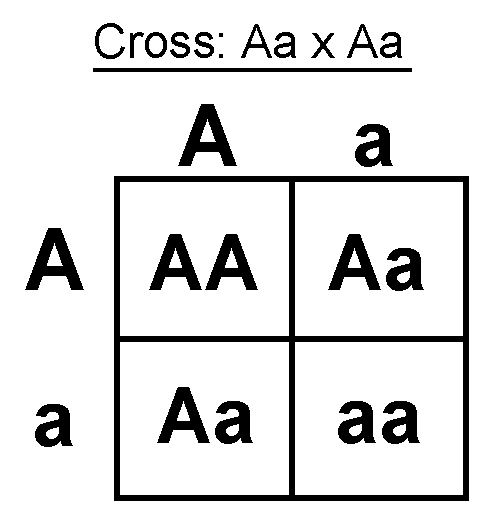
154.
What is the probability of heterozygous offspring?
a)
25%
b)
50%
c)
0%
d)
100%
155.

What are the possible phenotype(s) of the offspring? (A-Brown hair; a-blond hair)

a)

50 % Brown Hair and 50% Blond Hair

b)

25 % Brown Hair and 75% Blond Hair

c)

75 % Brown Hair and 25% Blond Hair

d)

0% Brown Hair and 100% Blond Hair