wayground logo

Free Printable Worksheets

Font size

S
M
L
XL
Worksheets

Midterm Review 2025-2026 (Principles of Physical Science)

Total questions: 152

Worksheet time: 3hrs 32mins

Name
Class
Date
1.

Velocity describes both speed and acceleration.

a)

True

b)

False

2.

An object accelerates if it speeds up, slows down, or changes directions.

a)

True

b)

False

3.

If Kim won a 300 meter race in 40 seconds, her average speed was _____.

a)

15 m/s

b)

25 m/s

c)

7.5 m/s

d)

8.5 m/s

4.

_____ is the rate of change of speed and/or direction.

a)

Acceleration

b)

Gravity

c)

Net force

d)

Inertia

5.
What is velocity?
a)
the quickness of an object
b)
the location of an object
c)
acceleration
d)
speed in a specific direction
6.
How is velocity different than speed?
a)
Speed opposes velocity
b)
Velocity is speed with a direction
c)
None of the answers are correct
7.
Which is an example of VELOCITY?
a)

A dog running at 3 m/s

b)

A deer sprinting at 4 m/s

c)

A migrating bird headed south for the winter at 3 m/s

d)

A person not moving at all

8.

What is speed?

a)

It is how far you go

b)

It is the distance traveled over a period of time

c)

It is how fast you accelerate

d)

It is the change in the postilion of a object

9.

A roadrunner travels 100m [East] then 300m [West]. What is its distance?

a)

300 m

b)

200 m

c)

400 m

d)

30 000 m

10.

Dash from the Incredibles runs 5 km [North] and then 20 km [South]. What is its displacement?

a)

15 km [South]

b)

25 km [South]

c)

15 km [North]

d)

25 km [North]

11.

In a 2,000 m race the athletes complete 5 laps around the 400 m long track. Find displacement.

a)

400 m

b)

2 000 m

c)

0 m

d)

4 000 m

12.

The diagram shows three vehicles travelling along a straight road at 14 m/s.

Which vehicle has the greatest momentum?

a)

Motorcycle

b)

Lorry

c)

Van

13.
Which of the following images has more momentum?
a)
Object A
b)
Object B 
c)
They are the same
14.
Which has more momentum: a car stopped at a red light or a bike moving at 15 mph?
a)
car
b)
bike
c)
they are equal
d)
cannot determine using the info provided
15.

Calculate the momentum of a 1200-kg truck moving northward at 30 m/s.

a)

36000 kg·m/s, north

b)

400 kg·m/s, north

c)

36000 kg·m/s

d)

400 kg·m/s

16.

Calculate the momentum of a 55-kg running back moving westward at 10 m/s.

a)

550 kg·m/s, west

b)

550 kg·m/s

c)

550 m/s, west

d)

550 kg, west

17.

What are the unit of momentum?

a)

kg m/s

b)

m/s2

c)

kg/m/s

18.
Determine the momentum of 1000-kg car moving southward at 20 m/s......... 
a)
20000 N
b)
20000 Joules
c)
20000 Kg * m/s south
d)
10000 kg * m/s south
19.
The equation to calculate momentum is
a)
p=mv
b)
p=1/2mv2
c)
p=mgh
d)
p=mg
20.

Which object will most likely move the farthest during 1 minute?

a)

A train traveling with 16 meters per second

b)

A racehorse running 15 meters per second

c)

A bowling ball rolling 7 meters per second

d)

A man swimming 2 meters per second

21.

A measure of how fast something moves over a certain distance is ________________.

a)

motion

b)

speed

c)

work

d)

force

22.

A measurement of distance divided by time no direction

a)

Acceleration

b)

Velocity

c)

Gravity

d)

Speed

23.

Distance travelled by an object in a given amount of time.

a)

speed

b)

density

c)

mixture

d)

wavelength

24.

Jermaine runs exactly 2 laps around a 400 meter track. What is the displacement?

a)

800 meters

b)

400 meters East

c)

0 meters

d)

200 meters SW

25.
Bill runs 400 meters to Andy's house, turns around, and runs 400 meters back home.  What is Bill's distance?
a)
0 meters
b)
400 meters
c)
800 meters
d)
1600 meters
26.
Which force produces a change in motion?
a)
unbalanced force
b)
balanced force
c)
gravitational force
d)
frictional force
27.
What is the standard unit force is measured in?
a)
Newtons
b)
pounds
c)
grams
d)
meters
28.
What is Newton's First Law known as? The Law of
a)
Friction
b)
Mass
c)
Inertia
d)
Gravity
29.
Which has more Inertia? (so need more force to move) 
a)
Truck
b)
Ant
c)
A cat
d)
A skateboard
30.
What is Newton's Third Law?
a)
Object in motion stays in motion and an object at rest stays at rest unless acted on by a outside force
b)
Force = mass x acceleration
c)
For every action there is an equal and opposite reaction
31.

Who is the scientist who came up with the Laws of Motion?

a)

Issac Newton

b)

Jeff Loomis

c)

John Dalton

d)

Kevin Newton

32.
"An object in motion (or at rest) will to stay in motion (or at rest) until an outside force acts upon it."
a)
Newton's 1st Law
b)
Newton's 2nd Law
c)
Newton's 3rd Law
d)
Newton's 4th Law
33.
What is the net force?
a)
400 N Up
b)
400 N Down
c)
- 400 N Down
d)
800 N Down
34.

When an object is moving, friction acts in the _______ direction as the motion.

a)

perpendicular

b)

same

c)

opposite

d)

precise

35.

A type of friction that occurs when air pushes against a moving object it to decelerate.

a)

surface area

b)

air resistance

c)

velocity

d)

gravity

36.
A push or pull exerted on an object
a)
Force
b)
Net force
c)
Momentum
d)
Speed
37.
The overall force on an object when all the individual forces acting on it are added together
a)
Momentum
b)
Net force
c)
Velocity
d)
Unbalanced force
38.
What are balanced forces?
a)
Forces in the same direction
b)
Forces of the same size
c)
forces of the same size in opposite directions
39.
What is it called when the force of gravity is acting on an object?
a)
Weight
b)
Sliding Friction
c)
Momentum
d)
Projectile Motion
40.

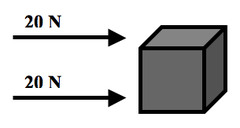
What is the resultant force?

a)

40 N, Left

b)

0 N, Balanced

c)

400 N, Right

d)

40 N, Right

41.
How will this object move? 
a)
It won't move. 
b)
It will move to the right. 
c)
It will move to the left. 
d)
It will move in both directions. 
42.

How do you calculate the resultant force when the forces on an object are acting in the same direction?

a)

Add the forces together.

b)

Subtract the smaller force from the larger force.

43.

The resultant force is the . . .

a)

force that acts in the opposite direction to motion.

b)

overall force acting on an object.

c)

unit for measuring force.

44.

The resultant force acting on the ball is ...

a)

6 N upwards.

b)

6 N downwards.

c)

30 N downwards.

d)

30 N upwards.

45.
In a tug of war the left team pulls with a force of 200N. The right team pulls with a force of 150N.What is the resultant force?
a)
50N to the left.
b)
350N to the left.
c)
350N to the right.
d)
50N to the right.
46.
Is the car
a)
Stationary
b)
Moving at constant speed
c)
Accelerating
d)
Decelerating
47.
What is the name for a single force on an object with the same effect as all the forces combined?
a)
big
b)
total
c)
resultant
d)
sum
48.
What is the force that pulls us towards the Earth?
a)
gravity
b)
weight
c)
friction
d)
mass
49.
The force of gravity acting on an object is the object's ______.
a)
mass
b)
matter
c)
weight 
d)
friction 
50.
The amount of matter in an object is 
a)
pressure
b)
weight
c)
mass
d)
force
51.
Which of the following never changes no matter where in the universe?
a)
weight
b)
force
c)
mass
d)
pounds
52.
A person would weigh less on on the Moon than on the Earth because . . .
a)
Moon has more mass, and therefore more gravity
b)
Moon has less mass, and therefore more gravity
c)
Moon has more mass, and therefore less gravity
d)
Moon has less mass and therefore less gravity
53.
If the mass of an object on Earth is 18 grams, what would the mass of the same object be on the Moon?
a)
18 g
b)
4 g
c)
0 g 
d)
32 g 
54.

What is the name of force F2?

a)

Drag

b)

Thrust

c)

Buoyancy

d)

water resistance

55.

A constant force of 20 N acts on a block placed on a rough surface as shown in Diagram.

If the friction is 5 N, the block will move with

a)

constant velocity

b)

constant acceleration

c)

increasing acceleration

d)

decreasing acceleration

56.
At which location would your mass be the greatest?
a)
Earth
b)
Moon
c)
Jupiter
d)
Mass Stays the Same Everywhere
57.

Which of the following is a contact force?

a)

weight

b)

air resistance

c)

magnetic force

d)

electrostatic force

58.

which is the correct formula for weight?

a)

weight x mass = gravitational field strength

b)

mass ÷ gravitational field strength = weight

c)

mass x gravitational field strength = weight

59.

what is weight measured in?

a)

newton meters

b)

grams

c)

newtons

d)

kilograms

60.

QUESTION:


A car has a mass of 10,000 kg. What is the WEIGHT of the car?


(Use 10n/kg as the value of gfs)

a)

1,000 N

b)

98,100 N

c)

10,000 N

d)

100 N

61.

if the resultant force on an object is zero it will ?????

a)

the direction may change

b)

it will continue at the same speed

c)

it will stay still

d)

the speed will change

62.
The free-body diagram represents a car being pulled by a towing cable. In the diagram, which
of the following is the gravitational force acting on the car?
a)
5800
b)
13 690
c)
14 700
d)
13 690 - 14 700   = -1110
63.
A 80 kg skydiver is free falling at a constant velocity of 19 m/s. What is the net (total) force acting on her?
a)
1,520 N
b)
0 N
c)
4.21 N
d)
Not enough information to answer
64.
What is the formula for force?
a)
Mass x Distance
b)
Time x Mass
c)
Acceleration x Time
d)
Acceleration x Mass
65.

Which of Newton's Laws states that an object will remain at rest or in uniform motion in a straight line unless acted upon by an external force?

a)

First Law

b)

Second Law

c)

Third Law

66.

Which of Newton's Laws explains the principle of action and reaction?

a)

First Law

b)

Second Law

c)

Third Law

67.
A space shuttle only has enough fuel to get it out of Earth’s atmosphere. Once the space shuttle is in space (where there is no friction/ air resistance) it will continue moving even without any fuel because of ________.
a)
Newton's First Law
b)
Newton's Second Law
c)
Newton's Third Law
d)
The Law of Space and Redundancy Law
68.

What is the formula for calculating the force applied to an object, according to Newton's Second Law of Motion?

a)

F=maF = ma

b)

F=maF = \frac{m}{a}

c)

F=m+aF = m + a

69.
Newton's Second Law states.........................
a)
that an object in motion, stays in motion; an object at rest stays at rest. 
b)
For every action there is an equal and opposite reaction.
c)
that acceleration occurs when a force acts upon an object. 
70.
a)
This is an example of Newton's First Law.
b)
This is an example of Newton's Second Law.
c)
This is an example of Newton's Third Law.
71.
a)
This is an example of Newton's First Law.
b)
This is an example of Newton's Second Law.
c)
This is an example of Newton's Third Law.
72.
This is an example of..........
a)
Newton's First Law
b)
Newton's Second Law
c)
Newton's Third Law
73.
How does friction affect speed?
a)
more friction decreases speed
b)
more friction increases speed
c)
less friction decreases speed
d)
less friction doesn't affect speed
74.
Friction is a force that acts in an ___________ direction of movement.
a)
similar
b)
opposite
c)
parallel
d)
west
75.
Which of the following is an example of friction that is helpful?
a)
Brakes used on a bike
b)
Tires from a car on the road
c)
Tread on the bottom of your shoes
d)
All are examples that are helpful
76.
What type of friction is not moving?
a)
static
b)
sliding
c)
fluid
d)
rolling
77.

Potential energy is the energy an object has due to its:

a)

Position/Height

b)

Motion

c)

Temperature

d)

Atomic Structure

78.

Kinetic energy is the energy an object has due to its:

a)

Position/Height

b)

Motion

c)

Temperature

d)

Atomic structure

79.

When does an object have no kinetic energy?

a)

When it is at rest

b)

When it is moving very slowly

c)

When the only force acting on it is gravity

d)

When it has no electrical charge

80.

Which object has the most potential energy?

a)

A ball on the ground

b)

A ball on top of a refrigerator

c)

A ball being thrown 100 miles an hour

d)

A ball resting on the edge of a cliff

81.

When is potential energy transformed to kinetic energy?

a)

When an object in motion remains in motion

b)

When an object at rest remains at rest

c)

When an object at rest is put into motion

d)

When an object at motion is stopped

82.

Which is the best synonym (word that means the same) for potential energy

a)

Stored energy

b)

Motion energy

c)

Gravitational energy

d)

Mechanical energy

83.

Which is an example of kinetic energy:

a)

A bowling ball resting on the ground

b)

A car driving down the road

c)

A car parked in a parking lot

84.

Which has the most kinetic energy

a)

A car traveling at 20 km an hour

b)

A truck traveling at 20 km an hour

c)

A bicycle traveling at 20 km an hour

85.
The law of conservation of energy means ________________________
a)
Energy CAN be created and destroyed or transformed
b)
Energy can be used up or transformed
c)
Energy CANNOT be created or destroyed, only transformed
d)
Energy cannot be transformed
86.
When does that ball have the greatest potential energy?
a)
A
b)
B
c)
C
d)
D
87.
When a pendulum swings, at which point is potential energy at its greatest? (assume there is no friction)
a)
1 and 5
b)
2 and 4
c)
d)
4 and 5
88.
When a pendulum swings, at which point is kinetic energy highest?
a)
1
b)
2
c)
3
d)
4
89.

List the energy transformations of this object.

a)

Electrical → Mechanical/ Radiant Energy

b)

Electrical → Mechanical / Sound / Thermal Energy

c)

Mechanical → Chemical / Thermal energy

d)

Mechanical→ Electrical energy

90.
As mass increases, KE ...
a)
increases
b)
decreases
c)
stays the same
91.

Gravitational potential energy depends on the strength of gravity, ________ and ________ of the object.

a)

height and mass

b)

friction and movement

c)

mass and movement

d)

height and friction

92.

Which letter shows the ball when it has THE MOST potential energy?

a)

A

b)

B

c)

C

d)

F

e)

G

93.

Which letter shows the ball when it has NO potential energy?

a)

B

b)

C

c)

D

d)

E

e)

F

94.

Which letter shows the ball when it has THE MOST kinetic energy?

a)

B

b)

C

c)

D

d)

E

e)

F

95.

Which letter shows the ball when it has THE LEAST kinetic energy?

a)

A

b)

B

c)

C

d)

F

e)

G

96.

What is the KE at point B?

a)

14 J

b)

12 J

c)

6 J

d)

8 J

97.

What is the Total Energy of the system?

a)

14 J

b)

12 J

c)

6 J

d)

8 J

98.

What is the GPE at point E?

a)

14 J

b)

12 J

c)

6 J

d)

8 J

99.

What is the KE at point D?

a)

14 J

b)

12 J

c)

6 J

d)

8 J

100.

What is the KE 1/4th of the way down?

a)

15,000 J

b)

3,750 J

c)

7,500 J

d)

11,250 J

101.

What is the Total Energy at the top?

a)

15,000 J

b)

3,750 J

c)

7,500 J

d)

11,250 J

102.

What is the KE 3/4th of the way down?

a)

15,000 J

b)

3,750 J

c)

7,500 J

d)

11,250 J

103.

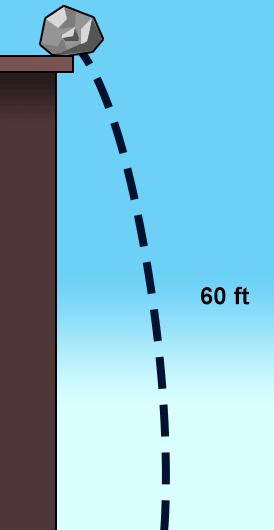
The rock in the picture is pushed over the edge and it begins to fall. Which type of energy conversion is taking place?

a)

mechanical to heat

b)

sound to mechanical

c)

potential to kinetic

d)

kinetic to potential

104.

The sum of kinetic and potential energy is called...

a)

sum energy

b)

nonmechanical energy

c)

mechanical energy

d)

space energy

105.

The total amount of energy

a)

varies

b)

can cancel out to zero

c)

goes out into space

d)

remains constant

106.

work is done when

a)

the object you apply a force on moves

b)

any force is applied to an object, regardless if it moves or not

c)

the force is zero

d)

the force and direction of motion are perpendicular

107.

The ability to do work is called

a)

energy

b)

force

c)

power

d)

machine

108.

The equation for Work is

a)

W= fd

b)

W= mgh

c)

W=1/2mv^2

d)

W=mg

109.

For work to be done on an object, the direction and force have to be going the same direction.

a)

True

b)

False

110.

The unit for energy and work is

a)

meters

b)

joules

c)

newtons

d)

watts

111.

Pick the correct formula to calculate for Potential Energy.

a)

PE = 1/2mv2

b)

PE = mgh

c)

m = PE/gh

d)

h = PE/mg

112.

Pick the correct formula to solve for Kinetic Energy.

a)

KE = 1/2mv2

b)

KE = mgh

c)

KE = d/t

d)

v2 = 2KE/m

113.

A book on a 2-meter high shelf has 20 joules of potential energy. What is the mass of the book?

a)

4.08 kg

b)

.1 J

c)

392 J

d)

.1 kg

114.

Calculate the PE of a bird sitting on a tree limb. The mass of the bird is 0.1 kg and it is 5 meters off the ground.

a)

4.9 J

b)

4.9 m/s

c)

5.4 J

d)

None of the above answers are correct.

115.
Calculate the KE of a moving 4 kilogram object traveling at a velocity of 3 m/s.
a)
18 J
b)
36 J
c)
12 J
d)
6 J
116.
How much KE does a moving 6 kilogram object have if it moves with a velocity of 3 m/s?
a)
27 J
b)
18 J
c)
9 J
d)
2 J
117.
A moving 10 kilogram object has 20 Joules of KE. What is its velocity?
a)
2 m/s
b)
4 m/s
c)
200 m/s
d)
10 m/s
118.
What is the mass of a moving object that has 100 Joules of KE and moves at a velocity of 2 m/s?
a)
50 kg
b)
200 kg
c)
25 kg
d)
100 kg
119.
As mass increases, KE ...
a)
increases
b)
decreases
c)
stays the same
120.
As the velocity of an object decreases its KE will...
a)
increase
b)
decrease
c)
stay the same
121.
Which has a greater impact on KE?
a)
mass
b)
velocity
122.
Is this activity as an example of potential or kinetic energy Choose “PE” or “KE”:
A child on his way down a playground slide.
a)
PE
b)
KE
123.

Potential energy depends on the ________ and ________ of the object.

a)

Height and mass

b)

Friction and movement

c)

Mass and Movement

d)

Height and Friction

124.

Calculate the potential energy of a rock with a mass of 55 kg while sitting on a hill that is 35 m high

a)

18,865 J

b)

1,925 J

c)

9,625 J

d)

336,875 J

125.
How long will it take an object to move 100 meters if the object is traveling with an average speed of 2 meters per second? 
a)
40 s
b)
30 s
c)
50 s
d)
60 s
126.
The average speed of a plane was 600 kilometers per hour. How long did it take the plane to travel 130 kilometers?
a)
0.5 s
b)
0.22 s
c)
3 s
d)
4 s
127.
A runner completed the 100 meter dash in 5.0 seconds. The runner's average speed is
a)
15 m/s
b)
25 m/s
c)
0.05 m/s
d)
20 m/s
128.
A cart starting from rest travels a distance of 3.6 meters in 1.8 seconds. The average speed of the cart is__________. 
a)
2.0 m/s
b)
0.20 m/s
c)
5.0 m/s
d)
0.50 m/s
129.
The average speed of an object during 6.0 seconds is 4 meters per second. What is the total distance traveled by the object?
a)
24 m
b)
20 m
c)
30 m
d)
40 m
130.
If a car is traveling at an average speed of 72 kilometers per hour, how long does it take to travel 12 kilometers? 
a)
0.5 hour
b)
0.72 hour
c)
0.17 hour
d)
6 hour
131.
Which is a unit of momentum?
a)
N-m/s^2
b)
kg-m/s
c)
kg-m/s^2
d)
N-m/s
132.
Which of the following objects has the greatest momentum? 
a)
a 100 kg object moving at 2 m/s
b)
a 20 kg object moving at 20 m/s
c)
a 10 kg object moving at 30 m/s
d)
a 1 kg object moving at 200 m/s
133.
A rocket with a mass of 1000 kilograms is moving at a speed of 20 m/s. The magnitude of the momentum is _________. 
a)
50 kg-m/s
b)
400,000 kg-m/s
c)
20,000 kg-m/s
d)
200 kg-m/s
134.
The momentum of an object is the product of its
a)
Force and displacement
b)
Mass and velocity
c)
Mass and acceleration
d)
Force and distance
135.
An object traveling at 4.0 meters per second has a momentum of 20 kilogram-meters per second. What is the mass of the object? 
a)
4 kg
b)
5 kg
c)
0.2 kg
d)
10 kg
136.
What is the momentum of a 30 kilogram cart moving with a speed of 10 meters per second? 
a)
20 kg-m/s
b)
3 kg-m/s
c)
40 kg-m/s
d)
300 kg-m/s
137.
Can a small car have the same momentum as a large truck?
a)
No, because the truck can be going slower
b)
Yes, because the car can be going slower
c)
No, because the truck can be going faster
d)
Yes, because the car can be going faster
138.
A change in which property does not change an object's momentum?
a)
Direction
b)
Velocity
c)
Speed
d)
Mass
139.

What two properties do you need to find density?

a)

Volume and weight

b)

Mass and volume

c)

Only volume

d)

Only mass

140.

A measure of the amount of matter in an object.

a)

mass

b)

volume

c)

density

d)

weight

141.

The amount of space an object takes up.

a)

mass

b)

volume

c)

density

d)

weight

142.

The equation for calculating density is?

a)

density = volume/mass

b)

density = mass/volume

c)

density = mass x volume

d)

density = mass + volume

143.
What units are used to measure Density?
a)
cm3/g
b)
g
c)
g/cm3
d)
cm3
144.
Why do some substances float on water?
a)
they are warmer than water
b)
they are cooler than water
c)
they are more dense than water
d)
they are less dense than water
145.
Jack has a rock. The rock has a mass of 14g and a volume of 2cm3. What is the density of the rock?
a)
7 mL
b)
7 g/cm3
c)
28 g/cm3
d)
1/7 g/cm3
146.

If an object has a density of 0.6 g/mL and you put it into water (density of 1 g/mL), will it sink or float?  

a)
sink
b)
float
147.

What is the mass of an object that has a density of 3 g/mL and a volume of 10 mL?

a)

30 grams

b)

0.3 grams

c)

3.33 grams

d)

3 grams

148.

Find the volume of a liquid that has a mass of 10 grams and a density of 5 g/mL.

a)

2 mL

b)

0.5 mL

c)

50 mL

d)

0.2 mL

149.

What is the boiling point of water in Celsius?

a)

212

b)

100

c)

0

d)

50

150.

Convert 25°C to Kelvin.

a)

25 K

b)

300 K

c)

298.15 K

d)

273 K

151.

What is the formula to convert Kelvin to Celsius?

a)

Celsius = Kelvin + 273.15

b)

Celsius = Kelvin - 273.15

c)

Celsius = Kelvin * 273.15

d)

Celsius = Kelvin / 273.15

152.

Convert 175 K to °C.

a)

-98 °C

b)

79 K

c)

230.9 °C

d)

-48.2 °C