
 Worksheets
Ecology - Part 2
Total questions: 45
Worksheet time: 1hrs 8mins
What term do we use to describe a fully developed ecosystem that does not need changing?
Pioneer Species
Climax Species
Endangered Species
Climax Community
Pioneer Community
No soil
Has soil
Begins with weeds / grass
Begins with lichen and moss
Takes a very long time to change and develop
Occurs after a major disturbance like a volcanic eruption
Slow process of soil formation
Can start on bare rock or sand
Develops faster
Can occur after a fire or flood
Can start on abandoned farmland
May involve the regrowth of existing vegetation
Which of the following are examples of pioneer species? (select all that apply)
Maple Tree
Grass
Lichens
Moss
Shrubs
Which type of succession occurs after a natural disaster wipes out most of the vegetation in a habitat? (Soil is present)
Primary Succession
Secondary Succession
Match the following pictures:

Primary succession

Pioneer species

Abiotic factor

Secondary succession

Climax community
What are the first organisms to colonize an area and begin the process of ecological succession?
Foundational organisms
Introductory organisms
Primary organisms
Pioneer species
Secondary species
What is the main difference between primary and secondary ecological succession?
Primary begins WITHOUT soil; Secondary begins WITH soil
Primary is the first state and secondary is the second stage
Primary builds plant community; secondary builds animal community.
Primary begins WITH soil; Secondary begins WITHOUT soil
What are examples of an area that is likely to undergo primary succession?
Glaciers melt and leave exposed rock
Plants die from drought and decompose
Land is bulldozed and soil remains
A wildfire sweeps through a forest
Volcano spewing lava into the area

Growing a vegetable garden
Changes in abiotic factors

After a volcanic eruption, volcanic rock is present (but no soil). Which of the following states the most likely order of succession that would be seen?
Lichens → Shrubs → Grasses → Trees
Lichens → tree → shrubs→Grasses
Grasses → Lichens → Shrubs → Trees
Lichens → Grasses → Shrubs → Trees

What is an example of a pioneer species for secondary succession?
Lichen and moss
Weeds
Shrubs
Trees
Rock
Definition: All of the organisms of one species living in the same area.
Individual
Population
Community
Ecosystem
Biomes
Definition: Groups of different organisms interacting and living in the same area.
Individual
Population
Community
Ecosystem
Biomes
Definition: A community living in an area with biotic and abiotic factors.
Individual
Population
Community
Ecosystem
Biomes
Definition: Similar ecosystems found around the world.
Individual
Population
Community
Ecosystem
Biomes
What term describes "leveling off of the population after the maximum number the environment can support has been reached".
Exponential growth
Carrying capacity
Biotic potential
Ecosystem
Limiting factors
Which of the following would likely be a limiting factor to a population?
Abundance of food
Living near a water source
Presence of a natural predator
Multiple sources for shelter
When rabbits were introduced to Australia, they began to breed exponentially. However, over time their population has begun to decrease due to a limiting factor.
What is most likely the limiting factor in this situation?
Abundant space to breed and live
No available predator in the area
Rabbits choosing not to mate to conserve space
Lack of available food
Habitat availability increases for a population. How would the carrying capacity of the prey change?
The carrying capacity would increase as more resources become available.
Carrying capacity occurs independent of factors in the environment.
The carrying capacity would decrease as more resources became available.
The carrying capacity is set in an environment and cannot change.

Which statement best describes the predator-prey relationship displayed on this graph?
There is no relationship between the predator and prey.
When the prey population increases, the predator population decreases.
When the prey population increases, the predator population increases.
when the predator population increases, the prey population increases.
What is carrying capacity?
A condition that occurs when two or more organisms compete for the same resources within an ecological community
A relationship in which two organisms are mutually dependent on each other for survivial
All the biotic and abiotic factors and the interactions among them in a given area
The maximum number of organisms an ecosystem can support
What is ecosystem?
A condition that occurs when two or more organisms compete for the same resources within an ecological community
All the biotic and abiotic factors and the interactions among them in a given area
The maximum number of organisms an ecosystem can support
A relationship in which two organisms are mutually dependent on each other for survival
Definition: A condition that occurs when two or more organisms fight for the same resources within an ecological community.
Parasitism
Commensalism
Competition
Mutualism
Predation
Scenario: Hermit crabs live in shells made and then abandoned by snails.
Parasitism
Commensalism
Competition
Mutualism
Predation
Scenario: Ostriches and gazelles feed next to each other. They both watch for predators and alert each other to danger. Because the visual abilities of the two species are different, they each can identify threats that the other animal would not see as readily.
Parasitism
Commensalism
Competition
Mutualism
Predation
Scenario: The frog uses its long, sticky tongue to catch insects for food.
Parasitism
Commensalism
Competition
Mutualism
Predation
Scenario: Lice attach to human hair and enjoy the warmth given off by the human. They eat tiny amounts of human blood, causing the human to have little red bumps that are quite itchy.
Parasitism
Commensalism
Competition
Mutualism
Predation
Scenario: A female African dog chases away other females creating more space in her territory.
Parasitism
Commensalism
Competition
Mutualism
Predation
Scenario: The Malibu stork uses its saw-like bill to cut up the dead animals it eats. As a result, the dead animal carcass is accessible to some bees for food and egg-laying,
Parasitism
Commensalism
Competition
Mutualism
Predation
Scenario: Otters float and sleep on the forests of kelp in the water. The kelp provides them a place to anchor in the moving water. The otters eat sea urchins, which normally feed on the kelp.
Parasitism
Commensalism
Competition
Mutualism
Predation
Scenario: A whale uses its teeth to filter plankton from the water and eats the plankton for food.
Parasitism
Commensalism
Competition
Mutualism
Predation
Scenario: The downy mildew fungus invades a host plant and feeds off it. This often causes discoloration or stunted growth in the plant.
Parasitism
Commensalism
Competition
Mutualism
Predation
Scenario: Migrating monarch butterflies all attempt to feed in a small flowered meadow.
Parasitism
Commensalism
Competition
Mutualism
Predation

What happens if a population grows past its carrying capacity?
The population keeps growing
The population starts to die off
The entire species will go extinct
The carrying capacity just increases
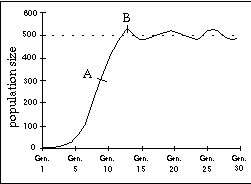
What is the carrying capacity of the graph?
Around 500
More than 800
Less than 300
Around 700
Increase in predators
Disease
Increase in available food
Drought
Fewer females in a population

A scientist was studying a population of fish in a pond over a period of 10 years. He observed that the population increased each year for 3 years, and then remained nearly constant for the rest of the study. The best explanation for this observation is that the population had __________.
Stopped reproducing
Reached carrying capacity
Mutated into a different species
Run out of food and all died
What are factors that limit the growth of a population are called?
Carrying Capacity
Limiting Factors
Biotic Potential
Exponential Growth
Density - Independent
Reorder the following levels of MACRO organization:
Individual / Organism
Population
Community
Ecosystem
Biomes
Predators
Lack of Water
Not enough space
Decrease in food sources
Unavailable shelter
Cell
Tissue
Organ
Organ System
Organism
Individual / Organism
Population
Community
Ecosystem
Biomes
Biosphere
Match the following:
Both organisms benefit
Mutualism
One organism benefits while the other is unaffected
Commensalism
One organism benefits while the other is harmed
Parasitism
One organism is being hunted and the other is being eaten
Predation
Organisms fighting over the same resources in order to survive
Competition
Reorder the following primary succession:
A glacier passes by and strips the top layers of the earth to expose bare rock.
Lichen and moss begin to grow on the rocks.
The rocks begin to break down and create soil.
Over time, weeds, grasses, and shrubs cover the area.
Larger plants replace the smaller and create a forested area.

