wayground logo

Free Printable Worksheets

Font size

S
M
L
XL
Worksheets

Genetics Unit Exam Review

Total questions: 96

Worksheet time: 24hrs 0mins
Name
Class
Date
1.
Aa, DD, bB, yy are all examples of
a)
genotypes
b)
phenotypes
2.
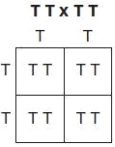
What ratio of the offspring from the cross shown will be homozygous recessive for the  trait of tallness? 
a)
0 in 4
b)
1 in 4
c)
2 in 4
d)
4 in 4
3.
Which of the following genotypes is homozygous dominant?
a)
A
b)
Aa
c)
AA
d)
aa
4.
Which of the following genotypes is heterozygous?
a)
Bb
b)
BB
c)
bb
d)
B
5.
What you see, or the physical appearance.
a)
Genotype
b)
Phenotype
c)
Homozygous
d)
Heterozygous
6.
In a heterozygous genotype, the ___________ allele takes over in the phenotype.
a)
recessive
b)
dominant
c)
lower case letter
d)
both 
7.
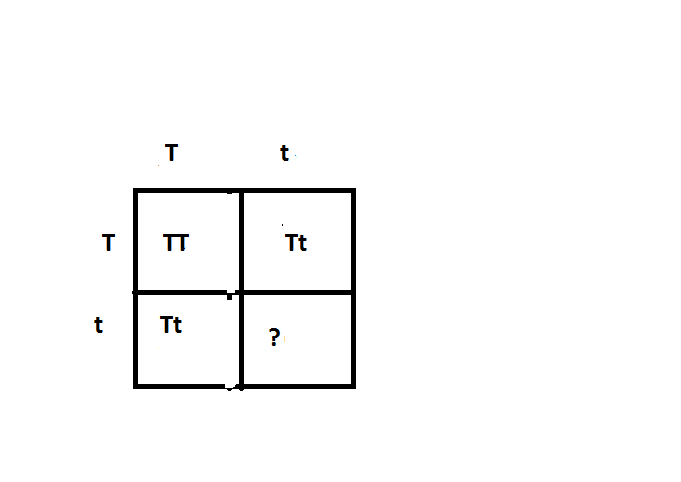
T - tall and t = short
In the punnett square below, what belongs in the missing square
a)
tt
b)
Tt
c)
Bb
d)
TT
8.
B = brown eyes
b = blue eyes
What is true about these two brothers that have brown eyes?
One has genotype BB the other Bb.
a)
they have same phenotype and genotype
b)
they have different genotypes and phenotypes
c)
they have same phenotype but different genotypes
d)
they have same genotype but different phenotypes
9.

Which of the following must be the father's genotype?

a)

RR

b)

Rr

c)

rr

10.

What genotype would go in box 2? And is it Homozygous or Heterozygous?

a)

BB Heterozygous

b)

Bb Heterozygous

c)

bb Homozygous

d)

Bb Homozygous

11.

Different versions of a trait (tall or short, white or purple) are called

a)

alleles

b)

traits

c)

versions

d)

genes

12.

Which of the following is/are an example(s) of a phenotype? Select all that apply.

a)

tall

b)

purple

c)

AA

d)

wrinkled

e)

bb

13.

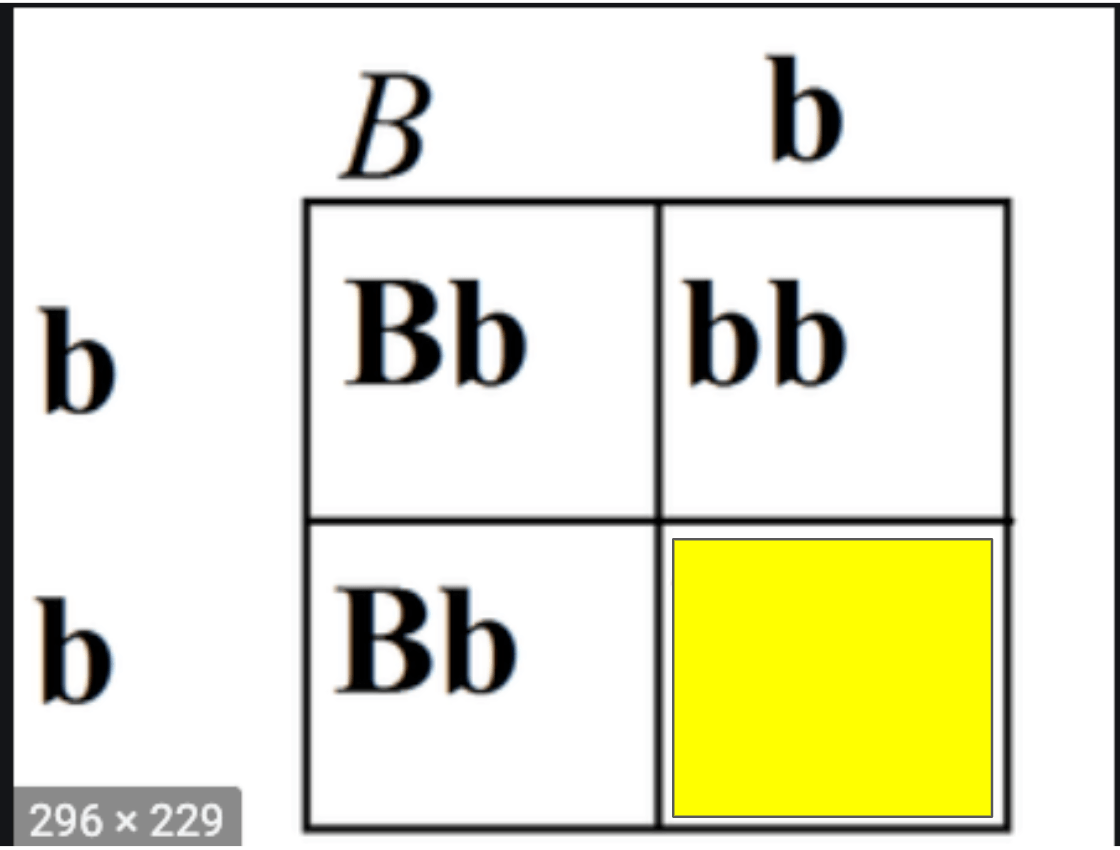
Fill in the yellow box.

a)

Bb

b)

BB

c)

bb

14.

In mice, black fur (B) is dominant to white fur (b). According to the Punnett square shown, how many offspring would be black?

a)

0

b)

1

c)

2

d)

3

e)

4

15.

Colorblindness is a recessive X-linked disorder.

Which genotype represents a male with normal vision?

a)

XN YN

b)

Xn Yn

c)

XN Y

d)

Xn Y

16.
Which of the following genotypes belongs in the red box in the Punnett square?
a)
XBXb
b)
XbXb
c)
XbY
d)
XBY
17.
The sex of a child is determined by
a)

whether the father's sperm contains an x or y chromosome

b)

whether the mother's egg contains an x or y chromosome

c)

the age of the parents

d)

whether the mother's egg contains an xx or xy

18.

X and Y are ​​ (a)   chromosomes. Females are ​ (b)   and males are ​ (c)   .

Choose from the below words
SEX
XX
XY
Autosomes
46
23
19.

​ (a)   are more likely to have an x-linked trait because males have only ​ (b)   X chromosome. Females can be ​ (c)   of an X-linked trait because they can be ​ (d)   for the trait since they have ​ (e)   X's.

Choose from the below words
Males
one
carriers
heterozygous
two
homozygous
Females
Dominant
Recessive
20.
What is the dominant trait?
a)
yellow pea seeds
b)
green pea seeds
c)
there is no dominant seed
d)
Jolly green giant
21.
Which of the following genotypes belongs in the red box in the Punnett square?
a)
XBXB
b)
XbXb
c)
XbY
d)
XBY
22.
What percentage of the female offspring will be a carrier for this recessive disease?
a)
0%
b)
50%
c)
100%
d)
25%
23.
Vitamin D resistant rickets (deformed bone formation) is a sex-linked DOMINANT trait.  According to the Punnett square, what percentage of female offspring will have the disorder?
a)
0%
b)
25%
c)
50%
d)
100%
24.

What is the name of the process where gametes are made in a cell division that reduces the number of chromosomes?

a)

Mitosis

b)

Meiosis

c)

Codominance

d)

Multiple Alleles

25.

In humans, the haploid number of chromosomes is ____.

a)

23

b)

46

c)

69

d)

92

26.

The products of MEIOSIS have _______ number of chromosomes.

a)

haploid

b)

diploid

27.
These organelles link amino acids together to form proteins; Protein synthesis occurs; no membrane around them.
a)
Lysosomes
b)
Ribosomes
c)
Vacuole
d)
Cell wall
28.
How can a person's muscle cells have the same exact DNA sequences as their nerve cells even though the look and perform completely different?
a)
The two different cells become mutated
b)
The proteins expressed in each cell are different
c)
They actually have different DNA in the two types of cells.
d)
The genome of the different cells changes
29.
Which organelle is DNA usually found in?
a)
cell membrane
b)
vacuole
c)
chloroplast
d)
nucleus
30.

the number of chromosomes in body cells; two sets or 2n

a)

haploid

b)

dominant

c)

genome

d)

diploid

31.

a section of DNA that carries the genetic code for a particular characteristic

a)

haploid

b)

chromosome

c)

nucleotide

d)

gene

32.

the number of chromosomes in gametes; one set or n

a)

genome

b)

diploid

c)

haploid

d)

zygote

33.

2 IDENTICAL alleles for the same trait. John has 2 genes for brown eyes so he is ___

a)

dominant

b)

recessive

c)

homozygous

d)

heterozygous

34.

DIFFERENT alleles for the same trait. Sue has 1 gene for brown eyes and 1 gene for blue eyes so she is ___

a)

dominant

b)

recessive

c)

homozygous

d)

heterozygous

35.

The genetic makeup of an organism. John has 2 genes that are homozygous recessive for eye color {e e }

a)

gene

b)

phenotype

c)

genotype

d)

probability

36.

The physical characteristics of an organism that is expressed. John has blue eyes and brown hair.

a)

gene

b)

phenotype

c)

genotype

d)

probability

37.
Chromosomes that carry the same set of genes are called
a)
homologous alleles
b)
homologous genes
c)
homologous zygotes
d)
homologous chromosomes
38.

During transcription, this type of ribonucleic acid is responsible for copying the DNA and brining it out of the nucleus.

a)

tRNA

b)

mRNA

c)

rRNA

d)

dRNA

39.
What allele combination should go in the missing box?
a)
AA
b)
Aa
c)
aa
d)
none of these
40.
One of the threadlike structures in the nucleus of a cell that contain directions for the cell's activities
a)
variation
b)
pedigree
c)
DNA
d)
chromosome
41.

If 2n = 48 for a particular cell, then the chromosome number in each cell after meiosis would be

a)

96

b)

48

c)

24

d)

12

42.
Which of the following cells is a gamete?
a)
egg
b)
bone
c)
heart
d)
muscle
43.
The fertilized egg is termed a/an _____.
a)
gamete
b)
allele
c)
homolog
d)
zygote
44.
The cells produced via meiosis are called:
a)
sex cells
b)
somatic cells
c)
body cells
d)
skin cells
45.
Unlike mitosis, meiosis in male mammals results in the formation of
a)
one haploid gamete
b)
three diploid gametes
c)
four diploid gametes
d)
four haploid gametes
46.
The chromosomes that pair up during meiosis, are called __________ chromosomes.  
a)
homozygous 
b)
asexual
c)
homologous
d)
genes
47.
Crossing over helps promote 
a)
male genotype
b)
genetic variation
c)
DNA replication
d)
mitosis
48.
A long chain of amino acids is a/an
a)
protein
b)
nucleic acid
c)
tRNA
d)
mRNA
49.
Why is DNA important?
a)
it is very small and very complicated
b)
it's in everything
c)
it serves as the blueprint for traits of all living things
d)
because we eat it every day for energy
50.

Different forms of the same gene located at the same point of homologous chromosomes.

a)

alleles

b)

Nucleotides

c)

phenotypes

d)

chromosomes

51.
When DNA makes a copy of itself, the new strands are identical or different?
a)
identical
b)
different
52.

How many pairs of chromosomes do you have?

a)

2

b)

46

c)

23

d)

8

53.

You have 23 pairs of chromsomes. How many chromosomes do you have total?

a)

23

b)

46

c)

69

d)

12

54.
What determines the code, or information, of a DNA molecule?
a)
the shape (structure) of the nitrogen bases
b)
the order (sequence) of the nitrogen bases
c)
the color of the nitrogen bases
d)
the frequency (number) of nitrogen bases
55.

What is a gene

a)

A long length of DNA that codes for a chromosome

b)

A short length of DNA that codes for a chromosome

c)

A short length of DNA that codes for a protein.

56.
A change in DNA or chromosomes
a)
Mitosis
b)
Meiosis
c)
mutation
d)
Osmosis
57.
How are similarities passed from parent to offspring?
a)
through teaching
b)
through learning
c)
through blood
d)
through genes
58.

An organism's ___________________ is its genetic make up, or two alleles.

a)

genotype

b)

phenotype

c)

jeans

d)

phonetype

59.

How many alleles for a particular trait does each person get from each parent?

a)

1

b)

2

c)

46

d)

23

60.

Which set of chromosomes represents a male?

a)

XX

b)

XY

c)

XXY

d)

XYY

61.

What is a variation of a particular gene such as brown and blue eyes?

a)

Karyotype

b)

DNA

c)

Allele

d)

Chromosome

62.

Where are chromosomes found in a cell?

a)

in the mitochondria

b)

in the cell membrane

c)

in the cytoplasm

d)

in the nucleus

63.

What is a specific observable characteristic of an organism?

a)

DNA

b)

Gene

c)

Trait

d)

Chromosome

64.

A haploid gamete is a

a)

cell with the full number of chromosomes

b)

a cell with half the number of chromosomes

c)

a cell with no chromosomes

d)

a cell with twice the number of chromosomes

65.

In Geckos body cells, 2N = 38. The N number is . . .

a)

38

b)

56

c)

19

66.
After meiosis, sex cells have ___ number of chromosomes as body cells
a)
the same
b)
half of the 
c)
a quarter of the
d)
more than the
67.

Where do you get your DNA from?

a)

only your mom

b)

only your dad

c)

both your mom and your dad

68.

Your body reads the genes and makes

a)

carbohydrates

b)

lipids

c)

nucleic acids

d)

proteins

69.

Brown eyes are dominant (B). Blue eyes are ​ (a)   (b) . Any ​ (b)   with a Big B represent a person with ​ (c)   eyes.

Choose from the below words
recessive
genotype
brown
Blue
phenotype
green
heterozygous
70.
Expressed only if NO dominant version is present
a)
homozygous
b)
heterozgyous
c)
allele
d)
recessive
71.

This is an example of

a)

Homologous Chromosomes

b)

Non-homologous Chromosomes

c)

Sister Chromatids

d)

Duplicated DNA

72.

This is an example of

a)

Homologous Chromosomes

b)

Non-homologous Chromosomes

c)

Sister Chromatids

d)

Duplicated DNA

73.

How many Chromosomes do we inherit from our parents?

a)

23 from dad and 23 from mom, or 46 total

b)

13 from dad and 13 from mom, or 26 total

c)

13 from dad and 33 from mom, or 46 total

74.
This is an allele whose trait will be hidden if the dominant allele is present.
a)
recessive
b)
hybrid
c)
dominant
75.

During translation, this type of ribonucleic acid is responsible for delivering amino acids to help make a protein.

a)

mRNA

b)

rRNA

c)

tRNA

d)

dRNA

76.
What is the mRNA strand that would result from the DNA template strand CCTA?
a)
GGAT
b)
CCAT
c)
GGAU
d)
CCAU
77.

DNA Sequence: ATCGCC

What will be the RNA sequence?

a)

UAGCGG

b)

TAGCGG

c)

CGATAA

d)

GCAUAA

78.

What amino acid is coded for by the codon UUA?

a)

Phe

b)

Ser

c)

Leu

d)

Pro

79.

What amino acid is coded for by the codon ACA?

a)

Ile

b)

Thr

c)

Asn

d)

Lys

80.

Use your codon chart and find the amino acid that codes for the mRNA codon UAA

a)

Phe

b)

Tyr

c)

START

d)

STOP

81.

Use your codon chart to find the amino acid that codes for the mRNA codon GCA

a)

Thr

b)

Ala

c)

Pro

d)

Ser

82.

Ribosomes make ________

a)

DNA

b)

Proteins

c)

Amino Acids

d)

Lipids

83.

Match the mRNA codon UUA to the correct tRNA anti-codon

a)

AAT

b)

AAU

c)

AUA

d)

ATA

84.

During Translation, mRNA finds a ________ to make a protein.

a)

Nucleus

b)

Ribosome

c)

Amino Acid

d)

Mitochondria

85.

During transcription, DNA is converted in mRNA inside the _______.

a)

Cell Membrane

b)

Ribosome

c)

Nucleus

d)

Cytoplasm

86.

the tRNA carries an

a)

Amino Acid

b)

Polysaccaride

c)

Lipid

d)

DNA

87.

During Transcription, DNA is converted into ____

a)

mRNA

b)

tRNA

c)

rRNA

d)

a Protein

88.

During Translation, mRNA is converted into a _______

a)

DNA

b)

Protein

c)

tRNA

d)

rRNA

89.

What is the correct order to make a protein?

a)

Protein --> DNA --> RNA

b)

RNA --> DNA --> Protein

c)

DNA --> RNA --> Protein

d)

Protein --> RNA --> DNA

90.
The codon is located on the 
a)
DNA
b)
mRNA
c)
tRNA
d)
rRNA
91.
In mRNA, each codon specifies a particular 
a)
nucleotide
b)
amino acid
c)
purine
d)
pyrimidine
92.
Which amino acid sequence will be made if the mRNA strand reads GGG UGU?
a)
Phe-Iso
b)
Val-Ala
c)
Val-Cys
d)
Gly-Cys
93.

A group of 3 letters representing an amino acid is called:

a)

nucleotide

b)

ribosome

c)

codon

d)

anticodon

94.

Changes in the DNA sequence that affect genetic information are known as:

a)

replications

b)

transformations

c)

mutations

d)

prokaryotes

95.

what is the role of DNA?

a)

control the cell

b)

makes proteins

c)

store and transmit genetic information for the cell

d)

cellular respiration

96.

The codon UUU codes for the amino acid:

a)

threonine

b)

phenylalanine

c)

glycine

d)

leucine