
Font size
 Worksheets
Quiz: Rock Cycle
Total questions: 76
Worksheet time: 1hrs 19mins
How are metamorphic rocks formed?
Heating and cooling
Deposition
Heating and pressure
Materials gathering and pressing together
What Are The Three Main Types Of Rocks?
Igneous, Depository, Metamorphic
Depository, Igneous, Sedimentary
Metamorphic, Igneous, Depository
Igneous, Metamorphic, Sedimentary
How are igneous rocks formed?
Sediment forming together
Heating and pressure
Cooling and Hardening
Deposition
How are sedimentary rocks formed?
Heating and pressure
Sediment forming together
Weathering
Cooling
One specific type of rock can turn into any other rock type? (a)
Minerals and rocks are the same? (a)
What are rocks made of?
Salt
Minerals
Other rocks
Sand
The rock cycle follows a specific order?
True
False
What geologic process changes pieces of rocks, minerals, and other materials into sedimentary rocks?
Compacting and Cementing
Cooling and Hardening
Heat and Pressure
Melting
What type of rock is formed from slow cooling magma under the earth's surface?
Extrusive Igneous
Intrusive Igneous
Metamorphic
Sediment
What type of rock is formed from slow cooling magma under the earth's surface?
Extrusive Igneous
Intrusive Igneous
Metamorphic
Sedimentary
Which characteristic is found only in sedimentary rocks?
Fossils
Crystals
Gas Bubbles
Glassy Surface

The Mount Rushmore National Monument is carved from the granite of South Dakota's Black Hills. What type of rock is granite?
Igneous
Metamorphic
Sedimentary
None of the above

The seated sculpture of President Lincoln inside the Lincoln Memorial was carved out of white Georgia marble, which was formed from Earth's pressure and heat. What type of rock is marble?
Igneous
Metamorphic
Sedimentary
None of the above


Which type of rock is made from magma cooling inside Earth?
EXTRUSIVE igneous
INTRUSIVE igneous
metamorphic
sedimentary
Which type of rock is made from lava cooling on the surface of Earth?
EXTRUSIVE Igneous
Metamorphic
Sedimentary
INTRUSIVE Igneous

Magma that reaches the surface flows from a volcano as ____________
Magma
Water
Ice
Lava

When water and other minerals move through open spaces between larger sediments, gluing them together, ____________ occurs.
Compaction
Deposition
Cementation
Erosion

Rock fragments, mineral grains, and bits of plants and animal remains moved by wind, water, ice, or gravity are called _________________.
sediments
granite
marble
sandstone

The process when rocks break into smaller pieces due to exposure to natural elements is called...
Deposition
Erosion
Weathering

This rock started as lava that cooled and then was heated and put under pressure over time. What type of rock is this?
Sedimentary
Igneous
Metamorphic

Obsidian is an example of (a) .

What part of the rock cycle is represented by A?
magma
igneous rock
sediment
sedimentary rock

What part of the rock cycle is represented by B?
igneous rock
sedimentary rock
magma
metamorphic rock

What part of the rock cycle is represented by C?
magma
sediment
igneous rock
metamorphic rock

What part of the rock cycle is represented by D?
magma
lava
igneous rock
sedimentary rock

What part of the rock cycle is represented by E?
sedimentary rock
metamorphic rock
magma
igneous rock
What process occurs in order for sedimentary rock to become magma?
exposure and weathering
lithification and compaction
cooling
melting

Metamorphic rock undergoes weathering and erosion to form
sediment
igneous rock
Sediment undergoes compaction & cementing to form
metamorphic rock
sedimentary rock
Metamorphic rock melts to form
igneous rock
magma

The type of rock that forms when magma or lava cools and hardens.
Sedimentary
Igneous
Metamorphic

Molten rock underground is known as...
magma
lava
sediment
basalt

Molten rock above ground is known as...
magma
lava
sediment
basalt


What stage of the rock cycle is number 2?
heat and pressure
melting
weathering
cooling and hardening
What stage of the rock cycle is number 4?
heat and pressure
melting
weathering
cooling and hardening
What stage of the rock cycle is number 3?
heat and pressure
melting
weathering
cooling and hardening
What stage of the rock cycle is number 1?
heat and pressure
melting
weathering
cooling and hardening
Sedimentary Rock <-- _____________ <-- Sediment
Compaction & cementation
Heat & pressure
Weathering & erosion
Melting & cooling
The process by which metamorphic rock changes to sedimentary rock begins with
Weathering
Melting
Heat
Pressure
The process by which metamorphic rock changes to igneous rock begins with
melting
erosion
deposition
crystallization
How does a metamorphic rock turn into sediment?
Cooling
heat and pressure
weathering and erosion
It can't
How does a sedimentary rock turn into a metamorphic rock?
Cooling
Heat and pressure
Weathering and erosion
Melting
How does igneous rock turn back into magma?
Cooling
heat and pressure
weathering and erosion
Melting
How can sedimentary rock turn BACK into sediment?
weathering
heat and pressure
erosion
Melting

Which number rock (look at their numbers in the diagram) is most likely formed by a volcano?
Rock #1
Rock #2
Rock #3
If Rock #1 is sedimentary rock, what process must be represented by Arrow A?
Heat and pressure
Weathering and Erosion
Formation of Lava
Both A and B
What additional process could be added to arrow A?
Heat and Pressure
Magma Formation
Cementation and Compaction
Quickly Moving Water
What type of rock is Rock #2?
Sedimentary
Igneous
Metamorphic
Sandstone
What type of rock is Rock #3?
Sedimentary
Igneous
Metamorphic
pumice
Granite is an igneous rock. During the rock cycle, granite is changed into gneiss, a metamorphic rock. The processes that act on granite and change it into gneiss are
weathering and erosion
heat and pressure
compacting and cementing
melting, cooling, and hardening
Water fills a small lake in a dry region. After a few weeks, the lake evaporates, leaving behind a thin layer of crystals that form from minerals dissolved in the lake water. Each year, a new layer is added. Which type of rock is MOST likely to be formed by this process?
sedimentary
igneous
metamorphic
pumice

This stone is called pumice. It is created when super-heated rock that has bubbles in it is rapidly cooled, forming lots of "holes" in the rock. What type of rock is pumice?
Sedimentary
Igneous
Metamorphic

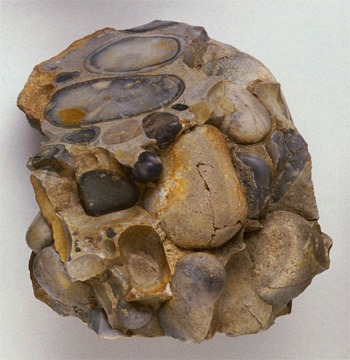
This rock is called a conglomerate rock, sometimes called a "puddingstone". It is composed of smaller rocks cemented together in a mixture of sand, mud, and chemical cement. What type of rock is this?
Sedimentary
Igneous
Metamorphic
Sedimentary rocks can be made of particles from which of the following?
Sedimentary rock
Igneous rock
Metamorphic rock
All of the different types of rocks
Label the parts of the rock cycle by dragging the label to the appropriate box
Match the following rock type with how it was created
Sedimentary rock
Sediments are compacted/ cemented
Igneous rock
Magma/lava cools and harden
Metamorphic rock
The texture, shape, or chemical structure of a rock is changed by heat or pressure
Magma/lava
Any type of rock melts
Sediment
Weathering breaks down pieces of rocks

Identify #8
Weathering and Erosion
Melts
Compaction and Cementation
Heat and Pressure
Identify #7
Weathering and Erosion
Melts
Compaction and Cementation
Heat and Pressure
Identify #6
Weathering and Erosion
Melts
Compaction and Cementation
Heat and Pressure
Identify #5
Weathering and Erosion
Melts
Compaction and Cementation
Heat and Pressure
Identify #4
Weathering and Erosion
Melts
Compaction and Cementation
Heat and Pressure
Identify #3
Weathering and Erosion
Melts
Compaction and Cementation
Heat and Pressure
Identify #2
Cools
Melts
Compaction and Cementation
Heat and Pressure
Identify #1
Cools
Melts
Compaction and Cementation
Heat and Pressure
Rocks are identified (a) .

