
 Worksheets
Animal and Plant Classification Review
Total questions: 64
Worksheet time: 59mins
Which of these animals is a vertebrate?
Spider
Snail
Worm
Cat
Some but not all invertebrates
have backbones.
have shells.
have no backbones.
can make their own food.
An animal has fur and feeds milk to its young. How should this animal be classified?
As an invertebrate
As an amphibian
As a mammal
As a reptile
A scientist discovers a new organism. It has scales and uses lungs to breathe air. How will they classify this organism?
As an invertebrate
As a reptile
As an amphibian
As a fish
Which statement is true about vertebrates?
Vertebrates do not have a backbone
Most of the animals on Earth are vertebrates
Vertebrates have backbones
Vertebrates only live on land
Which group do frogs belong to?
Reptiles
Birds
Mammals
Amphibians
Which of these is NOT a vertebrate?
Grasshopper
Penguin
Salamander
Mouse
Which one of these organisms is a reptile?
Hawk
Grasshopper
Mushroom
Crocodile
The skin of a reptile...
is smooth and moist.
is covered in scales.
is covered with feathers.
is covered with fur.
Which of these animals can be grouped with other animals called vertebrates?
spider
worm
clam
frog
Which of these organisms is a vertebrate?
Polar Bear
Octopus
Redwood Tree
Bacteria
How do scientists classify humans?
As vertebrates and as amphibians
As invertebrates and as mammals
As vertebrates and as mammals
As vascular and as mammals
Which statement is true ONLY of amphibians?
They have gills as young and lungs as adults
They look like their parents
They have backbones
They are consumers

Vertebrates and invertebrates
Mammals and reptiles
Amphibians and reptiles
Reptiles and fish

Reptiles
Invertebrates
Amphibians
Mammals
Vertebrates that are warm blooded, have feathers and reproduce by laying eggs would be classified as
reptile
bird
fish
amphibian
Trees in the mid-west change colors and lose their leaves in the cooler parts of the year. What kinds of trees lose their leaves?
deciduous
nonvascular
evergreen
nonwoody
Blake and Brent are sorting plants into groups. They have two sets of groups labeled: vascular and non-vascular and flowing and non-flowering. They must place the moss into one of the groups. Blake says it goes in the non vascular group, Brent says it goes in the non-flowering group. Who is correct?
Blake. Moss plants are non-vascular
Both boys. Moss plants are non-vascular and non-flowering plants.
Brent. Moss plants do not have flowers or seeds.
Neither of them is correct. Moss plants are vascualr and have flowers.
Seeds grow into plants. Some flowering plants produce fruits. What does the fruit contain?
water
roots
seeds
other plants
Kathy classified a list of trees into two groups. What two titles could be used for Groups 1 and 2?
Group 1: fir tree, spruce tree, pine tree
Group 2: dogwood tree, oak tree, maple tree
Group 1: Needles
Group 2: Leaves
Group 1: Seed Producers
Group 2: Non-Vascular
Group 1: Flowering
Group 2: Non-flowering
Group 1: Taproots
Group2: Fibrous Roots
Brooke made a list of organisms and classified them into two groups, What would be the best titles for these groups?
Group 1: fish, amphibians, reptile
Group 2: mollusks, arthropods, insects
Group 1: Exoskeleton
Group 2: Endoskeleton
Group 1: Vertebrates
Group 2: Invertebrates
Group 1: Mammals
Group 2: Invertebrates
Group 1: Invertebrates
Group 2: Endoskeleton
Which two types of animals share these characteristics?
warm-blooded
four-chambered hearts
breathe with lungs
vertebrates
fish and amphibians
mammals and fish
reptiles and birds
birds and mammals
Which two types of animals share these characteristics?
cold-blooded
hatch from eggs
born with gills
insect and fish
amphibians and reptiles
fish and amphibians
reptiles and insects
Which list includes only plants classified as non-seed porducers?
pine tree, carrot, tomato
carrot, fern, tomato
moss, fern, liverwort
oak tree, moss, water lily
Sally classified a list of plants into two groups. What two titles could be used for Groups 1 and 2?
Group 1: moss, fern, liverwort
Group 2: pine tree, sunflower, cucumber
Group 1: Non-vascular
Group 2: Non-seed Producers
Group 1: Non-seed Producers
Group 2: Seed Producers
Group 1: Seed Producers
Group 2: Non-vascular
Group 1: Vascular
Group 2: Non-vascular
Groups of Animals
Group 1: giraffe, elephant, tiger
Group 2: penguin, ostrich, eagle
Group 3: crocodile, alligator, lizard
Group 4: flea, butterfly, bee
Group 5: tree frog, toad, salamander
Which group of animals contains warm-blooded vertebrates that lay eggs and have feathers?
Group 1
Group 3
Group 5
Group 2
Which statement is true about the following; a flowering plant, a pine tree with a pine cone, and a fern.
A flowering plant and pine tree have spores while a fern never has spores.
A flowering plant has seeds, but a pine tree and fern never has seeds.
A pine tree and fern has seeds, while a pine tree will never have seeds.
A pine tree and a flowering plant have seeds, while a fern never has seeds.
Scientists sort animals into two groups, vertebrate and invertebrate. They discovered a new organism. Its babies are born alive, drink milk from the mother's body, and have fur on their bodies. They are warm-blooded and breathe with lungs. How would these animals be classified?
as a vertebrate and a reptile
as a vertebrate and a fish
as a vertebrate and a mammal
as an invertebrate and a mammal
An animal without a backbone is called a
vertabrate
invertebrate
non-vascular
vascular
I have dry scales, am cold blooded, lay leathery shelled eggs, and have a vertebrate. What am I?
a bird
a fish
a mammal
a reptile
I am cold blooded and live both on land water. I have moist skin, a backbone and lay jelly coated eggs in the water. What am I?
A reptile
An amphibian
A mammal
A fish
This can be made up of many cells. It is a decomposer in many ecosystems and cannot make its own food. What could this be?
Fungi
Bacteria
Protists
Mammals
Which of the following travel through the tubes of some plants?
soil
blood
water
food
Which of the following travel through the tubes of some plants?
soil
blood
water
food
Nonvascular plants have tubes to carry nutrients.
True
False
Nonvascular plants are usually small to make it easier to get nutrients to every cell.
True
False
Which of the following is NOT an example of a nonvascular plant?
oak tree
moss
liverwort
hornwort
Vascular plants do have tubes to carry materials to all cells of the plant.
True
False
All vascular plants reproduce with seeds.
True
False
All trees are vascular plants.
True
False


Which plant below would scientist group with watermelon plants?
fern
rose
pine tree
apple tree
Pine trees have cones that...
make seeds
do not make seeds
Magnolia trees have flowers that...
make seeds
do not make seeds

If an apple is a type of fruit, then on what type of tree does an apple grow?
a spore-producing tree
a flower-producing tree
an evergreen tree
a tropical tree
Which of the following plants produces spores?


Ken has a flower from an unknown plant. What does Ken know about this plant just because it has a flower?
The plant does not have significant leaf development.
The plant does not have a significant root system.
The plant reproduces using spores.
The plant reproduces using seeds
Plants that go dormant, or leafless, during the year are considered
deciduous.
herbaceous.
evergreen.
woody.

Which type of plant is a fern?
seed-producing plant
cone-producing plant
flower-producing plant
spore-producing plant
Plants that hold onto their leaves throughout the year are considered
deciduous.
herbaceous
evergreen.
woody
What is the function of vascular tissue in plants?
carry out photosynthesis
anchor the plant to the ground
transport water and nutrients
attract insects for pollination
Which of the following is an example of a gymnosperm?
moss
monocot
conifer
fern
Which plant is flowering and seed forming?


A scientist observes that a plant specimen has no true roots, stems, or leaves. What term would she use to describe this plant?
vascular
flowering
wilted
nonvascular
What are the 2 MAIN groups of plants?
seed plants and seedless plants
gymnosperms and angiosperms
horsetails and ferns
vascular and nonvascular
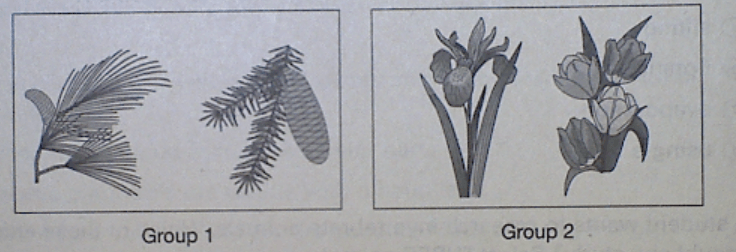
A student researches four plants that are in the same group. He sorts the plants into two smaller groups.
How does the student MOST LIKELY sort the plants?
by seed size
by flower shape
by whether they have cones or flowers
by whether they produce seeds or spores
Nonvascular plants tend to grow
in shady areas
low to the ground in order to be close to a water source
in sunny areas
very tall

