
 Worksheets
Developmental Biology Quiz
Total questions: 135
Worksheet time: 1hrs 13mins
What is a zygote?
A type of larva
A hollow ball of cells
A fertilized egg
The process of cell division without growth
What does the term "blastula" refer to in the development process?
A fertilized egg
A hollow ball of cells
The folding inward of one end to create a tube
A type of larva
What is cleavage in the context of development and genetics?
The process of cell division without growth
A hollow ball of cells
The folding inward of one end to create a tube
A fertilized egg
What is a gastrula?
A type of larva
A hollow ball of cells
A stage where one end invaginates inward to create a tube
The process of cell division without growth
What does the term "pelagic" refer to when describing a larva?
A larva that lives on land
A larva that lives in fresh water
A larva that lives in the open sea
A larva that is attached to a substrate
What term is used to describe an organism with no body cavity?
Pseudocoelomate
Eucoelomate
Acoelomate
Coelomate
Which phylum is an example of acoelomate organisms?
Phylum Nematoda
Phylum Arthropoda
Phylum Platyhelminthes
Phylum Chordata
What is the characteristic feature of a pseudocoelomate?
A body cavity that is not fully lined with mesoderm
A body cavity that is fully lined with mesoderm
No body cavity at all
A body cavity outside the mesoderm
Which phylum is an example of pseudocoelomate organisms?
Phylum Annelida
Phylum Mollusca
Phylum Nematoda
Phylum Echinodermata
What distinguishes a eucoelomate organism from others?
Having a body cavity outside the mesoderm
Having no body cavity
Having a body cavity that is not fully lined with mesoderm
Having a body cavity fully lined with mesoderm
Which of the following is an example of a eucoelomate organism?
Phylum Platyhelminthes
Phylum Nematoda
Phylum Arthropoda
Phylum Porifera
What is the name of the structure labeled as "ancient gut" during the gastrulation process?
Blastula
Gastrula
Archenteron
Blastopore
During which stage does the blastopore form?
Blastula
Gastrulation begins
Late gastrula stage
Site of future mouth (or anus)
What does the opening of the blastopore signify in the late gastrula stage?
It is the site of the future mouth.
It is the site of the future anus.
It is the site of the future mouth or anus.
It is the site of the future mesoderm.
Which layers are formed during the gastrulation process?
Ectoderm and endoderm
Mesoderm and ectoderm
Endoderm and mesoderm
Ectoderm, mesoderm, and endoderm
What does "Ontogeny" refer to in the context of the image?
The study of animal behavior
The classification of animals
Embryonic development
The evolution of animal species
Which of the following animals is mentioned as an example of the Deuterostome lineage?
Sponges (Porifera)
Jellyfish & kin (Cnidaria)
Earthworms
Starfish
How do protostomes and deuterostomes differ according to the image?
They have different types of body symmetry.
They have different numbers of tissue layers.
They "grow" their coelom differently.
They belong to different kingdoms.
Which phylum is characterized by triploblastic organisms with bilateral symmetry according to the phylogeny of the Animal Kingdom?
Porifera
Cnidaria
Platyhelminthes
Echinodermata
What type of symmetry do organisms in the phylum Cnidaria exhibit?
Bilateral symmetry
Radial symmetry
Asymmetrical
No symmetry
Which of the following phyla includes organisms with no tissues and an asymmetrical body plan?
Arthropoda
Nematoda
Porifera
Annelida
What is the common name for organisms in the phylum Arthropoda?
Bugs
Roundworms
Segmented worms
Flatworms
Which phylum is known for organisms that are diploblastic and have radial symmetry?
Mollusca
Annelida
Chordata
Cnidaria
What term is used to describe the first multicelled animal ("metazoan")?
Choanoflagellate-like unicellular ancestor
Diploblastic, radial symmetry
Triploblastic, bilateral symmetry
Deuterostomes
What are sponges classified as in terms of their feeding mechanism?
Predators
Parasites
Filter-feeders
Herbivores
What is the role of choanocytes in sponges?
They produce spicules for support.
They line the chambers and help in pumping water.
They are involved in reproduction.
They secrete toxins to deter predators.
How do sponges ingest food particles?
Through photosynthesis
By phagocytosis (intracellular digestion)
By extracellular digestion
By absorbing dissolved nutrients
What structure in sponges is responsible for the movement of water and capturing food particles?
Spicules
"Collar" of microvilli
Nematocysts
Osculum
What term is used to describe organisms that have two different body plans?
Monomorphic
Polymorphic
Dimorphic
Biomorphic
Which of the following terms refers to an organism that is attached and does not move?
Pelagic
Sessile
Motile
Planktonic
What is the term for the body plan of a non-moving organism that lives attached to a surface?
Medusa
Polyp
Larva
Nymph
What type of habitat is associated with the term 'benthic'?
Open water
Deep sea
Ocean floor
Freshwater surface
What body plan is typically associated with a pelagic lifestyle?
Polyp
Medusa
Larva
Nymph
What is the earliest hydrostatic skeleton found in cnidarians?
A) A rigid external shell
B) A "controlled water balloon"
C) A solid bone structure
D) A flexible cartilage framework
What are the two muscle layers in the cnidarian hydrostatic skeleton?
A) Diagonal and horizontal muscles
B) Longitudinal and circular muscles
C) Vertical and spiral muscles
D) Oblique and transverse muscles
What is the function of longitudinal muscles in cnidarians?
A) They lengthen the body and make it skinny
B) They shorten the body and make it stout
C) They are responsible for the digestion
D) They protect the cnidarian from predators
What is the function of circular muscles in cnidarians?
A) They shorten the body and make it stout
B) They lengthen the body and make it skinny
C) They enable the cnidarian to fly
D) They are used for sensory perception
What is the nephridium in annelids analogous to in terms of function?
Heart
Lung
Proto-kidney
Stomach
What does the nephrostome do in the excretory system of annelids?
It excretes waste out of the body.
It reabsorbs "good" salts and chemicals.
It "sucks" in body fluid.
It separates segments.
What happens to "good" salts and chemicals in the nephric tubule of annelids?
They are excreted as waste.
They are reabsorbed into capillaries.
They stay in the tubule.
They are transported to the heart.
What is the role of the septum in the excretory system of annelids?
It reabsorbs necessary chemicals.
It excretes waste.
It "sucks" in body fluid.
It separates segments.
What is the fate of "bad" chemicals in the nephric tubule of annelids?
They are reabsorbed into capillaries.
They are transported to the heart.
They stay in the tubule.
They are "sucked" in by the nephrostome.
What is the function of the portal vessel in the single-pump circulatory system?
It pumps blood at high pressure.
It links two systemic capillary beds.
It oxygenates the blood.
It carries blood away from the heart.
Where is the blood oxygenated in the single-pump circulatory system?
In the heart.
In the vein.
In the capillary bed in the respiratory organ.
In the portal vessel.
What is the pressure level of the blood in the arteries of the single-pump circulatory system?
High pressure.
Very low pressure.
Low pressure.
No pressure.
Which statement correctly describes the veins in the single-pump circulatory system?
They carry oxygenated blood to the heart.
They carry blood at high pressure.
They have a portal vessel that links two capillary beds.
They carry blood at very low pressure.
What type of heart is associated with a double-pump circulatory system?
Single-chambered heart
Double-chambered heart
Branchial (gill) or Pulmonary (lung) heart
Open circulatory system heart
Which animals have a higher blood pressure due to a double-pump circulatory system compared to those with a single-pump system?
Fish and amphibians
Cephalopods, birds, mammals
Reptiles and insects
Sponges and jellyfish
In a double-pump circulatory system, what is the pressure level in the veins?
High pressure
Medium pressure
Low pressure
No pressure
What is the role of systemic capillary beds in the double-pump circulatory system?
To pump blood into the heart
To transport oxygen to the brain
To facilitate the exchange of gases, nutrients, and waste
To store blood
What is the term used to describe "skin breathing" in many annelids, including earthworms?
Pulmonary respiration
Cutaneous respiration
Tracheal respiration
Branchial respiration
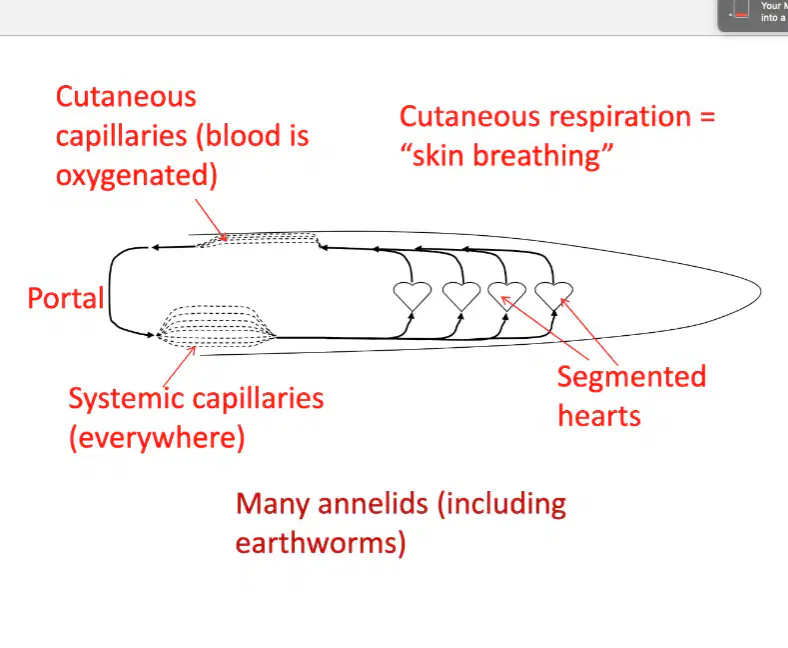
What type of circulatory system is depicted in the diagram, characterized by the presence of segmented hearts?
Open circulatory system
Closed circulatory system
Single-loop circulatory system
Double-loop circulatory system
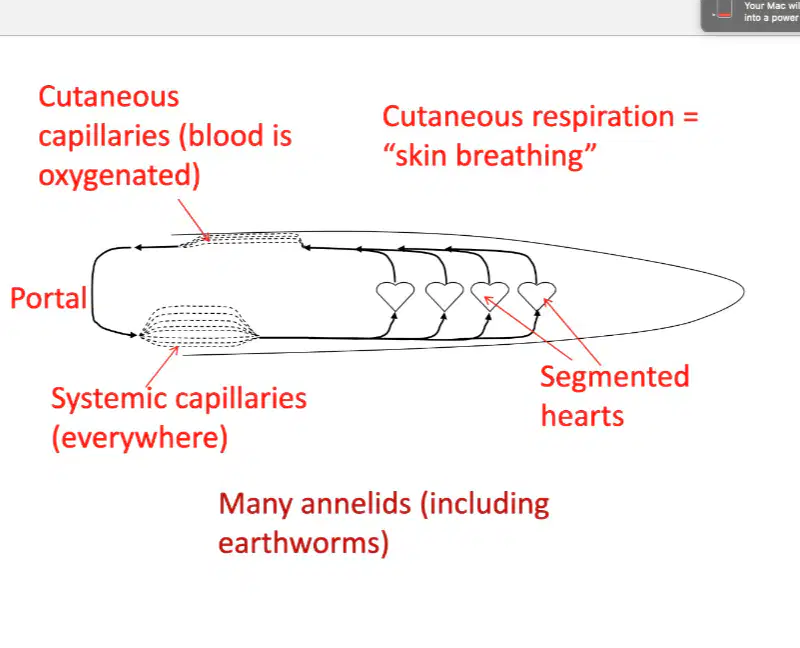
What are the systemic capillaries labeled in the diagram responsible for?
Carrying oxygenated blood to the skin
Carrying deoxygenated blood to the lungs
Carrying oxygenated blood throughout the body
Carrying deoxygenated blood to the heart
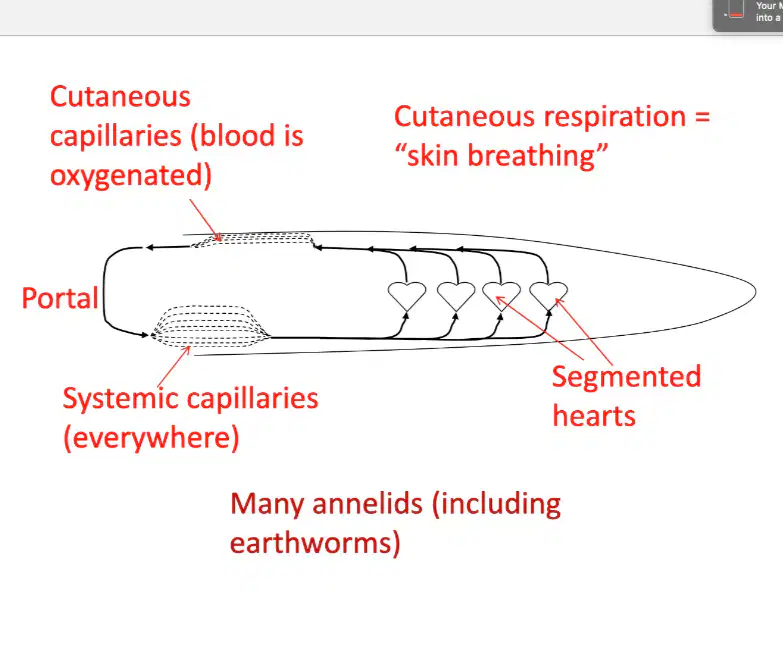
According to the diagram, where are the cutaneous capillaries located?
Inside the segmented hearts
Throughout the body
In the skin
In the portal system
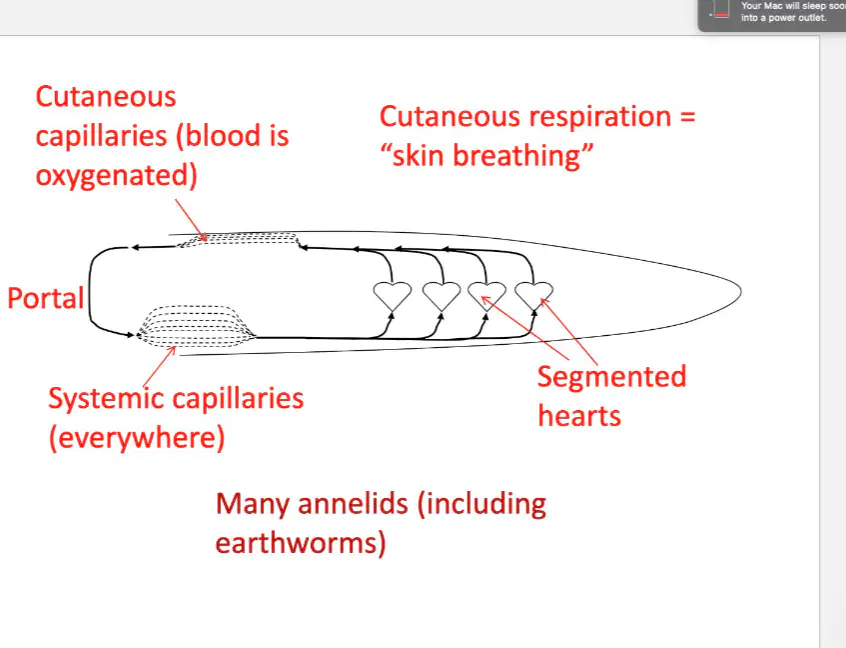
What does the term "Portal" refer to in the context of the diagram?
A type of heart
A respiratory system
A vessel connecting two capillary beds
A specialized group of annelids
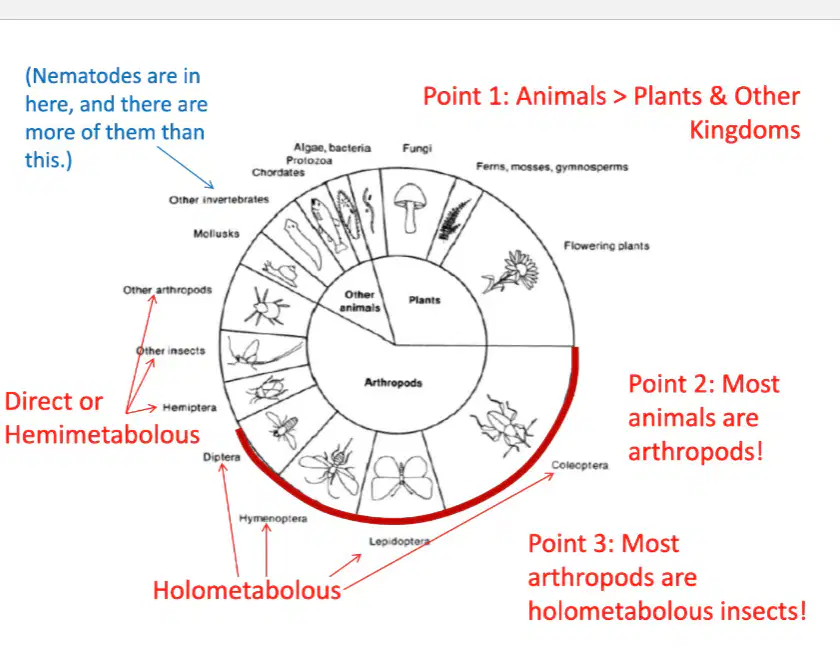
According to the diagram, which statement is true about the diversity of life forms?
Plants are more diverse than animals.
Most animals are arthropods.
Nematodes are less diverse than other invertebrates.
Holometabolous insects are less common than hemimetabolous insects.
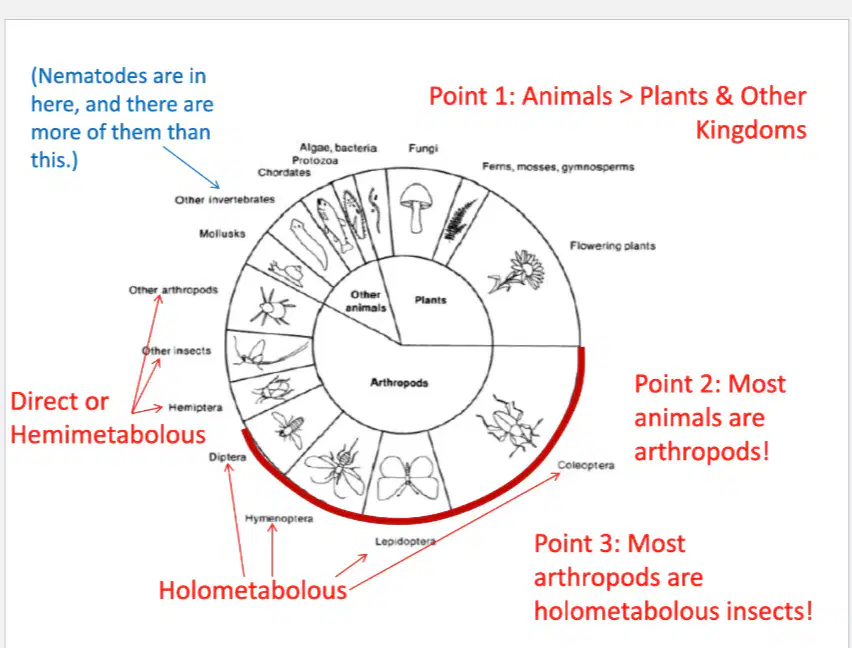
What does the diagram suggest about holometabolous insects?
They are a minority among arthropods.
They undergo direct development without metamorphosis.
They are the most common type of arthropods.
They are less diverse than hemimetabolous insects.
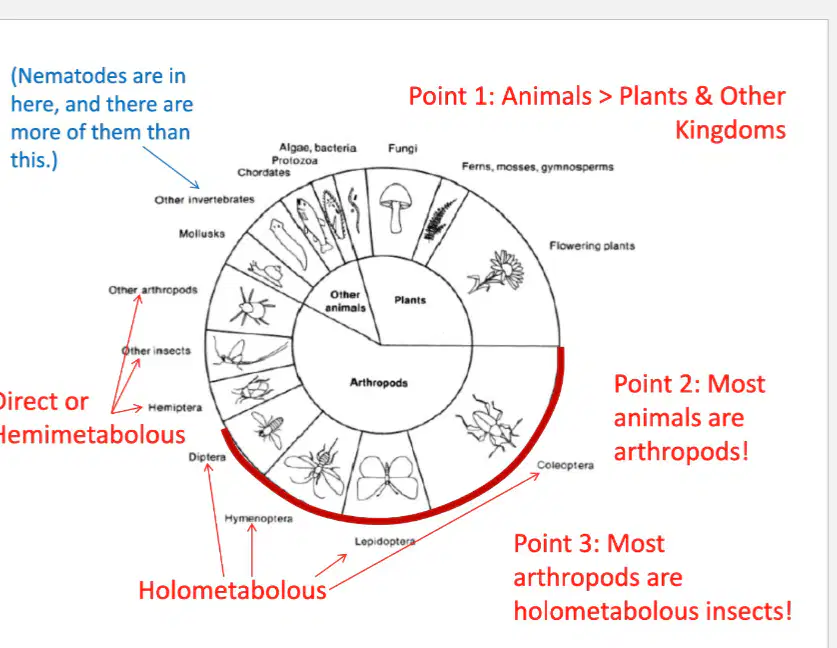
Which group is indicated to have more diversity than what is shown in the diagram?
Fungi
Nematodes
Flowering plants
Chordates
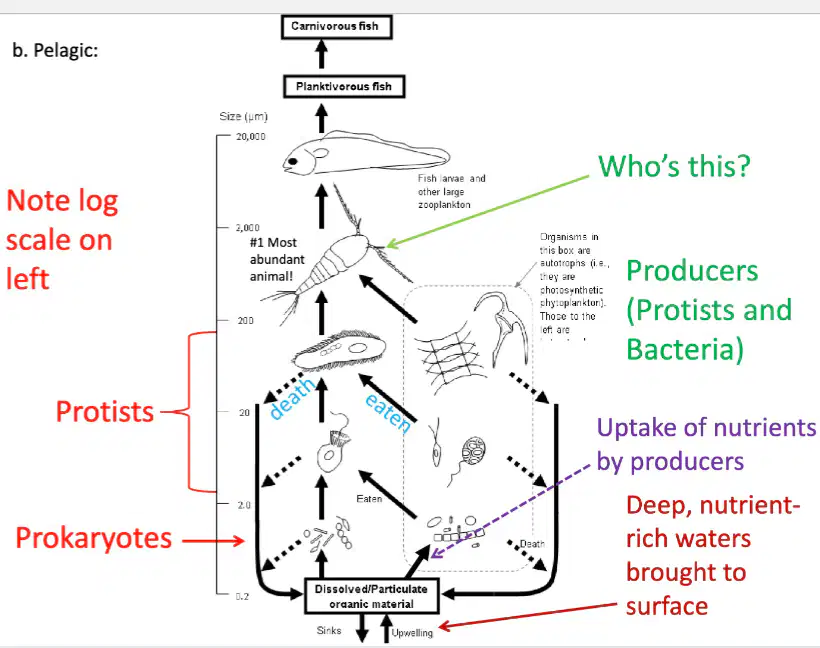
What are the primary producers in the pelagic zone according to the diagram?
Fish larvae and other large zooplankton
Carnivorous fish
Protists and Bacteria
Dissolved/Particulate organic material
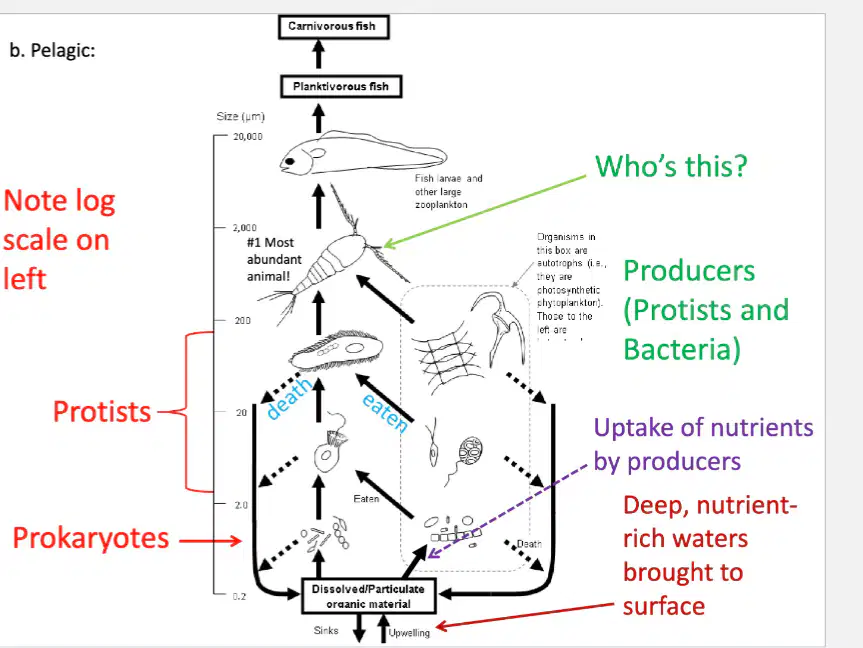
What process brings deep, nutrient-rich waters to the surface as indicated in the diagram?
Upwelling
Death
Eaten
Sinks
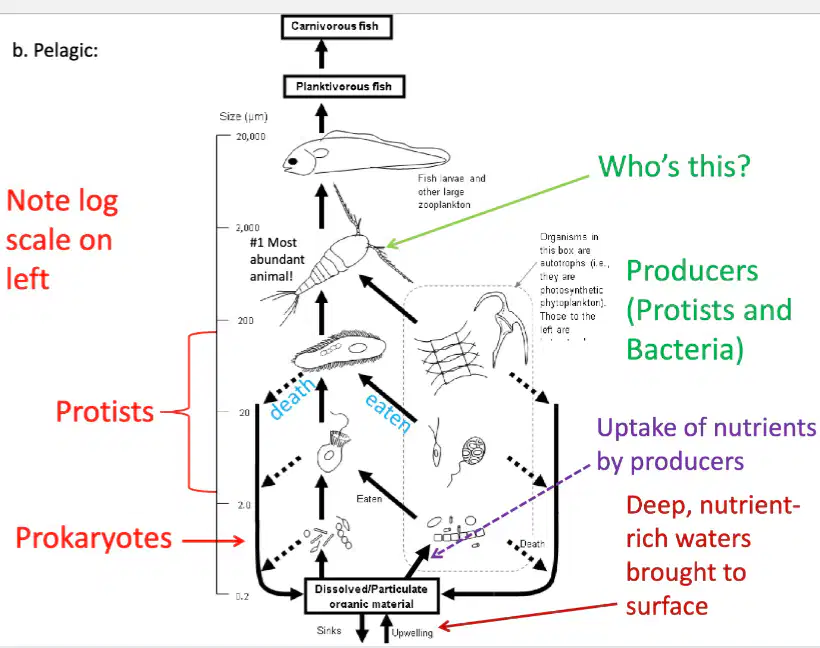
According to the diagram, what happens to most abundant animals in the pelagic zone?
They become carnivorous fish
They are eaten by other organisms
They sink to the bottom
They cause upwelling
What is a probable characteristic of the ancestral deuterostome?
Radial symmetry and no circulatory system
Bilateral symmetry and circulatory system
Bilateral symmetry and absence of gill slits
Asymmetry and presence of gill slits
Which of the following traits is not present in the chordates according to the phylogeny?
Neural crest derived pharyngeal endoskeleton
Shift from filter feeding to active predation
Secondary loss of gill slits
Bilateral symmetry and circulatory system
What evolutionary process is indicated by the presence of traits in echinoderms that are absent in hemichordates and cephalochordates?
Convergent evolution
Evolutionary reversal
Divergent evolution
Parallel evolution
Which phylum is characterized by having a CaCO3 skeleton and a water vascular system?
Phylum Arthropoda
Phylum Echinodermata
Phylum Chordata
Phylum Mollusca
What type of symmetry is ancestral to both Deuterostomes and Protostomes?
Radial symmetry
Asymmetry
Bilateral symmetry
Spherical symmetry
Which of the following represents an evolutionary reversal found in Phylum Echinodermata?
Bilateral to radial
Simple to complex anatomy
Radial to bilateral
Complex to simple anatomy
What is the evolutionary trend regarding the complexity of anatomy in Phylum Echinodermata?
From simple to complex
From complex to simple
From radial to bilateral
From bilateral to radial
Which organisms are considered producers in a terrestrial food web?
(a)
What role do decomposers play in a terrestrial food web?
Which of the following can be an arthropod in a terrestrial food web?
(a)
Arthropods can occupy which trophic levels in a terrestrial food web?
Which group of organisms are usually key consumers and decomposers in terrestrial ecosystems?
Chordates
Arthropods
Molluscs
Annelids
According to the trophic pyramid, which level is considered the most important of all?
Primary consumers
Secondary consumers
Tertiary consumers
Producers
What percentage of energy transfer is typically represented between each trophic level in the pyramid?
5 percent
10 percent
20 percent
30 percent
What does "instar" refer to in the context of arthropod development?
A type of arthropod
A stage between molts
A specific kind of metamorphosis
The final stage before adulthood
Which of the following is an example of an arthropod with direct development?
Grasshoppers
True bugs
Chelicerates
Butterflies
What is characteristic of incomplete metamorphosis (hemimetabolous) in arthropods?
Wings develop and become functional after the final molt
There is no change in form from birth to adulthood
The arthropod goes through a pupal stage
The arthropod develops wings from the beginning
Which of the following arthropods undergo incomplete metamorphosis?
Myriapods
Chelicerates
Some insects, e.g., grasshoppers, true bugs
Butterflies
What is the term used to describe the complete metamorphosis process in insects?
Hemimetabolous
Ametabolous
Holometabolous
Paurometabolous
Which stage is not part of the complete metamorphosis of insects?
Larva
Pupa
Nymph
Winged adult
What is the final stage of complete metamorphosis in insects?
Larva
Pupa
Winged adult
Benthic adult
Most crustaceans undergo metamorphosis from zooplankton to what type of adult?
Pelagic adult
Winged adult
Benthic adult
Terrestrial adult
Do crustaceans have a special name for their metamorphosis process like insects do?
Yes
No
Which list puts the early stages of development in correct order?
Blastula --> Gastrula --> Cleavage divisions --> Zygote
Zygote --> Gastrula --> Cleavage divisions --> Blastula
Zygote --> Cleavage divisions --> Blastula --> Gastrula
Gastrula --> Zygote --> Blastula --> Cleavage divisions
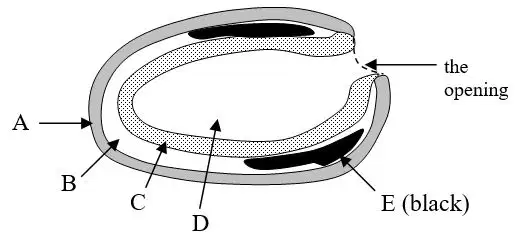
Endoderm is indicated by which arrow?
Arrow E
Arrow C
Arrow A
Arrow B
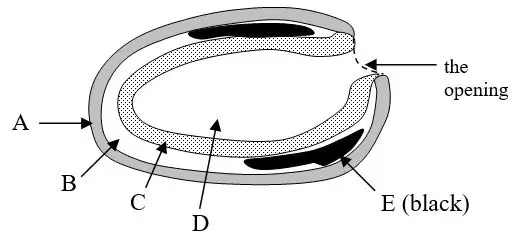
Which is true of the embryo shown above?
If it is the embryo of a Protostome, the structure labeled “the opening” would become the mouth.
It is the kind of embryo a sponge would exhibit.
It has four tissue layers.
This embryonic stage is called a blastula.
Which of the following traits apply to humans?
Humans have all these traits.
Triploblastic
Deuterostome
Complete digestive system
Eucoelomate
Which is true of sponge structure?
Sponges support themselves using a hydrostatic skeleton.
Sponges digest their food in a gastrovascular cavity.
Cells called choanocytes pump water and allow the sponge to filter-feed.
Sponges have radial symmetry.
Which is true of Cnidarians?
They have a gastrovascular cavity.
The stinging cells are called spicules.
They are asymmetrical.
They have a separate mouth and anus.
Which class of Cnidarians includes the typical jellyfish, including the most common stinging jellyfish in the Gulf of Mexico?
Hydrozoans
Cubozoans
Anthozoans
Scyphozoans
Which of the following animals would you expect to be common in the marine benthic habitat?
Poriferans
ALL of these are at least somewhat common in the marine benthos.
Cnidarian polyps
Nematodes
How might coral reefs be impacted by climate change?
Climate change is expected to be good for reefs, because it will lower sea levels.
The main driver of climate change is CO2, which makes the ocean more acidic, and this harms coral.
Climate change is causing the ocean to become cooler, and this harms the coral.
All of these answers are correct.
Which is correct, concerning human impacts on coral reefs?
Coral reefs are difficult to protect because they are a nuisance, and local people would benefit economically if the reefs disappeared.
Fishing benefits the coral reef because most fish on the reef are harmful, and removing them helps the coral to grow.
Agricultural fertilizer can harm reefs because it ends up in the ocean, where it stimulates the growth of algae.
All of these answers are correct.
What is true of Nematodes?
They are pseudocoelomate.
They are diploblastic.
They have radial symmetry.
None of these are Nematode traits.
What is a trait shared by both Platyhelminthes and Nematodes?
Both phyla have no body cavity of any kind outside the gut.
Both phyla are highly cephalized.
Both phyla lack a complete digestive tract.
Both phyla include some parasitic species and also some free-living species
If you found a platyhelminth crawling across a wet sidewalk or hiding in leaf litter in Montgomery, which class would it be in?
Monogenea
Turbellaria
Trematoda
Nematoda
Which group of organisms are obligate endoparasites with two or more host species?
Filarial nematodes
All of these groups match the description.
Trematoda
Cestoda
Consider the four phyla Porifera, Cnidaria, Platyhelminthes, and Nematodes.
Of these four, which phylum has the greatest number of species?
Poriferans
Cnidarians
Nematodes
Platyhelminths
Which phylum is acoelomate (i.e, they are triploblasts but lack a body cavity outside the gut)?
Nematodes
Poriferans
Cnidarians
Platyhelminthes
Which phylum probably has the biggest impact on marine ecology?
All have equal impact.
Porifera
Platyhelminthes
Cnidaria
Which is true of hookworm and pinworm?
They are free-living nematodes.
They are flukes.
They are parasitic nematodes.
They are tapeworms.
What is the normal, resting condition for a nerve or muscle?
The outside of the membrane is positive relative to the inside of the membrane.
The outside of the membrane is negative relative to the inside of the membrane.
The entire cell (inside and outside) is positively charged, compared to other cells in the body.
There is no charge difference between the inside and outside of the membrane.
A single neuron communicates with other neurons. How does this communication occur?
Neurons communicate by a flow of electrons (basically, electricity), which travel from one neuron to another.
Physical vibrations (movements) of one neuron are detected by another neuron.
Neurons are separated by a tiny gap called a synapse, and chemicals called neurotransmitters cross the gap.
The neurons directly touch one another.
What is necessary in order for an animal to have a hydrostatic skeleton?
They need to have a fluid-filled space with at least two muscle layers surrounding it.
They must have a complete digestive tract.
They need to have the ability to make a hard substance such as CaCO3.
They must be bilaterally symmetrical.
Which is true of animal toxins?
The toxin produced by cnidarians tends to be hemotoxic in nature.
A typical animal’s venom from a bite or sting is chemically very simple; it just contains a single type of toxin.
Neurotoxins tend to be more deadly than hemotoxins.
A hemotoxin is specialized at disrupting the neuromuscular system.
Osmoregulation is the process of __________________.
getting rid of nitrogenous waste, and it is handled by the kidney.
getting rid of food waste in our intestine, and it is handled by the gut (GI tract).
getting rid of nitrogenous waste, and it is handled by the gut (GI tract).
adjusting the salt levels in our blood, and it is handled by the lungs.
adjusting the salt levels in our blood, and it is handled by the kidney.
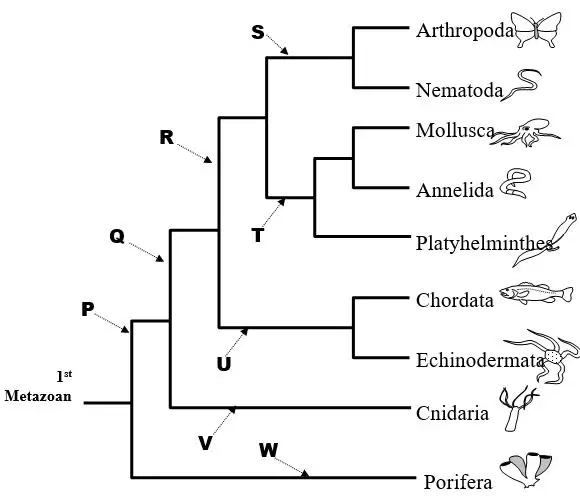
Which arrow corresponds to Protostomes?
Arrow R
Arrow S
Arrow T
Arrow V
Arrow U
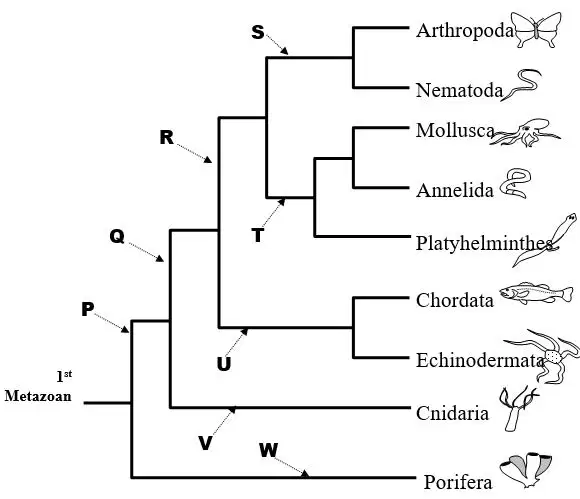
Which arrow corresponds to the first bilateral triploblast?
Arrow Q
Arrow V
Arrow P
Arrow R
Arrow U
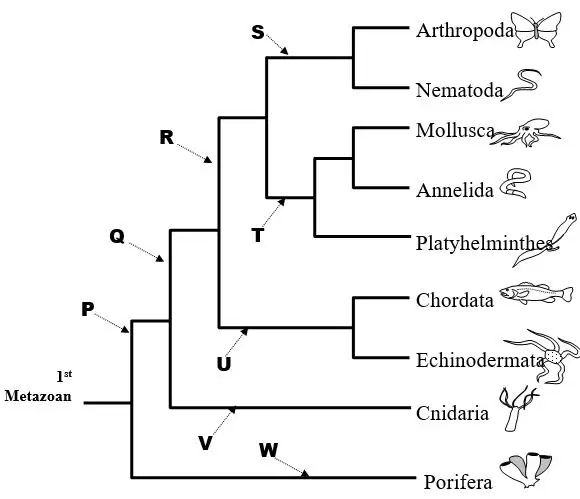
Which arrow corresponds to animals with spicules and choanocytes?
Arrow S
Arrow V
Arrow T
Arrow U
Arrow W
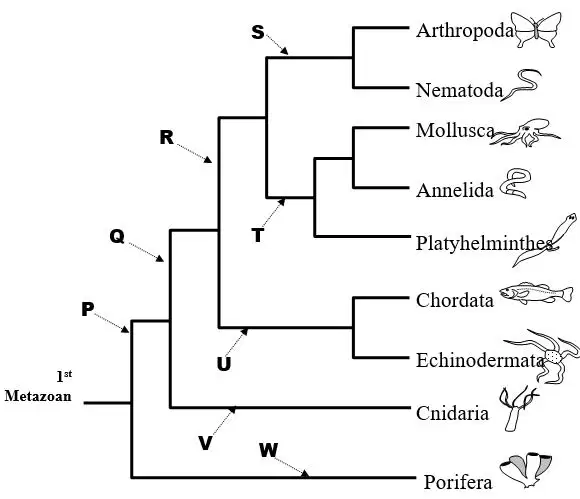
Which arrow corresponds to a subgroup of the Protostomes called the Lophotrochozoa
Arrow T
Arrow R
Arrow S
Arrow U
Arrow Q
Which is a difference between mollusks and annelids?
Mollusks are Protostomes, and Annelids are Deuterostomes.
Mollusks are Ecdysozoans, and Annelids are Lophotrochozoans.
Mollusks are segmented, Annelids are NOT segmented
Mollusks have a mantle and radula, Annelids do NOT have these structures
What is a trait that mollusks and annelids both share?
Both have an incomplete gut, with a GVC.
Both have radial symmetry.
Both phyla are eucoelomates.
Both have a shell of Calcium Carbonate, which they use for support.
Members of the class Cephalopoda are commonly known as __
squids and octopus
earthworms
slugs and snails
leeches
The class ___________ is the largest group of mollusks, and members of this class crawl on their foot and use a well-developed radula to feed.
Hirudinea
Polychaeta
Gastropoda
Bivalvia
Oligochaeta
The class ___________ includes the leeches.
Polychaeta
Bivalvia
Gastropoda
Oligochaeta
Hirudinea

Which is true, of the diagram of the annelid nephridium, above?
Arrow X indicates where the waste is expelled from the body (i.e., the “pee” comes out here).
Arrow Y indicates a general region where useful chemicals (e.g., needed salts) are moved from the white tube into blood capillaries, so they are not lost.
The blood vessel leading towards this nephridium would be the efferent vessel.
Arrow Z indicates a place where feces (i.e., digestive waste) are stored before being ejected.
What are setae, in the anatomy of annelids and arthropods?
Mini-bones” that can be used for skeletal support
Part of the respiratory system
Feeding structures
Hairs, which can be used for locomotion or for sensing
Animal circulatory systems can be categorized two ways: Whether they are open or closed, and also whether they are single-pump or double-pump. How would you characterize the circulatory system of a Human (and also a Cephalopod)?
Closed, Double-pump
Open, Single-pump
Open, Double-pump
Closed, Single-pump
What kind of respiratory structure does an earthworm use?
None (no respiratory organ)
Lung (pulmonary)
Skin (cutaneous)
Gills (branchial)
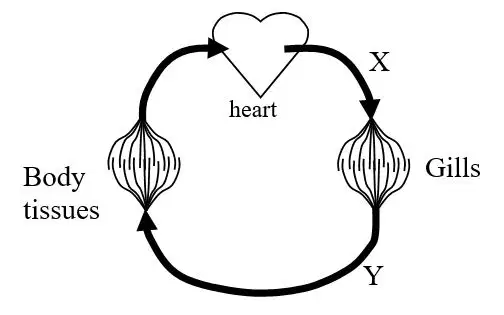
Let's say you find an animal with the circulatory system diagrammed here. Which statement is true?
All of these answers are correct.
The vessel labeled "Y" is a Portal Vessel.
This is a single-pump system.
The vessel labeled "X" is the Branchial Artery.
Which habitat is home to the largest number of species of both Molluscs and Annelids?
Freshwater
Marine benthic
Terrestrial
Marine pelagic
Which group of Arthropods went extinct at the end of the Permian Period (aka the beginning of the Mesozoic Period)?
Myriapods
Trilobites
Crustaceans
Chelicerates
Which group of Arthropods includes the spiders, scorpions, sea-spiders, and horseshoe crabs?
Chelicerates
Which group of Arthropods is ecologically dominant in the Marine environment, wins the “body plan diversity prize” and includes a number of species which are an important food source for humans?
Myriapods
Chelicerates
Trilobites
Crustaceans
Which of the following is a trait found in Arthropods?
Member of the Ecdysozoa lineage.
Good example of adaptive radiation.
All of these are traits of Arthropods.
Exoskeleton with jointed appendages.
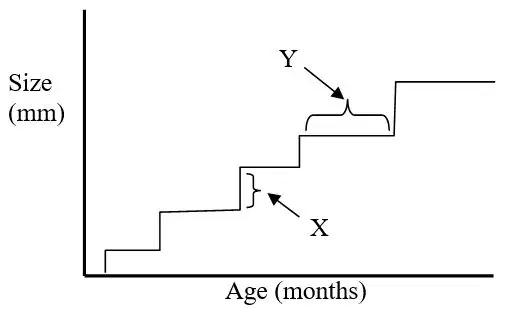
Above is a graph showing how an arthropod grows. Which is true?
Once it hardens, the arthropod exoskeleton cannot expand, so growth does not occur between molts.
A human’s growth curve would be smoother, and would lack the dramatic “steps.”
The sudden increase (shown by “X”) represents the process of molting.
All of these answers are correct.
The period of no growth (shown by arrow “Y”) indicates a particular instar.
Which statement about Arthropod respiration is correct?.
Gills are the most common form of respiration for insects.
Spiracles are internal respiratory structures in crustaceans.
Book lungs are tiny tubes that travel throughout the body of the animal, bringing oxygen directly to the tissues.
Book lungs are structures that resemble the pages of a book, and are used to breathe air.

The marine pelagic food web is shown above. Which arrow indicates an Arthropod?
Arrow A
Arrow B
Arrow D
Arrow C
Arrow E
A sea urchin is in the class __________ and a brittlestar is in the class __________.
Ophiuroidea – Asteroidea
Asteroidea – Holothuroidea
Ophiuroidea – Echinoidea
Echinoidea – Ophiuroidea
Asteroidea – Ophiuroidea
What is the main function of the Echinoderms’ water vascular system?
Digestion
Respiration
Excretion and Osmoregulation
Locomotion
Which is true of echinoderms?
They seem to have evolved a simple, radially-symmetrical anatomy from a more complex, bilateral anatomy long ago.
The name “echinoderm” means “poisonous skin.”
They have become one of the largest phyla of animals alive today, with hundreds of thousands of species.
From simple ancestors, Echinoderms have evolved a much more complicated anatomy, including a powerful circulatory system and an advanced central nervous system.
Coleopterans are __________ and Lepidopterans are ____________.
Flies – Butterflies/Moths
Ants/Wasps/Bees – Flies
Beetles – Flies
Beetles – Butterflies/Moths
Let's say you discover an animal that begins life as a larva, then molts into a pupa, and then the pupa molts into a winged adult. Which statement is true?
All of these answers are correct.
This creature is an insect.
The winged adult will not molt again; it reproduces and that's it.
This creature has Holometabolous development (i.e., Complete Metamorphosis).
Which statement is true, comparing the pelagic and terrestrial food webs?
In the pelagic food web, arthropods are everywhere, from the smallest producers to the largest consumers, but in terrestrial webs arthropods only occupy a single level.
In the pelagic food web, arthropods dominate one link, but this is not true in terrestrial food webs.
In the pelagic food web, arthropods are rare and unimportant, but arthropods are common and important in terrestrial webs.
The average length of a pelagic food chain is shorter than a terrestrial food chain.

