
 Worksheets
INT MKT Practice Test
Total questions: 34
Worksheet time: 19mins
Kyoung Tae is the CEO of a specialty lawn mower company that sells lawn mowers that are designed specifically for golf courses. He is ready to take his company outside of his home country of South Korea. Which targeting technique would you advise Kyoung Tae to take?
Standardized
Specialized
Differentiated
Concentrated
Benefit
Mexico has a per capita Gross National Income (GNI) of approximately $10,500. The country has a relatively stable stock market, a growing middle class, and a diversified economy that includes manufacturing, services, and energy. Financial services are expanding, and the regulatory environment continues to evolve with efforts to improve transparency and investor protections. What stage of market development is Mexico in?
Pre-emerging
Emerging
Secondary-emerging
Developed
Which of the following is NOT one of the selection criteria for a good Olympics host country?
Infrastructure
Experience in hosting events
Geographical rotation
Public enthusiasm for specific Olympic sports
Cultural and historical significance
Of the four main management orientations, ______ orientation is focused most on the home country, while ______ orientation is focused on the complete global stage.
ethnocentric, geocentric
regiocentric, polycentric
ethnocentric, polycentric
geocentric, regiocentric
What is a learned tendency to respond in a consistent way to a given object or entity?
Belief
Attitude
Value
Personality
What is the key trade policy that has led to the rise of direct-to-consumer overseas E-commerce companies like Shien and Temu?
De minimis
Value-added tax (VAT) rebate
Export subsidy alignment
Harmonized tariff classification
Which of the following is NOT one of the current strengths of AI tools?
language processing
complexity
information synthesis
idea generation
prototyping
Select ALL of the characteristics that are commonly found in a high context culture.
Competitive bidding is rare
Negotiations proceed quickly
People need private space
Leadership takes responsibility for organizational failures
Lawyers are not very important
McDonalds sells a Dosa Masala Burger in India and Poutine in Canada. McDonalds believes that…
Consumer preferences vary by culture and localization increases customer satisfaction
Standardization is always better than adaptation in global marketing
There is a global customer
The best way to build a brand is to keep the exact same menu across all countries
Some emerging markets are currently in the spotlight of international business. Currently the most sought after countries are the BRICS. Which country is the “S” in BRICS?
Spain
South Africa
Saudi Arabia
Slovakia
Switzerland
A true global economy began to emerge following which event?
The War of 1812
Civil War
WWI
WWII
Korean War
Roughly what percent of economies are integrated globally?
20%
35%
50%
65%
What is the primary purpose of the World Trade Organization (WTO)?
To promote free and fair trade by establishing rules and resolving disputes between member countries
To regulate currency exchange rates between developed and developing nations
To enforce labor laws and minimum wage standards globally
To provide loans and financial aid to countries experiencing trade deficits
List two of the four types of preferential trade agreements.
(a)
After defining the problem and research question, the next step in the research process is to...?
Collect data
Define the variables
Test your hypothesis
Select your data source
The quiz we took in class about the current start of the world demonstrated that in general most countries are ________ when looking at key metrics such as education and poverty?
Improving
Slightly worsening
Drastically worsening
Staying the same
What is the best segmentation category if your goal is to predict future behavior?
Income
Behavior
Ethnicity
Age
Benefit
Which of the following is a reason that intuition is inferior to systematic research?
Overconfidence bias
Confirmatory bias
Congruency bias
Both overconfidence and confirmatory
All of the above
Visa’s global marketing campaign “It’s Everywhere You Want to Be” is a good example of which type of positioning?
Attribute/Benefit
Quality/Price
Use/User
Competition
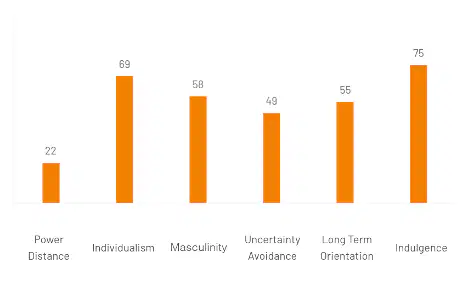
These are the cultural dimensions for New Zealand.
Which of the following likely is NOT true about citizens of New Zealand?
They respect titles (e.g., Dr., PhD, MD)
They are likely to book a luxurious vacation to Fiji
They would not prioritize family and community
They are likely to make an impulse buy at the store to “treat themselves”
Which of Hofstede’s cultural dimensions has to do with assertiveness and control?
Masculinity
Individualism
Power distance
Indulgence
Long-term orientation
Select ALL of the following which are key sourcing considerations?
Cost efficiency
Intellectual property rights
Legal restrictions of the Origin Country
Quality Assurance
Bill Clinton believed that intertwining the US economy with China would ensure peace and cooperation. What is one piece of evidence that the US government no longer believes this is true?
Amazon purchased MGM for $8.45 billion
Pfizer develops a Covid vaccine that has 95% efficacy
Nike was sued for using contractors in southwest China to manufacture their shoes
In 2022, ground was broken for a new Intel Semiconductor facility in Albany Ohio
Which of the following is NOT one of the four protections from the video Our New Global Economy?
Workers
Climate
Supply Chains
Trade
From Geopolical rivals
Which of the following is NOT a key political factor that influences international business?
Bureaucracy
Social unrest
Transparency and fairness
Corruption
Leadership interdependence
What is a shell company?
A company that only operates in the manufacturing sector and outsources all financial operations
A legally established company that exists on paper but has little or no actual business operations or assets
A company that specializes in selling packaging and containers to other businesses
A startup company that is funded through crowdsourcing but has not yet launched a product
According to our guest speaker, Chris Splan, Coke’s marketing activities have a ______ level of concentration and P&G’s marketing activities have a ______ level of concentration?
high; high
high; low
low; low
low; high
What should channels be treated like?
Customers
Corporations
Clients
Competitors
China buys and sells large quantities of US dollars to influence the exchange rate with their currency. Which exchange rate principle does this best exemplify?
Manipulation
Stability
You have to believe in it
Supply and demand
List one advantage and one disadvantage of a Global Strategic Alliance.
(a)
Which of the following is a consequence of tariffs as highlighted in recent U.S. trade policy?
Tariffs always increase domestic employment without affecting prices
Tariffs generate more revenue than the government pays out in relief
Tariffs can protect specific industries in the short term but may harm others that rely on those inputs
Tariffs reduce the risk of retaliation from international trade partners
Which of the following is NOT a market expansion strategy?
Country and market concentration
Country concentration and market diversification
Country diversification and market concentration
Country and market diversification
All of the above are market expansion strategies
P&G is organized with __________ because all of their key decisions come from the corporate office.
high convergence
high concentration
low convergence
low concentration
List two types of Licensing.
(a)

