
 Worksheets
Male Reproductive System Quiz
Total questions: 75
Worksheet time: 40mins
Which of the following is not part of the male duct system?
Epididymis
Ductus (vas) deferens
Urethra
Seminal vesicle
What is the term for the external sac that contains the testes?
Scrotum
Prostate
Ureter
Bulbourethral gland
Where is the epididymis located in relation to the testes?
Above the testes
Behind the testes
Within the testes
In front of the testes
What is the function of the urethra in the male reproductive system?
Produces sperm
Stores sperm
Transports urine and semen out of the body
Secretes testosterone
Which of the following is considered an accessory organ of the male reproductive system?
Penis
Scrotum
Seminal glands (vesicles)
Glans penis
What is the term used for the external male genitalia that contains the testes?
Prostate
Scrotum
Ureter
Bulbourethral glands
Which part of the male reproductive system is responsible for the production of sperm?
Prostate
Seminal vesicle
Testis
Bulbourethral gland
What is the name of the tube that carries sperm from the testes to the urethra?
Ureter
Prostatic urethra
Ductus deferens
Ejaculatory duct
Where is the bulbourethral gland located in the male reproductive system?
Below the prostate
Above the testis
Within the scrotum
At the tip of the penis
What structures are housed within the spermatic cord?
Blood vessels, nerves, and ductus deferens
Seminiferous tubules, septa, and lobules
Tunica albuginea, rete testis, and epididymis
Blood vessels, seminiferous tubules, and ductus deferens
What is the name of the capsule that surrounds each testis?
Septum
Tunica albuginea
Epididymis
Ductus deferens
What are the septa in the testes?
Tubes that carry sperm to the epididymis
Extensions of the capsule that divide the testis into lobules
The outer layer of the testis
Blood vessels that supply the testis
How many seminiferous tubules does each lobule in the testes contain?
One to four
Five to eight
Nine to twelve
Thirteen to sixteen
What is the function of the seminiferous tubules?
Produce androgens such as testosterone
Function as sperm-forming factories
Transport sperm to the epididymis
Store mature sperm
Where do sperm travel after leaving the rete testis?
Vas deferens
Urethra
Epididymis
Seminal vesicle
What do interstitial cells in the seminiferous tubules produce?
Estrogen
Progesterone
Testosterone
Luteinizing hormone
During which months do the testes normally descend through the inguinal canal in a male fetus?
1st to 3rd month
4th to 6th month
7th to 9th month
After birth
What is the final destination of the testes after their descent in male fetal development?
Abdominal cavity
Inguinal canal
Scrotum
Pelvic cavity
Which phase involves the anchoring of the testes during their development?
Embryonic position
Transabdominal Phase
Inguinoscrotal Phase
Elongation of cord
What is the process called when the testes move from the abdominal cavity to the scrotum?
Proliferation
Migration
Differentiation
Elongation
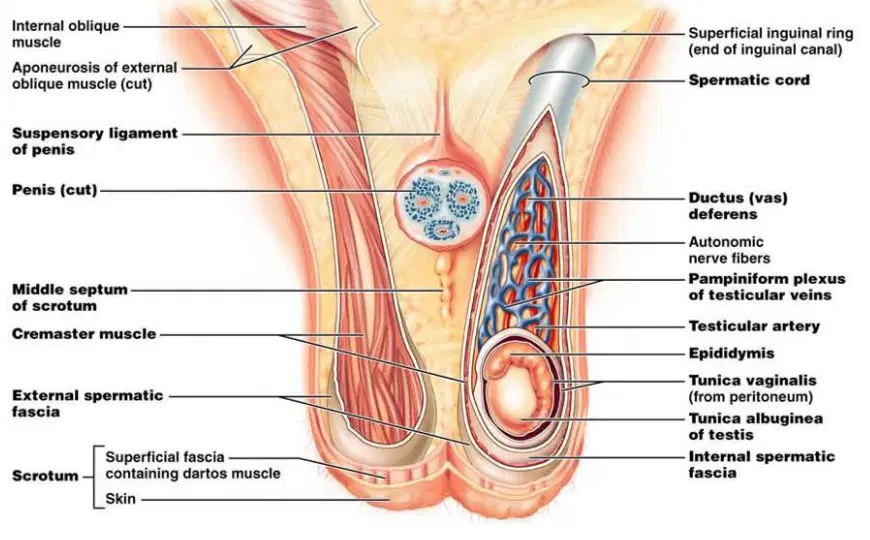
What is the function of the scrotum as mentioned in the image?
Produces sperm
Regulates testosterone levels
Maintains testes at 3°C higher than normal body temperature
Maintains testes at 3°C lower than normal body temperature to protect sperm viability
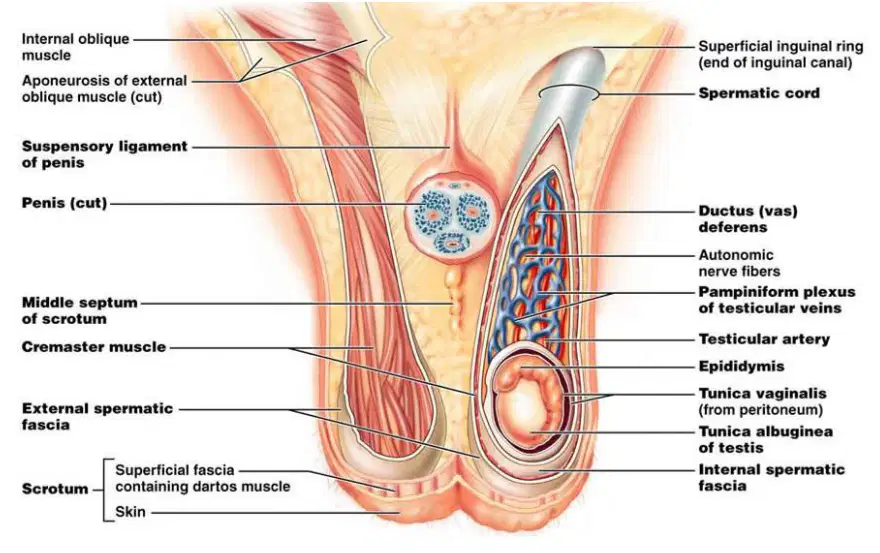
According to the image, what does the scrotum contain?
A thick layer of fat
A thin layer of smooth muscle
A network of blood vessels
A layer of hair follicles
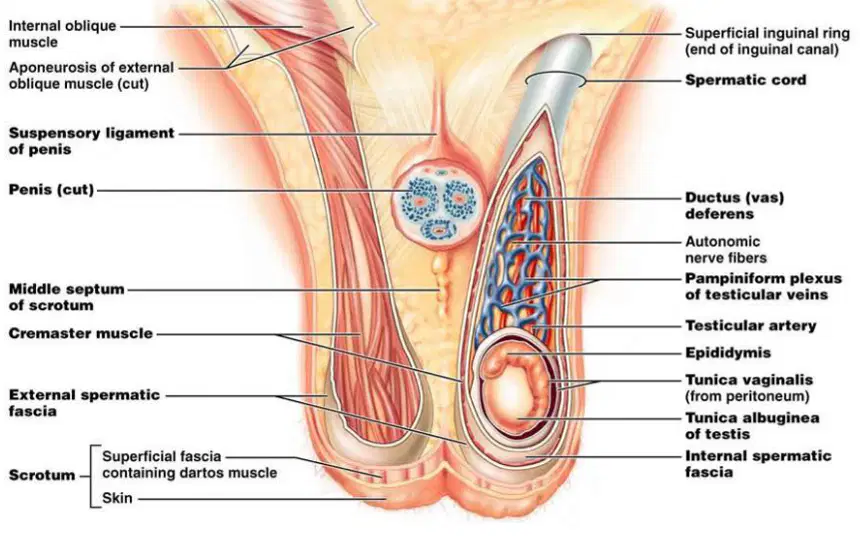
Where is the scrotum located as per the information in the image?
Inside the abdomen
Outside the abdomen
Within the pelvic cavity
Attached to the perineum
What is the function of the duct system in the male reproductive anatomy?
It transports urine from the body.
It transports sperm from the body.
It secretes hormones into the body.
It absorbs nutrients from digested food.
Which of the following is NOT a part of the duct system mentioned in the image?
Epididymis
Ductus deferens
Urethra
Seminiferous tubule
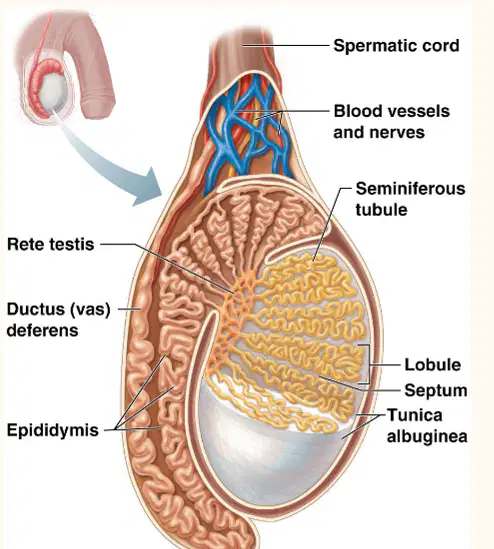
Identify the structure labeled in the diagram where sperm matures and is stored.
Ductus (vas) deferens
Seminiferous tubule
Epididymis
Rete testis
How long is the epididymis?
6 cm
6 m
12 m
20 ft
Where is the epididymis found?
Along the anterior lateral side of the testis
Inside the testis
Along the posterior lateral side of the testis
Outside the scrotal sac
What is the role of the epididymis in the male reproductive system?
Produces testosterone
Temporary storage and maturation site for sperm
Produces sperm
Transports urine
During ejaculation, where are sperm propelled from the epididymis?
Urethra
Seminiferous tubules
Ductus (vas) deferens
Prostate gland
What is the function of the ductus (vas) deferens?
It produces sperm.
It moves sperm by peristalsis into the urethra.
It stores sperm.
It secretes testosterone.
Where does the ampulla of the ductus deferens empty?
Into the urinary bladder.
Into the seminal vesicle.
Into the ejaculatory duct.
Into the ureter.
Through which structure does the ejaculatory duct pass to merge with the urethra?
Seminal vesicle.
Bulbourethral gland.
Prostate.
Epididymis.
What is the function of the smooth muscle in the walls of the ductus deferens?
It prevents transportation of sperm.
It creates peristaltic waves to squeeze sperm forward.
It promotes sterility.
It retains secondary sex characteristics.
What is a vasectomy?
A procedure that promotes the production of sperm.
A procedure that enhances the peristaltic movement of the ductus deferens.
A procedure that retains secondary sex characteristics.
A procedure that involves cutting of the ductus deferens to prevent transportation of sperm.
What is one of the outcomes of a vasectomy?
It decreases male secondary sex characteristics.
It increases the risk of prostate cancer.
It promotes sterility.
It enhances sperm motility.
Despite a vasectomy, what does a male retain?
The ability to produce sperm.
Secondary sex characteristics.
The peristaltic movement in the ductus deferens.
The ability to transport sperm.
What does the urethra carry?
Urine only
Sperm only
Both urine and sperm
Neither urine nor sperm
Where does sperm enter the urethra?
From the urinary bladder
From the seminal vesicle
From the ejaculatory duct
From the prostate
What is the extent of the urethra in the male reproductive system?
From the base of the urinary bladder to the tip of the penis
From the epididymis to the external urethral orifice
From the prostate to the glans penis
From the seminal vesicle to the scrotum
Which region of the urethra is surrounded by the prostate gland?
Membranous urethra
Spongy (penile) urethra
Prostatic urethra
External urethral orifice
What is the function of the internal urethra sphincter during ejaculation?
It allows urine to pass into the urethra.
It allows sperm to enter the urinary bladder.
It prevents urine from passing into the urethra.
It increases the flow of sperm into the urethra.
Where does the membranous urethra run from and to?
From the urinary bladder to the prostate gland
From the prostate gland to the external urethral orifice
From the prostate gland to the penis
From the external urethral orifice to the tip of the penis
What is the function of the spongy (penile) urethra?
It connects the urinary bladder to the prostate gland.
It runs the length of the penis to the external urethral orifice.
It transports sperm from the testes to the ductus deferens.
It encircles the membranous urethra.
Where are the seminal vesicles located?
At the tip of the penis
Inside the testes
At the base of the bladder
Within the prostate gland
What percentage of semen is the secretion produced by the seminal vesicles?
30%
60%
80%
50%
Which of the following substances is NOT contained in the secretion of the seminal vesicles?
Fructose
Vitamin C
Prostaglandins
Testosterone
What is the function of the substances produced by the seminal vesicles?
To decrease sperm motility
To nourish and activate sperm
To initiate the production of sperm
To store sperm
What forms the ejaculatory duct?
The union of the ductus deferens and the urethra
The union of the duct of each seminal vesicle and the ductus deferens on each side
The union of the epididymis and the ductus deferens
The union of the urethra and the seminal vesicle duct
What is the function of the prostate gland?
It secretes a fluid that helps to activate sperm.
It produces sperm cells.
It stores sperm cells.
It is responsible for the production of testosterone.
Where does the fluid secreted by the prostate gland enter?
It enters the bladder.
It enters the seminal vesicles.
It enters the urethra through several small ducts.
It is absorbed into the bloodstream.
What part of the urethra does the prostate encircle?
The lower (membranous) part of the urethra.
The entire length of the urethra.
The upper (prostatic) part of the urethra.
The external urethral orifice.
What is the function of the mucus produced by the bulbourethral glands?
To neutralize the acidity of the urine in the urethra
To aid in sperm motility
To provide nutrients to sperm
To initiate the sperm capacitation process
Where are the bulbourethral glands located in relation to the prostate?
Superior to the prostate
Inferior to the prostate
Anterior to the prostate
Posterior to the prostate
What additional role does the mucus from the bulbourethral glands serve during sexual intercourse?
It acts as an antiseptic
It serves as a lubricant
It enhances sperm viability
It triggers ovulation
What is the appearance of semen as described in the learning material?
Transparent and colorless
Milky white mixture
Yellowish fluid
Reddish secretion
What is the role of the liquid portion of accessory gland secretions in semen?
It provides color to the semen
It acts as a transport medium to dilute sperm
It solidifies the semen
It serves as a source of protein for sperm cells
What is the shape of sperm cells as mentioned in the learning material?
Oval-shaped
Streamlined cellular "tadpoles"
Round and compact
Irregularly shaped
What does fructose provide for sperm cells?
Color
Energy
Motility
Protection
Why is the alkalinity of semen important?
It enhances the color of semen
It provides energy for sperm cells
It helps neutralize the acidic environment of the vagina
It increases the volume of semen
What is the function of semen with respect to bacteria?
It promotes bacterial growth
It has no effect on bacteria
It inhibits bacteria
It serves as a nutrient for bacteria
How much semen is typically ejaculated at one time?
0.5-1.0 ml
1.5-5.0 ml
5.0-10.0 ml
10.0-15.0 ml
What is the function of the scrotum?
Produces sperm
Maintains testes at a temperature higher than normal body temperature
Maintains testes at a temperature 3°C lower than normal body temperature
Stores urine
Why can't viable sperm be produced at normal body temperature?
Because it requires a higher temperature
Because it requires a lower temperature
Because it requires a specific pH level
Because it requires a specific nutrient
What is the scrotum described as in the learning material?
What is the function of the penis in the male reproductive system?
To produce sperm
To deliver sperm into the female reproductive tract
To filter blood
To store urine
Which part of the penis is often removed by circumcision?
Shaft
Glans penis
Prepuce (foreskin)
Spongy urethra
What occurs when the erectile tissue of the penis fills with blood?
Ejaculation
Urination
Erection
Contraction
What is the glans penis?
The base of the penis
The internal tube within the penis
The folded cuff of skin around the proximal end of the penis
The enlarged tip of the penis
What is the term used for the skin covering the penis that folds downward to form a cuff of skin around the proximal end of the glans?
Epidermis
Dermis
Prepuce
Cuticle
What is the medical procedure called in which the foreskin is surgically removed shortly after birth?
Vasectomy
Circumcision
Castration
Biopsy
What is the spongy tissue that fills with blood during sexual excitement called?
Tunica albuginea
Corpus cavernosum
Corpus spongiosum
Cavernosal artery
How many elongated areas of erectile tissue surround the spongy urethra internally?
1
2
3
4
Which part of the penis contains the urethra?
Glans penis
Corpus cavernosum
Corpus spongiosum
Corona
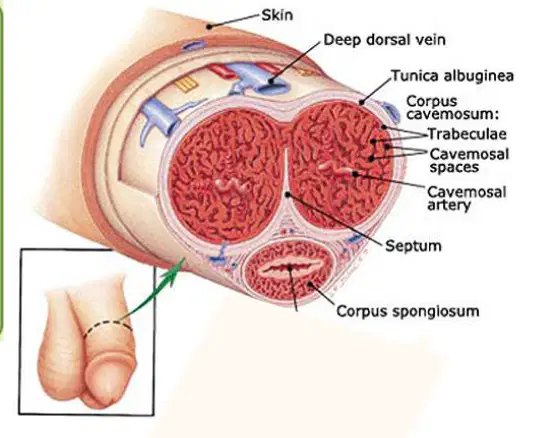
What is the name of the structure indicated by the arrow in the inset image?
Glans penis
Prepuce (foreskin)
Corona
Urethral opening

