wayground logo

Free Printable Worksheets

Font size

S
M
L
XL
Worksheets

Under the Microscope Assessment

Total questions: 73

Worksheet time: 37mins

Name
Class
Date
1.
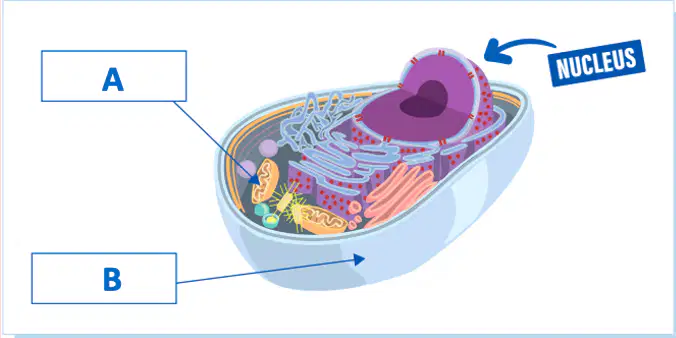
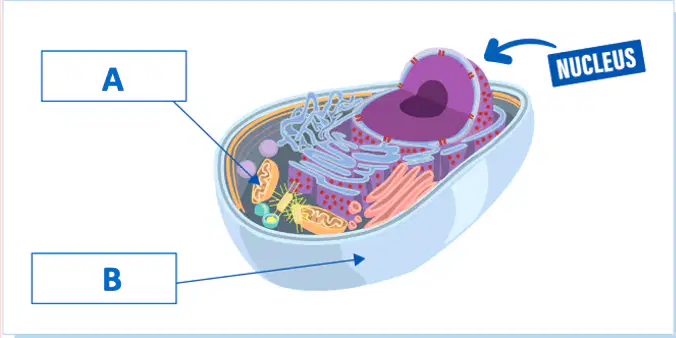
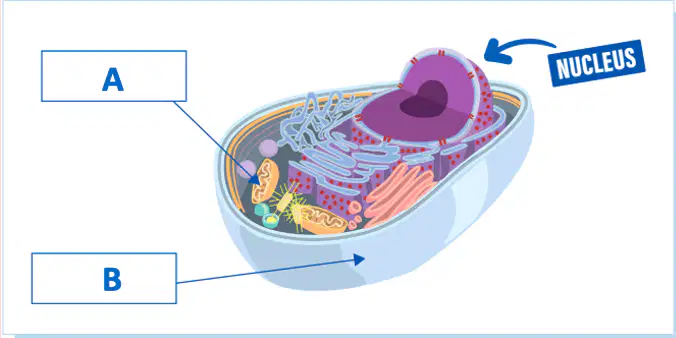
Describe if the images below are a plant or animal cell.
a)
Cell 1- Plant, Cell 2- Animal
b)
Cell 1- Animal, Cell 2- Plant
c)
Cell 1- Animal, Cell 2- Animal
d)
Cell 1- Plant, Cell 2- Plant
2.
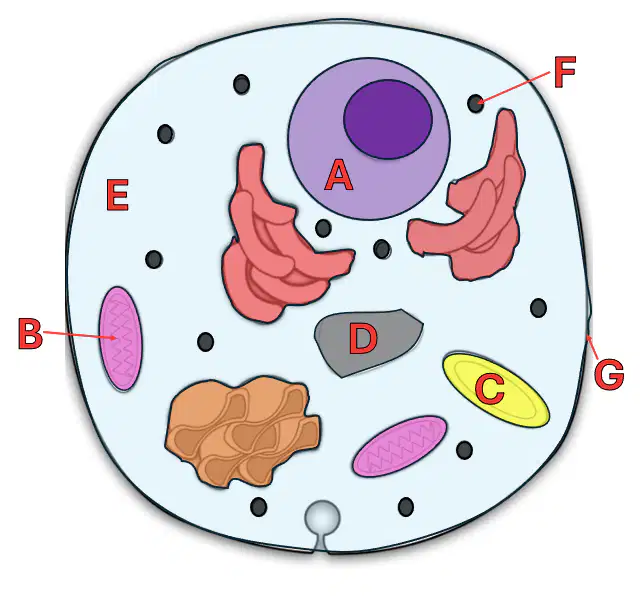
What is the name of the organelle shown by letter A?
a)
Mitochondrion
b)
Cell Wall
c)
Chloroplast
d)
Cell Membrane
3.
Which structure shown in the model contains genetic material and controls the cell’s functions?
a)
Mitochondrion
b)
Cell Membrane
c)
Nucleus
d)
Cell Wall
4.
How would the model shown below be different if it were showing a plant cell?
a)
There would be a second cell membrane to help the plant make its own nutrients.
b)
There would be chloroplasts to convert air and water into sugar (photosynthesis).
c)
There would be no mitochondria to provide the plant with proteins.
d)
There would be no nucleus so the cell would not have genetic information.
5.
Which of the following pieces of evidence would you use to argue for or against the claim that the structure and function of the cell membrane is related to the overall function of the cell?
a)
The structure of the cell membrane allows some, but not all, materials to pass through the cell
b)
The function of the cell membrane is related to the function of the cell as a whole because the membrane is located in the very center of the cell.
c)
The cell membrane only functions normally after all the other cell organelles carry out their individual functions.
d)
Oxygen enters the cell and waste products exit the cell through the cell membrane, but not all cells need oxygen or produce waste.
6.
Why can't humans perform photosynthesis?
a)
Humans are made of animal cells which do not have chloroplasts
b)
Human are made of plant cells which only perform photosynthesis when we eat glucose
c)
Humans can perform photosynthesis, but only when the sun is shining
d)
Humans are made of animal cells, but their chloroplasts are just for storage and do not work
7.
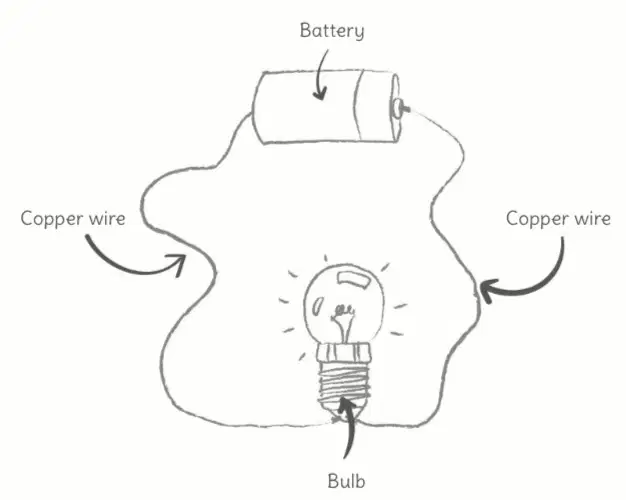
What component in the system sketched above models the mitochondria, and why?
a)
The battery in the circuit is like a mitochondrion in a cell because that's where the energy for the system comes from.
b)
The wires in the circuit are like the mitochondria because they contain green pigment, like the chlorophyll used for photosynthesis
c)
The light in the circuit is like a mitochondrion because it is the energy producer for the cell, and the light bulb provides the energy needed for the battery to work.
8.
Imagine you made a chain of paperclips to model a protein. How could you use your paperclip chain to model the activity of the lysosome?
a)
I can add more paperclips to the protein chain because lysosomes make proteins.
b)
I can break apart the protein paperclip chain and recycle the old parts because lysosomes break down cellular waste.
c)
I cannot use a paperclip chain to model the activity of a lysosome.
9.
Explain how a strainer or colander models a cell membrane
a)
A strainer is like a cell membrane because it allows some materials to pass through, but not others
b)
A strainer is like a cell membrane because it has to be activated by the user for materials to pass through
c)
A strainer is like a cell membrane because it is blue in color and difficult to hold.
10.
Explain how cilia is like a weather instrument.
a)
Weather instruments are only made from proteins, like cilia is inside a cell. They provide structure and support for the weather.
b)
Weather instruments are used in every country around the world to make predictions. The cilia in your cells are used in every single organ in your body to make predictions and fortunes about your health.
c)
Weather instruments gather information about weather conditions around you, like how cilia gather information about the conditions around the cell
11.
Imagine you have an envelope. Inside the envelop is a list of colors to make a string of beads. How does this model the function of a nucleus?
a)
A cell's nucleus contains proteins which built all the strings for the cell, like the instructions in the envelope made all the strings for the bead necklace.
b)
A cell's nucleus contains DNA which provides instructions for the cell's activities and parts, like the envelope contained instructions for how to make a string of beads.
c)
A cell's nucleus contains small bead like structures in hundreds of colors, just like the instructions for the bead string provide.
12.
Imagine a cell has damaged mitochondria. How might this affect the cell?
a)
The cell would likely make less proteins since mitochondria make protein for the cell.
b)
The cell would likely function normally since mitochondria are just storage containers and not very important.
c)
The cell would likely stop working properly because mitochondria provides energy for the cell.
13.

Sac that contains enzymes to digest and break down cellular waste- only in animal cells

a)

Mitochondria

b)

Nucleus

c)

Cytoplasm

d)

Ribosome

e)

Lysosome

14.

Control Center of the cell- contains DNA

a)
Ribosome
b)
Lysosome
c)

Nucleus

d)

Mitochondria

15.

Surrounds the cell and controls the flow of materials into and out of the cell

a)

Cytoplasm

b)
Cell wall
c)
Nuclear membrane
d)
Cell membrane
16.

Produces proteins needed by the cells

a)
Mitochondria
b)
Ribosomes
c)
Endoplasmic reticulum
d)
Golgi apparatus
17.

Contains chlorophyll to perform photosynthesis- only in plant cells

a)
Ribosome
b)
Mitochondria
c)
Chloroplast
d)
Nucleus
18.

The powerhouse of the cell- produces energy through cellular respiration

a)
Endoplasmic reticulum
b)
Ribosomes
c)
Golgi apparatus
d)
Mitochondria
19.

Jelly like fluid that fills the cell and supports the organelles

a)
nucleus
b)
mitochondria
c)
ribosomes
d)
cytoplasm
20.

Storage sac for fluid or other materials inside the cell

a)

Vacuole

b)

Ribosomes

c)

Nucleus

d)

Cytoplasm

21.

Rigid outer structure that provides protection and support only in plant cells
a)
cell wall
b)
chloroplast
c)
vacuole
d)
cell membrane
22.

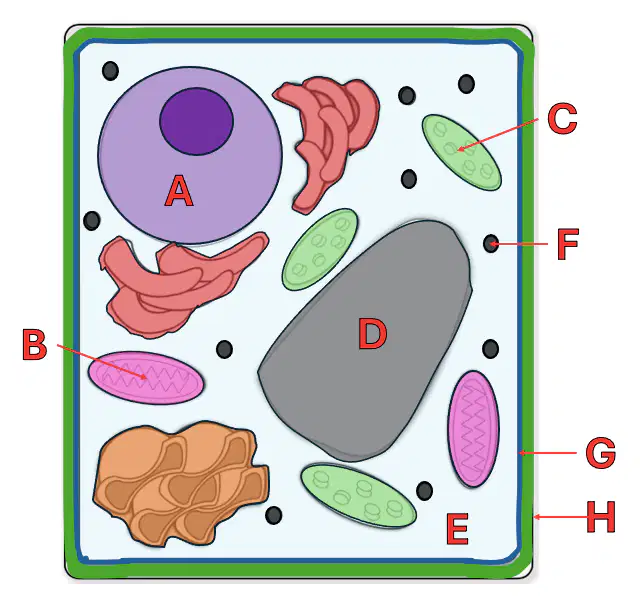
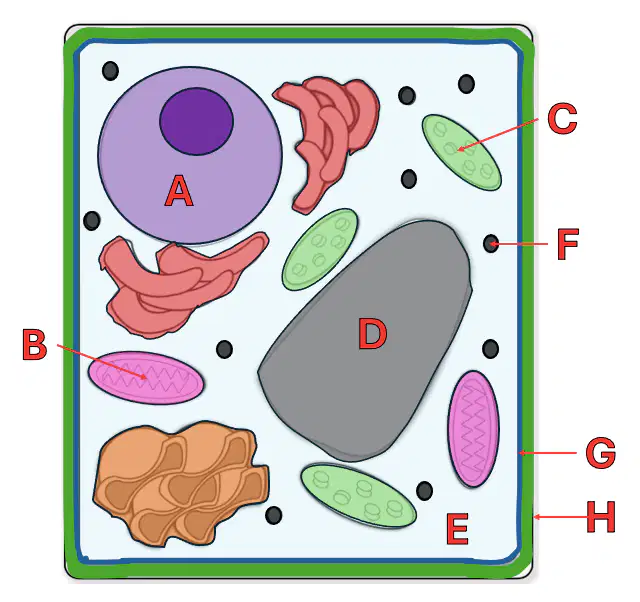
What type of cell is this?

a)

Animal

b)

Plant

c)

Bacteria

d)

None of the above

23.

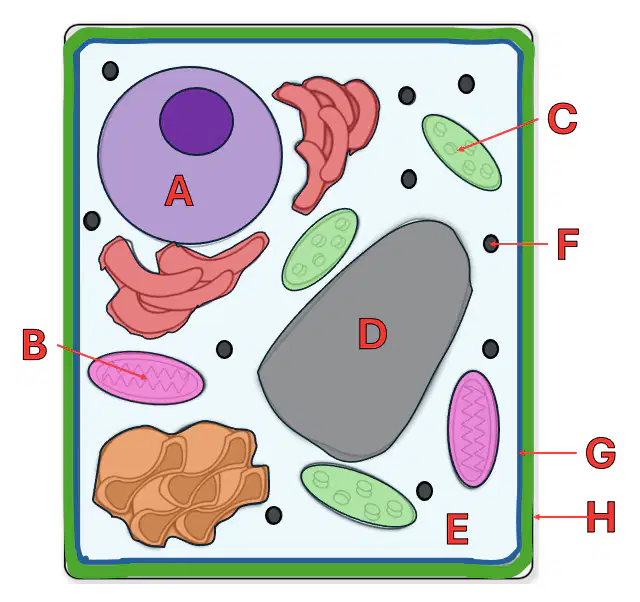
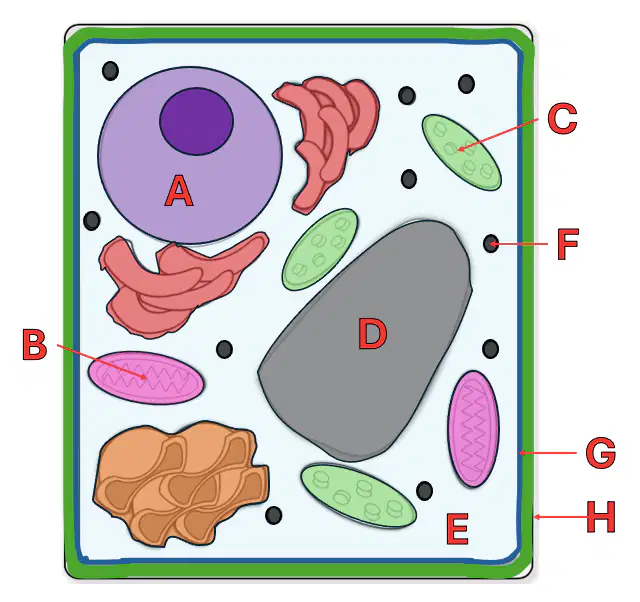
What type of cell is this?

a)

Animal

b)

Plant

c)

Bacteria

d)

None of the above

24.

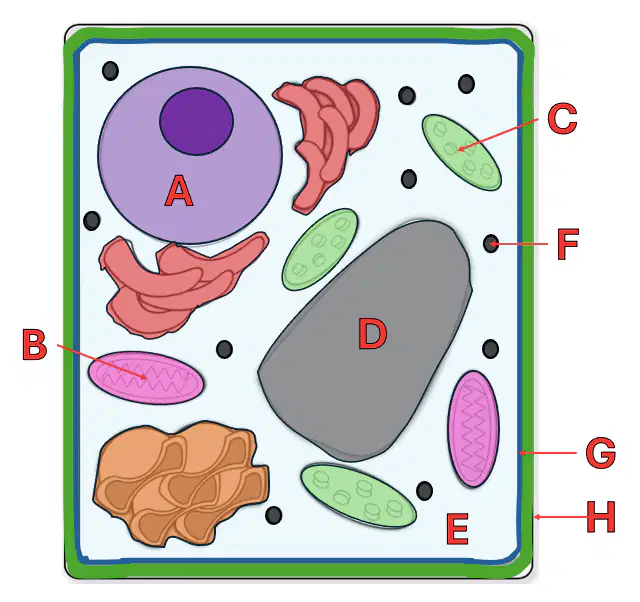
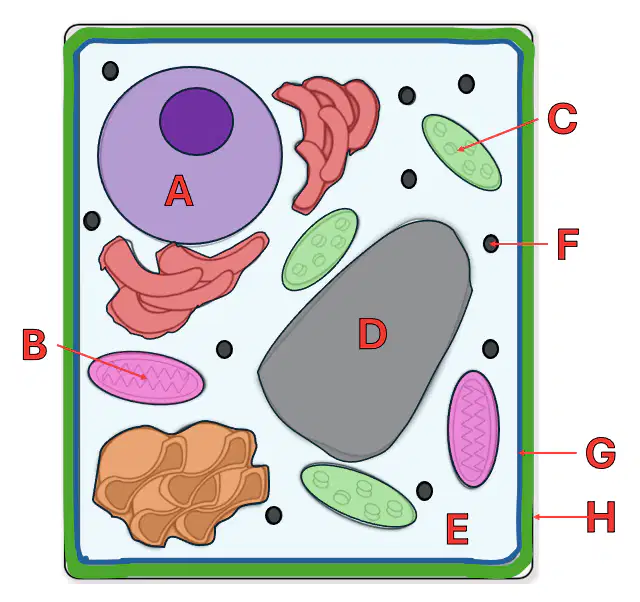
What organelle is letter A?

a)

Nucleus

b)

Vacuole

c)

Cell Wall

d)

Mitochondria

25.

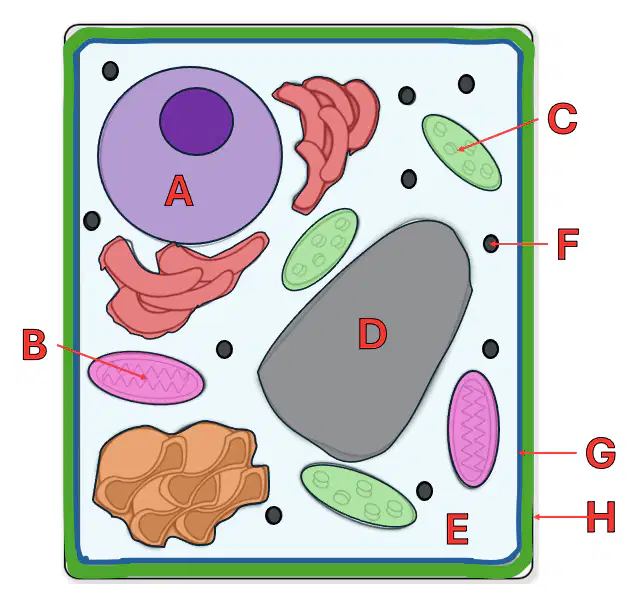
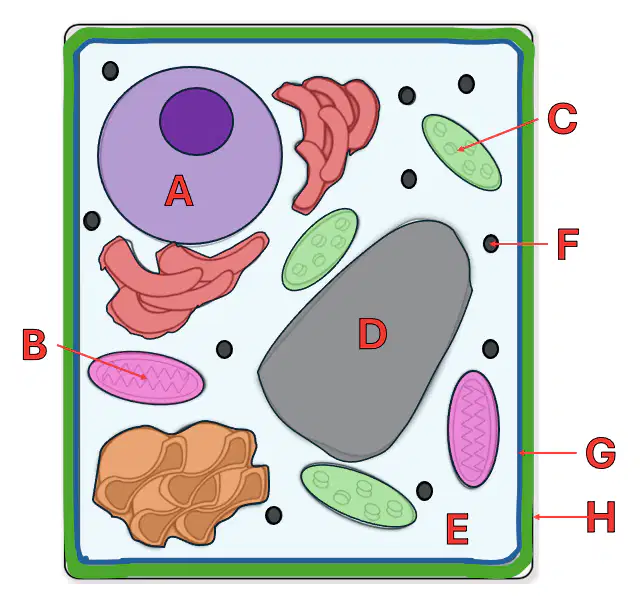
What organelle is letter A?

a)

Nucleus

b)

Vacuole

c)

Cell Wall

d)

Mitochondria

26.

What organelle is letter B?

a)

Nucleus

b)

Vacuole

c)

Cell Wall

d)

Mitochondria

27.

What organelle is letter B?

a)

Nucleus

b)

Vacuole

c)

Cell Wall

d)

Mitochondria

28.

What organelle is letter C?

a)

Nucleus

b)

Lysosome

c)

Cell Wall

d)

Ribosome

29.

What organelle is letter C?

a)

Nucleus

b)

Chloroplast

c)

Cell Wall

d)

Ribosome

30.

What organelle is letter D?

a)

Nucleus

b)

Lysosome

c)

Cell Wall

d)

Vacuole

31.

What organelle is letter D?

a)

Nucleus

b)

Lysosome

c)

Cell Wall

d)

Vacuole

32.

What organelle is letter E?

a)

Cell Membrane

b)

Cytoplasm

c)

Endoplasmic Reticulum

d)

Vacuole

33.

What organelle is letter E?

a)

Cell Membrane

b)

Cytoplasm

c)

Endoplasmic Reticulum

d)

Vacuole

34.

What organelle is letter F?

a)

Cell Membrane

b)

Cytoplasm

c)

Ribosome

d)

Vacuole

35.

What organelle is letter F?

a)

Cell Membrane

b)

Cytoplasm

c)

Ribosome

d)

Vacuole

36.

What organelle is letter G?

a)

Cell Membrane

b)

Cytoplasm

c)

Ribosome

d)

Vacuole

37.

What organelle is letter G?

a)

Cell Membrane

b)

Cytoplasm

c)

Ribosome

d)

Vacuole

38.

What organelle is letter H?

a)

Cell Wall

b)

Cytoplasm

c)

Endoplasmic Reticulum

d)

Lefty Lane

39.

Which of the following slides show NON-LIVING organisms? (Select 3)

a)

Slide B

b)

Slide E

c)

Slide F

d)

Slide A

e)

Slide C

40.
How do living things compare to nonliving things at a microscopic scale?
a)
Claim A: On a microscopic scale, living things and nonliving things are made up of cells.
b)
Claim B: On a microscopic scale, nonliving things are more complex than living things. However, living things can grow and nonliving things cannot.
c)
Claim C: On a microscopic scale, only living things are made up of cells, but both living and nonliving things have structures that can only be seen with a microscope.
41.
How do human organs compare to each other at a microscopic scale?
a)
Claim A: On a microscopic scale, the cells of human organs have different shapes and sizes and have different specialist roles.
b)
Claim B: On a microscopic scale, the cells of human organs have different sizes, but are all the same shape.
c)
Claim C: On a microscopic scale, the cells of human organs are all the same size, but have different shapes.
42.
How do humans compare to plants at a microscopic scale?
a)
Claim A: On a microscopic scale, human and plant cells are identical to each other.
b)
Claim B: On a microscopic scale, human and plant cells are different shapes and sizes.
c)
Claim C: On a microscopic scale, the cells of plants are all identical, and human cells have different shapes and sizes.
43.
How do microorganisms compare to human samples?
a)
Claim A: On a microscopic scale, microorganisms are made of one giant cell, and humans are made of many tiny cells. They are both made of cells.
b)
Claim B: On a microscopic scale, the cells of microorganisms cannot carry out processes, but human cells can. They are both made of cells.
c)
Claim C: On a microscopic scale, microorganisms and humans are both made of cells. However, humans are made of many different types of cells.
44.
Renee is designing an investigation using a microscope to COMPARE cells in different living things.What should be her MAIN consideration when designing the investigation?
a)
a. The number of cells collected within each sample, so that the student can record the total cells
b)
b. The variety of living things selected, so the student can examine the cells of many living things
c)
c. The temperature of the lab during the investigation, so the student can control how the environment affects the cells
d)
d. The style of the microscope to examine the cells, so the student can take pictures of the slides
45.
What evidence do you have to support the claim that the body is a grouping of systems working together?
a)
The body is made of different systems like the respiratory, digestive, and nervous system. These systems work together because a problem with one system affects others. For example, breaking a bone in your skeletal system also means the muscles around it can‘t effectively do their job of moving .
b)
The body is made of different systems like the respiratory, digestive, and nervous system. However, these systems are completely isolated meaning they do not work together. There is no evidence to support their interaction.
c)
The body is made up of only one complete system- the body system. There are lots of tiny incomplete systems like cellulose and protein that work together so the body can move. However, all other systems work independently and do not need to work together for you to survive.
46.
Students in three Grade 6 classes are currently experiencing similar symptoms. The data shows how many students are sick in each class. The school is trying to figure out if students are experiencing seasonal allergies, or if bacteria are spreading. What evidence from cells or body systems would you collect to determine the cause of the illness?
a)
I would collect tissue samples from their lungs to see if they have a foreign body stuck inside like a pea.
b)
I would collect cheek swabs from their mouth and look for the presence of bacteria or a virus that may be making them sick.
c)
I would collect historical data from the area to see what illnesses had been spread to their ancestors.
47.

Which of the following slides show evidence of UNICELLULAR organisms? (Select 2)

a)

Slide C

b)

Slide D

c)

Slide E

d)

Slide F

e)

Slide H

48.
Finish the sentences using the answer choices: Living things 1:[have / do not have] cells. Nonliving things 2:[have / do not have] cells.
a)
1 have; 2 have
b)
1 have; 2 do not have
c)
1 do not have; 2 do not have
d)
1 do not have; 2 have
49.
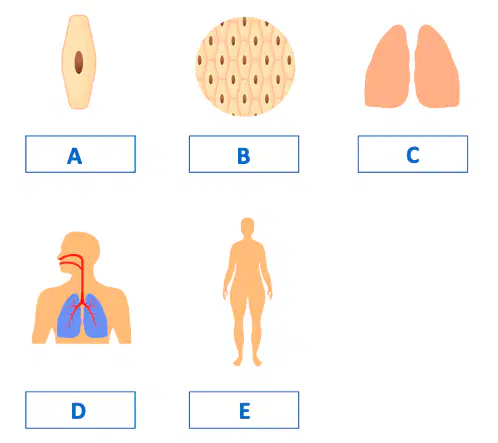
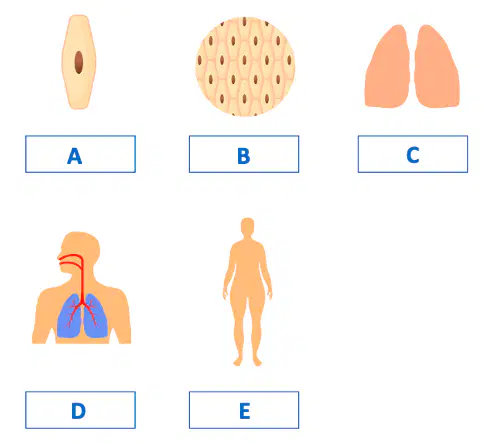
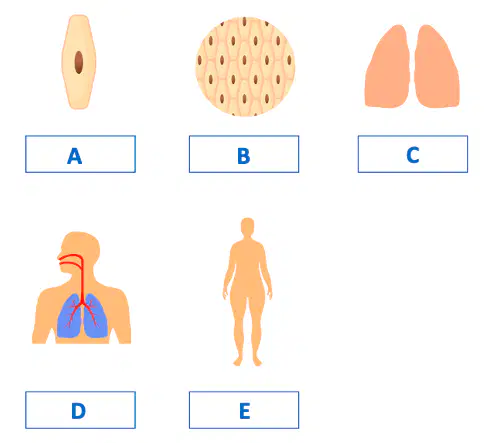
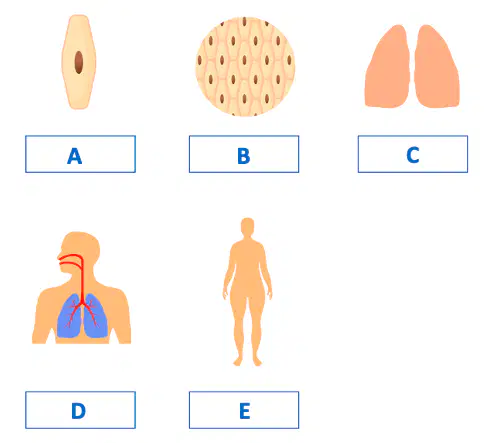
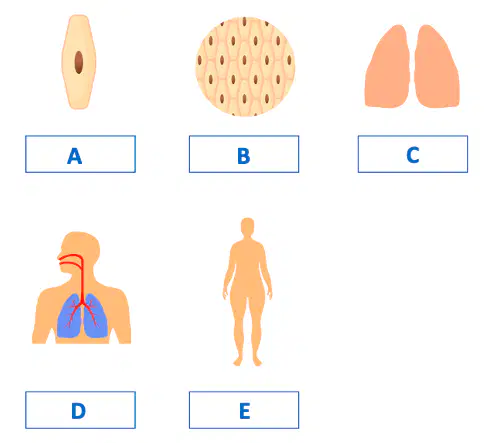
The following images show the relationship between components of a body system in the human body. What level of organization is shown in letter A?
a)
Cell
b)
Tissue
c)
Organ
d)
Organ System
e)
Organism (complete living thing)
50.
The following images show the relationship between components of a body system in the human body. What level of organization is shown in letter B?
a)
Cell
b)
Tissue
c)
Organ
d)
Organ System
e)
Organism (complete living thing)
51.
The following images show the relationship between components of a body system in the human body. What level of organization is shown in letter C?
a)
Cell
b)
Tissue
c)
Organ
d)
Organ System
e)
Organism (complete living thing)
52.
The following images show the relationship between components of a body system in the human body. What level of organization is shown in letter D?
a)
Cell
b)
Tissue
c)
Organ
d)
Organ System
e)
Organism (complete living thing)
53.
The following images show the relationship between components of a body system in the human body. What level of organization is shown in letter E?
a)
Cell
b)
Tissue
c)
Organ
d)
Organ System
e)
Organism (complete living thing)
54.
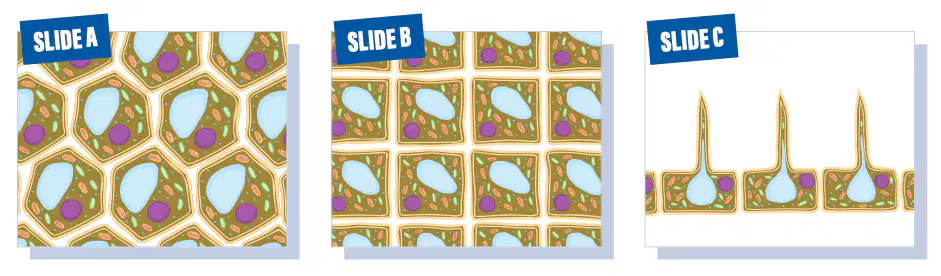
A new discovery Scientists need your help with a paper they plan to publish. The paper is about a new organism they’ve discovered. In this paper, they want to discuss what type of organism it is and describe how it functions. First, the scientists need you to examine some cell samples to help confirm what type of organism they have found. The samples they collected are shown below. Images were taken using a microscope. The scientists use this data to confirm that the organism they discovered is a living thing. How do the photos they collected provide evidence that they have discovered a living organism? (1 paragraph minimum).
4 lines
55.

Doctors use many methods to determine why a patient is sick. Match statements to the different types of evidence from cells doctors can use to figure out why someone is sick:

Evidence for different types of cells.

a)

Different types of cells have different functions and look different

b)

Living things are made of cells and nonliving things are not. A sample could include nonliving things like dust in a lung tissue sample.

c)

There could be fungi, parasites, or unicellular organisms like bacteria in the sample. These would look different from the patient's cells.

d)

There are not different types of cells. All have the same size and shape regardless of organism.
56.

Doctors use many methods to determine why a patient is sick. Match statements to the different types of evidence from cells doctors can use to figure out why someone is sick:

Evidence of other organisms in the body.

a)

Different types of cells have different functions and look different

b)

Living things are made of cells and nonliving things are not. A sample could include nonliving things like dust in a lung tissue sample.

c)

There could be fungi, parasites, or unicellular organisms like bacteria in the sample. These would look different from the patient's cells.

d)

There are not different types of cells. All have the same size and shape regardless of organism.
57.

Doctors use many methods to determine why a patient is sick. Match statements to the different types of evidence from cells doctors can use to figure out why someone is sick:

Evidence between living and nonliving things.

a)

Different types of cells have different functions and look different

b)

Living things are made of cells and nonliving things are not. A sample could include nonliving things like dust in a lung tissue sample.

c)

There could be fungi, parasites, or unicellular organisms like bacteria in the sample. These would look different from the patient's cells.

d)

There are not different types of cells. All have the same size and shape regardless of organism.
58.
ALL living things have 3 main traits. Select the 3 traits below:
a)
They grow
b)
They move
c)
They take in nutrients
d)
They reproduce
e)
They send brain waves
59.
What is the difference between dead and non-living?
a)
If something is dead, it was once living. If something is non-living, it has never been alive and will never be alive.
b)
If something is non-living it was once living. If something is dead, it has never been alive and will never be alive.
c)
There is no difference. Dead and non-living mean the same thing in biology.
60.
What is the correct order of the hierarchy of life from the smallest unit of life to the largest?
a)
tissue, organ system, organism, cell, organ
b)
cell, organism, organ system, organ, tissue
c)
cell, cells, tissue, tissues, organisms, organs, organ, systems, organ systems
d)
Cell, tissue, organ, organ system, organism
61.
The basic unit of life
a)
cell
b)
tissue
c)
organ
d)
organ system
e)
organism
62.
A living thing that carries out all of life's functions
a)
cell
b)
tissue
c)
organ
d)
organ system
e)
organism
63.
A group of specialized cells that work together for a particular function
a)
cell
b)
tissue
c)
organ
d)
organ system
e)
organism
64.
a distinct structure made up of different tissues that have a specific function
a)
cell
b)
tissue
c)
organ
d)
organ system
e)
organism
65.
a collection of organs that carry out specific functions within an organism
a)
cell
b)
tissue
c)
organ
d)
organ system
e)
organism
66.
What may happen to the human body when one body system malfunctions?
a)
the other systems in our body would most likely behave normally and not be affected by the malfunctioning system
b)
when any system malfunctions, only the skeletal system works harder to make up for it
c)
when one system malfunctions, it can affect other body systems or even the whole body
d)
the entire body immediately stops working until the malfunctioning system is cured
67.
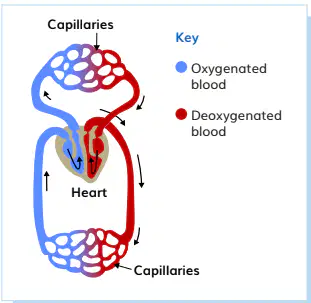
When you exercise, you heart rate and breathing rate ___(1)____ because your muscles need more ___(2)____.
a)
1- increase, 2- carbon dioxide
b)
1- increase, 2- oxygen
c)
1- decrease, 2- water
d)
1- decrease, 2- sunlight
68.
The model in the photo shows two body systems interacting. Which two body systems are interacting in this model?
a)
Circulatory and nervous
b)
Muscular and respiratory
c)
Nervous and muscular
d)
Respiratory and circulatory
69.
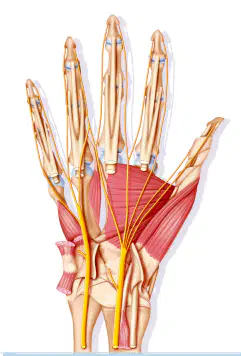
What are 2 of the main body systems involved when a hand picks up an object?
a)
Muscular
b)
Digestive
c)
Nervous
d)
Excretory
70.
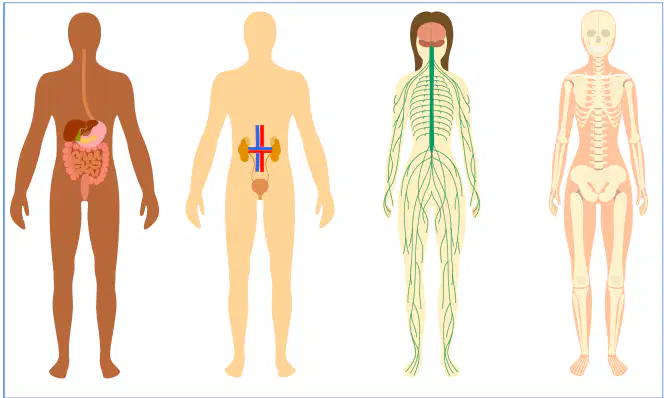
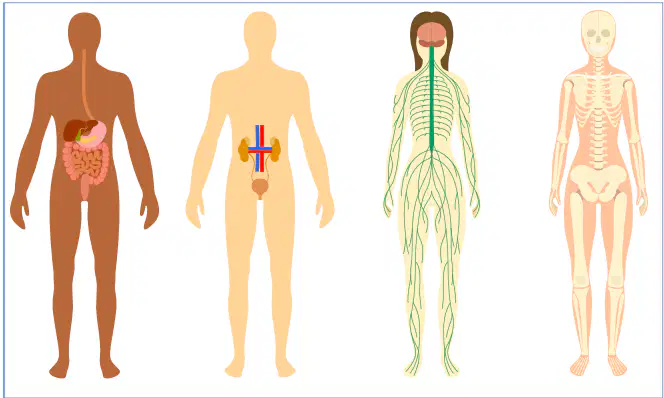
Select the correct system. Use the photo to help you. This system is the framework of the body, protects and supports body tissues and internal organs. Also creates blood cells.
a)
Digestive
b)
Excretory
c)
Nervous
d)
Skeletal
71.
Select the correct system. Use the photo to help you. This system contains organs responsible for the absorption of food for the purposes of energy release
a)
Digestive
b)
Excretory
c)
Nervous
d)
Skeletal
72.
Select the correct system. Use the photo to help you. This system causes a network of nerve cells and fibers that transmit nerve impulses between parts of the body
a)
Digestive
b)
Excretory
c)
Nervous
d)
Skeletal
73.
The heart and appendix are both organs that are part of different body systems. You already know what the heart does. The appendix is a finger-shaped tube attached to the large intestine and its function is uncertain. Many people in the United States live without an appendix. Doctors develop the argument: “You can survive without an appendix but not without a heart.” Support their argument by using evidence to explain why you can’t live without a heart. (1 paragraph minimum).
4 lines