
 Worksheets
ANW 03/04/24 Linear, Quadratic, Exponential Assignment
Total questions: 29
Worksheet time: 2hrs 32mins

Match the following functions to their represented regression equation.
Linear Function
y=mx+b
Quadratic Function
y=ax2+bx+c
Exponential Function
y=abx

Match the correct type of function that appears to best fit the data for each graph shown.

Exponential

Linear

Quadratic
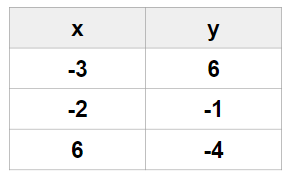
Write the linear regression equation for the following data points. Round to the nearest hundredth.
y=−0.83x+0.61
y=0.83x+0.63
y=0.83x+−0.8
a2+b2=c2
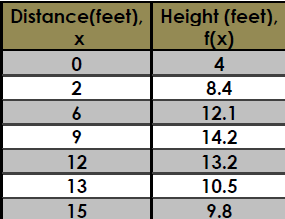
Find the quadratic equation for the relationship of the horizontal distance and the height of the ball.
-18x2 + 2.11x + 4.21
-.06x2 +1.06x + 7.9
-6x2 +1.06x + 79
-.12x2 + 2.11x + 4.22
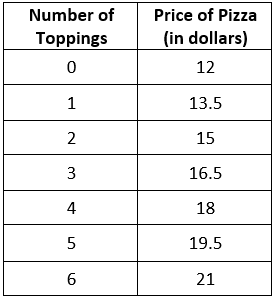


This is a _______________ function.
Linear
Exponential
Quadratic

This is a ________________ function.
Linear
Exponential
Quadratic

This is a _______________ function.
Linear
Exponential
Quadratic

This is a _______________ function.
Linear
Exponential
Quadratic


y=x2
What type of equation is the above?
exponential
linear
quadratic
neither

Linear
Quadratic
Exponential
This equation y=x2+4x−12 is an example of a
(a) equation.

Organize these options into the right categories.
f(x)=3x+2
f(x)=4(2)x+1
y=5x
y=7(.25)3x
f(x)=2
y=4x2+2x−1
Organize these options into the right categories.


Organize these options into the right categories.


Labels the parts of the parabola
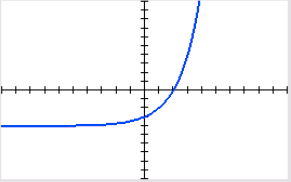
What is the y-intercept of this function?
(0,0)
(0,1)
(-3,0)
(0,-3)
Is the equation linear, exponential, or quadratic?
y = 2x+ 4
Linear
Exponential
Quadratic
None of the above
Quadratic equations take the shape of a _______ when graphed.
parabola
straight line
snaked line
elliptical
MATCH TABLE GRID EXAMPLE 1
Which of the relations shown represent y as a function of x?
Select ONE correct answer in each row.
Identify the following characteristics of a parabola
Axis of Symmetry
y-intercept
Roots/Zeros/Solutions
Vertex

The values of the table represents a linear relationship between x and y.
What is the rate of change of y with respect to x?

The graph of linear function g passes through the points (-7, -4) and
(7, 6), as shown. What are the slope and y-intercept of the graph of g?
The slope is 75, and the
y-intercept is -1.
The slope is 75, and the
y-intercept is 1.
The slope is 57, and the
y-intercept is -1.
The slope is 57, and the y-intercept is 1.
What is the solution to:
4(y−3)+19=8(2y+3)+7 ?
HINT: Use nSolve

