
 Worksheets
Product and Service Management
Total questions: 56
Worksheet time: 43mins
What is product/service management?
A) A process focused solely on the pricing of products.
B) A marketing function that involves obtaining, developing, maintaining, and improving a product or service mix in response to market opportunities.
C) A financial strategy for maximizing stock value.
D) A customer service protocol for handling complaints and returns.
Which of the following is NOT one of the activities involved in product/service management?
Discovering new-product opportunities
Developing marketing plans and strategies for products
Coordinating the product mix
Increasing the price of products annually
What is product planning?
The process of deciding on a marketing strategy
The decisions made about what features should be used in the selling of a business's products and services
The financial planning for product development
The distribution methods for products
Which of the following is NOT a decision related to product planning?
Packaging
Labeling
Market research
Design
Why should companies consider the benefits that appeal to the consumer?
Because it increases the product's technological advancement
Because it simplifies the product design
Because customers buy benefits, not just the product itself
Because it reduces the cost of the product
What does the term "Product Mix" refer to in a business context?
The marketing strategies used for selling products
The combination of all marketing elements
The total number of products a company is capable of producing
All of the products a company makes or sells
How is "Product Width" defined in the context of a product mix?
The number of units sold of each product type
The number of different product lines a business manufactures or sells
The physical size of the product packaging
The number of countries in which the product is sold
What is the first step in the 7 Steps of Developing New Products?
Screen ideas
Generate ideas
Test the product
Evaluate customer acceptance
What is the final step in the 7 Steps of Developing New Products?
Test the product
Introduce the product
Evaluate customer acceptance
Develop the product
What is the focus during the Growth stage of the Product Life Cycle?
Decreasing production costs
Drawing attention to the product
Focusing on customer satisfaction
Deciding whether to continue
What does Gap refer to in the context of finding opportunities?
The difference between what is currently available and what is needed/desired
The physical space between two objects
A break or pause in a process
The time interval between two events
Which of the following is NOT one of the aspects mentioned in the PRODUCT OPPORTUNITY GAP diagram?
Social trends and drivers
State of the economy
Level of disposable income
Political stability
True or false: the FIRST step in new product development is screening ideas.
True
False
what is the stage in the product life cycle when people get bored with the product?
Introduction
Growth
Maturity
Decline
What is product management? (choose 2)
business
product strategy
prdocut development
market
To meet the needs of its customers and help it achieve its company goals, a drugstore offers a large assortment of products, known as its product ______.
depth.
mix
width
consistency
At a grocery store, you might decide to buy a bottle of Coca-Cola, a DiGiorno frozen pizza, and a can of Dole pineapple chunks. Each of these purchases is a product _____.
width
mix
item
line
Which of the following is an example of a product line:
Kraft cheeses
A1 Steak Sauce
Philadelphia Cream Cheese
Capri Sun
A technology company that offers its products in many different colors and at several different price points likely has a __________ product mix.
shallow
narrow
broad
deep
Which of the following is a reason that a business would make changes to its products:
To keep up with changing consumer preferences
To make room for other products
To spread risk over a wider area
To predict the success of the changed product
A hair salon recently added manicure/pedicure services to its product mix. This strategy is called
contraction
trading up.
expansion
alteration
A fast-food company offers burgers, chicken nuggets, pizza, and French fries. Eventually, the company realizes that the pizzas are not profitable and decides to stop selling them. Which product-mix strategy is the company using?
Trading down
Trading up
Alteration
Contraction
Management of the company is trying to make the decision on the innovation of their service and they have taken the decision on introducing the new range of athletic wear and equipment. What marketing mix are they using:
Product
Place
Price
Promotion
What is the definition of a product line?
A marketing strategy used by a company.
A group of related products offered by a company.
A group of unrelated products offered by a company.
A single product offered by a company.
What is the definition of a product mix?
Total number of product lines offered by a company
The profit margin of a company
The location of a company's headquarters
Total number of employees in a company
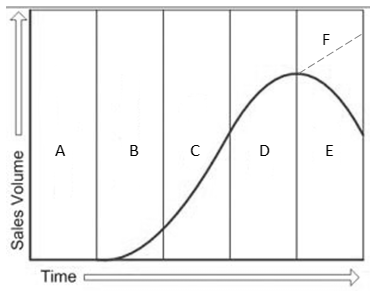
In this stage:
•Sales peak
•Low cost per customer
•High profits
•Middle majority are targeted
•Competition begins to decline
Product development
Introduction
Growth
Maturity
Decline
In this stage:
•Declining sales
•Low cost per customer
•Declining profits
•Laggards are targeted
•Declining competition
Product development
Introduction
Growth
Maturity
Decline
In this stage:
•Rapidly rising sales
•Average cost per customer
•Rising profits
•Early adopters are targeted
•Growing competition
Product development
Introduction
Growth
Maturity
Decline
In this stage:
•Low sales
•High cost per customer acquired
•Negative profits
•Innovators are targeted
•Little competition
Product development
Introduction
Growth
Maturity
Decline
Branding is
the use of a name, design, symbol, or a combination of those elements that a sports or entertainment organization uses to help differentiate its products from the competition
is a device that legally identifies ownership of a registered brand or trade name
The process of working toward maximizing recognition of a particular brand
Consumer preference for a particular brand as compared to competitor products or services
the process through which a business differentiates itself from its competitors and manages consumer perceptions concerning its identity and value
Branding Process
Co-branding
Branding
Brand Personality
the practice of two or more brands forming an alliance and producing a product which includes both brand names
Branding Process
Co-branding
Branding
Brand Personality
the practice of authorizing a third party to use a brand’s name and/or identifiers for a specified use
Trademark
Sub-brand
Licensing
AIDA
When General Mills uses Cheerios to promote a new product like apple cinnamon Cheerios is called
Mixed brand
Brand extension
Brand licensing
Publix is an example of _____________ ________________ products
Private distriputer
National brand
Generic brand
Heinz is an example of a
Private label
National brand
Generic brand
Generic brands don't have a
Product
Price
Brand name


Game Freak wish to introduce a new product into the market. First, they need to
screen ideas
brainstorm ideas
conduct business analysis
develop marketing strategy
Creativity is essential in this step of new product development.
Testing the product
Development of the product
Generating ideas
Introduction of the product
Marketers track customer responses to the product.
Evaluating customer acceptance
Developing the product
Testing the product
Testing a product proposal
Companies make plans relating to production, packaging, labeling, branding, promotion, and distribution.
Testing the product
developing the product
evaluating customer acceptance
generating ideas
A prototype is made and tested.
testing the product
evaluating customer acceptance
screening ideas
generating ideas
Eliminating possibilities until one or two ideas are selected for development.
generating ideas
screening ideas
introducing the product
evaluating customer acceptance
Involves cultural trends and observing customer behaviors.
introducing the product
evaluating acceptance
testing the product
generating ideas

