
 Worksheets
Senses Review
Total questions: 45
Worksheet time: 55mins
Taste buds are located inside raised bumps on the tongue called (a) .
Match the following types of tongue papillae to their shape and location:
mushroom-shaped
located at front of tongue
flat-shaped
located on sides of tongue
dome-shaped
located at back of tongue
cone-shaped
located on entire surface of tongue
Which of the following tongue papillae are involved with the sense of taste? (select 3)
fungiform
foliate
cicumvallate
filiform
Put the steps of tasting in order:
Food molecules are dissolved by saliva
Dissolved food molecules enter the tongue papillae and reach the taste buds
Food molecules bind to receptors on the gustatory cell hairs
Activated cells form nerve impulses carried by facial nerves
Gustatory cortex receives nerve impulses and interprets the pattern as taste
The gustatory sense involves which of the following tastes? (select all that apply)
Sweet
Sour
Salty
Bitter
Umami
Odor molecules enter through the nasal (a) where particles are filtered out. They pass through a large chamber behind the nose called the nasal (b) . The cavity acts to warm and humidify air before it passes into the (c) .
Odor molecules travel to the roof of the (a) to a region called the (b) . This structure features millions of sensory receptors called (c) . The molecules then bind to receptors found on (d) . The activated sensory receptors generate (e) .
(a) , caused by odor molecules activating sensory receptors, travel along axons to a small region called the (b) . The bulb relays the stimulus along the (c) , which travels to the (d) . A brain region called the (e) interprets the nerve impulses as smell.
Which of the following is the best definition for combinational diversity in the olfactory sense.
The olfactory system's ability to detect thousands of smells because each odorant molecule binds with multiple olfactory neurons
The olfactory system's ability to detect taste through smell because odorant molecules bind to a single neuron
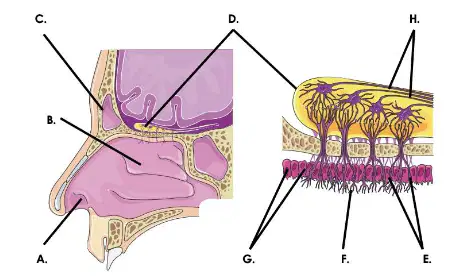
Label the diagram
A
Nasal vestibule
B
Nasal cavity
C
Sinus
D
Olfactory bulb
Label the diagram
E
Olfactory neuron
F
Olfactory cilia
G
Support cell
H
Olfactory nerve
Match the following
Mechanoreceptor
Touch
Thermoreceptor
Temperature
Nociceptor
Pain
Chemoreceptor
Chemical
Photoreceptor
Light
Label the following touch receptors from superficial to deep:
Free nerve ending
Meissner's corpuscle
Merkel's disk
Hair follicle receptor
Pacinian corpuscle

Label the diagram:
1
Free nerve ending
2
Meissner's corpuscles
3
Merkel's disk
Label the diagram:
4
Hair follicle receptor
5
Ruffini's corpuscles
6
Pacinian corpuscles
Which of the following is considered a general sense?
Sight
Hearing
Smell
Taste
Touch
Which of the following are special senses that have receptors found in the ear? (Select 2)
Sight
Hearing
Smell
Taste
Balance
A thin membrane called the (a) covers the surface of the eyeball and the inner layer of the eyelid.
(a) above the eye constantly release tears to cleanse and moisten the eye. (b) contain mucus, antibodies, and lysozyme.
Organize these options into the correct layer of the eye:
white of the eye
protects and shapes the eye
Pigmented (has color)
includes the iris and pupil
contains photoreceptors
turns light energy into nerve impulses
The (a) is made of thick, transparent tissue that covers the front of the eye.
The (b) , the colored part of the eye, is located behind the cornea. The (c) is the opening in the center of the iris through which light enters.
Which 2 structures work together to regulate light entering the eye.
Iris
Pupil
Cornea
Retina
Optic nerve
In low light environments, the pupil will be ___________________.
dilated (wide)
constricted (narrow)
neutral
In high light environments, the pupil will be ___________________.
dilated (wide)
constricted (narrow)
neutral
Which of the following is the best definition for the lens of the eye?
A transparent, semi-solid disc that directs light waves towards the retina.
Identify the two structures that help bend or flatten the lens based on the distance of the image being viewed.
In the eye, the (a) is in front of the lens and nourishes the cornea. Behind the lens is the (b) , a thick, jelly-like fluid that refracts light and fills the space between the lens and retina.
________ are extremely sensitive photoreceptors distributed all over the retina and are responsible for low-light vision in black and white.
______ are photoreceptors concentrated in the center of retina and are responsible for detection of colors.
Put the following steps in the correct order for the creation of an optic impulse
Light causes molecular changes that begin an impulse
The impulse travels through the rods & cones
The impulse travels through the bipolar neurons
The impulse travels through the ganglion cells
The impulse travels to the brain via the optic nerve
At which location in the eye provides the sharpest image?
Where the optic nerve meets the eye is the _____ _____.
(a)
When the eye is too long, it causes (a) . Scientifically known as (b) .
When the eye is too short, it causes (a) . Scientifically known as as (b) .
The ear uses ____________________ to collect and transfer sound vibrations to the auditory nerve.
mechanoreceptors
thermoreceptors
nociceptors
chemoreceptors
photreceptors
Put the following steps hearing in the correct order:
Sound waves enter the outer ear and travel down the ear canal
The tympanic membrane vibrates and moves the ossicles
The ossicles amplify the vibrations and send them to the inner ear
In the cochlea, the organ of Corti transmits the sound waves into electrical signals via sterocilia
The electrical impulse travels through the auditory nerve to the brain
Match the common name to the latin root for the ossicles:
malleus
hammer
incus
anvil
stapes
stirrup
(a) are receptor cells found in the cochlea that help to maintain static equilibrium at rest and keep our head upright.
Receptor cells ( (a) ) of the maculae are embedded in a gel-like membrane with calcium salts called (b) resting on it. When the otoliths move, the (c) send signals through the (d) to the brain that the head is moving.
The _________ ___________ are filled with fluid to help maintain dynamic equilibrium (while moving). Because the 3 canals are at right angles, all types of motion can be recognized.
semicircular canals
vestibular nerve
stereocilia
ossicles
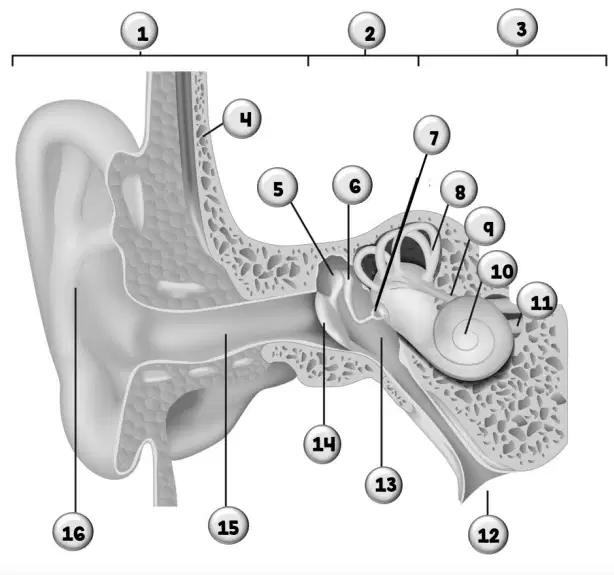
Match the number in the diagram to the correct answer:
1
Outer ear
4
Temporal bone
10
Cochlea
16
Auricle (pinna)
7
Stapes
Match the number in the diagram to the correct answer:
2
Middle ear
8
Semicircular canals
12
Auditory tube
15
Ear canal
6
Incus
Match the number in the diagram to the correct answer:
3
Inner ear
5
Malleus
9
Vestibular nerve
14
Tympanic membrane (ear drum)
11
Auditory nerve

Match the following terms to the correct number in the diagram:
sclera
1
choroid
2
retina
3
optic nerve
4
vitreous humor
5
Match the following terms to the correct number in the diagram:
cilary muscles
6
aqueous humor
8
pupil
9
lens
10
cornea
11

