
NEW
Font size
 Worksheets
RC - GEAS 2
Total questions: 50
Worksheet time: 25mins
1. In a partially elastic collision between two objects with unequal mass:
the velocity of one will increase by the amount that the velocity of the other decreases.
the momentum of one will increase by the amount that the momentum of the other decreases.
the energy of one increases by the amount that the energy of other decreases.
the total momentum of the system will decrease
2. A cylinder contains 7.0 g of nitrogen gas. How much work must be done to compress the gas at a constant temperature of 80°C until the volume is halved?
504 J
508 J
510 J
506 J
3. An ideal gas (k = 1.4), with an initial specific volume of 30 cubic meters per kilogram, experiences an isothermal compression from 200 kilopascals to 800 kilopascals. What is the final specific volume of the gas?
7.5 m³/kg
11.14 m³/kg
75 m³/kg
120 m³/kg
4. A piston and cylinder system contains 3 kg of air at 15°C. In an isothermal compression in which the final volume is one-third of the initial volume, how much boundary work has been performed?
– 272 kJ/kg
– 265 kJ/kg
– 227 kJ/kg
– 256 kJ/kg
5. The SI unit for absolute temperature is ______.
Kelvin
Celsius
Rankine
Fahrenheit
6. What is the efficiency of an air standard Brayton cycle that operates with a 4:1 pressure ratio?
43 %
33 %
53 %
35 %
7. If 4 kg of carbon monoxide gas is introduced into a 5.3 m³ vessel at 25°C, what is the pressure of the gas?
65.90 kPa
67.44 kPa
64.37 kPa
66.78 kPa
8. What properties are determined by dividing the value of an extensive property by the mass of the system?
Chemical properties
Relative properties
Specific properties
Intensive properties
9. What is the coefficient of performance of a Carnot refrigerator operating between 20°F and 75°F?
6.5
7.8
5.6
8.7
10. What properties are proportional to the mass of the system?
Intensive properties
Specific properties
Relative properties
Extensive properties
11. How much energy must be transferred through a heat interaction to raise the temperature of a 4-kilogram sample of methane in a closed system from 15°C to 35°C? Use c_v = 1.74 kJ/kg-K
34.8 kJ
139 kJ
45 kJ
180 kJ
12. Calculate the rate of black body radiation between two surfaces at 400 K and 300 K with an area of 05 m².
500 W
575 W
525 W
550 W
13. Which of the following situations is an example of change in momentum?
A hiker walks through a spider’s web.
A baseball is hit by a bat.
A car drives over a pebble.
A volleyball hits a mosquito in the air.
14. 1 atomic mass unit (u) is equal to how many kilograms?
1.66 x 10¯²⁶
1.66 x 10¯²⁵
1.66 x 10¯²⁸
1.66 x 10¯²⁷
15. What is the molar mass of the following mixture where the composition is defined in terms of mole fractions? Argon – 0.28, Helium – 0.34, Neon – 0.38. Given: Molar mass of argon 40 g/mol, molar mass of Helium = 4 g/mol and molar mass of neon = 20 g/mol
25 g/mol
4 g/mol
40 g/mol
20 g/mol
16. One kilogram of air undergoes an isometric process, starting from 200°C and 600 kilopascals, in which the temperature drops to 110°C. What is the final pressure?
1,091 kPa
486 kPa
330 kPa
741 kPa
17. Which of the following best describe a perfectly inelastic collision free of external forces?
The linear momentum is never conserved.
Kinetic energy is sometime conserved.
Kinetic energy is always conserved.
Kinetic energy is never conserved
18. A 70-kg man is standing in a 20-kg boat. The man steps to the right thinking he is stepping out onto the dock. However, the following will actually happen (ignore the friction of the water or air on the boat or the man):
None of the choices
The man only moves a short distance to the right while the boat moves a larger distance to the left.
The boat doesn`t move and the man moves to the right
The man actually stays still while the boat moves toward the left.
19. For uniform circular motion, the net force:
Is zero.
Points toward the center of the circle.
Is tangent to the circle
Points toward the outside of the circle.
20. What is the SI unit of pressure?
The N-m²
The atmosphere
The psi
The Pascal
21. Momentum is:
The area under the force curve in a force-versus-time graph.
Mass times velocity.
One-half mass times speed-squared.
Velocity per unit mass
22. The most general thermodynamic process is:
Isothermal
Polytropic
Isochoric
Isentropic
23. What properties are independent of the mass of the system?
Specific properties
Intensive properties
Extensive properties
Independent properties
24. All real processes are _____ processes.
irreversible
isometric
adiabatic
reversible
25. A beaker contains 0.1 kg of water, initially at room temperature (20°C). If the specific heat of water is 4.2 kJ/kg × °C and the latent heat of vaporization is 2,260 kJ/kg, how much thermal energy would the water need to absorb to turn completely to steam?
2.4 cm
2.2 cm
2.0 cm
1.8 cm
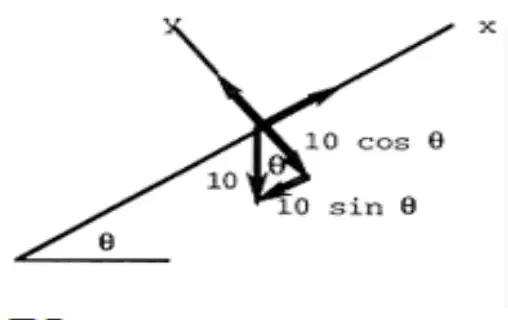
1. The angle of repose is the maximum angle to which a plane can be tilted before a block on the plane will begin to slide. If the coefficient of friction is 0.25 and a block weighs 10 lbs, what is the angle of repose?
15.09ᵒ
13.66ᵒ
14.04ᵒ
12.81ᵒ
2. A fixed quantity of gas occupies a volume of 2.0 L at a temperature of 20ᵒC and a pressure of 1.0 atm. Find the volume that this gas would occupy at 40ᵒC and 1.75 atm pressure.
1.22 L
1.42 L
1.32 L
1.52 L
3. 1 pound (as a unit for force) is equal to ____ N.
3.33
2.25
1.45
4.45
4. The thermal behavior of water is characterized by the value of its _____.
specific heat
heat constant
heat density
thermal index
5. A 50 lb block is projected up a 23ᵒ incline. The initial velocity of the block is 20 fps. If the block moves 10 ft up the incline, what is the coefficient of friction between the block and the plane?
0.35
0.25
0.45
0.55
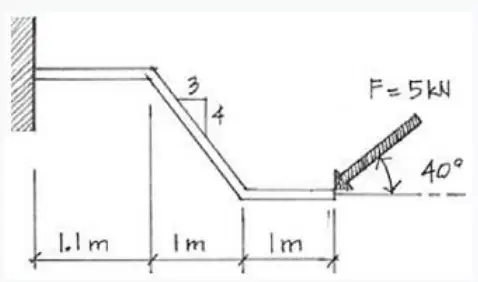
6. Find the resultant moment at A
– 17.43 kN-m
– 18.60 kN-m
– 15.04 kN-m
– 16.90 kN-m
7. The transfer of energy to a system by the application of a force is called
Dot product
Energy transformation
Work
Power
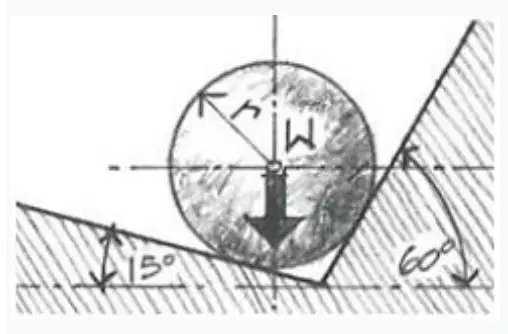
8. Given a sphere of radius 0.15 m and weight of 2.5 kN. Find the forces on the inclined surfaces as shown.
A = 2.24 kN, B = 0.67 kN
A = 2.43 kN, B = 0.67 kN
A = 2.24 kN, B = 0.87 kN
A = 2.43 kN, B = 0.87 kN
9. A reversible adiabatic process is called _____.
Isentropic
Isothermal
Polytropic
Isobaric
10. A liquid has begun to freeze. A salt is added to the liquid. When the salt is dissolved:
The rate of solidification becomes zero
The rate of solidification increases
The liquid warms up
The salt settles to the bottom of the tank
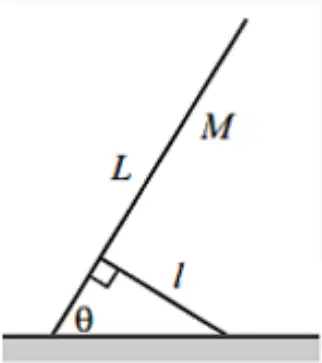
11. A ladder of length L and mass M has its bottom end attached to the ground by a pivot. It makes an angle θ with the horizontal, and is held up by a massless stick of length l which is also attached to the ground by a pivot as shown in the figure. The ladder and the stick are perpendicular to each other. Find the force that the stick exerts on the ladder.
(Mg)(sin θ)/2lL
(Mgl)(sin θ)/2L
(MgL)(sin θ) / 2l
(MLsin θ)/2lg
12. A person standing on a horizontal floor feels two forces: the downward pull of gravity and the upward supporting force from the floor. These two forces:
have unequal magnitudes and form an action/reaction pair
have unequal magnitudes and do not form an action/reaction pair
have equal magnitudes but do not form an action/reaction pair
have equal magnitudes and form an action/reaction pair
13. A box of mass 2 kg is placed in a tabletop is attached to another box of mass 10 kg that hangs over a frictionless and massless pulley. If the tabletop has a coefficient of kinetic friction of 0.5, determine the tension in the cord once the blocks are released from rest.
20 N
25 N
30 N
35 N
14. Two objects move toward each other, collide, and separate. If there was no net external force acting on the objects, but some kinetic energy was lost, then:
the collision was elastic and total linear momentum was not conserved
the collision was not elastic and total linear momentum was not conserved
the collision was not elastic and total linear momentum was conserved
the collision was elastic and total linear momentum was conserved
15. One mole is equal to how many particles?
5.61213169 x 10²³
6.02214179 x 10²³
7.44503197 x 10²³
8.13215859 x 10²³
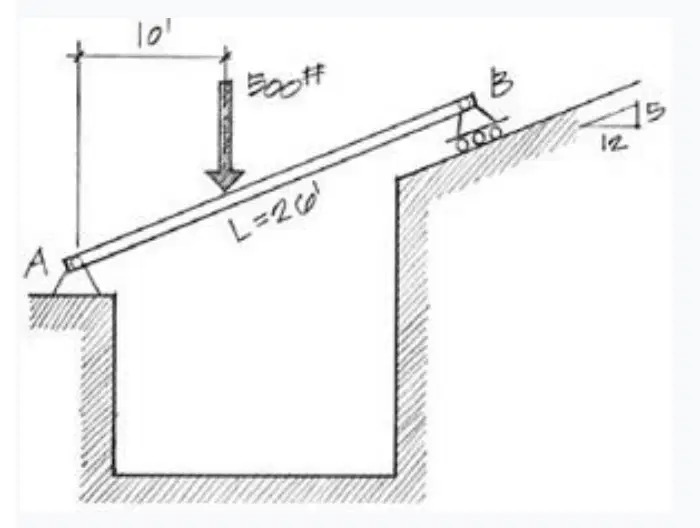
16. Determine the support reactions at A and B.
Ax = 74#, Ay = 177.5#, Bx = 74#, By = 322.5#
Ax = 177.5#, Ay = 74#, Bx = 322.5#, By = 74#
Ax = 74#, Ay = 177.5#, Bx = 322.5#, By = 74#
Ax = 74#, Ay = 322.5#, Bx = 74#, By = 177.5#
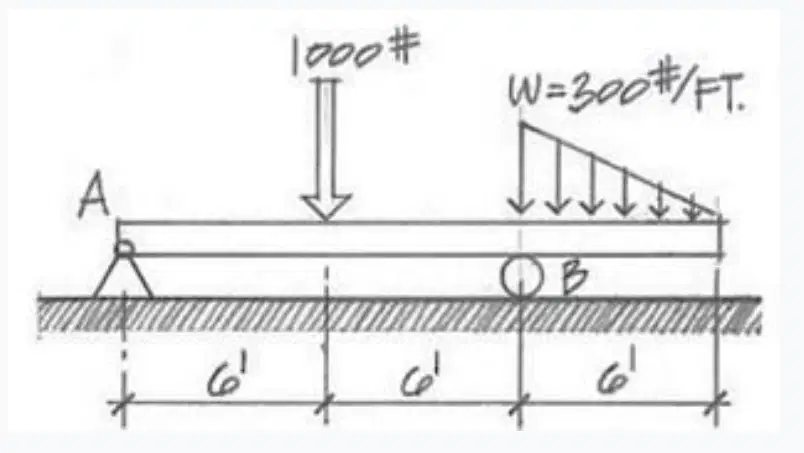
42. Solve for the support reactions at A and B.
Ax = 0, Ay = 1550#, By = 350#
Ax = 0, Ay = 350#, By = 1550#
Ax = 0, Ay = 300#, By = 1650#
Ax = 350#, Ay = 0, By = 1650#
18. An 80 kg stuntman jumps out of a window that’s 50 m above the ground. How fast is he falling when he reaches ground level?
70 mph
90 mph
80 mph
60 mph
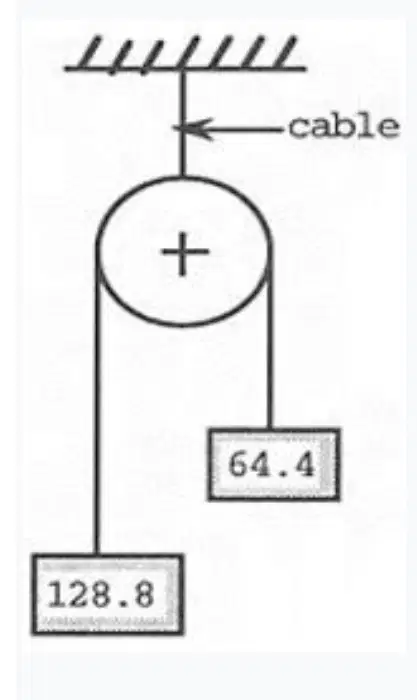
19. The cable is weightless and the pulley weightless and frictionless as shown in the figure. The tension in the cable is:
173.54
175.90
177.56
171.76
20. The coefficient of static friction between a box and a ramp is 0.5. The ramp’s incline angle is 30°. If the box is placed at rest on the ramp, the box will
not move
accelerate briefly down the ramp but then slow down and stop
move with constant velocity down the ramp
accelerate down the ramp
21. If the distance between two point particles is doubled, then the gravitational force between them _____.
Increases by a factor of 4
Increases by a factor of 2
Decreases by a factor of 2
Decreases by a factor of 4
22. A ball of mass m traveling horizontally with velocity v strikes a massive vertical wall and rebounds back along its original direction with no change in speed. What is the magnitude of the impulse delivered by the wall to the ball?
2mv
0.5mv
4mv
mv
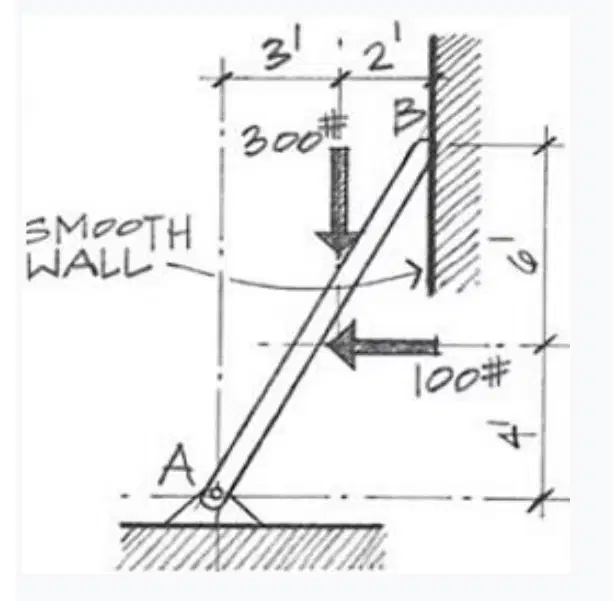
23. Wall B is a smooth, frictionless wall. Find the vertical and horizontal components of the reactions of A and B.
Ax = 300#, Ay = 150#, Bx = 50#
Ax = 300#, Ay = 50#, Bx = 150#
Ax = 150#, Ay = 300#, Bx = 50#
Ax = 150#, Ay = 300#, Bx = 150#
24. The room temperature is 68ᵒF. What is this temperature in kelvins?
292 K
293 K
290 K
291 K
25. Calculate the root-mean-square speed of H₂ molecules in meters per second at 20ᵒC.
1.90 x 10³ m/s
1.30 x 10³ m/s
1.50 x 10³ m/s
1.70 x 10³ m/s

