
Font size
 Worksheets
Environmental Science Final
Total questions: 111
Worksheet time: 2hrs 3mins


1?
1?
Capillary Action
The property of water that allows ice to float on the surface of liquid water
The property of water that allows it to dissolve polar substances
When water molecules stick to other surfaces
The property of water that allows water to move up a thin tube (or the stem of a plant) by itself


An electronic device for solving mathematics problems.
microscope
meter stick
calculator
hand lens
hand-held instrument used to make an item look larger
hand lens
meter stick
microscope
thermometer
an optical instrument used for viewing very small objects, such as mineral samples or animal or plant cells, typically magnified several hundred times.
Thermometer
Microscope
Compass
Stopwatch
a tool used to measure length, or distance for larger objects. (Meter)
Meter Stick
Metric Ruler
Graduated Cylinder
Stopwatch
An instrument used to measure temperature of air and most liquids.
Meter Stick
Metric Ruler
Thermometer
Stopwatch
Instrument used to measure mass. Uses three weights and beams to calculate mass.
Triple Beam Balance
Compass
Digital Scale
Stopwatch
any material that attracts iron and materials that contain iron
Triple Beam Balance
Magnet
Digital Scale
Stopwatch
Used to protect eyes in the science lab.
Lab Apron
Triple Beam Balance
Test Tube
Safety Goggles
instrument used to measure volume of a liquid
Metric Ruler
Graduated Cylinder
Triple Beam Balance
Thermometer
A lab tool used to heat substances.
Metric Ruler
Graduated Cylinder
Hot Plate
Thermometer
In some areas of the world, like California and Japan, earthquakes are a common occurrence. How can this best be explained?
The strong ocean currents are undermining both areas causing earthquakes.
Both areas are located near the edge of the Pacific Ocean, the unstable sand causes earthquakes.
Both areas are subjected to strong ocean wind and waves that causes earthquakes.
Both areas are on the boundary of active plates, the motion of the plates causes earthquakes.
Alfred Wegener thought which 2 continents looked like puzzle pieces that could fit together?
Antarctica and Asia
South America and Africa
South America and Australia
Africa and Pangaea
continental
puzzle effect
Most tectonic plates have both oceanic and continental crust. How are they different?
Oceanic is thinner and less dense than continental.
Continental is thinner than more dense than oceanic.
Continental is thicker and less dense than oceanic.
Oceanic is thicker and more dense than continental.
What is CONVECTION? (Select all that apply)
The transfer of heat by the movement of a heated solid.
When heated particles become less dense and rise, then they cool off become more dense and sink.
The transfer of heat when cold matter rises and heated matter sinks.
What geologic feature will form at a hot spot?
volcano
folded mountain
deep sea trench
rift valley
What type of plate boundary creates new sea floor?
Divergent
Convergent
Transform
Subduction

What type of plate boundary is represented in the picture?
Athensphere
Divergent
Transform
Convergent

Which crust subducts because it is denser than other crust?
pizza crust
oceanic crust
continental crust
new crust
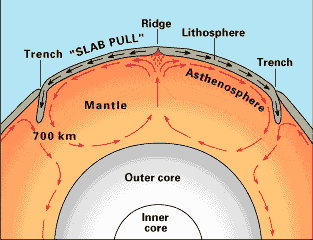
What is the source of energy that drives plate movement?
the subducton of the sea floor
the different densities of the oceanic and crustal plates
convection currents in the asthenosphere
the friction force between the plates that move past each other
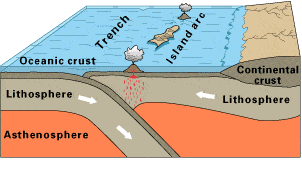
Observe this diagram of a plate boundary. One statement BEST describes what is happening. It is that
the oceanic crust is melting.
the denser ceanic crust is subducting under the less dense oceanic crust
volcanic islands are forming.
the tectonic plates are moving away from each other.
Discarded solid material is best known as -
solid waste
poison
pollutant
compost
How much solid waste is produced per day per person in the US?
4.4 pounds
4.4 tons
4.4 grams
4.4 ounces
A material that can be broken down by biological processes is considered -
nonbiodegradable
biodegradable
Products made from synthetic materials, such as polyester, plastic, and parts of electronics (E-waste), are -
nonbiodegradable
biodegradable
What is the problem with plastics?
Plastics are made from petroleum or natural gas.
In plastics, elements are put together in molecular chains that are not found in nature and cannot be broken down by microorganisms.
All of the mentioned
Some plastics may accumulate and last for hundreds or even thousands of years.
The waste produced by households and businesses is –
Miscellaneous waste
Machinery waste
Municipal waste
Multiple waste
Permanent waste-disposal facilities where wastes are put in the ground and covered each day with a layer of soil, plastic or both, are called -
Incinerators
Landfills
Trash cans
Bins
Nature’s process of recycling organic material by decomposing it into a soil-like material to fertilize soil is called -
burying
reusing
incinerating
composting
What are some ways you can reduce the amount of waste you produce?
[Select 3 that apply]
Reuse materials
recycle
compost
Put them in the garbage can
What are some benefits of reducing solid waste?
[select 3 that apply]
To reduce amount of solid waste delivered to the landfills.
To reduce amount of solid waste delivered to the incinerators.
To reduce amount of amount of pollution.
To increase costs.
Making products from recycled materials usually saves energy, water, and other resources - true or false?
True
False
Shredded paper, tea leaves, coffee grounds, yard trimmings are -
reusable
recyclable
compostable
go to the landfill
Rubber bands, books, egg cartons, grocery bags are all –
reusable
recyclable
compostable
go to the landfill
What makes up most of the water on Earth?
Salt water
Fresh water
What is one example of a body of water that is salt water?
lakes
oceans
rivers


In which part of the ocean do the greatest number of organisms live?
in the deep zone to escape predators
near the shore to burrow
close to the surface to be near the largest food source
in the open ocean to regulate their bodies in cooler temperatures

