
 Worksheets
Anatomy Nervous System Review part 1
Total questions: 99
Worksheet time: 2hrs 40mins


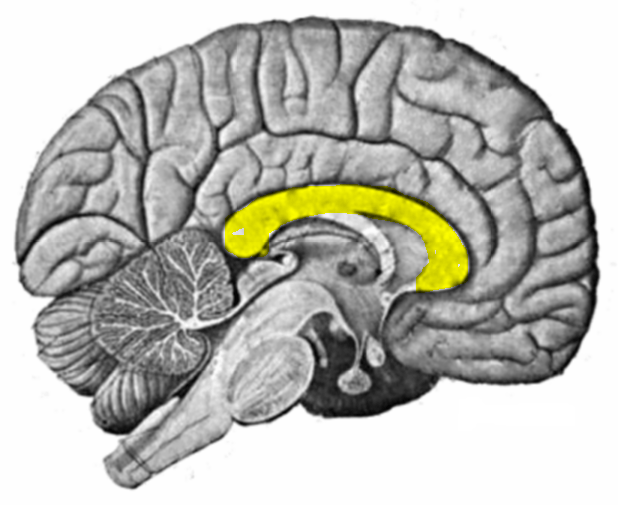
Which lobe is shown in red?
Frontal
Parietal
Occipital
Temperal

Cranial Nerves
Spinal Nerves
Autonomic Nervous System
All incoming sensory information goes first to...
the hypothalmus
the thalmus
the amygdala
the hippocampus
Select all true statements about the hypothalamus.
located below the thalamus
monitors external information
monitors internal information
regulates an individuals personal interactions

This region of the brain monitors information coming in from the outside of the body such as senses (except smell).
The Hypothalmus
The Thalamus
Hippocampus
The Cortex
Match the following
Frontal Lobe
Controls voluntary movements
Parietal Lobe
Processes sensory information
Occipital Lobe
Visual processing center
Temporal Lobe
Hearing and memory
The autonomic nervous system is a branch of your ... nervous system.
central
peripheral
What are the two divisions of the autonomic nervous system?
central and peripheral
parasympathetic and sympathetic
brain and spinal cord
nerves and ganglia
The sympathetic division is responsible for...
stress
relaxation
digestion
resting
Which one coordinates the inner organs?
somatic nervous system
autonomic nervous system
They slow heartbeat.
sympathetic nerves
parasympathetic nerves
If Jessica accidentally touches the stove while cooking and she immediately pulls her hand back, this is an example of the autonomic nervous system.
True
False
Neuron process that convey incoming messages toward the cell body.
Dendrite
Axon terminal
Axon
Synapse
What is the function of the axon of the neuron?
a long projection that conducts electrical impulses toward the cell body
a long projection that conducts electrical impulses away from the cell body
tree-like structures that receive messages from other neurons
What is the function of the synapse?
a long projection that conducts electrical impulses away from the cell body
a long projection that conducts electrical impulses toward the cell body
tree-like structures that receive messages from other neurons
tree-like structures that transfers messages to other neurons
space between the neurons where the electrical impulse "jumps"
What part of the neuron is also called the Soma. It is where the signals from the dendrites are joined and passed on.
cytoplasm
dendrite
axon
cell body
nucleus
What part of the neuron is within the cell body and maintains cell function?
cytoplasm
dendrite
axon
cell body
nucleus
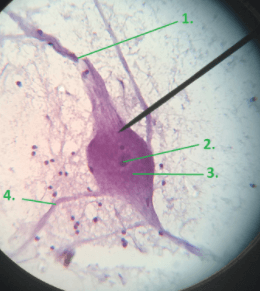
What part of the neuron is represented by #1 in the picture below?
nucleus
soma
dendrite
axon
What part of the neuron is represented by #2 in the picture below?
nucleus
soma
dendrite
axon
What part of the neuron is represented by #3 in the picture below?
nucleus
soma
dendrite
axon


What direction does an electrical signal move?
Dendrite, Cell body, Axon
Cell body, Axon, Dendrite
Cell body, Dendrite, Axon
Axon, Cell Body, Dendrite
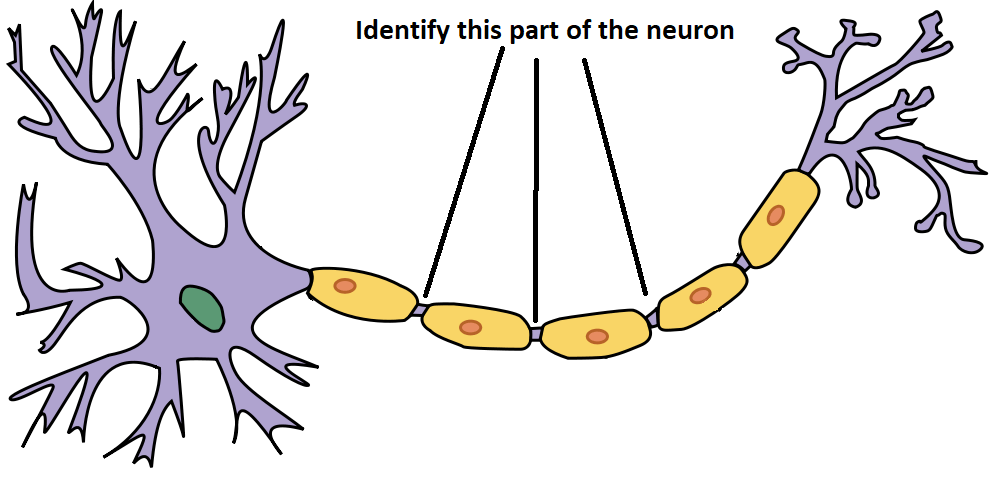
Nucleus
Cell Body
Axon
Node of Ranvier
What does the neuron's Myelin Sheath do?
Controls the actions of the neuron
Produces food for the neuron
Carries information from the cell body to other neuronsThis is a wrong answer
Surrounds and insulates the axon
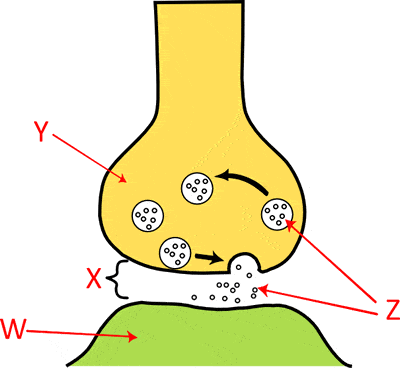
Z
Axon Terminal Button
Neurotransmitters
Dendrite
Synapse

Produce cerebrospinal fluid in the brain & spinal cord
ependymal cells
oligodendrocytes
microglia
astrocytes
Small cells that engulf and destroy microbes and cellular debris in the CNS
microglia
horns
neuroglia
astrocytes
If you picked up a hot coal, the signal from the sensory neurons in your fingertips would travel to ____________ in your spinal cord.
Sensory Neurons
Motor Neurons
Interneurons
Type of neuron that perceive information about your environment.
Motor Neuron
Interneuron
Sensory Neuron
Neurons that only have on process?
Multipolar
Bipolar
Unipolar
Unpolar
The Central Nervous System is almost all ....
Unpolar
Bipolar
Multipolar
Unipolar
Match the following

1 process

2 processes

many processes

carry impulses toward the CNS

carry impulses away from CNS
Match the following neurons of the CNS

support & anchor neurons to capillaries

provide immune response to CNS

secrete/circulate cerebrospinal fluid

provide myelin insulation to neurons

