
 Worksheets
Gene + Chromosomal Mutations
Total questions: 71
Worksheet time: 51mins
What is a gene
a section of DNA that codes for a trait
a pair of pants that are made of denim
the whole entire chromosome found in the nucleus
What is a genetic mutation
the making of a zombie
any change in the DNA base pairs
the process of duplicating the DNA in a cell
A substitution mutation occurs when
a base pair is missing from the DNA strand
a base pair is added to the DNA strand
a base pair is replaced with a different base pair
An insertion/additon mutation occurs when
a base pair is missing from the DNA strand
a base pair is added to the DNA strand
a base pair is replaced with a different base pair
A deletion mutation occurs when
a base pair is missing from the DNA strand
a base pair is added to the DNA strand
a base pair is replaced with a different base pair
A mutation that helps an organism survive and reproduce
harmful mutation
helpful mutation
neutral mutation
A mutation that decreases an organism's ability to survive and reproduce
harmful mutation
helpful mutation
neutral mutation
A mutation that has NO effect on an organism's ability to survive and reproduce
harmful mutation
helpful mutation
neutral mutation
The base pair adenine always pairs with which other base pair?
thymine
adenine
cytosine
guanine
The base pair thymine always pairs with which other base pair?
thymine
adenine
cytosine
guanine
The base pair cytosine always pairs with which other base pair?
thymine
adenine
cytosine
guanine
The base pair guanine always pairs with which other base pair?
thymine
adenine
cytosine
guanine
Mutations can be...
Harmful
Beneficial
Neutral
All of the Above

One nucleotide base is changed so only one amino acid
is affected
Frameshift Mutation
Point Mutation
Translocation
Insertion Mutation

A point mutation where one amino acid replaces an original amino acid
Silent Mutation
Nonsense Mutation
Frameshift Mutation
Substitution/Missense Mutation

A point mutation that has no effect
on the amino acid sequence
Substitution/Missense Mutation
Translocation
Silent Mutation
Nonsense Mutation

A nucleotide base is inserted or deleted shifting the entire DNA sequence. Entire protein will be changed.
Substitution Mutation
Silent Mutation
Frameshift Mutation
Translocation

A frameshift mutation where a nucleotide base
is removed from the DNA sequence.
Deletion Mutation
Substitution Mutation
Translocation
Silent Mutation

A frameshift mutation where a nucleotide base is added
to the DNA sequence
Insertion Mutation
Deletion Mutation
Substitution Mutation
Chromosomal Mutation
Mutations that involve parts of or all of
a chromosome
Replication
Deletion Mutation
Chromosomal Mutation
Transcription
Which of the following does NOT cause mutations?
Mistakes in replication
Exposure to chemicals
Inheritance of somatic (body) cells
Exposure to radiation
Mutations can benefit humans because they can:
Cause illness
Make an organism more suited to live in its environment.
Make organisms live shorter lives
Cause organisms to grow extra limbs.

3'-GCT-5'
T-G-A-C-C-A
T-G-A-C-C-A-A
AGA-TTC-ATA-GCG
Mutant-
AGA-TTC-AAT-AGC-G

Why are insertion and deletion mutations so harmful?
They change all of the codons from the mutation on down the line, which changes the amino acid sequence
They insert things that an organism doesn't need.
They often delete things that organisms need.
Insertion and deletions are not any more harmful than substitution mutations.
A point mutation where one base replaces an original base. What would happen because of this mutation (circled)?
the same amino acid would be made
a different amino acid would be made
no amino acid would be made
ATTGAGCC - Mutated
The example above is an example of a
A single base pair change (point mutation) can result in all of the following except __________.
A nonsense mutation produces _________.
A shortened polypeptide chain
A slightly altered polypeptide chain
A shift in the reading frame
A lengthened polypeptide chain

Deletion
A
B
C
Substitution
A
B
C
Insertion
A
B
C

What type of mutation is this?
Nonsense mutation
Missense mutation
Silent mutation
Frameshift mutation
True or false, mutations create genetic diversity?
True
False
A piece of a chromosome is lost
deletion
duplication
inversion
translocation
A piece of a chromosome is copied and remains within the chromosome
deletion
duplication
inversion
translocation
A piece of the chromosome detches, turns 180 degrees, and reattaches
deletion
duplication
inversion
translocation
A piece of one chromosome detaches and reattaches to a different chromosome
deletion
duplication
inversion
translocation

The chromosomal mutation shown in the image is a
deletion
duplication
inversion
translocation

The chromosomal mutation shown in the image is a
deletion
duplication
inversion
translocation

The chromosomal mutation shown in the image is a
deletion
duplication
inversion
translocation

The chromosomal mutation shown in the image is a
deletion
duplication
inversion
translocation

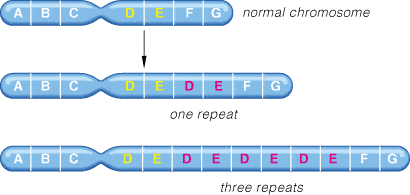

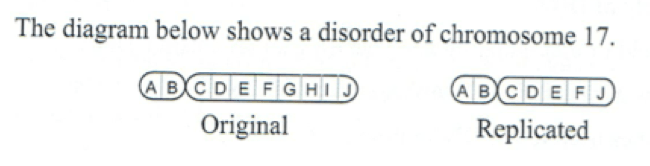

Notice the abnormal 23rd chromosome. This individual has an extra X chromosome. What type of mutation is this?
Translocation
Nondisjunction
Dublication
Inversion
Deletion
Deletion
When a segment of a chromosome breaks off.
When a segment of a chromosome breaks off, flips, and reattaches.
When a segment of a chromosome is copied or doubles.
When a segment of a chromosome breaks and attaches to a non homologous chromosome.
When entire chromosomes don't separate evenly during meiosis.
Inversion
When a segment of a chromosome breaks off.
When a segment of a chromosome breaks off, flips, and reattaches.
When a segment of a chromosome is copied or doubles.
When a segment of a chromosome breaks and attaches to a non homologous chromosome.
When entire chromosomes don't separate evenly during meiosis.
Duplication
When a segment of a chromosome breaks off.
When a segment of a chromosome breaks off, flips, and reattaches.
When a segment of a chromosome is copied or doubles.
When a segment of a chromosome breaks and attaches to a non homologous chromosome.
When entire chromosomes don't separate evenly during meiosis.
Translocation
When a segment of a chromosome breaks off.
When a segment of a chromosome breaks off, flips, and reattaches.
When a segment of a chromosome is copied or doubles.
When a segment of a chromosome breaks and attaches to a non homologous chromosome.
When entire chromosomes don't separate evenly during meiosis.
Nondisjunction
When a segment of a chromosome breaks off.
When a segment of a chromosome breaks off, flips, and reattaches.
When a segment of a chromosome is copied or doubles.
When a segment of a chromosome breaks and attaches to a non homologous chromosome.
When entire chromosomes don't separate evenly during meiosis.

Deletion
A
B
C
D
Translocation
A
B
C
D
Duplication
A
B
C
D
Inversion
A
B
C
D

Duplication
A
B
C
D
E
Inversion
A
B
C
D
E
Translocation
A
B
C
D
E

Deletion
A
B
C
D
Duplication
A
B
C
D
Inversion
A
B
C
D
Translocation
A
B
C
D

