
 Worksheets
3-22-24 Ch 5 & 6 quiz
Total questions: 125
Worksheet time: 1hrs 3mins
The moving particles that make up an object have ______ energy. *
kinetic
potential
increasing
decreasing
____ is a measure of the average kinetic energy of all the particles that make up an object.
radiation
conduction
density
If the particles that make up an object begin to move quickly, their average kinetic energy ____ and the object's temperature ____.
increases, falls
increases, rises
decreases, rises
decreases, falls
Thermal energy is the ____ of the particles in a system.
average kinetic energy
temperature
total energy
potential energy
The amount of heat needed to raise the temperature of 1 kg of a material by 1 degree Celsius.
temperature
thermal energy
heat
specific heat
______ is the thermal energy that is transformed from a material with a higher temperature to one with a lower temperature.
Work
Kinetic energy
Potential energy
The specific heat of 4 substances is given, determine which would be the best coolant in an engine? Consider all substances as liquid during operating temperatures.
Substance A = 4,200 J/kg*C
Substance B = 1,500 J/kg*C
Substance C = 250 J/kg*C
Substance D = 6,500 J/kg*C
A
B
C
D
Refer to table 1 on p 141 for specific heat of substances. What is the change in thermal energy if we have 2 kg of wood that starts at 10 degrees Celsius and is warmed to 26 degrees Celsius.
25,000 J
18,000 J
54,400 J
76,200 J
Refer to table 1 on p 141 for specific heat of substances. What is the change in thermal energy if we have 3 kg of water that starts at 0 degrees Celsius and is warmed to 25 degrees Celsius.
100,000 J
176,000 J
289,000 J
315,000 J
Refer to table 1 on p 141 for specific heat of substances. What is the change in temperature if you have 5 kg of sand and have 100,000 J for change in thermal energy.
24.1 C
17.4 C
2.1 C
8.6 C
Refer to table 1 on p 141 for specific heat of substances. What is the change in temperature if you have 10 kg of iron and have 100,000 J for change in thermal energy
26.4 C
22.2 C
18.7 C
12.1 C
Refer to table 1 on p 141 for specific heat of substances. If we have 150,000 J of change in thermal energy in some iron. Iron starts at 2 degrees C and heats up to 32 degrees Celsius. What is the mass of iron that is heated.
1.2 kg
7.4 kg
11.1 kg
13.4 kg
Refer to table 1 on p 141 for specific heat of substances. If we have 150,000 J of change in thermal energy in some graphite. Graphite starts at -5 degrees C and heats up to 15 degrees Celsius. What is the mass of graphite that is heated.
2.4 kg
8.6 kg
10.6 kg
13.6 kg
If we have 250,000 J of change in thermal energy in an unknown substance. The substance starts at -5 degrees C and heats up to 25 degrees Celsius. The mass of the substance is 10 kg. What is the specific heat of the substance?
120 J / (kg * C)
415 J / (kg * C)
1265 J / (kg * C)
833 J / (kg * C)
If we have -100,000 J of change in thermal energy in an unknown substance. The substance starts at 25 degrees C and cools to -5 degrees Celsius. The mass of the substance is 3 kg. What is the specific heat of the substance?
1,111 J / (kg * C)
111 J / (kg * C)
256 J / (kg * C)
2,560 J / (kg * C)
If you had to cool an object SLOWLY, what would you want the specific heat to be for the coolant? Assume that the same amount of coolant will be used.
We would want a high specific heat for our coolant to cool this as efficiently as possible
We would want a low specific heat for our coolant to cool this as quickly as possible
We would want a low specific heat for our coolant to cool this as slow as possible
We would want a high specific heat for our coolant to cool this as slow as possible
Considering table 1 on p 141. If we applied the same amount of joules of thermal energy to the substances. Which one would have the lowest change in temperature?
water
wood
sand
carbon (graphite)
iron
Considering table 1 on p 141. If we applied the same amount of joules of thermal energy to the substances. Which one would have the highest change in temperature?
water
wood
sand
carbon (graphite)
iron
If sand had the same specific heat as water we would say that it would take more or less energy to make glass?
more
less
If sand had the same specific heat as iron we would say that it would take more or less energy to make glass?
more
less
The transfer of energy through matter by the direct contact of particles is called _____. *
conduction
confluence
convection
radiation
Which is the most effective thermal conductor?
gas
liquid
plasma
solid
Any material that flows is a ________.
current
gas
liquid
______ is the transfer of energy in the form of electromagnetic waves.
Conduction
Convection
Radiation
Refraction
A(n) ________ is a material that does not allow thermal energy to be transferred through it easily.
thermal conductor
fluid
thermal insulator
current
IF we were going to make an insulated product we would want to use water as our insulator over a vacuum (vacuum means there is no matter in the area).
True
False
A hallmark of good thermal insulators is
High Specific heat
Low Specific heat
Air pockets throughout the substance
Very dense
What is the original source of the most of the energy that people use?
By radiation from the sun.
By radiation from the Earth's core.
By convection from the sun.
Conduction from Earth's core.
Which best explains how this roasting marshmallows happens?
Heat from the fire is conducted into the marshmallow.
The coolness of the marshmallow is conducted into the fire.
Heat from the fire is radiated into the marshmallow.
The coolness of the marshmallow is radiated into the fire.
Which of the following is an example of convection?
A spoon placed in the cup filled with cold coffee.
Boiling spaghetti noodles in water.
When a car engine turns hot after being turned on.
What heat transfer happens when you put the pan in the open stove?
Conduction
Convection
None
Radiation
Warm air rises and the cool air sinks demonstrates this type of heat transfer.
Conduction
Convection
None
Radiation
Walking on a warm sand with your bare feet shows this type of heat transfer.
Conduction
Convection
None
Radiation
Ironing a shirt is an example of:
Conduction
Convection
None
Radiation
This is the transfer of thermal energy through "space":
Conduction
Convection
None
Radiation
Heat transfer in boiling water:
Conduction
Convection
None
Radiation
What kind of heat transfer is occurring when the sun warms the sand?
Conduction
Convection
None
Radiation
Heat transfer always moves ...
east to west
hot to cold
cold to hot
north to south
Heat transfers from an area of ______ temperature to an area of ______ temperature.
low to low
low to high
high to high
high to low
Select all that apply. Which of the following are examples of radiation?
microwave
fire
sunlight
touching a piece of hot metal
Which heating systems use fuel to heat a mass of surrounding air that is blown through a series of ducts?
forced air
electrical
solar
radiator
According to the first law of thermodynamics, the increase in thermal energy of a system is equal to _______.
work done on the system minus the heat into the system
heat into the system minus work done on the system
work done on the system plus heat into the system
the heat into the system
According to the 2nd law of thermodynamics, states that energy spreads from _______ areas of concentration to _______ areas of concentration.
low, low
low, high
high, high
high, low
All heating systems for homes require _______.
electricity
energy
fuel oil
heat
Which would you expect to find in a home with passive solar heating?
wall of large windows
central furnace
fan
ceiling heating coils
A(n) ________ is something that transforms radiant energy from the Sun into thermal energy.
radiator
solar collector
combustion engine
heating coil
Heat engines convert ________ energy into ________ energy.
mechanical, thermal
thermal, mechanical
potential, kinetic
kinetic, potential
Which is an internal combustion engine?
air conditioner
forced air heating system
gasoline engine in a car
early steam locomotive
Refrigerators use the process of _____ to remove thermal energy from the interiors.
evaporation
compression
sublimation
combustion
When you measure the temperature of an object, you are measuring _____.
the average chemical energy of its particles
the sum of its kinetic and potential energies
the average kinetic energy of its particles
the specific heat of the object
Which of the following substances has the highest specific heat?
glass
iron
water
carbon
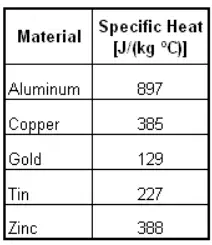
Which of the metals in the table would experience the largest temperature increase for a given amount of heat input?
copper
gold
tin
zinc
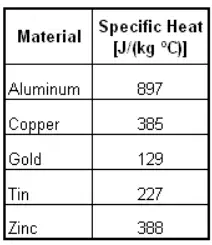
Using the table, how much heat would be required to raise the temperature of 4.0 kg of copper by 2.0°C?
190 J
380 J
3080 J
790 J
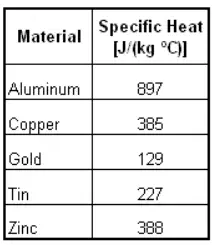
A 10.0 kg block of gold is heated in the Sun from 25.0°C to 30.0°C. Use the table to help calculate the change in the block's thermal energy.
900 J
1300 J
6450 J
3900 J
Energy is transferred from the Sun to Earth by ____.
conduction
convection
radiation
conduction and radiation
Which of these substances is likely to be the best insulator?
ice
steel
oxygen
water

A heat source is located under one end of a solid material. What process, represented in the illustration, carries thermal energy to the other end of the block?
convection
conduction and radiation
conduction
radiation
Which is likely to conduct thermal energy most efficiently?
air
wood
metal
fiberglass
Which type of energy transfer does not require matter?
work
conduction
radiation
convection
____ is the thermal energy that is transferred from a material with a higher temperature to one with a lower temperature.
Work
Kinetic energy
Potential energy
Which is the result of convection?
snow melting in your hand
rain forests near the equator
Earth heated by the Sun
Which would be the best material to use for making tea kettles?
aluminum, specific heat 900
graphite, specific heat 710
copper, specific heat 380
iron, specific heat 450
Thermal energy is the ________ of the particles that make up a system.
total energy
temperature
potential energy
average kinetic energy
____ is a measure of the average kinetic energy of all particles in an object.
Radiation
Temperature
Density
Conduction
A(n) ____ is a material that does not allow thermal energy to be transferred through it easily.
thermal insulator
fluid
current
thermal conductor
What is static electricity? *
electricity produced by like electric charges attracting
electricity used for powering radios and televisions
a buildup of balanced electric charges
a buildup of excess electric charge
The law of conservation of charge states that _______.
the mass of all substances present before a chemical change equals the mass of all the substances remaining after the change
charge can be created and destroyed but can not be transferred
electric charge is not created or destroyed
charge is not created or destroyed or transferred from object to object
What exerts the force that causes other electric charges to move?
electrical poles
the electric field
insulators
conductors
Elements that are shiny and good conductors of electricity are _______.
colloids
metalloids
metals
nonmetals
____ is a material through which electrons move easily.
conductor
insulator
thermos
gas
____ is a material through which electrons are not able to move easily.
conductor
insulator
thermos
solid
The negatively charged particles in an atom are called ____.
electrons
neutrons
negatrons
protons
____ is the process of transferring charges by touching or rubbing.
Charging by contact
Charging by induction
Charging by conduction
Charging by radiation
Rearrangement of electrons on a neutral object by a nearby charged object is called ____.
Charging by contact
Charging by induction
Charging by conduction
Charging by radiation
Just before a lightning strike the charge on the bottom of the cloud would be said to be what?
Neutral
Positive
Negative
Conductive
Just before a lightning strike the charge on the top of the cloud would be said to be what
neutral
positive
negative
conductive
Just before a lightning strike the charge on the ground just below the cloud is said to be what
neutral
positive
negative
conductive
When we hear a thunder clap it is due to what?
The presence of so much charge disrupts the electromagnetic field
When electricity hits the ground the mass of the strike causes the sound
When the strike occurs it super heats the air around it causing the sound
Sound and electricity are interchangeable and they freely convert from one form to another. Thus any electric charge produces sound which is why we hear lightening in the form of thunder
What is the purpose of grounding?
It take in charge
To discharge any excess electric charge
To make an object more conductive
To make an object an insulator
____ is a device that can detect electric charge.
electroscope
electrosphere
electrometer
electro watch
If two charges repel each other, the two charges must be ____.
negative and neutral
Positive and neutral
Positive and negative
negative and negative
An object becomes charged when the atoms in the object gain or lose __________. Mark only one oval.
electrons
protons
neutrons
all of the above
If you bring a charged object near an electrically neutral surface without allowing the object to touch the surface, the charges in the surface are rearranged by __________. Mark only one oval.
friction.
convection.
induction.
conduction.
A region around a charged particle that can exert a force on another charged particle is called an __________. Mark only one oval.
electric pulse.
electric charge.
electric force.
electric field.
When two balloons with the same charge are brought near each other they:
repel
attract
do nothing
______ is related to the push that causes charges to move. *
Induction
Static
High-resistance
Voltage difference
A(n) ______ is a closed, conducting path.
current
circuit
resistor
ampere
Positive charges flow from ______.
low-voltage areas to high-voltage areas
insulators to conductors
low-resistance areas to high-resistance areas
high-voltage areas to low-voltage areas
______ is the net movement of electric charges in a single direction.
Electric Current
Voltage difference
Ohm's law
Jasper's law
related to the force that causes electric charges to flow; measured in volts
Electric Current
Voltage difference
Ohm's law
Jasper's law
____ is the tendency for a material to oppose the flow of electrons.
Resistance
Induction
Transistance
Conduction
A type of this battery has lead and lead dioxide plates immersed in a sulfuric acid solution.
Lithium ion battery
Dry cell Battery
Wet Cell Battery
Ferrous Battery
A type of this battery has 1 electrode that is a carbon rod. The other is the zinc container. The electrolyte is a moist paste containing several chemicals.
Lithium ion battery
Dry cell Battery
Wet Cell Battery
Ferrous Battery
Which is designed to transform electrical energy into thermal energy?
parallel circuit
series circuit
resistor
battery
The current in a circuit equals the voltage difference divided by the resistance.
Electric Current
Voltage difference
Ohm's law
Jasper's law
The voltage difference across a light bulb is 120 volts. The resistance is 180 ohms. What is the current?
1.5 amps
0.67 amps
1 amp
0.5 amps
The voltage difference across a light bulb is 120 volts. The resistance is 270 ohms. What is the current?
1.5 amps
0.67 amps
2.25 amp
0.44 amps
The current through an appliance is 5 amps. The resistance is 24 ohms. What is the voltage difference?
120 V
60 V
180 V
240 V
The current through an appliance is 35 amps. The resistance is 3.5 ohms. What is the voltage difference? Mark only one oval.
182.5 V
62.5 V
122.5 V
242.5 V
What is the resistance in a circuit that has 12 volts of drop and 10 amps of current flowing through it? Mark only one oval.
12 ohms
1.2 ohms
0.12 ohms
0.83 ohms
What is the resistance in a circuit that has 120 volts of drop and 16 amps of current flowing through it? Mark only one oval.
1.2 ohms
5.2 ohms
0.13 ohms
7.5 ohms
A circuit has a resistance of 4 ohms. What voltage difference will produce a current of 1.4 amps in the circuit?
5.6 V
2.86 V
0.35 V
2.6 V
How many amps of current will there be in a circuit if the voltage difference is 9 volts and the resistance in the circuit is 3 ohms?
0.33 amps
27 amps
3 amps
16 amps
If a voltage difference of 3 volts causes a 1.5 current in a circuit, what is the resistance the circuit?
0.5 ohms
2 ohms
4.5 ohms
3 ohms
The current in an appliance is 3 amps and the voltage difference is 120 V. What is the resistance? Mark only one oval.
0.025 ohms
360 ohms
180 ohms
40 ohms
In which type of circuit does charge have only one loop to flow through? *
parallel
series
open
uniform
In which type of circuit are there two or more branches for charge to move through?
parallel
series
open
uniform
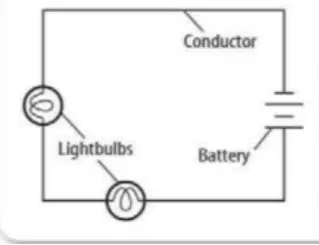
Is the following circuit a parallel or series circuit?
series
parallel
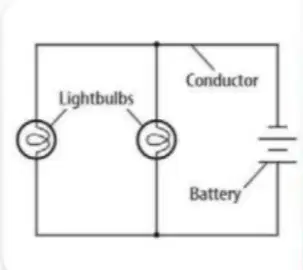
Is the following circuit a parallel or series circuit?
series
parallel
If you had a single power source and multiple things that could be turned off or on, which type of wiring would you want for this circuit?
series
parallel
parabola
induction
What is the standard voltage difference of electrical energy entering homes in the United States?
220 V
12 V
120 V
1200 V
The purpose of fuses and circuit breakers is to _______.
prevent circuits from overheating
prevent breaks in the circuit
allow circuits to be overloaded
decrease the resistance
The rate at which electrical energy is converted to another form of energy is called _______.
energy transformation
hydroelectricity
transmission
electrical power
What is the power rating of an electrical device that has 5 amps of current and 120V of drop across the device
24 watts
300 watts
600 watts
0.042 watts
What is the power rating of an electrical device that has 25 amps of current and 120V of drop across the device
3,000 watts
0.21 watts
4.8 watts
500 watts
How much current does a device use that is rated at 500 watts and has 120V of drop across the device?
0.24 amps
60,000 amps
4.2 amps
15,000 amps
How much current does a device use that is rated at 200 watts and has 12V of drop across the device?
0.06 amps
2,400 amps
1,000 amps
16.7 amps
What is the voltage drop across a device that is rated for 500 watts of power and has 5 amps of current?
0.01 V
100 V
2,500 V
1 V
What is the voltage drop across a device that is rated for 1000 watts of power and has 50 amps of current?
20 V
0.05 V
5,000 V
1 V
How much electrical energy would you consume if you plug in a device rated for 1.5 kW and is on for 0.5 hours?
0.75 kWh
3 kWh
0.33 kWh
1 kWh
How much electrical energy would you consume if you plug in a device rated for 10 kW and is on for 2 hours?
5 kWh
0.2 kWh
1 kWh
20 kWh
If the total energy consumed by a device is 1.6 kWh, and it was on for 0.37 hours, what is the electrical power of the device?
0.23 kW
4.32 kW
0.59 kW
2.76 kW
If the total energy consumed by a device is 26.2 kWh, and it was on for 1.6 hours, what is the electrical power of the device?
0.061 kW
0.59 kW
16.4 kW
41.9 kW
How long was a device on that consumed 10.6 kWh and is rated for 0.89 kW?
11.9 hours
0.084 hours
9.4 hours
7.6 hours
How long was a device on that consumed 9.1 kWh and is rated for 2.6 kW?
0.286 hours
4.7 hours
3.5 hours
23.7 hours

