

wayground logo

Free Printable Worksheets

NEW

Font size

S
M
L
XL
Worksheets

Blood, Cardio-, and Respiratory Systems

Total questions: 70

Worksheet time: 51mins

Name
Class
Date
1.
The main purpose of Red Blood Cells is to 
a)
carry gases, wastes, and nutrients
b)
attack and destroy pathogens
c)
clot the blood
d)
digest food
2.
What part of blood carries hemoglobin?
a)
Red blood cells
b)
Plasma
c)
Platlets
d)
White blood cells
3.
What is the function of hemoglobin?
a)
to carry iron
b)
to carry wastes
c)
to carry oxygen
d)
to produce oxygen
4.
Another name for white blood cells is
a)
erythrocytes
b)
plasmocytes
c)
leukocytes
d)
thrombocytes
5.
Which of the following is not a primary function of blood?
a)
help fight disease
b)
transports nutrients, oxygen, wastes, and hormones
c)
to provide structure 
d)
distributes heat
6.
Blood is classified as ___ tissue.
a)
connective
b)
circulatory
c)
epithelial
d)
muscular
7.

Blood becomes bright red in color because of the of oxygen present

a)

True

b)

False

8.

What is false about blood cell formation?

a)

Blood cells are made in red bone marrow

b)

The process is called hematopoiesis

c)

During fetal development, RBC are made in the liver and spleen

d)

None of these are False - All of these are true
9.
Red blood cells are
a)
thrombocytes
b)
neutrophils
c)
monocytes
d)
erthryocytes
10.
The liquid portion of the blood is
a)
leukocytes
b)
erthryocytes
c)
plasma
d)
thrombin
11.
What part of blood is responsible for fighting infections?
a)
Red Blood Cells
b)
White Blood Cells
c)
Platelets
d)
Plasma
12.

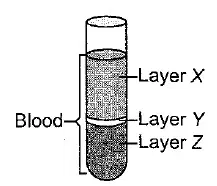
The diagram illustrates a blood sample separated using a centrifuge.

Which layer is known as the "buffy coat" and consists of White Blood Cells and platelets?

a)

X

b)

Y

c)

Z

13.

The blood flowing through human veins is blue until it is exposed to air

a)

True

b)

False

14.

The terms "Coagulation" and "Hemostasis" both refer to ____

a)

Stopping blood flow or Clotting

b)

The thinning of blood

c)

Blood typing

d)

Blood pressure

15.
Name this part.
a)
Right atrium
b)
Left ventricle
c)
Right ventricle
d)
Left atrium
16.
Name this part.
a)
Right ventricle
b)
Pulmonary artery
c)
Left ventricle
d)
Right atrium
17.
Which side of the heart pumps oxygen-rich blood to the rest of the body?
a)
Right
b)
Left
18.
Which side of the heart pumps blood into the lungs?
a)
Right
b)
Left
19.
______ carry blood to the heart.
a)
Arteries
b)
Veins
c)
Capillaries
d)

Bronchi

20.
Name the part.
a)
Pulmonary vein
b)
Right atrium
c)
Aorta
d)
Pulmonary artery
21.
The heart has ___ chambers.
a)
1
b)
2
c)
3
d)
4
22.
This chamber of the heart RECEIVES blood returning from the body
a)
Right Atrium
b)
Right Ventricle
c)
Left Atrium
d)
Left Ventricle
23.
The _________ PUMPS blood to the lungs.
a)
Right Atrium
b)
Right Ventricle
c)
Left Atrium
d)
Left Ventricle
24.
The _______ RECEIVES blood returning from the lungs.
a)
Right Atrium
b)
Right Ventricle
c)
Left Atrium
d)
Left Ventricle
25.
This chamber of the heart PUMPS blood to the body.
a)
Right Atrium
b)
Right Ventricle
c)
Left Atrium
d)
Left Ventricle
26.
The __________ is a wall of muscle that divides the right and left halves of the heart.
a)
Atrioventrucular Valve
b)
Semilunar Valve
c)
Septum
d)
Diaphragm
27.
Name the organ label # 6. 
a)
alveoli 
b)
bronchi 
c)
trachea 
d)
lungs 
28.
Why is the diaphragm important to the respiratory system ?  
a)
It contracts or expands air from the lungs.
b)
It helps the system to digest. 
c)
It helps the system to do its main functions. 
d)
It helps decrease the carbon dioxide in the system. 
29.

Which of the following detects low blood oxygen levels which stimulates the production of erythropoietin which then stimulates the production of more red blood cells?

a)

Kidneys

b)

Liver

c)

Lungs

d)

Spleen

30.
When the diaphragm contracts and moves down, the lungs are...
a)
expanding with air
b)
shrinking - pushing air out
31.

Where is the aortic valve of the heart?

a)

between the right and left atriums

b)

Between the right ventricle and the lungs

c)

Between the left ventricle and the main artery leaving the heart

d)

Between the right and left ventricles

32.
Identify the circled valve
a)
Tricuspid
b)
Mitral
c)
Pulmonary
d)
Aortic
33.
Identify the circled valve
a)
Tricuspid
b)
Mitral
c)
Pulmonary
d)
Aortic
34.
When you breathe, your lungs take in ___ and remove ___. 
a)
air/oxygen
b)
oxygen/carbon dioxide 
c)
carbon dioxide/waste 
d)
waste/air 
35.
What is the main organ in the respiratory system?
a)
Kidney
b)
Heart
c)
Lungs
d)
Diaphragm
36.
When you exercise, your heart beats faster to...
a)
spread oxygen throughout your body more quickly.
b)
make you feel excited.
c)
let you know you're working hard.
37.

78% of the air we breathe is made up of ___

a)

Nitrogen

b)

Oxygen

c)

Carbon dioxide

d)

Argon and helium

38.
Which of the following does NOT make up part of the lungs?
a)
Alveoli
b)
Bronchioles
c)
Trachea
d)
Bronchi
39.

The pharynx is lined with tonsils, which are clusters of lymphatic tissue that help fight infection

a)

True

b)

False

40.

Where are new red blood cells made?

a)

red bone marrow

b)

Kidneys

c)

Lungs

d)

Liver

41.

What element is critical for hemoglobin function?

a)

Copper

b)

Iron

c)

Zinc

d)

Magnesium

42.

What does the presence of high levels of leukocytes in the blood indicate?

a)

Anemia

b)

Infection or inflammation

c)

Dehydration

d)

High blood sugar levels

43.

A ___ is a measurement of the percentage of red blood cells per cubic mL of blood. This tests for anemia and indicates oxygen level capacity in the blood.

a)

embolism

b)
hematocrit
c)
hemoglobin
d)
hemostasis
44.
Rh factor → A red blood cell surface antigen, first discovered in rhesus monkeys, that is a crucial consideration in blood transfusions.
a)
True
b)
False
45.

_______ is a genetic disease that causes red blood cells to be shaped like crescent shapes - reducing their oxygen carrying abilities and leading to blood flow issues in the capillaries

a)

Rhinitis

b)

Laryngitis

c)

Sickle-cell Anemia

d)

Hemophilia

46.

Which of the following refers to the lungs?

a)

Cardio-

b)

Vascular

c)

Pulmonary

d)

Arteriol

47.

The heart is encased in a sack called the ___

a)

Pericardium

b)

Epicardium

c)

Myocardium

d)

Endocardium

48.

The clinical/medical term for voice box

a)

Pharynx

b)

Trachea

c)

Larynx

d)

Bronchi

49.

The largest veins in the body is/are the

a)

Inferior and Superior Vena Cavas

b)

Aorta

50.

The respiratory tract is lined with ciliated ____ tissue

a)

Nervous

b)

Muscle

c)

Connective

d)

Epithelial

51.

Mucus and other matter expelled from the lower respiratory tract through the mouth or nose is known as

a)

Phlegm

b)

Spital

c)

Saliva

d)

Chyme

52.

This lung has only 2 lobes

a)

Right Lung

b)

Left Lung

53.

The S-A nodes (sinoatrial nodes) function as

a)

the natural pace maker of the heart

b)

The 'gate keeper' that controls the heart valves

c)

The contraction of the diaphragm

d)

none of these

54.

This extends from the larynx to the bronchi

a)

Trachea

b)

Pharynx

c)

Diaphragm

55.

Blood flowing away from the heart travel through

a)

Veins

b)

Arteries

56.

The only artery that carries deoxygenated blood is the ____ artery

a)

Superior vena cava

b)

Inferior vena cava

c)

Aorta

d)

Pulmonary

57.

Cardiac cells are self-stimulating but are ultimately controlled by what part of the brain that also controls breathing rate.

a)

Cerebellum

b)

Cerebrum

c)

Brain stem

58.

What structure acts like a lid to cover the windpipe during swallowing?

a)

Uvula

b)

Epiglottis

c)

pharynx

59.

The normal range of heart beats per minute in human adults is

a)

20-40 bpm

b)

40-50 bpm

c)

60-100 bpm

d)

100-120 bpm

60.

In a blood pressure of 120/80 - what is the bottom number?

a)

Systolic pressure

b)

Diastolic number

61.

Which part of blood pressure is a measure of pressure when the ventricles contract

a)

Systolic

b)

Diastolic

62.

The amount of air taken in during a normal, relaxed inhale/exhale cycle is called the ___.

a)

Vital Capacity

b)

Tidal Volume

c)

Inspiratory Reserve Volume

d)

Residual Volume

63.

What is the clinical term for a blood clot?

a)

Embolism

b)

Platelet

c)

Thrombus

d)

hematocrit

64.

Which of the following is NOT a blood plasma protein?

a)

Erythrocyte

b)

Albumin

c)

Globulin

d)

Fibrinogen

65.

Which blood type is the universal donor?

a)

O+

b)

O-

c)

AB+

d)

AB-

66.

What is this blood type?

a)

A+

b)

AB+

c)

AB-

d)

A-

67.

What is the blood type?

a)

AB+

b)

AB-

c)

A+

d)

B-

68.

What blood type is the universal recipient?

a)

O+

b)

O-

c)

AB+

d)

AB-

69.

Someone with Type A blood has...

a)

A antigens

b)

A antibodies

c)

B antigens

d)

A & B antigens

70.

This determines whether a person's blood type is positive or negative...

a)

Rh factor

b)

platelets

c)

The presents of A or B antigens

d)

plasma
