Worksheets
Unit 9a Ecology Part 1
Total questions: 200
Worksheet time: 4hrs 26mins

Is wind a biotic or abiotic factor?
biotic
abiotic

Is soil a biotic or abiotic factor?
biotic
abiotic

Are rocks biotic or abiotic factors?
biotic
abiotic

Is water a biotic or abiotic factor?
biotic
abiotic

Is temperature a biotic or abiotic factor?
biotic
abiotic

Is precipitation a biotic or abiotic factor?
biotic
abiotic

Is sunlight a biotic or abiotic factor?
biotic
abiotic
Abiotic factors are ___________.
non-living parts of an ecosystem
living parts of an ecosystem
things that once were alive, but now are dead
not important parts of ecosystems.
Biotic factors are ___________.
non-living parts of an ecosystem
living parts of an ecosystem
things that once were alive, but now are dead
not important parts of ecosystems.
An ecosystem is made up of __________.
living things only
non-living things only
both living and non-living things
T/F: Abiotic factors are an unimportant part of ecosystems.
true
false

Zebra
Biotic (living)
Abiotic (non-living)

Lion
Abiotic (non-living)
Biotic (living)

Sand
Abiotic (non-living)
Biotic (living)

Sunlight
Biotic (living)
Abiotic (non-living)
Dead organisms are
Abiotic Factors
Biotic Factors


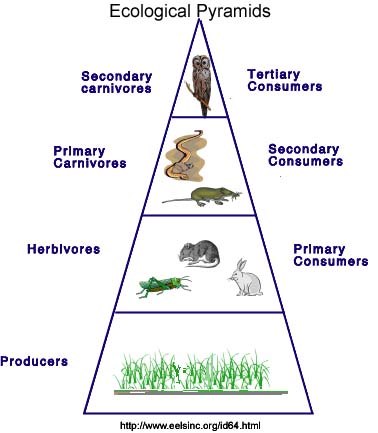
If these organisms were arranged in a energy pyramid, which organism would have the least amount of total energy available?


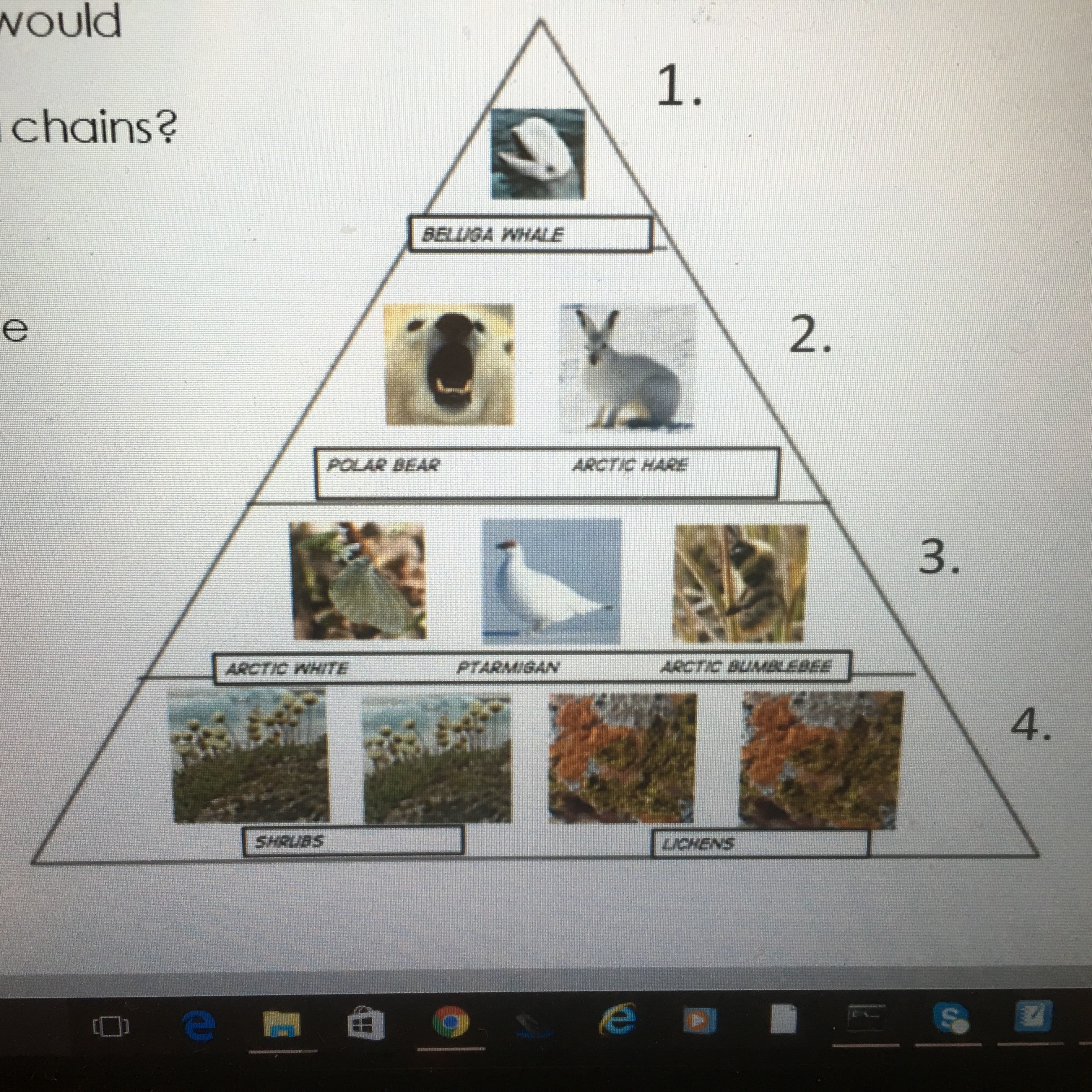
The #1 on the pyramid is called the _____________ trophic level.
What amount of percentage does the energy decrease as it goes up the pyramid?
100%
1000%
10%
1%
How does the energy flow in an energy pyramids?
up the pyramid
down the pyramid
Photosynthesis is important because...
it makes carbon dioxide
it makes food for the food webs
it makes water
it's not important

What would happen to the bird if the green fish died out?
the bird population would grow
the bird population would die out
the smaller fish will die out
What is the bottom layer of the an energy pyramid?
producer
tertiary consumer
Secondary consumer
primary consumer
All tertiary consumers are scavengers
true
false
What would happen if their were no producers?
Every population would grow larger
Everything would die out
The animals would make their own food

Cannot make its own food
Autotroph
Producer
Heterotroph
Biomass
Only eats plants
Herbivore
Carnivore
Omnivore
Decomposer
Only eats meat
Herbivore
Carnivore
Omnivore
Producer
Living or organic matter
Decomposer
Autotroph
Biomass
Consumer
Eats dead organisms and returns nutrients to soil
Autotroph
Decomposer
Biomass
Carnivore
Process through which plants make their own food
Photosynthesis
Autotroph
Biomass
Trophic
Which organisms eat only producers?
Secondary Consumers
Apex Predators
Tertiary Consumers
Primary Consumers


All food webs and food chains begin with _________________.
Primary Consumer
Producers
Secondary Consumers
Predators

Which level has the fewest organisms?
Tertiary
Secondary
Primary
Quaternary

What would happen if their were no producers?
Every population would grow larger
Everything would die out
The animals would make their own food


The diagram represents different levels of a marine food pyramid. Between which two levels is the greatest amount of energy transferred
R and Q
S and R
T and S
U and T
Several owls live in a forest. The owls prey on mice. Hawks also prey on mice. Which might happen if several hawks move to the forest where the owls live?
The number of owls will increase, and the number of hawks will decrease.
The number of mice will increase, and the number of owls will decrease.
The number of owls and hawks will increase.
The number of owls and mice will decrease.


Which organism do the owl and the weasel compete for in the food web?
Hawk
Spider
Grasshopper
Shrew

How are primary consumers different from secondary consumers?
Primary consumers eat only plants; secondary consumers eat other consumers.
Primary consumers eat other consumers; secondary consumers eat only plants.
Primary consumers eat plants and other consumers; secondary consumers eat plants and decompose matter.
Primary consumers eat plants and decompose matter; secondary consumers eat plants and other consumers.


Decomposers can be found where on the food chain?
1st level
2nd level
3rd level
Anywhere on the food chain.

The lion in this picture is a ________.
Autotroph/Carnivore
Autotroph/Herbivore
Heterotroph/Carnivore
Heterotroph/Herbivore


The secondary consumer here is?
The snake
The Eagle
The mouse
The plant

How many Tertiary consumers are there
1
2
3
4


Which cycle are fossil fuels (oil, coal, natural gas) part of?
carbon
water
nitrogen
phosphorus
Which cycle DOESN'T have an atmosphere component (part)?
carbon
nitrogen
phosphorus
water

Which one of these does not add CO2 to the atmosphere?
cooking with gas
planting trees
burning wood
riding in a bus


Identify the cycle pictured.
The Water cycle
The Carbon cycle
The Nitrogen cycle
The Phosphorus cycle.

Identify the cycle pictured.
The Water cycle
The Carbon cycle
The Nitrogen cycle
The Phosphorus cycle.

Photosynthesis is an important part of the ______ cycle
Carbon
Water
Phosphorus
Nitrogen

Decomposition is part of all cycles except _______
the carbon cycle
the nitrogen cycle
the water cycle
the phosphorus cycle


Which of the following is true of carbon as it cycles in nature?
Carbon dioxide is released during photosynthesis
Carbon compounds rarely exist in the gaseous state
Carbons sinks include forests and oceans
The carbon dioxide concentration in the atmosphere is reduce by cutting trees
Carbon is concentrated in igneous rocks

Coal, natural gas, and oil are examples of _________
the carbon cycle
products of photosynthesis
good fuels for barbecues
fossil fuels
What process is part of the hydrological (water) cycle?
transpiration
nitrification
combustion
sedimentation
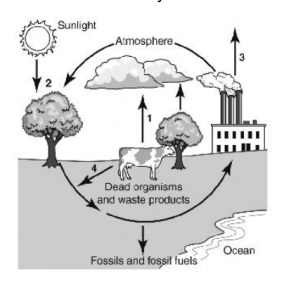
Which of the following is an example of how biogeochemical cycles are important in sustaining life?
The atoms of water molecules are destroyed during a drought.
Oxygen atoms are converted into carbon during cellular respiration.
Nitrogen in wastes are converted into useable nutrients for other organisms.
New carbon atoms are created during the carbon cycle.

The burning of fossil fuels is known as...
Decomposition
Photosynthesis
Combustion
Respiration
How does a cow transfer carbon to other parts of the environment?
It releases CO2 through respiration
It releases carbon as waste
it transfers carbon to humans when we eat it
all of the answers are correct
Energy flows through an ecosystem and is transferred as ____________, but chemical elements are ____________.
light, heat
heat, lost
light, gained
heat, recycled


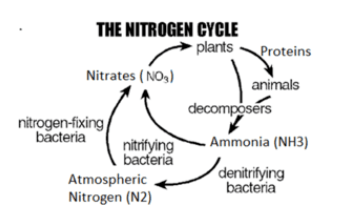
According to this diagram, plants use nitrogen to make _________________________
bacteria
animals
proteins
decomposers
As a part of the water cycle, water from Earth's surface enters the clouds and finally falls back to the ground in the form of rain. What is the correct sequence of processes water undergoes?
Evaporation, Condensation, Precipitation
Precipitation, Condensation, Evaporation
Condensation, Evaporation, Precipitation
Evaporation, Precipitation, Condensation

The image shows various stages in the water cycle. During which stage does water flow back towards the sea as runoff?
W
X
Y
Z
What is precipitation?
Sweat from our bodies on hot days
Warm rain but not cold snow or sleet
Gas that we use in furnaces or ovens
Any form of water that falls from the sky
Condensation occurs when water vapor_____________.
heats up and becomes liquid water
cools off and becomes liquid water
freezes and becomes ice
rains on the land
The process when plants release water vapor from their leaves is called _____________.
precipitation
evaporation
transpiration
condensation

What step of the water cycle does this picture show?
Condensation
Runoff
Precipitation
Evaporation

Which best explains why runoff is important?
It returns water to other locations on Earth
It increases the chance of flooding
It makes evaporation occur faster
It increases condensation
When water changes from a liquid to a solid it is known as...
melting.
condensation.
freezing.
evaporation.
An underground layer of sand, gravel or rock that stores and carries water
water table
water cycle
aquifer
Infiltration
Turns frozen water into water vapors - skipping the melting stage
Sublimation
Percolation
Transpiration
Evaporation
Water running off the land surface
Evaporation
Sublimation
Transpiration
Run-off

What are formed when water vapor condenses and come together?
Clouds
Mountains
Transpiration
Valleys


Habitat or niche?
spread seeds
habitat
niche
Habitat or niche?
a nest
habitat
niche
Habitat or niche?
a tree
habitat
niche
Habitat or niche?
releases oxygen
habitat
niche
Habitat or niche?
eats insects
habitat
niche
Habitat or niche?
hunts deer
habitat
niche
Habitat or niche?
under a rock
habitat
niche
Habitat or niche?
the tree trunk
habitat
niche
Habitat or niche?
eats grass
habitat
niche
A niche ________________.
is the function that an organism performs in the food web of that community.
includes everything else the organism does and needs in its environment.
is specific to each individual animal and plant.
All of the above.
A squirrels niche would be _________________.
hunting prey and providing meat for other squirrels.
searching for fish to eat in the ocean.
staying busy storing nuts and seeds for winter.
help decompose other animals and plants.
A squirrels habitat would be _____________.
Ocean
Arctic
Forest
Dessert
What is a niche?
Where an organism lives.
An organisms role, or job, within its ecosystem.
What an organism eats.
What is a Niche of a honeybee?
Pollenating Flowers
A Honeycomb
Eating other insects.
Swimming.
What is the competitive exclusion principle?
The competitive exclusion principle is a theory that has been disproven by recent scientific research.
The competitive exclusion principle only applies to plants and not animals.
The competitive exclusion principle states that two species competing for the same limited resources cannot coexist in the same ecological niche for an extended period of time.
The competitive exclusion principle states that two species can coexist in the same ecological niche for an extended period of time.
How do organisms adapt to reduce competition within their ecological niche?
By evolving different feeding habits, occupying different niches, or developing specialized structures or behaviors.
By forming alliances with other organisms to share resources.
By competing more aggressively with other organisms in their niche.
By migrating to a different habitat to avoid competition within their niche.
How does the competitive exclusion principle impact species coexistence?
It promotes the coexistence of multiple species by creating a balance in resource availability.
It leads to the elimination of one species by another due to competition for the same resources.
It has no impact on species coexistence.
It only impacts species that are closely related to each other.
Process in which organisms diversify rapidly into a multitude of new forms, particularly when a change in the environment makes new resources available, creates new challenges, or opens new environmental niches
Adaptive Radiation
Geographical Isolation
Diversification through domination
Recessive Isolation
Cichlid fishes in lakes of the East African Rift. The lakes in this area are believed to support and sustain about 2,000 different species of these fish, each with different ecological and morphological characteristics such as body size. These lakes form a fragmented landscape that bio-geographically isolates the different species of cichlid fish from one another, allowing them, and many of the organisms they live with, to evolve separately.
Phyletic Speciation
Adaptive Radiation
Convergent Evoltion
Divergent Evoltuion
Co-evolution


According to the diagram, what is the common ancestor of ALL organisms on the phylogenetic tree?
B
C
D
E
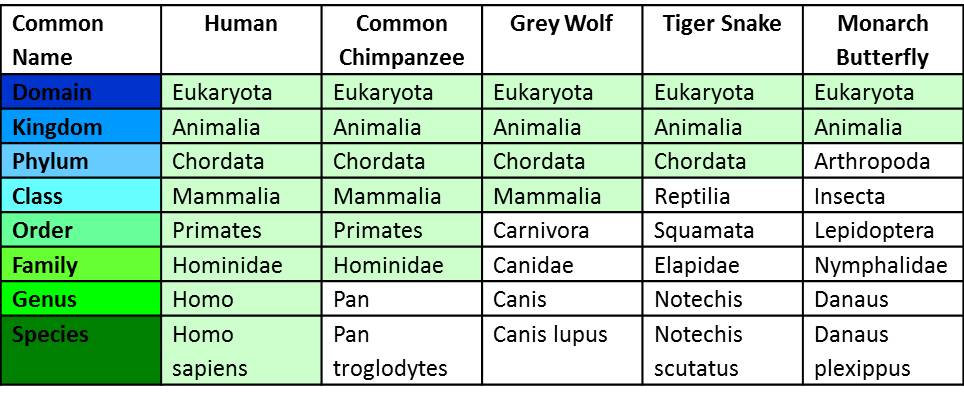
Which of the following are most closely related?
Two organisms in the same genus
Two organisms in the same family
Two organisms in the same phylum
Two organisms of the same species
Similarity at which of these levels indicates the closest relationship?
Domain
Kingdom
Class
Genus

What is the most specific taxonomic grouping that the ocean sunfish and triggerfish share?
Phylum
Class
Kingdom
Order

Red foxes and dogs are both members of the order Carnivora. Dogs belong to the genus Canis. Which of the following is true about dogs and foxes?
The are in different classes
They are in the same phylum
They can't be in the same family
They are both in the same genus

Based on the figure, how long ago lived the most recent common ancestor of the European Brown Bear and the Asian Brown Bear?
470,000 years ago
220,000 years ago
330,000 years ago
140,000 years ago
What is the difference between a phylogenic tree and a cladogram?
Shows how related organisms are to one another
Contains common ancestors
Shows evolutionary time
Contains clades
Which diagram is a phylogenic tree?