Wayground logo

Free Printable Worksheets

Font size

S
M
L
XL
Worksheets

HW - 3/26 - Biology - Reporting Category 2 STAAR Review

Total questions: 75

Worksheet time: 56mins

Name
Class
Date
1.

Where does DNA replication occur?

(a)  

2.

DNA replication occurs during ​ (a)   .

Choose from the below words
interphase
metaphase
telophase
anaphase
prophase
3.

Match the following

a)

Polymerase

1.

builds the complimentary DNA strand

b)

Ligase

2.

bonds DNA fragments together

c)

Primase

3.

Indicates whee DNA replication begins

d)

Helicase

4.

"unzips" the DNA

4.

Reorder the following

a)

DNA is unzipped

b)

Primase marks region to begin replication

c)

Polymerase builds complimentary DNA strand

d)

Ligase bonds DNA fragments

1)
2)
3)
4)
5.

After replication, each strand has ​ (a)   new strand(s) and ​ (b)   old strand(s).

Choose from the below words
one
two
zero
6.
The shape of DNA.
a)
double helix
b)
nucleotide
c)
DNA polymerase
d)
single stranded
7.
Which shows the correct complementary base pairing for DNA?
a)
C-A, T-G
b)
A-G, C-T
c)
C-G, U-A
d)
T-A, G-C
8.
If we think of DNA as a ladder, which parts are the steps of the ladder?
a)
the nitrogenous base pairs
b)
the phosphate-sugar backbone
c)
the genes
d)
the phospholipid bilayer
9.
If we think of DNA as a ladder, which parts are the sides of the ladder?
a)
the nitrogenous base pairs
b)
the phosphate-sugar backbone
c)
the genes
d)
the phospholipid bilayer
10.
What are the four nitrogen bases?
a)
adenine, thymine, guanine, cytosine
b)
adenine, lysine, prolene, guanine
c)
arganine, cytosine, lysine, purine
d)
lysine, cytosine, lucine, guanine
11.
The sugar in DNA is ?
a)
sucrose
b)
glucose
c)
deoxyribose
d)
fructose
12.
When DNA makes a copy of itself, the new strands are identical or different?
a)
identical
b)
different
13.
Which sequence of complementary DNA bases would pair with this partial strand
ATG TGA CAG?
a)
ATG TGA CAG
b)
TAC ACT GTC
c)
GTA AGT GAC
d)
CAT TCA CTG
14.
Which of the following best describes a DNA molecule?
a)
double helix
b)
contains ribose
c)
made of amino acids
d)
contains uracil
15.
Which of the following monomers are repeatedly joined together to form a strand of DNA?
a)
amino acids
b)
nucleotides
c)
fatty acids
d)
polysaccharides
16.
What determines the code, or information, of a DNA molecule?
a)
the shape (structure) of the nitrogen bases
b)
the order (sequence) of the nitrogen bases
c)
the color of the nitrogen bases
d)
the frequency (number) of nitrogen bases
17.
The two strands of nitrogenous bases in DNA are joined by which type of bond?
a)
polar bonds
b)
ionic bonds
c)
covalent bonds
d)
hydrogen bonds
18.
What are the three components of a nucleotide?
a)
sugar, hydrogen, nitrogen base
b)
sugar, oxygen, nitrogen base
c)
sugar, phosphate, nitrogen base
d)
sugar, phosphate, protein
19.
order of replication
a)
3, 2, 1, 4
b)
2, 1, 4, 3
c)
2, 3, 1, 4
d)
3, 4, 1, 2
20.
This picture is illustrating the ____ nature of DNA.
a)
anti-parallel
b)
deoxyribosic
c)
helical
d)
radioactive
21.
Rosalind Franklin's "photo 51" was critical in helping Watson and Crick to discover what?
a)
The double helix structure of DNA
b)
X-Ray crystalography was a technology worth looking in to. 
c)
That stealing is a great way to get ahead in life
d)
That there could possibly be life on other planets. 
22.

DNA makes proteins that determine your (a)   !

23.
If a DNA molecule contains 44% for A and T combined, how much G will be present?
a)
66%
b)
56%
c)
28%
d)
22%
24.
If a DNA molecule contains 15% A, how much C and G will be present?
a)
15%
b)
30%
c)
60%
d)
70%
25.
What is the relationship between a protein, the cell, and DNA?
a)
DNA is produced by protein which is produced in the cell
b)
Protein is composed of DNA which is produced in the cell
c)
DNA controls the production of protein in the cell
d)
A cell is composed of DNA and protein
26.

The genetic code describes the way that information is coded in DNA. This code is -

a)

unique to organisms like a fingerprint

b)

similar between closely related organisms

c)

determined by organism’s environment

d)

the same among all living organisms

27.

True or False: The genetic code is different for every organism.

a)

True

b)

False

28.

Which organelle is the location where protein is made?

a)

Ribosome

b)

Nucleus

c)

Cytoplasm

d)

Nucleotide

29.

When these bond together, they form a protein

a)

Amino Acids

b)

Peptide Bonds

c)

Ribose

d)

Nucleotides

30.

mRNA occurs during this process

a)

Translation

b)

Transcription

c)

Replication

d)

Delivery

31.

Which of the following is the complementary mRNA sequence to this DNA strand: AACTGAA

a)

UUGACUU

b)

TTGACTT

c)

AACTGAA

d)

AACUGAA

32.
What is the term for a three-nucleotide sequence that codes for an amino acid?
a)
base
b)
codon
c)
amine
d)
serine
33.
The process to go from mRNA to a protein is called ____
a)
transcription
b)
rRNA
c)
replication
d)
translation
34.
Genetic info flows in one direction. Which best represents this flow?
a)
DNA-protein-RNA
b)
Protein-RNA-DNA
c)
RNA-protein-DNA
d)
DNA-RNA-protein
35.
What is the location in the cell for transcription?
a)
nucleus
b)
cytoplasm
c)
ribosome
d)
mitochondria
36.

What brings the amino acids to the ribosome to assemble a protein?

a)
mRNA
b)
tRNA
c)
rRNA
d)

DNA

37.

How many nucleotides code for 1 amino acid?

a)

1

b)

2

c)

3

d)

4

38.

What is the location in the cell for translation?

a)

Cytoplasm

b)

Nucleus

c)

Lysosome

d)

Golgi apparatus

39.

Match the following terms with their definitions

a)

protein synthesis

1.

the making of proteins

b)

transcription

2.

converting DNA code into RNA code

c)

translation

3.

converting RNA code into a protein

d)

cellular respiration

4.

process that produces energy

40.

Place the steps below in the correct order.

a)

transcription

b)

mRNA travels to the ribosome

c)

translation

d)

new protein is created

1)
2)
3)
4)
41.

How are DNA and RNA different? (CHECK ALL THAT APPLY)

a)

Only DNA can leave the nucleus

b)

RNA contains Thymine; DNA contains Uracil

c)

DNA is double stranded, RNA is a single stranded

d)

DNA contains Thymine, RNA contains Uracil

42.

Amino Acids form a __________ ____ that is then folded into a protein

a)

Polypeptide Chain

b)

Protein Chain

c)

Carbohydrate

d)

Deoxyribose Nucleic Acid

43.

Use your codon chart and find the amino acid that codes for the mRNA codon UAA

a)

Phe

b)

Tyr

c)

START

d)

STOP

44.

Use your codon chart to find the amino acid that codes for the mRNA codon GCA

a)

Thr

b)

Ala

c)

Pro

d)

Ser

45.
How can a person's muscle cells have the same exact DNA sequences as their nerve cells even though the look and perform completely different?
a)
The two different cells become mutated
b)
The proteins expressed in each cell are different
c)
They actually have different DNA in the two types of cells.
d)
The genome of the different cells changes
46.

When gene expression occurs

a)

A gene is mutated with either an insertion or deletion

b)

The gene is removed from the genotype in that cell

c)

The gene is passed on to the daughter cells during mitosis

d)

The gene is activated and used in protein synthesis

47.
A frameshift mutation can occur with either _________ or __________ mutations.
a)
Addition, division
b)
Deletion, substitution
c)
Addition, substitution
d)
Addition, deletion
48.

Which type of mutation is MOST LIKELY to cause the greatest disruption?

a)

Frameshift

b)

Silent

c)

Point

49.

Match the following

a)

Mutation

1.

a change in the DNA sequence

b)

Point mutation

2.

a type of mutation where one to few bases are substituted with different bases

c)

Frameshift mutation

3.

a type of mutation caused by adding or deleting bases, affecting all the codons after the change

d)

Silent mutation

4.

a type of mutation that doesn't result in a change in the amino acid sequence (same protein)

e)

Chromosomal mutation

5.

a type of mutation where large sections of the chromosome are affected

50.

Match the following

a)

1.

Substitution Point Mutation

b)

2.

Insertion Frameshift Mutation

c)

3.

Deletion Frameshift Mutation

51.

What would be the correct sequence of nitrogen bases to complete the strand of mRNA?

a)

UGC AAG UAC UCA GCU

b)

ACG UUC AUG AGU CGA

c)

GCA TTA GTU GTU AGG

d)

ACG TTC ATG AGT CGA

52.

What is the correct sequence of amino acids that correspond with ACG UUU CAU GAG UCG?

a)

THR SER TER VAL ASP

b)

SER THR PHE HIS GLU

c)

THR PHE HIS GLU SER

d)

LYS TYR HIS ASP SER

53.
When can a mutation be passed on to offspring?
a)
only when the mutation is present during or occurs during mitosis
b)
only when the mutation is present during or occurs during meiosis
c)
when the mutation occurs during mitosis or meiosis
d)
when the mutation occurs in somatic cells
54.

Match the following chromosomal mutation.

a)

1.

Inversion

b)

2.

Translocation

c)

3.

Duplication

d)

4.

Deletion

55.

Match the following

a)

Heterozygous

1.

Two different alleles for a gene

b)

Homozygous

2.

Two identical alleles for a particular gene

c)

Phenotype

3.

Physical characteristics of an organism

d)

Genotype

4.

An organisms alleles

e)

Punnett Square

5.

Tool used to predict the outcome of a genetic cross

56.
Two brown eyed parents (Bb) have a baby. What is the chance the baby is blue eyed?
a)
0 %
b)
25%
c)
50%
d)
75%
57.
Snapdragon flowers come in red, pink and white.  What type of inheritance is this?
a)
Complete Dominance
b)
Incomplete Dominance
c)
Codominance
d)
Polygenic Inheritance
58.

Match the following combinations of alleles:

a)

Homozygous dominant

1.

DD

b)

Homozygous recessive

2.

dd

c)

Heterozygous

3.

Dd

59.

A calico cat shows both the traits for orange fur and black fur. What kind of allele expression is this?

a)

Incomplete dominance

b)

Codominance

c)

Complete dominance

d)

Mendelian inheritance

60.
The genotypic percentage resulting from this this cross would be _____________________.
a)
25% blue eye 75 % brown eye 
b)
BB = 25% Bb = 50% bb = 25%
c)
BB= 50 % bb = 50%
d)
All brown eye
61.

What would be the gametes for the YyRr plant?

a)

YR, YR, yR, yR

b)

YR, Yr, yR, yr

c)

Yy, Rr, YY, RR

d)

yy, rr, yy, rr

e)

YR, Yr, yR, yr, Rr, Yy

62.
G = green, g = yellow
The genotype for a yellow plant is...
a)
GG
b)
Gg
c)
gg
d)
all of the choices result in yellow
63.

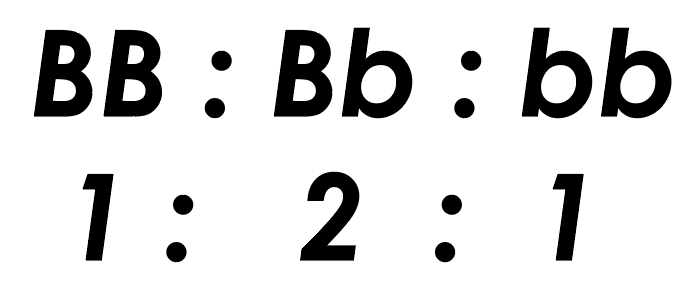
Punnett Square #1

In plants tall is dominant to short.

Cross two heterozygous plants.

What is the phenotypic ratio?

a)

1:2:1

b)

2:2

c)

3:1

64.

The ratio of homozygous dominant to heterozygous

to homozygous recessive offspring

a)

Genotypic Ratio

b)

Phenotypic Ratio

c)

Monohybrid Cross

d)

Homologous Pair

65.

What is the genotype that should be in the blank square?

a)

yyRr

b)

YYRR

c)

yyrr

d)

YrYr

66.

A white mouse with red eyes is crossed with a black mouse with brown eyes. The white mouse is recessive for both of its traits. The black mouse is dominant for both of its traits.

This cross would be

a)

BBEE x bbee

b)

BBEe x BbEe

c)

BbEE x BbEe

d)

BBee x BBEE

67.

In which stage of MEIOSIS does crossing over occur? (The exchange of genetic material between chromosomes in a tetrad.)

a)

Anaphase I

b)

Metaphase I

c)

Prophase I

d)

Telophase I

68.

Which phrase best describes MEIOSIS?

a)

cell division of somatic cells (normal body cells)

b)

cell division of prokaryotic cells

c)

cell division of gametic cells

69.

Meiosis occurs in the _________________ of organisms.

a)

digestive organs (stomach, intestines)

b)

reproductive organs (testes, ovaries)

c)

sensory organs

(eyes, ears, nose)

70.

The daughter cells created in Meiosis are _____________.

a)

identical

b)

non-identical

71.

What process is being represented in this diagram?

a)

asexual reproduction

b)

mitosis

c)

meiosis

d)

DNA replication

72.

What is a gamete?

a)

a body cell (ex. skin or heart cell)

b)

an autosome

c)

a sex cell (ex. sperm or egg)

d)

a somatic cell

73.

A diploid pea plant cell contains 14 chromosomes. How many chromsomes would be in a haploid pea plant cell?

a)

28

b)

14

c)

7

d)

21

74.

The end result of meiosis is...

a)

4 identical cells

b)

4 genetically different cells

c)

2 identical cells

d)

2 genetically different cells

75.

How many chromosomes do the daughter cells have in meiosis?

a)

23

b)

46

c)

2

d)

4