
 Worksheets
Electromagnetism KS5
Total questions: 109
Worksheet time: 4hrs 8mins
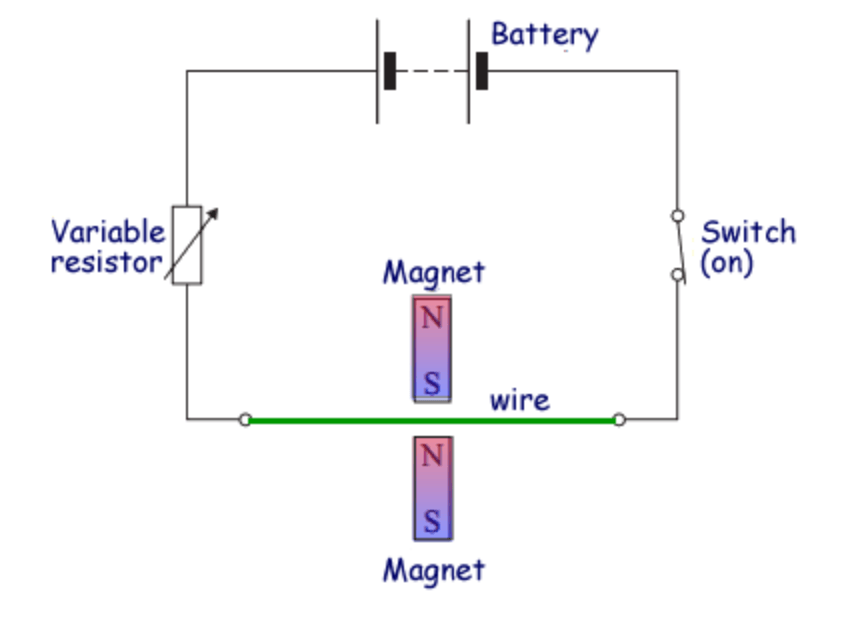
When a wire carrying an electric current is placed in a ________________, it may experience a force. The field from the fixed magnet ___________ with the field due to the current. This can cause the wire to be attracted or repelled from the fixed magnet you will see the effect of the attraction/repulsion in the ___________of the wire.

A __________ is an electrical device that converts AC electricity from one voltage level to another
transformer
primary coil
secondary coil
center tap
Step-up transformers...
improve the efficiency of the national grid
reduce the voltage to a safe level for the home
increase resistance
are better than the Autobots

Thumb and first finger represent .......
magnetic field, force
force, current
force, magnetic field
current, force

The diagram show the direction of magnetic field,B and current, I.
By using Fleming left hand rules, determine the direction of Magnetic force, F.
left
downward
into the page
out from the page

The diagram show the direction of magnetic field,B and current, I.
By using Fleming left hand rules, determine the direction of Magnetic force, F.
no force produced
downward
into the page
out from the page
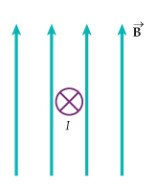
The diagram show the direction of magnetic field,B and current, I.
By using Fleming left hand rules, determine the direction of Magnetic force, F.
no force produced
right
into the page
out from the page

The diagram show the direction of magnetic field,B and current, I.
By using Fleming left hand rules, determine the direction of Magnetic force, F.
no force produced
right
downward
out from the page

The diagram shows a cross-section through a simple DC motor. Select the correct statement:
The loop will rotate clockwise
The loop will rotate anticlockwise
The slip rings aid commutation
The loop rotates the same way even if the battery is reveresed

If a conductor is wound into a coil and a current is passed through it creating a magnetic field, what is it known as?
Bar Magnet
Solenoid
Polarnoid
Transformer
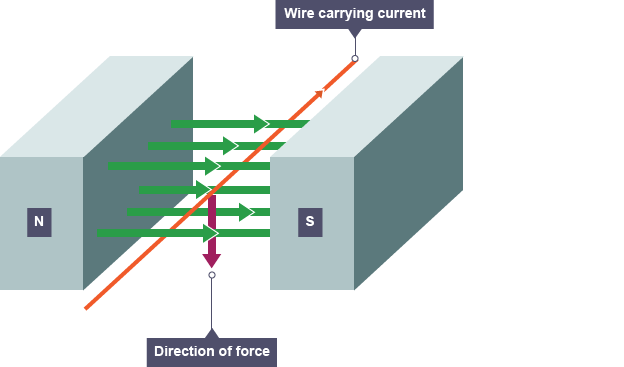
Why might a current-carrying wire be placed between a magnetic field?
To increase the current from the interaction of magnetic fields
To increase the voltage from the interaction of magnetic fields
To produce a force from the interaction of magnetic fields
What does the thumb indicate in flemings left hand rule?
Force
Motion
Current
Magnetic field direction
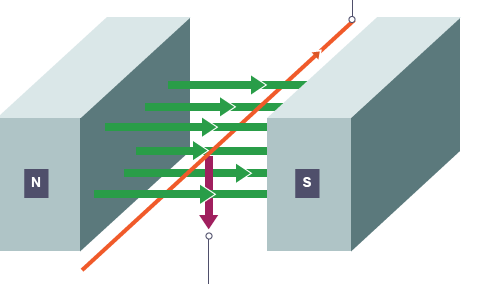
What direction is the force/motion in the following diagram?
Perpendicular to the magnets
Downwards
Parallel and through the magnets
Name the effect that causes a coil of current-carrying wire in an electric motor to move.
The electromagnetism effect
The magnetic effect
The motor effect
Which rule can be used to work out which way a coil of wire rotates in a motor?
Fleming's left-hand rule
Fleming's right-hand rule
Give two ways you can reverse the direction of a basic dc motor?
Reverse the current
Keep the current the same
Reverse the magnetic field
Keep the magnetic field the same
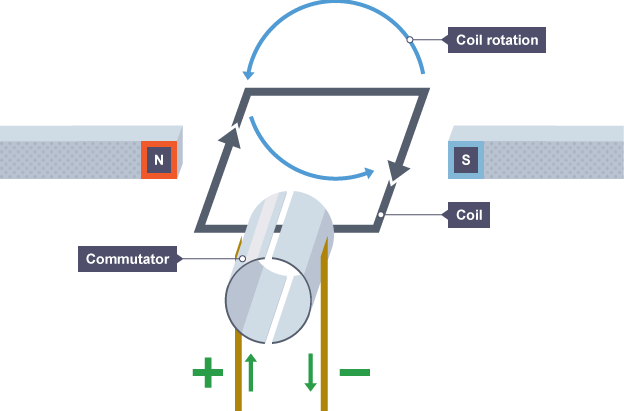
How does a split ring commutator work?
Swaps the contact evert full turn, so that the left-hand and right-hand arms of the coil always experience a force in the same direction.
Swaps the contact evert half turn, so that the left-hand and right-hand arms of the coil do not experience a force in the same direction.
Swaps the contact evert half turn, so that the left-hand and right-hand arms of the coil always experience a force in the same direction.
Which hand should you use if you want to investigate the motor effect?
Left
Right
What needs to be present for motion to occur in the motor effect? Tick all that apply
Air
Magnetic field
Current
A conductor
A turning force
In Flemming's left hand rule, what does the first finger stand for?
Movement
Field
Current
In Fleming's left hand rule, what does the second finger stand for?
Movement
Field
Current
In Fleming's left hand rule, what does the thumb stand for?
Movement
Field
Current
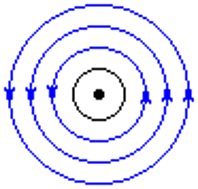
In this diagram, which way is the current flowing?
Into the page
Out of the page
Left to right
Right to left
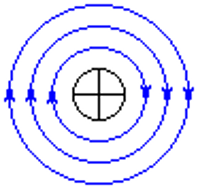
In this diagram which way is the current flowing?
Into the page
Out of the page
Left to Right
Right to Left
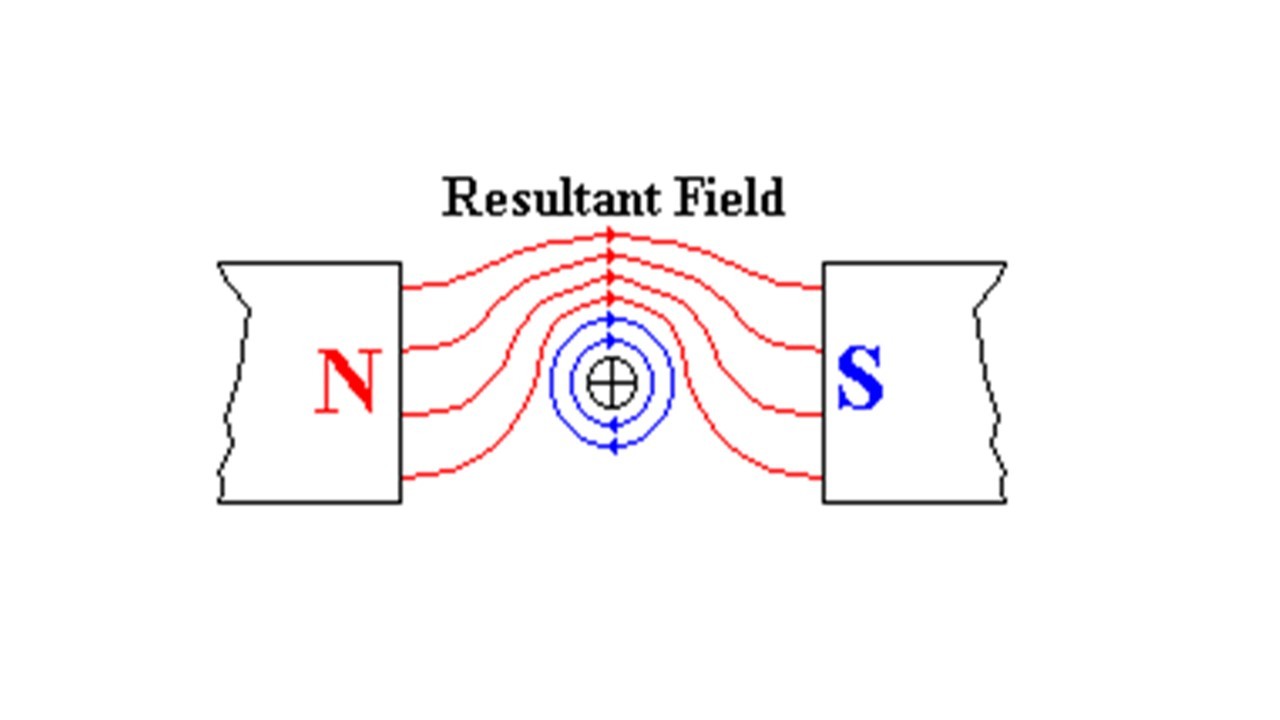
Which way will the conductor move in this picture?
Left
Up
Right
Down
The magnetic field lines near a long straight wire carrying current are:
Straight lines
Concentric rings
Spiral lines
Radial lines
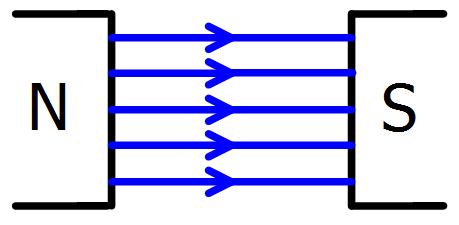
A magnetic field like this is called...
a parallel field
a distorted field
a uniform field
a paramagnetic field
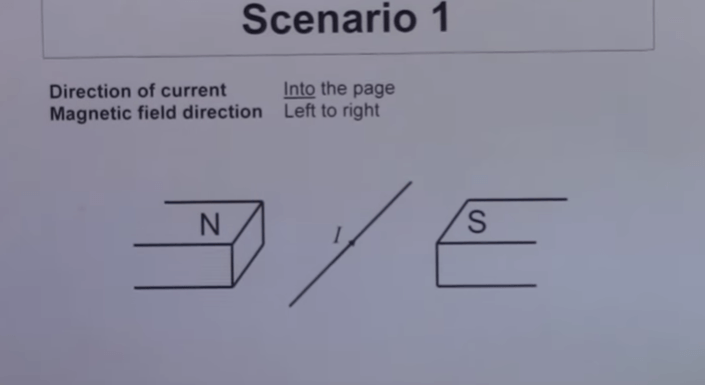
What direction does the wire move?
Up
Down
Left
Right
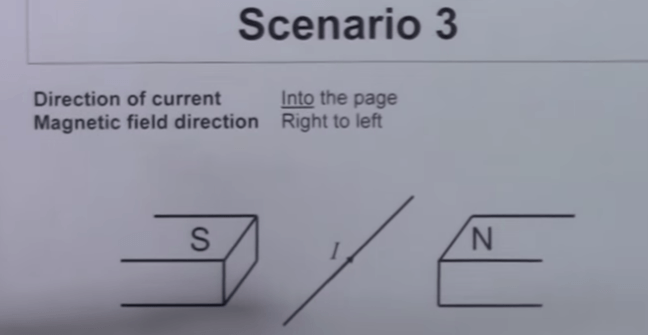
What direction would the wire move?
Up
Down
Left
Right
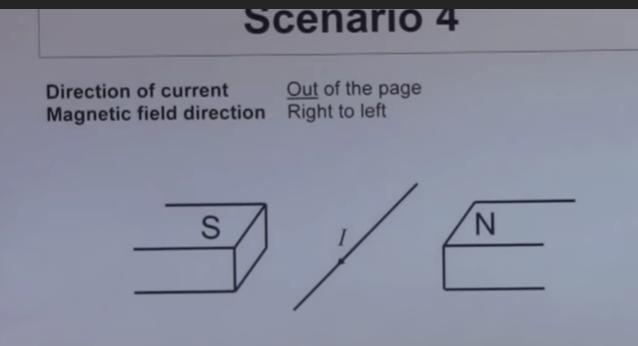
What direction does the force act?
Up
Down
Left
Right
The diagram show the direction of magnetic field,B. The current is going into the page.
By using Fleming left hand rules, determine the direction of Magnetic force, F.
no force produced
right
into the page
out from the page
Which hand should you use if you want to investigate the motor effect?
Left
Right
What needs to be present for motion to occur in the motor effect? Tick all that apply
Air
Magnetic field
Current
A conductor
A turning force
In Flemming's left hand rule, what does the first finger stand for?
Movement
Field
Current
In Fleming's left hand rule, what does the second finger stand for?
Movement
Field
Current
In Fleming's left hand rule, what does the thumb stand for?
Movement
Field
Current
In this diagram, which way is the current flowing?
Into the page
Out of the page
Left to right
Right to left
In this diagram which way is the current flowing?
Into the page
Out of the page
Left to Right
Right to Left
Which way will the conductor move in this picture?
Left
Up
Right
Down

Which way will the conductor move in this picture?
Left
Up
Right
Down
What causes the conductor to move?
The interaction between the current and the conductor
The interaction between the magnetic field around the conductor and the permanent magnets
The interaction between the force and the magnetic field
The interaction between the magnet and the air
A magnetic field like this is called...
a parallel field
a distorted field
a uniform field
a paramagnetic field
The diagram show the direction of magnetic field,B and current, I.
By using Fleming left hand rules, determine the direction of Magnetic force, F.
no force produced
downward
into the page
out from the page
What direction would the wire move?
Up
Down
Left
Right

What direction would the wire move? (What direction does the force act?)
Up
Down
Left
Right
Thumb and first finger represent .......
magnetic field, force
force, current
force, magnetic field
current, force
Particles with opposite charges ____________ and particles with same (or like) charges ____________.
attract, repel
repel, repel
attract, attract
repel, attract


The diagram show the direction of magnetic field,B and velocity,v of an electron.
By using Fleming left hand rules, determine the direction of Magnetic force, F.
left
right
into the page
out from the page
The diagram show the direction of magnetic field,B and current, I.
By using Fleming left hand rules, determine the direction of Magnetic force, F.
left
downward
into the page
out from the page
The diagram show the direction of magnetic field,B and current, I.
By using Fleming left hand rules, determine the direction of Magnetic force, F.
no force produced
right
into the page
out from the page
The diagram show the direction of magnetic field,B and current, I.
By using Fleming left hand rules, determine the direction of Magnetic force, F.
no force produced
right
downward
out from the page

The diagram show the direction of magnetic field,B and velocity,v.
By using Fleming left hand rules, determine the direction of Magnetic force, F.
left
into
right
upward

Which of the following does not influence the strentgh of electromagnet?
Number of turns of wire
Magnitude of current flow in the wire
Type of core
Material used for insulator of the wire

Diagram above shows a solenoid. Which of the following rules may be used to determine the direction of the current in the coil?
Fleming’s Left Hand Rule
Fleming’s Right Hand Rule
Right Hand Screw Rule
Right Hand Grip Rule

Diagram above shows the apparatus used to study the effect of an electromagnet. Which change will increase the number of paper clips attracted to the iron rod?
Use a thinner wire to form the coils
Use a non-insulated wire to form the coils
Reduce the number of coils
Increase the magnitude of current

Diagram above shows the apparatus used to set-up to observe the magnetic field due to a current in a coil.


Diagram above shows a conductor wire placed in a magnetic field. When the switch is on, the conductor wire initially moves towars..
W
X
Y
Z

Diagram above shows a current-carrying conductor in a magnetic field. What is the direction of the force that acts on the conductor?
J
K
L
M

Diagram above shows an electric motor. The magnitude of force F increses when..
The number of turns of the wire coil decreases
The magnitude of the electric current decreases
The magnitude of magnetic fields decreases
The resistance of the wire coil decreases

Diagram above shows a left hand which represents the Fleming’s Left Hand Rule. X represents ....
Motion
Electric current
Magnetic field
Potential difference

Diagram above shows a conductor placed inside a magnetic field. What is the direction of motion of the conductor when the current flows ?
W
X
Y
Z

Diagram above shows a straight conductor placed in a magnetic field. Both of the soft springs extend when the switch is on. Which change will decrease the extension of the springs?
Use a stronger magnet
Use a thicker conductor
Increase the number of batteries
Increase the distance between magnets


Which activity will produce the highest current?
Move the magnet bar into the coil while the coil remains stationery
Move the coil into the magnet bar while the magnet remains stationery
Move the coil and magnet towards each other
Move the coil and magnet away from each other

What type of current is being produced?
Alternating
Direct
In electromagnetic induction, what is being created?
Magnetism
Electrical energy
Mechanical energy
Chemical energy

When a conductor is moved to cut through the magnetic flux, an _______________ is produced.
induced current
electromotive force
electromagnetic induction
internal resistance
The production of electric current by a changing magnetic field is called ____________________________________.
induced current
electromotive force
electromagnetic induction
internal resistance
___________________rule can be used to determine the direction of the ___________ induced current produced.
Fleming's Left Hand Rule
Fleming's Right Hand Rule
Right Hand Grip Rule

In Fleming's Right Hand Rule, First finger and center finger represent
current, magnetic field
magnetic field, current
force, current
magnetic field, force

____________law states that the direction of the induced current is such that it always _______ ___ the change producing it.
Lenz's Law, oppose
Faraday's Law, oppose
Lez's Law, follow
Faraday's Law, follow
Faraday’s Law states that the magnitude of the induced e.m.f. is _________________ to the rate of change of magnetic flux linkage with the solenoid.
equal
inversely proportional
directly proportional
The d.c generator and a.c generator make use of electromagnetic induction to produce _______________________
force
electricity
energy
power
Which device uses slip rings?
a cathode-ray tube
a d.c. generator
an a.c. generator
a solenoid
Which of the following increases frequency of AC?
increasing number of turns on the coil
using a stronger magnet
rotating the coil faster
increase area of the coil
No EMF is induced when?
When the wire is not moving
When the wire is parallel to magnetic field direction
When no lines are cut by the wire
all of the above
into a coil with twice the number of loops,
Can you produce current in a wire with a magnet that is sitting still?
Yes; having a magnet near a wire is enough to excite the electrons
No; the magnetic field has to be changing to excite the electrons
No; magnets cannot create electricity
What type of current is being produced?
Alternating
Direct

