wayground logo

Free Printable Worksheets

Font size

S
M
L
XL
Worksheets

PS Unit 3 Review

Total questions: 104

Worksheet time: 3hrs 18mins

Name
Class
Date
1.
Alpha particles.....
a)
a) are positively charged.
b)
b) consist of two protons and four neutrons.
c)
c) can penetrate any thickness of matter
d)
d) All of the above 
2.
Radioactive materials have unstable...
a)
electrons
b)
protons
c)
nuclei
d)
neutrons
3.
Negatively charged particles emitted from a nucleus at a high speed are ____.  
a)
alpha particle
b)
gamma rays
c)
beta particles
d)
X rays
4.
Two atoms of the same element but with different mass numbers are called________
a)
electrons
b)
isotopes
c)
ions
d)
reaction partners
5.

What do these isotopes of carbon all have in common?


126C, 136C, 146C

a)

they all have the same number of neutrons & mass number

b)

they all have the same atomic number and neutrons

c)

they all have the same atomic number and electrons

d)

they all have the same number of protons, atomic number, and mass number

6.
In order of most to least penetrating radiation we have
a)
Alpha , Beta,  Gamma
b)
Beta , Gamma , Alpha
c)
Gamma, Beta, Alpha
d)
Gamma, Alpha, Beta
7.
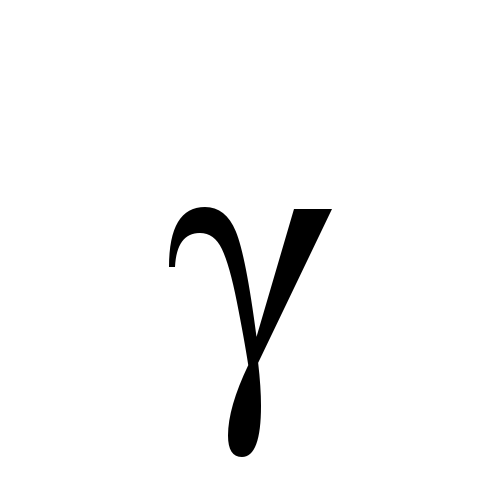
Has the symbol
a)
Alpha
b)
Beta 
c)
Gamma
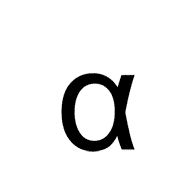
8.
Has the symbol
a)
Alpha
b)
Beta
c)
Gamma
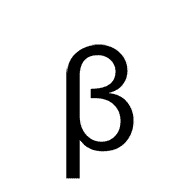
9.
Has the symbol
a)
Alpha
b)
Beta
c)
Gamma
10.

The % of the parent isotope remaining after 1 Half Life.

a)

50%

b)

25%

c)

12.5%

d)

6.25%

11.

The % of the parent isotope remaining after 2 Half Lives.

a)

50%

b)

25%

c)

12.5%

d)

6.25%

12.
Nuclear Power is - 
a)
Renewable
b)
Non-renewable
13.
Nuclear power uses ____ for fuel.
a)
steel
b)
coal
c)
uranium
d)
hydrogen
14.
Splitting a uranium atom is called - 
a)
fission
b)
fusion
15.
Energy is stored in the ___ of an atom.
a)
proton
b)
neutron
c)
electron cloud
d)
nucleus
16.

What nuclear process occurs in the sun?

a)

fission

b)

fusion

c)

endothermic

d)

atomic bomb

17.

The process where one neutron hits a nuclei, which causes it to split releasing more neutrons which hit more nuclei causing more more neutrons to be released which hit more nuclei and so for and so on is called what?

a)

fusion

b)

hydrogen bomb

c)

chain reaction

18.

The amount of time it take for 1/2 of any sample to decay is know as its what?

a)

half life

b)

chain reaction

c)

half reaction

d)

U-235

19.

When does a nuclear power plant create energy?

a)

when uranium is added

b)

when water is added

c)

when steam turns a turbine

d)

when heat is added

20.
After the third half-life, how much of the sample is left?
a)
1/2
b)
1/3
c)
1/16
d)
1/8
21.
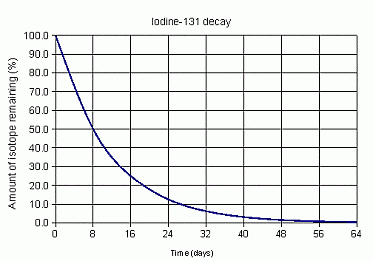
If 10 mg of iodine 131 is given to a patient, how much is left after 24 days? The half-life of iodine-131 is 8 days.
a)
1.25mg
b)
1.25g
c)
10g
d)
10mg
22.
If the half-life of uranium-232 is 70 years, how many half-lives will it take for 10 g of it to be reduced to 1.25 g?
a)
1 half-life
b)
2 half-lives
c)
3 half-lives
d)
4 half-lives
23.
What is Half-life?
a)
The amount of time it takes for some of the nuclei in a sample of the isotope to decay
b)
The amount of time it takes for half the electrons in a sample of the isotope to decay
c)
The amount of time it takes for half the nuclei in a sample of the isotope to decay
d)
the amount of time it takes to double the nuclei in a sample of the isotope to decay
24.
When nuclei decay, massive amounts of __________ is released.
a)
energy
b)
jello
c)
protons
d)
neutrons
25.
The half-life of strontium-90 is 25 years. How much strontium-90 will remain after 100 years if the initial amount is 4.0 g?
a)
3.0g
b)
0.25mg
c)
0.3g
d)
0.25g
26.
What is the half-life of iodine-131?
a)
32 days
b)
8 days
c)
16 days
d)
24 days
27.

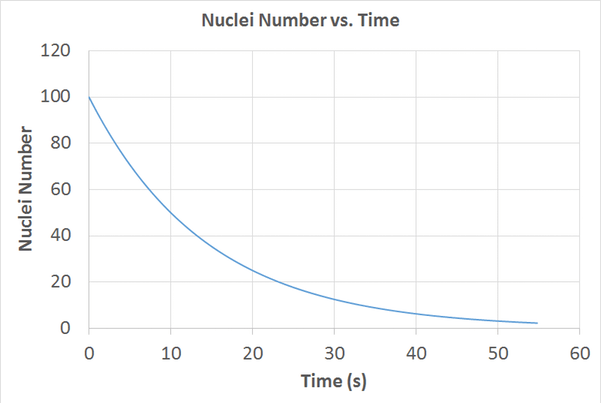
What is the Half life of this isotope?

a)

5 seconds

b)

10 seconds

c)

15 seconds

d)

20 seconds

28.
Takes two small nuclei and combines them into a larger nucleus
a)
fission
b)
fusion
29.
The splitting of a nucleus into smaller nuclei is
a)
fusion
b)
fission
c)
half-life
d)
gamma radiation
30.
How do nuclear power-plants work?
a)
Fusion
b)
Half-life
c)
Fission
d)
Fusion or fission
31.

The transfer of energy through molecules in direct contact is ...

a)

Heat

b)

Conduction

c)

Convection

d)

Radiation

32.
The flow of energy that occurs when a warm liquid or gas rises ..
a)
Heat
b)
Conduction
c)
Convection
d)
Radiation
33.
The transfer of energy by electromagnetic waves.
a)
Heat
b)
Conduction
c)
Convection
d)
Radiation
34.

As you touch a hot stove the heat transfers -

a)

from your hand to the stove by conduction.

b)

from the stove to your hand by conduction.

c)

from your hand to the stove by radiation.

d)

from the stove to your hand by radiation.

35.
In a lava lamp, the warm part rises and the cool part sinks.  This is an example of 
a)
heat computation
b)
convection
c)
conduction
d)
radiation
36.
The movement of thermal energy from a region of _________________ temperature to a region of _____________________ temperature is called heat.
a)
higher, lower
b)
cooler, warmer
c)
lower, higher
d)
medium, medium
37.
The rubber that makes up the handle on the pan is considered a thermal ___________________ because thermal energy moves slowly through this material.
a)
conductor
b)
insulator
c)
regulator
d)
temperature
38.

True or False?

Heat and temperature are different.

a)

True

b)

False

39.

As thermal energy increases, kinetic energy also...

a)

Increases

b)

Decreases

c)

Remains the same

40.
The diagram to the right shows a solid iron bar that is being heated in a flame. The primary method of heat transfer in the solid iron bar is—
a)
convection
b)
conduction
c)
absorption
d)
radiation
41.

Metal objects heat up more slowly than plastic or wooden objects?

a)

True

b)

False

42.

Identify the energy transfer

a)

electrical to chemical to light

b)

kinetic to potential

c)

chemical to electrical to light

d)

light to sound

43.

Identify the energy transfer

a)

mechanical to sound

b)

chemical to electrical

c)

sound to mechanical

d)

thermal to sound

44.

Identify the energy transfer

a)

chemical to light

b)

thermal to electrical

c)

chemical to heat

d)

electrical to thermal

45.

Plants need the sun for _____________________ energy.

a)

Light / Radiant

b)

Sound

c)

Chemical

d)

Electrical

46.

What type of energy is stored in batteries or food?

a)

Potential energy

b)

Thermal energy

c)

Chemical energy

d)

Mechanical energy

47.
According to the Law of Conservation of Energy...
a)
energy changes form
b)
energy can be created and destroyed
c)
energy flows from one material to the next
d)
energy cannot be created or destroyed
48.

What are the energy transformations that occur when a person rides a bike to the top of a hill?

a)

mechanical, thermal,

b)

chemical, mechanical, thermal, electrical

c)

chemical, mechanical, thermal, electrical, radiant

d)

chemical, mechanical, thermal

49.
When you eat pizza, Chemical Energy is transferred to _____ Energy.
a)
Solar
b)
Electrical
c)
Mechanical
d)
Chemical
50.

A student measures the pressure and volume of an empty water bottle to be 1.4 atm and 2.3 L. She then decreases the pressure to 0.65 atm. What is the new volume?

a)

2.1 L

b)

5.0 L

c)

8.2 L

d)

3.9 L

51.

A student inflates a balloon with helium then places it in the freezer. The student should expect

a)

the balloon's volume to increase

b)

the balloon's volume to decrease

c)

the balloon's moles to increase

d)

the balloon's moles to decrease

52.

If a hairspray can is heated, what can be expected of the pressure of the gas inside the can?

a)

The pressure will increase

b)

The pressure will decrease

c)

The pressure will remain constant

d)

The pressure will equalize

53.
Which of the following would increase the (gas) pressure of a system?
a)
Increase the Temperature
b)
Pump in more gas
c)
Decrease the volume
d)
All of these
54.
In order to convert to Kelvin, you add ______ to the Celsius measurement.
a)
372
b)
273
c)
237
d)
732
55.

Pressure is

a)

defined as the mass that an object exerts when at rest.

b)

not a measurable in gases.

c)

defined as the number of moles of substance divided by the mass of the substance.

d)

created by the force of the gas particles impacting the walls of the container.

56.

Absolute zero is

a)

0 K

b)

where there is no molecular movement

c)

the coldest temperature possible

d)

all of these

57.
If a balloon is cooled what will happen to the volume?
a)
Volume will increase
b)
Volume will decrease
c)
Volume will not change
58.
What is standard temperature?
a)
0K
b)
0oC
c)
173 K
d)
173.15 K
59.
Which container will have lower pressure?
a)
left
b)
right
c)
they both have the same pressure
60.

What describes the motion of a Gas Molecule?

a)

Molecules are far apart

b)

Move in constant, random motion

c)

It will travel in a straight path

d)

All of the above

61.

If a hairspray can is heated, what can be expected of the pressure of the gas inside the can?

a)

The pressure will increase

b)

The pressure will decrease

c)

The pressure will remain constant

d)

The pressure will equalize

62.
Bob puts 200 grams of ice into a pitcher with 900 grams of water. He gets distracted and comes back later to find that the ice has melted in the water. How many grams of water does Bob now have in the pitcher?
a)
200 g
b)
700 g
c)
1,100 g
63.
You have a gas that has a pressure of 2 ATM and a volume of 10L.  What would be the new volume if the pressure was changed to 1 ATM?
a)
5 L
b)
20 L
c)
It would stay at 10L
d)
1 L
64.
If the temperature of a gas increase, the pressure...
a)
Decreases
b)
Increases
c)
Does not change
65.
Which of the following is NOT a value for standard pressure?
a)
101.3 kPa
b)
760 mm Hg
c)
1 atm
d)
1 torr
66.
Warming hand over a radiator.
a)
Conduction
b)
Convection
c)
Radiation
67.
What is the definition of CONDUCTION?
a)
When heat is transferred from objects like rays of light or electromagnetically.
b)
a  hot liquid or air that  expands, becomes less dense, and rises or becomes more dense, and sinks.
c)
When heat transfers from objects that are touching.
d)
When heat transfers through the heater or AC in your house.
68.
What is the definition of CONVECTION
a)
When heat transfers through waves.
b)
When heat transfers from objects that are touching.
c)
a  hot liquid or air that  expands, becomes less dense, and rises or becomes more dense, and sinks.
d)
Heat traveling from the sun
69.
A group of friends gather around a fire to stay warm.
a)
conduction
b)
convection
c)
radiation
70.

An iron is placed on your clothes to smooth out the wrinkles. The iron transfers heat to your clothes through

a)

conduction

b)

convection

c)

radiation

71.

You get sunburned due to __________ from the sun.

a)

conduction

b)

convection

c)

radiation

72.

Near the ceiling of a room the air is warmer. The warm air rises because of

a)

conduction

b)

convection

c)

radiation

73.

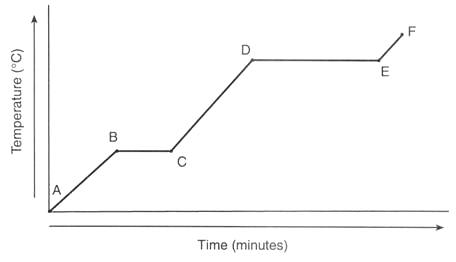
Between which points is the temperature of the substance remaining constant?

a)

A-B only

b)

A-B, C-D, and E-F

c)

B-C only

d)

B-C and D-E

74.

__________ show the change in state of matter as heat is added.

a)

Phase diagrams

b)

Heating curves

c)

Density graphs

d)

Temperature plots

75.

The melting point of the sample is

a)

-60 ºC

b)

20 ºC

c)

60 ºC

d)

100 ºC

76.

A measure of the average kinetic energy of the particles in an object is called

a)

Heat

b)

Temperature

c)

Kinetic energy

d)

Enthalpy

77.

In which region(s) does temperature increase?

a)

Region C only

b)

Regions B and D

c)

Regions A, C, and E

d)

Regions A and B

78.

In which region(s) of the heating curve would water be a liquid and a gas at the same time?

a)

A

b)

B

c)

C

d)

D

e)

E

79.

NaCl was heated starting at an initial temperature of 0°C. The heating curve is shown in the picture. What is the melting point of this substance?

a)

0°C

b)

801°C

c)

1000°C

d)

1465°C

80.

Heat __________ depend on the amount of substance, while temperature __________.

a)

Does not, does

b)

Does, does not

81.

At higher temperatures

a)

Particles in an object move slower

b)

Particles in an object move faster

c)

Particles move at the same speed as lower temperature

82.

You have decided to start sealing all your letters with glittery wax because you are so "cool". Which answer BEST explains what you must do to make the SOLID wax a LIQUID?

a)

In order to make the SOLID wax a LIQUID you must ADD HEAT ENERGY by putting the wax in the FREEZER.

b)

In order to make the SOLID wax a LIQUID you must ADD HEAT ENERGY by putting the wax over a FLAME.

c)

In order to make the SOLID wax a LIQUID you must REMOVE HEAT ENERGY by putting the wax in an OVEN.

83.

You have dropped your popsicle and are watching it become a LIQUID. Which answer BEST explains what PHASE CHANGE has occurred AND how the molecule MOVEMENT has changed?

a)

The PHASE CHANGE that has occurred is CONDENSATION and the molecule MOVEMENT has become FASTER.

b)

The PHASE CHANGE that has occurred is EVAPORATION and the molecule MOVEMENT has become SLOWER.

c)

The PHASE CHANGE that has occurred is MELTNG and the molecule MOVEMENT has become FASTER.

84.

You are drinking a cold drink on a hot day when you notice LIQUID water has collected on the can. Which answer BEST explains what PHASE CHANGE has occurred AND how the molecule ARRANGEMENT has changed?

a)

The PHASE CHANGE that has occurred is CONDENSATION and the molecule ARRANGEMENT has become CLOSER.

b)

The PHASE CHANGE that has occurred is FREEZING and the molecule ARRANGEMENT has become CLOSER.

c)

The PHASE CHANGE that has occurred is EVAPORATION and the molecule MOVEMENT has become FASTER.

85.

Phase change going from Liquid to Solid...

a)

Melting

b)

Freezing

c)

Condensation

d)

Sublimation

86.
The amount of energy required to raise the temperature 1ºC for every kilogram is called____?
a)
Thermal Energy
b)
Specific Heat
c)
Temperature
d)
Kinetic Energy
87.
What is the symbol for Thermal Energy?
a)
Q
b)
t
c)
m
d)
C
88.
Water has a specific heat of 4184 J/KgºC.  Wood has a specific heat of 1760 J/KgºC.  What material needs more energy to raise the temperature 1ºC
a)
Wood
b)
Water
c)
Both are the same
89.
Copper, Stainless Steel, Carbon Steel, and Zinc were all heated using the same thermal energy.  What material would be the coolest after being heated?
a)
Copper
b)
Carbon Steel
c)
Zinc
d)
Stainless Steel
90.
How does heat flow?
a)
Always from cold to warm
b)
Always from warm to cold
c)
Both warm to cold & cold to warm
d)
It depends on the temperature
91.
A high specific heat means...
a)
It requires less energy to change temperature
b)
It requires more energy to change temperature
c)
It heats up very quickly
92.
When a  piece of aluminum foil is taken out of the oven and cools from 100° C to 50°C, What is the change in temperature?
a)
50°
b)
c)
100°
d)
150°
93.
Which of the following would be the best insulator?
a)
air
b)
aluminum
c)
copper
d)
silver
94.
If I heat up 2 pans of water one has 100 mL in it and one has 1000mL. Which one heats up the fastest?
a)
100 mL
b)
1000 mL
c)
They both heat up at the same speed
d)
They cool down.
95.

Which of the following best explains why the sand at the beach is hotter than the water?

a)

Sand has a higher specific heat than water.

b)

Sand has a lower specific heat than water.

c)

There is more water than sand at the beach.

d)

There is more sand than water at the beach.

96.
What would be the effect on the particles if more heat is supplied to the system?
a)
They would slow down
b)
They would stop moving
c)
They would speed up
d)
There would be no effect
97.

Which of the following is not a type of energy?

a)

Mechanical

b)

Gravitational

c)

Electrical

d)

A wave

98.

What are the two type of mechanical energy?

a)

Kinetic & Potential

b)

Potential & Thermal

c)

Kinetic & Electrical

d)

Electrical & Thermal

99.

Energy of an object due to its high position compared to a low one is called...

a)

Gravitational

b)

Potential

c)

Elastic

d)

Chemical

100.

Energy carried by light and other types of electromagnetic radiation is called...

a)

Sound

b)

Elastic

c)

Radiant

d)

Electrical

101.

Energy made available through the flow of electric current is called...

a)

Sound

b)

Elastic

c)

Radiant

d)

Electrical

102.

Energy of an object or a particle due to its motion is called...

a)

Kinetic

b)

Potential

c)

Elastic

d)

Electrical

103.

A solar power plant converts _____________ to ____________.

a)

Electrical energy to solar energy

b)

radiant energy to electrical energy

c)

chemical energy to electrical energy

d)

mechanical energy to thermal energy

104.
What energy transformations take place when a battery-operated radio is in use?
a)
Electrical to chemical to light
b)
Sound to chemical to mechanical
c)
Chemical to electrical to sound
d)
Light to electrical to thermal