
 Worksheets
Ecology Concepts 1-3 Review
Total questions: 50
Worksheet time: 26mins
What is the study of ecology concerned with?
The study of human behavior
The study of relationships between organisms and their environment
The study of geological formations
The study of historical events
Which of the following is one of the characteristics of life?
Ability to remain the same size throughout life
Capability of movement from one place to another
Being capable of growth (develop and becoming larger)
Ability to survive without water
What is the result of asexual reproduction?
Which level of ecological organization is represented by a group of the same species living in an area?
Community
Population
Ecosystem
Biosphere
What is the term used for all the different populations that live together in an area?
Ecosystem
Community
Population
Organism
Which level of ecological organization includes all of the living things and all the physical environments on Earth?
Ecosystem
Community
Biosphere
Biome
What is the correct order of ecological organization from the smallest to the largest level?
Organism
Population
Community
Ecosystem
Biome
Which of the following is an example of a community?
A pack of wolves hunting in a forest
A single oak tree in a park
All of the deer, birds, plants, insects, squirrels, etc. in a field
A pond with water and soil only
Which of the following is an example of abiotic factors that are part of an ecosystem?
Deer and birds
Temperature and precipitation
Plants and insects
Squirrels and other animals
What does biodiversity refer to?
The variety of ecosystems in a geographical area
The variety of organisms considered at all levels, from populations to ecosystem
The conservation efforts to protect wildlife
The study of living organisms in their natural habitat
What is a cladogram?
A tool used for identifying organisms based on their characteristics.
A diagram that shows ancestral relationships like a phylogenetic tree does.
A diagram that shows relatedness of organisms.
A type of organism.
What is a dichotomous key used for?
Showing the evolution of organisms.
Identifying organisms based on their characteristics.
Displaying the genetic information of organisms.
Mapping the habitat of different organisms.
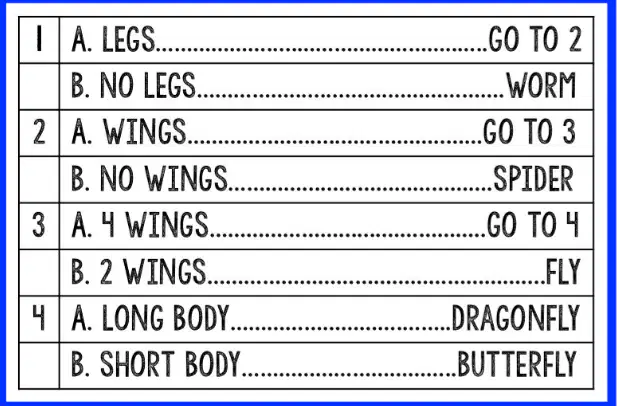
According to the dichotomous key in the image, what organism is identified by having no legs?
Spider
Worm
Fly
Dragonfly
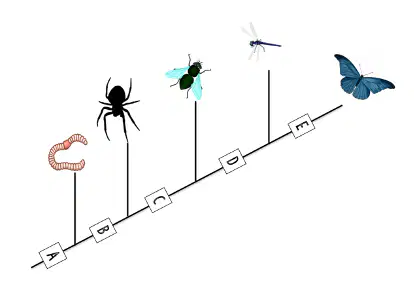
What point on the cladogram would most likely represent having the characteristic of four wings wings?
C
B
D
E
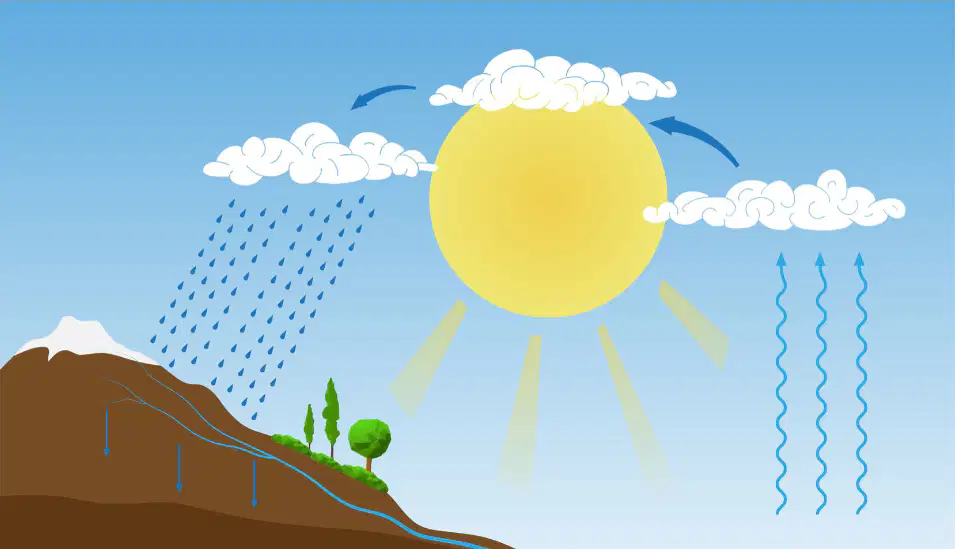
What drives the water cycle according to the overview provided?
The moon
The ocean
The sun
The wind
What is infiltration in the water cycle?
Water vapor condenses to form clouds.
Water rises back into the atmosphere as water vapor from plants.
Sun heats liquid water to vapor and it rises to the atmosphere.
The process of water moving into the ground.
What does transpiration refer to in the water cycle?
The process of water vapor turning into liquid water.
The movement of water through the ground.
Water vapor condensing to form clouds before precipitation.
Water rising back into the atmosphere as water vapor from plants.
What is condensation in the context of the water cycle?
The process by which plants absorb water from the soil.
The process by which water vapor rises into the atmosphere.
Water vapor condenses to form clouds before precipitating again.
The process by which water in rivers and lakes gets heated by the sun.
What is the process called when organisms release water and carbon dioxide while breaking down food for energy?
Photosynthesis
Cellular respiration
Transpiration
Condensation
How does deforestation negatively impact the water cycle?
Increases precipitation
Decreases transpiration
Stops condensation
Speeds up evaporation
What does paving, building, and development increase, which negatively impacts the water cycle?
Transpiration
Infiltration
Runoff
Evaporation
What is eutrophication?
The process of water vapor turning into liquid water
The increase of water in the atmosphere due to deforestation
When a body of water becomes overly enriched with nutrients, causing excessive algae growth
The contamination of water bodies with harmful substances
How does carbon differ from water in terms of cycling through the environment?
Carbon cycles in a single chemical form, while water changes chemical forms.
Carbon and water both cycle in a single chemical form.
Carbon changes chemical forms as it cycles, unlike water.
Water changes chemical forms as it cycles, unlike carbon.
In what form is carbon found in our atmosphere?
Minerals and rocks
Fossil fuels
CO2
Organic materials
During which process is CO2 released into the atmosphere as waste from metabolism?
Photosynthesis
Consumption
Cellular Respiration
Fermentation
What do photosynthetic organisms like plants and algae do in the carbon cycle?
They release CO2 into the atmosphere.
They remove CO2 from the atmosphere and convert it into simple sugars.
They consume simple sugars and produce CO2.
They break down carbon-rich foods for energy.
What happens during combustion that negatively impacts the carbon cycle?
It decreases the amount of CO2 in the atmosphere.
It increases the amount of oxygen in the atmosphere.
It increases the amount of CO2 in the atmosphere.
It has no impact on the atmosphere.
Can plants and animals directly use the nitrogen found in the atmosphere?
Yes, they can use atmospheric nitrogen directly.
No, they cannot use atmospheric nitrogen in its elemental form.
Yes, but only plants can use it directly.
Yes, but only animals can use it directly.
What is nitrogen fixation in the nitrogen cycle?
The process by which animals use nitrogen to build muscle tissue
The release of nitrogen gas into the atmosphere by plants
The conversion of nitrogen from the air or water into forms usable by plants
The movement of nitrogen in its gaseous form from the atmosphere to the soil
What is the role of decomposers in the nutrient cycles?
They convert nitrogen in the air into usable forms for plants.
They break down dead matter, returning nutrients to the soil.
They consume nutrients from the atmosphere and store them in their tissues.
They release nutrients into the atmosphere through respiration.
What is the process called where bacteria convert nitrogen in ammonia into nitrates and nitrites to be absorbed by plants?
Denitrification
Ammonification
Nitrification
Nitrogen fixation
During which process do bacteria convert nitrogen in ammonia to N2 gas to be released back into the atmosphere?
Nitrification
Ammonification
Nitrogen fixation
Denitrification
What is ammonification in the nitrogen cycle?
The process of converting nitrogen gas into ammonia
The process of converting ammonia into nitrites
The process of converting organic nitrogen into ammonia
The process of converting nitrites into nitrates
Which organism is most important for converting nitrogen to different forms in the nitrogen cycle?
Plants
Fungi
Bacteria
Animals
What does the term "Population" refer to in ecology?
A) A single organism living in a specific place.
B) A group of organisms of the same species living in different places.
C) A group of organisms of the same species living in the same place.
D) A community of different species living together.
What does Population Density measure?
The size of an area where organisms live
The number of individual organisms living in a defined space
The number of habitats available in an ecosystem
The rate of population growth over time
Which of the following terms describes individuals moving into a population?
Emigration
Death (mortality)
Immigration
Natural disasters
Which of the following terms describes individuals moving out of a population?
Birth (natality)
Immigration
Emigration
Vaccination programs
What does dispersion refer to in the context of population ecology?
The size of a population
The spatial distribution of organisms in a population
The number of species in a community
The age structure of a population
What type of population growth is characterized by a growth without limit?
Logistic
Exponential
Linear
Declining
Which of the following is an example of a population that typically exhibits exponential growth?
Fish
Rabbits
Trees
Human population
What is the term for the theoretical maximum population that a given environment could support?
Growth limit
Population threshold
Carrying capacity
Environmental ceiling
Which type of population growth levels off as it approaches the carrying capacity of the environment?
Exponential
Logistic
Linear
Declining
What are limiting factors in the context of population growth?
Factors that increase the size a population can reach
Aspects of the environment that limit the size a population can reach
The maximum population size that an environment can sustain
Strategies that populations use to increase their size
Limiting factors can be classified into which two main types?
Biotic (living) and Abiotic (nonliving)
Intrinsic and Extrinsic
Renewable and Nonrenewable
Predation and Competition
What type of limiting factors have a bigger impact on more dense populations?
Density-independent limiting factors
Density-dependent limiting factors
Non-density related limiting factors
Population-independent limiting factors
Which of the following is NOT an example of a density-dependent limiting factor?
Competition
Predation
Parasitism
Weather
What triggers density-dependent limiting factors?
Decrease in population size
Increase in population size
Constant population size
The presence of predators
What are density-independent limiting factors?
Factors that regulate population growth based on the population size or density
Factors that regulate population growth regardless of the population size or density
Factors that only affect high population density areas
Factors that only affect low population density areas
Which of the following is an example of a density-independent limiting factor?
Competition for resources
Weather changes
Predation
Disease

