Wayground logo

Free Printable Worksheets

Font size

S
M
L
XL
Worksheets

HOMS Review: Properties of Matter

Total questions: 67

Worksheet time: 50mins

Name
Class
Date
1.

What is the definition of solubility in the context of physical properties of matter?

a)

The ability to be hammered into thin sheets

b)

The ability to dissolve in another substance

c)

The temperature at which a substance turns from a solid to a liquid

d)

The ability to transfer heat or electricity from one area to another

2.

is a chemical property of a material.

a)
Malleability
b)
Ductility
c)
Flammability
d)
Melting point
3.

What is the main difference between a physical property and a chemical property?

a)

Physical properties can be observed without changing the composition of the material, while chemical properties cannot.

b)

Chemical properties can be observed without changing the composition of the material, while physical properties cannot.

c)

Physical properties are related to the material's ability to burn, while chemical properties are not.

d)

Chemical properties are related to the material's ability to dissolve, while physical properties are not.

4.

What determines the physical and chemical properties of matter?

a)

The type of reactions the matter is involved in

b)

The type of atoms that make up the matter and their arrangement

c)

The state of matter (solid, liquid, gas, plasma)

d)

The temperature and pressure conditions the matter is exposed to

5.

Which state of matter has low energy and definite shape and volume?

a)

Liquid

b)

Gas

c)

Solid

d)

Plasma

6.

What is the kinetic energy of particles in a plasma compared to a gas?

a)

Lower

b)

The same

c)

Higher

d)

None of the above

7.

Which state of matter has particles with medium kinetic energy?

a)

Liquid

b)

Gas

c)

Plasma

d)

Solid

8.

What is the definition of length as a measurement?

a)

A measure of the amount of matter in a substance

b)

A measure of the amount of space a substance or object takes up

c)

A measure of the distance from one point to another

d)

The amount of liquid in a container

9.

Which tool is commonly used to measure length?

a)

Balance

b)

Graduated cylinder

c)

Ruler or meter stick

d)

Weighing scale

10.

What units are used to measure mass?

a)

Meter, cm, km

b)

cm³, mL

c)

Grams, kg

d)

Liters, gallons

11.

How many millimeters are in 1 centimeter?

a)

1

b)

10

c)

100

d)

1000

12.

What is the volume in mL for the object shown in the diagram?

a)

30 mL

b)

40 mL

c)

45 mL

d)

50 mL

13.

How do you find the volume of a regular shaped object such as a box?

a)

Measure the length and add it to the height and width

b)

Measure the length, height, and width of the object and multiply the 3 measurements

c)

Fill the object with water and measure the water volume

d)

Weigh the object and convert the weight to volume

14.

How is the volume of an irregularly shaped object found using the displacement method?

a)

Add the volume of the water before and after submerging the object.

b)

Measure the volume of water displaced when the object is submerged.

c)

Subtract the volume of the water after submerging the object from the volume before submerging it.

d)

Divide the volume of the water before submerging the object by the volume after submerging it.

15.

Based on the table provided, which objects will sink or float in water?

a)

Copper will sink and glass will float.

b)

Copper and glass will sink, while apple and oak will float.

c)

Copper and oak will sink, while apple and glass will float.

d)

Apple will sink and oak will float.

16.

What is the density of water?

a)

0.5 g/cm³

b)

1 g/cm³

c)

1.5 g/cm³

d)

2 g/cm³

17.

What is the equation to calculate density?

a)

D = volume / mass

b)

D = mass * volume

c)

D = mass / volume

d)

D = mass + volume

18.

Olivia is baking a cake and needs to calculate the density of the cake batter. The batter has a mass of 150 grams and occupies a volume of 50 cm³. What is the density of the cake batter? g/cm³

a)
3 g/cm³
b)

5 g/cm³

c)

2 g/cm³

d)

4 g/cm³

19.

If an object has a mass of 200 grams and a volume of 600 cm³, what is the density? g/cm³

a)
0.33 g/cm³
b)

0.5 g/cm³

c)

1.5 g/cm³

d)

2 g/cm³

20.

What is the boiling point of water at sea level?

a)
100°C
b)

0°C

c)

212 °C

d)

10 °C

21.

What is the formula to calculate the speed of an object?

a)

Speed = Distance × Time

b)

Speed = Distance / Time

c)

Speed = Time / Distance

d)

Speed = Distance + Time

22.
The water is ______ dense than the boat
a)
more
b)
less
c)
equally
23.
If water has a density of 1.0 g/cm3, and object X has a density of 1.30 g/cm3, then object X will __________
a)
float 
b)
sink 
c)
fly 
24.
What is the volume of the rock? The water level is displaced from 20 mL to 23 mL with the rock.
a)
3 mL
b)
23 mL
c)
20 mL
d)
43 mL
25.
Which physical property is the amount of space something takes up and can be measured with a graduated cylinder?
a)
conductivity
b)
relative density
c)
thermal energy
d)
volume
26.
When paper is folded to make an origami bookmark, what physical property of the paper changes?
a)
mass
b)
weight
c)
shape
d)
smell
27.
Which tool would be used to measure the mass of an object?
a)
balance
b)
graduated cylinder
c)
meter stick
d)
spring scale
28.
What is an example of a physical property?
a)
reactivity
b)
 color
c)
flammability
d)
toxicity
29.
ability for a solid to be hammered without shattering
a)
Density
b)
Conductivity
c)
Malleability
d)
Viscosity
30.
ability to allow heat to flow 
a)
Viscosity
b)
Thermal Conductivity
c)
Electrical Conductivity
d)
Melting/Boiling Point
31.
Definition of Physical property
a)
properties are those that can be observed without changing the identity of the substance
b)
Properties that describe how a substance changes into a completely different substance
c)
only observations that can be measured quantitatively
d)
Only observations that can be made qualitatively
32.
A substance's ability to be pulled into thin wires is.....
a)
Conductivity
b)
Malleability
c)
Ductility
d)
Hardness
33.
An example of a physical property is 
a)
flammability
b)
acidic
c)
color
d)
ability to rust
34.
Which one is not a physical property?
a)
shiny
b)
makes a rattling sound
c)
smells like vinegar
d)
metal turns to rust
35.
Density is
a)
matter/solids
b)
volume/mass
c)
gas/liquid
d)
mass/volume
36.
Objects that shine have 
a)
mass
b)
solubility
c)
malleability
d)
luster
37.
Freezing is...
a)
Solid to gas
b)
Liquid to solid
c)
Gas to solid
d)
Liquid to gas
38.
Molecules move quickest in which state of matter
a)
solid
b)
liquid
c)
gas
d)
solid, liquid and gas
39.
Matter changing states creates a new substance 
a)
True
b)
False
40.
Which of the following is NOT matter?
a)
Air
b)
Oxygen
c)
Cells
d)
Gravity
41.

Which form of matter takes the shape of a container?

a)
liquid
b)
solid
c)
glass
d)
gas
42.
Which state of matter do the particles in this picture represent?
a)
solid
b)
liquid
c)
gas
d)
plasma
43.
What is the melting point of water?
a)
0 degrees Fahrenheit
b)
100 degrees Celcius
c)
212 degrees Fahrenheit
d)
0 degrees Celcius
44.
What is the boiling point of water?
a)
80 degrees Celsius
b)
27 degrees Celsius
c)
90 degrees Celsius
d)
100 degrees Celsius
45.
Change from gas to liquid is called....
a)
expansion
b)
evaporation
c)
condensation
d)
sublimation
46.

A block has a mass of 20.0 g and a volume of 40.0 cm3. What is its density?

a)

2.0 g/cm3

b)

1.2 g/cm3

c)

0.5 g/cm3

d)

4.0 g/cm3

47.
The mass of an object is 30 g.  The volume is 5 mL.  What is the density of this object?
a)

3 g/cm

b)
6 g/mL
c)

8 g

48.

As part of a classifying elements lab Joe was finding the density of different samples. One sample had a mass of 26.4 and a volume of 12 mL. What element is it?

a)

Sulfur

b)

Carbon

c)

Boron

d)

Krypton

49.

Which box has a higher density?

a)

A

b)

B

c)

They both have the same density.

50.
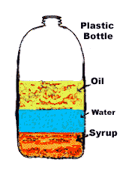
Which liquid is the least dense?
a)
oil
b)
water
c)
syrup 
d)
plastic bottle
51.

A graduated cylinder is used to measure...

a)

Volume

b)

mass

c)

weight

d)

density

52.

What is this tool called....

a)

Ruler

b)

Thermometer

c)

Beaker

d)

Graduated Cylinder

53.


What two types of measurements make up DENSITY? 

a)

Volume and Weight

b)

Temperature and Mass

c)

Mass and Volume

54.

What is the density of water?

a)

34 g/mL

b)

1 g/mL

c)

29 g/mL

d)

6 g/mL

55.
Put the liquids in order from most dense to least dense?
a)
4, 3, 2, 1
b)
1, 2, 3, 4
c)
3, 4, 2, 1, 
d)
4, 3, 1, 2
56.
What is the formula for density?
a)
density = mass x volume
b)
density = mass / volume
c)
density = mass + volume
d)
density = mass - volume
57.
Why do some substances float on water?
a)
they are warmer than water
b)
they are cooler than water
c)
they are more dense than water
d)
they are less dense than water
58.
Helium balloons rise on earth because
a)
helium is less dense than air
b)
helium is more dense than air
c)
helium is cooler than air
d)
helium is warmer than air
59.
What units are used to measure Density?
a)
cm3/g
b)
g
c)
g/cm3
d)
cm3
60.
A crayon has a mass of 10g and volume of 5 mL. What is the density?
a)
30 g/mL
b)
15 g/mL
c)
1 g/mL
d)
2 g/mL
61.
If an object has a density of .6 g/mL and you put it into water, will it sink or float?  
a)
sink
b)
float
62.
If an object has a density of 3.6 g/mL and you put it into water, will it sink or float?  
a)
sink
b)
float
63.
True or False:  The density of a specific type of material never changes.  
a)
True
b)
False
64.

How could two objects have different volumes, but still have the same mass?

a)

If they both have the same density

b)

If the larger object has a lower density

c)

If the smaller object has a lower density

d)

If the larger object has a higher density.

65.

True or False: Physical properties involve things that can be measured without changing the chemical properties.

a)

True

b)

False

66.
Describe what luster means
a)
How an object reflects light
b)
How soft an object is
c)
If an object floats
d)
If an object can be dug out of the earth.
67.

Which of the following is a characteristic of gases?

a)

Fixed shape

b)

Fixed volume

c)

Takes the shape and volume of its container

d)

Cannot be compressed