
 Worksheets
Davis PAP Chem Solutions Review
Total questions: 77
Worksheet time: 3hrs 30mins
CHECK ALL THAT APPLY:
Electronegative atoms that are often involved in Hydrogen Bonds.
Nitrogen
Carbon
Oxygen
Fluorine
Calcium

The Oxygen atoms in the molecule shown have this charge:
Positive
Partial Positive
Negative
Partial Negative

Hydrogen bonds are VERY important in determining the many properties of this very important molecule
(a)
Define the term insoluble.
Can dissolve in water.
Cannot dissolve in water.
Partially dissolves in water.
Define the term soluble.
Can dissolve in water
Cannot dissolve in water
Partially dissolves in water
The substance being dissolved in a solution is the?
solution
solute
solvent
mixture

When 40 grams of NaCl is dissolved in 100 grams of water at 90 ºC, the solution can be correctly described as:
supersaturated
saturated
unsaturated
A homogeneous mixture is the same thing as...
a solution
a heterogeneous mixture
a compound
an element
The prefix hetero means...
same
different
together
awesome
A type of mixture that forms when one substance dissolves in another is known as a
heterogeneous mixture
solution
solute
solvent

Which substance is least soluble at 0 ºC?
KI
KNO3
KClO3
Ce2(SO4)3

How many grams are soluble in 100 g of water at 100 ºC?
300 grams
250 grams
100 grams
50 grams

Which solute is most likely a gas?
NH3
NaNO3
KCl
NaCl
When 40 grams of NaCl is dissolved in 100 grams of water at 90 ºC, the solution can be correctly described as:
supersaturated
saturated
unsaturated


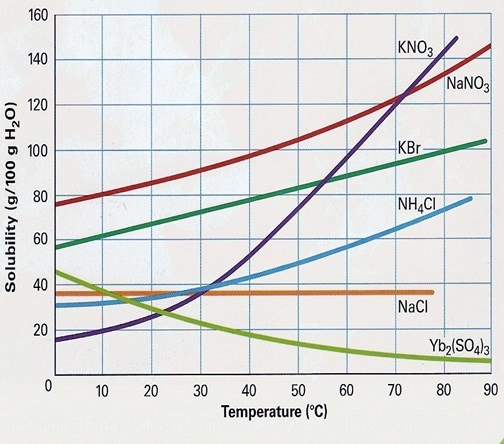
Identify how many grams of KNO3 is required to make a saturated solution at 40'C.
50 g
45 g
55 g
33 g
Water is considered polar due to:
its neutral poles
its charged poles
the odd number of atoms involved

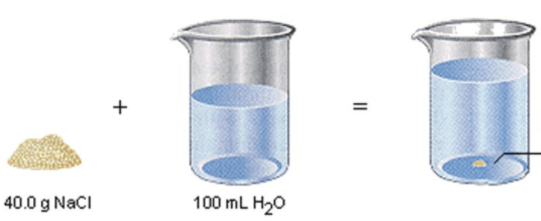
Identify the saturation associated with the product of this experiment.
Unsaturated
Saturated
Supersaturated

What is the solvent example in this picture?
Sugar
Water
Solution
Polar solutes will dissolve in _________ solvents. Nonpolar solutes will dissolve in ____________ solvents.
polar, polar
polar, nonpolar
nonpolar, polar
nonpolar, polar
Two liquids that are soluble in each other in any proportion are said to be:
insoluble
immiscible
miscible
soluble
When the solution equilibrium point is reached and no more solute will dissolve, the solution is said to be _________.
unsaturated
saturated
supersaturated
Which of the following best describes a supersaturated solution?
a solution that contains the maximum amount of solute that is capable of being dissolved
a solution that contains less than the maximum amount of solute that is capable of being dissolved.
a solution that contains more than the maximum amount of solute that is capable of being dissolved.
none of the above
A solution with less than the maximum amount of solute completely dissolved.
Saturated solution
Unsaturated solution
Supersaturated solution
What is the molarity of a 0.5L sample of a solution that contains 60.0 g of sodium hydroxide (NaOH)
0.8 M
1.5M
3.0M
6.0M
Which of the following is the correct formula for calculating molarity?
moles/liters of solution
moles/kg of solvent
# particles/Avogadro's #
theoretical yield/actual yield
As we dilute a solution.....
The volume increases and the molarity (M) increases
The volume increases and the molarity (M) decreases
The volume decreases and the molarity (M) increases
The volume decreases and the molarity (M) decreases
50 ml of a 1 M solution is diluted until the final volume is 80ml. How much water was added?
50 ml
1.3 ml
30 ml
130 ml
In writing the chemical equation for a reaction that produces a precipitate, what abbreviation of the physical state must appear with one of the products?
(s)
(g)
(l)
(w)
What would be the formula of the precipitate that forms when Pb(NO3)2 (aq) and K2SO4 (aq) are mixed?
K(NO3)2
PbSO4
PbK2
H2O
CuCl2(aq) + NaOH(aq) → Cu(OH)2(s) + NaCl(aq)
What is the net ionic equation for the reaction between K3PO4 (aq) and CuSO4 (aq) that produces K2SO4 (aq) and Cu3(PO4)2 (s)?
2 K+(aq) + SO42-(aq) → K2SO4 (s)
K+(aq) + SO42-(aq) → KSO4 (s)
2 Cu2+(aq) + 3 PO43-(aq) → Cu3(PO4)2 (s)
Cu2+(aq) + PO43-(aq) → CuPO4 (s)
Na2S
Name this compound: KF
Potassium fluoride
Potassium fluorite
Fluorine potasside
Potassium fluorate
calcium arsenide
ammonium phosphate
(NH4)3PO4
NPO4
NH4PO4
NH4(PO4)3
What is the formula for manganese(III) oxide?
MnO
MnO3
Mn3O
Mn2O3
What is the correct chemical name for Cu2O ?
Copper oxide
Copper oxalate
Copper (II) oxide
Copper (I) oxide
Which of the following equations is Nickel (II) nitrite ?
Ni2NO2
Ni(NO2)2
Ni(NO3)2
Ni3N2
What is the name of the following ternary ionic compound:
NaMnO4 ?
Sodium Permangante
Sulfur Permanganate
Sodium Manganese Oxide
What is the name of the following ternary ionic compound:
Zn3(PO4)2?
Zinc Phosphate
Zinc Phosphite
Zinc Phosphide
What is the name of the following ternary ionic compound:
KClO4?
Potassium perchlorate
Phosphorus perchlorate
Potassium Chlorine Oxide
What is the name of the following ternary ionic compound:
AgCN?
Silver Cyanide
Silver Carbon Nitride
Silver Carbonoxide
What is the name of the following ternary ionic compound:
NiNO3?
Nickel Nitrate
Nickel Nitrite
Nickel nitogen oxide
What is the name of the following ternary ionic compound:
Al2(SO3)3
Aluminum Sulfite
Aluminum sulfate
aluminum sulfur oxide
What is the name of the following ternary ionic compound:
Ba(OH)2 ?
Barium Hydroxide
Boron Hydroxide
Beryllium Hydroxide
NH4NO3
Na2SO3
Name the following ionic compound: MgSO4
magnesium sulfoxide
magnesium sulfide
magnesium sulfate
magnesium oxide
Ammonium chloride
NHCl4
NH4Cl
NHCl
ACl
Lead II Nitrate
PbNO3
Pb(NO3)2
Pb2NO3
LN
Rubidium Chromate
RbCrO4
RbCr2
Rb2CrO4
Rb(CrO4)2
Calcium Nitrite
CaNO2
CaNO3
Ca(NO2)2
Ca(NO3)2

