
 Worksheets
Chapter 17 Question Bank
Total questions: 108
Worksheet time: 2hrs 39mins
Match the following keywords to their meaning:
Explains the effects of temperature and volume on gas molecules; entropy increases when energy is more dispersed.
Kinetic Molecular Theory (KMT)
Occurs without external intervention; can be fast or slow
Spontaneous Process
In any spontaneous process, there is always an increase in the entropy of the universe (ΔSuniverse=ΔSsystem+ΔSsurroundingsΔSuniverse=ΔSsystem+ΔSsurroundings).
Second Law of Thermodynamics
the different ways particles can order themselves
Spatial Arrangement
Entropy values for common substances at 25°C; perfect crystals at absolute zero have the lowest possible entropy values.
S°
Entropy can be described as
the dispersal of matter
the dispersal of energy
the degree of disorder
all of these
Systems in nature tend to undergo changes toward
lower energy and less disorder
lower energy and more disorder
higher energy and less disorder
higher energy and more disorder
What are the best conditions to lead towards a spontaneous reaction?
high negative enthalpy, high negative entropy
high positive enthalpy, high positive entropy
high negative enthalpy, high positive entropy
high positive enthalpy, high negative entropy.
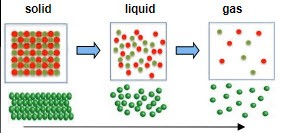
Entropy increases from solid, liquid to gas. Why? (Multiple Answers)
Molecular disorder increases
Number of molecules increase in number from solid to gas
As the phases change, they occupy more volume
Molecules are heavier in solid; the density is greater
The number of possible spatial arrangements increases as you go through phases
How does increasing temperature affect entropy and why?
Entropy decreases as kinetic energy decreases, so particles are more stable
Entropy increases as kinetic energy increases, so the energy is more dispersed
Entropy decreases as kinetic energy increases, so level of disorder decreases
Entropy increases as kinetic energy decreases, so rate of reaction decreases
The entropy will usually increase when
a molecule is broken into two or more smaller molecules
a reaction occurs that results in an increase in the number of moles of gas
a solid changes to a liquid
all of these

Predict the entropy change
ΔS = +ve
ΔS = -ve
ΔS = 0
no change in ΔS

Predict the entropy change
ΔS = +ve
ΔS = -ve
ΔS = 0
no change in ΔS


Which combination of ΔH and ΔS NEVER has a spontaneous reaction?
+ΔH and +ΔS
+ΔH and -ΔS
-ΔH and -ΔS
-ΔH and +ΔS
Which factor affects the entropy of a system?
Volume
Temperature
Pressure
All of the above
What does the entropy of a perfect crystal at absolute zero temperature tend to be according to the Third Law of Thermodynamics?
Zero
Infinite
Constant
Unpredictable
Which reaction has a +ΔS ?
AgNO3(aq) + NaCl(aq) → AgCl(s) + NaNO3(aq)
H2O(g) + CO2(g) → H2CO3(aq)
H2(g) + I2(g) → 2Hl(g)
C2H2O2(g) → 2CO(g) + H2(g)
For a reaction to be spontaneous under standard conditions at all temperatures, the signs of ΔHΟ and ΔSΟ must be __________ and __________, respectively.
+, +
+, -
-, +
-, -
+, 0
The reaction 2 H2(g)+O2(g)→ 2 H2O(g) shows
no change in entropy
an increase in entropy
a decrease in entropy
Which of these would ALWAYS indicate a process is spontaneous?
ΔH is + ΔS is +
ΔH is − ΔS is −
ΔH is + ΔS is −
ΔH is − ΔS is +
What is the correct expression for calculating ΔSsystem ?
ΣΔSreactnts −ΣΔSproducts
ΣΔSproducts −ΣΔSreactnts
ΣΔSproducts +ΣΔSreactnts
ΣΔSreactnts +ΣΔSproducts

Calculate the standard entropy change (ΔS sys) for the industrial synthesis of urea (a common fertilizer):
CO2(g) + 2 NH3(g) → CO(NH2)2(s) + H2O(ℓ)
at 25◦C the thermodynamic data shown is applicable.
YES Calculator!
−424.13 J/mol⋅K
−212.07 J/mol⋅K
−848.26 J/mol⋅K
−1696.52 J/mol⋅K
What is the correct expression for calculating ΔSsurroundings ?
ΔSsurr = ΔH +T
ΔSsurr = TΔH
ΔSsurr =− Tqsurr
ΔSsurr =− Tqsys
Calculate the entropy change of the surroundings (ΔSsurr) when one mole of water freezes at 0°C and a pressure of one atmosphere.
H2O(l) → H2O(s)
ΔH° = -6.02 kJ/mol
22.1 J/K
397 J/K
-22.1 J/K
-397 J/K
What does Gibbs Free Energy tell us?
How much energy is given off by a reaction.
The tendency of a reaction to become "random"
How spontaneous a reaction is.
What information do we need to perform a calculation of Gibbs Free Energy?
Enthalpy of the reaction.
Entropy of the reaction.
The temperature of the reaction in Kelvin.
All of the options are needed.
Enthalpy is a driving force when:
exothermic
endothermic
there is an increase in entropy
there is a decrease in entropy
What is the equation for Gibbs Free Energy Change?
ΔG = ΔH + TΔS
ΔH = ΔG - TΔS
ΔS = ΔH - TΔG
ΔG = ΔH - TΔS
How does Gibbs free energy change tell us a reaction is feasible?
When G < 0
When G > 0
A reaction that has a –ΔH and a –ΔS is
favorable at all temperatures
favorable at high temperatures
i.e. when ΔH < TΔS
unfavorable at all temperatures
favorable at low temperatures
i.e. when ΔH > TΔS
A reaction that has a –ΔH and a +ΔS is
favorable at all temperatures
favorable at high temperatures
i.e. when ΔH < TΔS
unfavorable at all temperatures
favorable at low temperatures
i.e. when ΔH >TΔS
A reaction that has a +ΔH and a +ΔS is
favorable at all temperatures
favorable at high temperatures
i.e. when ΔH < TΔS
unfavorable at all temperatures
favorable at low temperatures
i.e. when ΔH >TΔS
A reaction that has a +ΔH and a –ΔS is
favorable at all temperatures
favorable at high temperatures
i.e. when ΔH < TΔS
unfavorable at all temperatures
favorable at low temperatures
i.e. when ΔH > TΔS
1. Given the following information, calculate ΔG0 for the reaction below at 250C.
SnCl4(l) + 2 H20(l) → SnO2(s) + 4HCl(g)
ΔH = 133.0 kJ and
ΔS = 401.5 J/K
-252.6 kJ
-13.4 kJ
13.4 kJ
252.6 kJ
Your enthalpy is +20 and your entropy is +5.
At what temperature will the reaction be spontaneous?
0 K
4 K
8 K
Your enthalpy is -20 and your entropy is -8.
Which temperature will give you a spontaneous reaction?
1 K
3 K
5 K
It will be spontaneous when ΔH > TΔS
It will be spontaneous when ΔH < TΔS
For the process at 250C : I2(g) →I2(s).
What are the signs for ΔG, ΔH and ΔS?
ΔH = (a)
ΔS = (b)
ΔG = (c)
Predict the signs of ΔH , ΔS and ΔG for the reaction:
Mg(s) --> Mg(g)
ΔH = (a)
ΔS = (b)
ΔG = (c)
True/False: The speed of a chemical reaction is unrelated to the spontaneity of the reaction.
The formation
½ A2 + 2 B2 + C --> CAB4
has an enthalpy of formation of -104 kJ and a change in entropy of -60.8 J/K at 30 °C.
What is the free energy and spontaneity of the reaction?
-85.6 kJ, spontaneous
-18.3 kJ, not spontaneous
+18.3 kJ, spontaneous
+85.6 kJ, not spontaneous
What is the standard unit for Gibbs free energy change?
kJ/mol
N/m
J/mol
mol/dm³
At what temperature would a given reaction become spontaneous if ΔH =+119kJ and ΔS=+263J/K.mol
455 K
-2210 K
382 K
-363 K
Free energy change at equilibrium is...
Zero
Positive
Negative
ΔG for the entire process at constant temperature.
NO Calculator!
+ΔH, −ΔS, ΔG=0
−H, +S, ΔG=0
+ΔH, +ΔS, −ΔG
−ΔH, −ΔS, −ΔG
2C(s) + 2H2(g) → C2H4(g) ΔH0rxn = +52.4 kJ/molrxn
It is observed that the reaction producing C2H4(g) from its elements goes essentially to completion. Which of the following is a true statement about the thermodynamic favorability of the reaction?
The reaction is unfavorable due to both enthalpy and entropy changes.
The reaction is favorable and driven by an entropy change only.
The reaction is favorable and driven by an enthalpy change only.
The reaction is favorable and driven by both enthalpy and entropy changes.
Which of the following sets of conditions must be true for a reaction that is thermodynamically favorable only at relatively high temperatures?
-ΔG
-ΔH
-ΔS
-ΔG
+ΔH
+ΔS
+ΔG
-ΔH
-ΔS
+ΔG
+ΔH
+ΔS
If a reaction increases the # of moles of gas, then the sign for ΔS is what?
Positive
Negative
Neutral
Equilibrium
Calculating ΔG for melting ice:
ΔHFus= 6.01 kJ/mol-rxn
ΔSFus= 22.0 kJ/mol-rxn*K
20oC (K=273+co)
ΔG=ΔH-TΔS
0.44 kJ/mol-rxn, spontaneous
-0.44 kJ/mol-rxn, nonspontaneous
0.44 kJ/mol-rxn, nonspontaneous
-0.44 kJ/mol-rxn, spontaneous
The First Law of Thermodynamics indicates that
Work is force exerted over a distance.
Energy in a universe is finite.
An increase in disorder is part of any spontaneous process.
Work is a state function.
The Third Law of Thermodynamics indicates that the
enthalpy of the universe is constant.
entropy of the universe increases.
sum of the entropies of the system plus surroundings is zero.
entropy of a perfectly ordered pure crystal is zero at absolute zero.
The substance with the smallest value of So is
AlCl3
MgCl2
NaCl
SnCl4
Entropy is always ________ in the Universe
increasing
decreasing
constant
What is a thermodynamically unfavorable reaction?
A process where the entropy of the system decreases
A reaction that occurs spontaneously without an external energy source
A reaction in which ΔG°< 0
A reaction that does not occur spontaneously without an external energy source
a reaction that is exothermic and has a decrease in entropy is
spontaneous at high temps
spontaneous at low temps
always spontaneous
never spontaneous
Which of the following would have a nonzero enthalpy of formation?
Fe(s)
Br2(s)
O2(g)
Hg(l)
Which of the following equations represents a reaction with a negative ΔS°?
2NO(g) + O2(g) → 2NO2(g)
2KClO3(s) → 2KCl(s) + 3O2(g)
PCl5(g) → PCl3(g) + Cl2(g)
C3H8(g) + 5O2(g) → 3CO2(g) + 4H2O(g)

The oxidation of PCl3(g) is represented by the equation above, and the table provides the approximate values of the absolute molar entropies, S°, for these substances. Based on the information given, what is the approximate ΔS° for the reaction?
+170J/(molrxn⋅K)
−170J/(molrxn⋅K)
+190J/(molrxn⋅K)
−190J/(molrxn⋅K)
CH3OH(g) --> CO(g) + 2H2(g)
The reaction represented above goes essentially to completion. The reaction takes place in a rigid, insulated vessel that is initially at 600 K
What can be inferred about ∆S° for the reaction at 600 K?
It must be positive, since the reaction is thermodynamically unfavorable at 600 K.
It must be negative, since there are more moles of products than reactants.
It must be positive, since ∆G° is negative and ∆H° is positive.
It must be negative, since ∆G° is positive and ∆H° is positive.
Reaction 1: 4 NH3(g) + 8O2(g) → 4 HNO3(aq) + 4 H2O(I)
Based on the values of ΔG° for the three reactions represented below, what is the value of ΔG° for Reaction 1 represented above?
Reaction 2: 4NH3(g) + 5O2(g) → 4 NO(g) + 6 H2O(l) ΔG° = -1010 kJ/mol
Reaction 3: 2NO2(g) → 2 NO(g) + O2(g) ΔG° = 70 kJ/mol
Reaction 4: 4NO2(g) + O2(g) + 2H2O(l) → 4 HNO3(aq) ΔG° = -170 kJ/mol
-1040 kJ/mol
-1110 kJ/mol
-1250 kJ/mol
-1320 kJ/mol
Although the dissolution of ammonium chloride (NH4Cl) in water is an endothermic reaction, even then it is spontaneous because:
TΔS<ΔH
ΔS=−ve and TΔS<ΔH
ΔS=0
ΔS=−ve
Which combination of acid (HCl) and base (KOH) will produce the greatest amount of heat?
1M of 10mL HCl with
1M of 10mL KOH
2M of 10mL HCl with
0.5M of 10mL KOH
0.5M of 10mL HCl with
0.5M of 10mL KOH
0.5M of 10mL HCl with
1M of 10mL KOH
Which of the following methods can be used to make a nonspontaneous reaction (ΔG > 0) proceed? (TWO correct answers)
Lowering the temperature
Increasing the pressure
Applying external energy
Decreasing the concentration of reactants
Pairing up the reaction with another (coupling)
Consider the following reaction:
2 NO (g) + O₂ (g) → 2 NO₂ (g) ΔG° = +70 kJ/mol
Which of the following reactions, when coupled with the main reaction, can make the overall process of converting NO to NO₂ more thermodynamically favorable?
2H₂O(g) → 2H₂ (g) + O₂ (g)
ΔG° ≈ -237 kJ/mol
Cl₂ (g) + H₂O (l) → HCl (g) + HClO (aq)
ΔG° ≈ +254 kJ/mol
2 NO₂ (g) + H₂O (l) → HNO₃ (aq) + HNO₂ (aq) ΔG° ≈ -140 kJ/mol
CO (g) + 2 NO₂ (g) → CO₂ (g) + N₂O₅ (g)
ΔG° ≈ -137 kJ/mol
What is the main purpose of Coupling Reactions?
To create increase the free energy of the overall process
To increase the activation energy of a reaction.
To decrease the rate of a reaction.
To make a thermodynamically unfavorable reaction proceed by utilizing a favorable one.
6. The formation ½ A2 + 2 B2 + C --> CAB4 has an enthalpy of formation of -104 kJ and a change in entropy of -60.8 J/K at 30 °C. What is the free energy and spontaneity of the reaction?
-85.6 kJ, spontaneous
-18.3 kJ, not spontaneous
+18.3 kJ, spontaneous
+85.6 kJ, not spontaneous
Which reaction has the greatest increase in entropy of the system?
A. HCl (g) + NH3 (g) → NH4Cl (s)
B. (NH4)2Cr2O7 (s) → Cr2O3 (s) + N2 (g) + 4H2O (g)
C. CaCO3 (s) → CaO (s) + CO2 (g)
D. I2 (g) → I2 (s)
A
B
C
D
What can be said about a chemical system that has reached a minimum in free energy?
The system has achieved equilibrium.
The reaction is complete.
The system entropy is zero.
The reaction is very fast.
At what temperature would a given reaction become spontaneous if ΔH =+119kJ and ΔS=+263J/K.mol
455 K
-2210 K
382 K
-363 K
For any reaction at equilibrium, which of the following is true?
ΔH<0
ΔS< 0
ΔG=0
ΔS=0
Given the change of phase:
CO2(g) —> CO2(s)
Predict the change in entropy of the process above. Justify your answer.
ΔS is negative
solid particles occupy less volume than gas
solid particles are less dispersed than gas
a gas is turning into a solid
solids have less possible spatial configurations than gases
the process is spontaneous
ΔS is positive
ΔS is zero
the kinetic energy of the solid particles is more dispersed
The correct statements about entropy and gibbs free energy (choose 3 instead of 4)
The entropy change is calculated in energy units of joules, but ΔG° and ΔH° are both measured in kJ.
ΔG = ΔH – TΔS
ΔG = ΔH + TΔS
For a reaction to be feasible, ΔG has to be negative.
For the equation,
ΔG° = -RTlnK
If K is less than 1, what is the value of ΔG°?
ΔG = 0
ΔG is negative since the reaction is reactant favoured
ΔG is positive since the reaction is product favoured
ΔG is positive since the reaction is reactant favoured
For the equation,
ΔG° = -RTlnK
If K is more than 1, (K>1) what is the value of ΔG°?
ΔG = 0
ΔG is positive since the reaction is reactant favoured
ΔG is negative since the reaction is product favoured
ΔG is negative since the reaction is reactant favoured
ΔG = ΔG° + RTlnQ
if Q > K

The graph shows Gibbs free energy of a mixture of N2O4 (g) and NO2 (g) in different proportions. Which point shows the system at equilibrium?
N2O4 (g) ⇌ 2NO2 (g)
A
B
C
D

Which statement is correct for a spontaneous reaction?
A
B
C
D

Which corresponds to a system at equilibrium?
A
B
C
D
What is the limitation of using ΔG to predict the feasibility of a reaction?
ΔG can only be used to predict the feasibility of a reaction under standard conditions.
ΔG indicates that the reaction will occur at an observable rate.
ΔG takes into account the kinetics of the reaction.
ΔG can predict the exact time when the reaction will occur.
If the equilibrium constant (K) for a reaction is greater than 1, what is true about the reaction?
Reactants are favored.
Neither reactants nor products are favored.
Products are favored.
The reaction is at equilibrium.
Rearrange the Gibbs free energy equation ( ΔG = ΔH - TΔS) to solve for the temperature at a phase transition e.g. H2O (l) --> H2O (g)
T=ΔSΔH−ΔG
T=ΔSΔH
T = - ΔG
T=ΔS−ΔG
The equation for Gibbs free energy in STANDARD conditions (ΔG°) is....
What is the correct rearrangement for calculating K from ΔG?
ΔG = -RTln(K)
K=eRTΔG
K=eΔG⋅RT
K=eRT−ΔG
K=eΔG+RT
The graph shows Gibbs free energy of a mixture of N2O4 (g) and NO2 (g) in different proportions. Which point shows the system at equilibrium?
N2O4 (g) ⇌ 2NO2 (g)
A
B
C
D
Which statement is correct for a spontaneous reaction?
A
B
C
D
Which corresponds to a system at equilibrium?
A
B
C
D
If the equilibrium constant (K) for a reaction is greater than 1, what is true about the reaction?
Reactants are favored.
Neither reactants nor products are favored.
Products are favored.
The reaction is at equilibrium.
H2(g) + I2(g) ⇋ 2HI(g)
For the reaction above the standard free energy is +1.7 kJ/mol
Therefore, what would the value of the equilibrium constant be?
For the equation,
ΔG° = -RTlnK
If K is less than 1, what is the value of ΔG°?
ΔG = 0
ΔG is negative since the reaction is reactant favoured
ΔG is positive since the reaction is product favoured
ΔG is positive since the reaction is reactant favoured
For the equation,
ΔG° = -RTlnK
If K is more than 1, (K>1) what is the value of ΔG°?
ΔG = 0
ΔG is positive since the reaction is reactant favoured
ΔG is negative since the reaction is product favoured
ΔG is negative since the reaction is reactant favoured
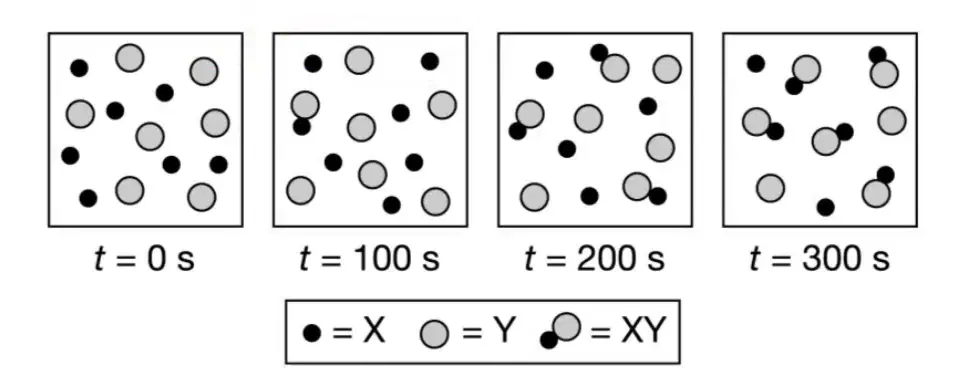
X(g) + Y(g) ⇌ XY(g)
In an experiment, the reaction above reaches equilibrium at 300s.
What can be concluded about the sign of ΔG for the reaction from 0s until 300s?.
We cannot determine the sign of ΔG
ΔG is negative as written, since the system shifts to the products
ΔG is positive as written, since the system shifts to the products
ΔG is negative as written, since the system shifts to the reactants
ΔG is positive as written, since the system shifts to the reactants
Calculate the equilibrium constant for the reaction below at 25oC:
N2O4(g) → 2NO2(g) ΔG°rxn = +4.8 kJ/mol
ΔG°rxn = - RT InK
0.14
1.14
1.40
0.40
What is the limitation of using ΔG to predict the feasibility of a reaction?
ΔG can only be used to predict the feasibility of a reaction under standard conditions.
ΔG indicates that the reaction will occur at an observable rate.
ΔG takes into account the kinetics of the reaction.
ΔG can predict the exact time when the reaction will occur.
ΔG = ΔG° + RTlnQ
if Q > K
Which expression can be used to plot a useful graph for finding ΔH° from the following equation?
ΔG°= –RT ln(K) = ΔH°–TΔS°
ln(K)=−RΔHo(T1)+RΔSo
ln(K)=RTΔHo−RΔSo
−RΔHo(T1+RΔSo)lnK
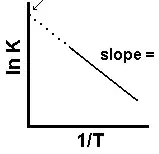
What is the value of the slope?
ΔG°= –RT ln(K) = ΔH°–TΔS°
ln(K)=−RΔHo(T1)+RΔSo
slope = R−ΔS
slope = R−ΔH
slope = RΔH
slope = RΔS
What is the value of the y intercept?
ΔG°= –RT ln(K) = ΔH°–TΔS°
ln(K)=−RΔHo(T1)+RΔSo
y intercept = R−ΔS
y intercept = R−ΔH
y intercept = RΔH
y intercept = RΔS

