wayground logo

Free Printable Worksheets

Font size

S
M
L
XL
Worksheets

Quiz: Evolution & Natural Selection

Total questions: 101

Worksheet time: 1hrs 5mins

Name
Class
Date
1.

Who developed the theory of natural selection?

a)

Jean-Baptiste Lamarck

b)

Charles Darwin

c)

James Hutton

d)

Gregor Mendel

2.

Does evolution describe a change in an individual or a population?

a)

Individual

b)

Population

3.

Artificial Selection can be defined as...

a)

the selective breeding of organisms by humans for specific, desirable traits

b)

the change in characteristics of a population from one generation to another

c)

the process where organisms with certain traits are better able to survive and reproduce

d)

what happens when there is a sudden decrease in population size, such as when there is a natural disaster

4.

Which is an example of artificial selection?

a)

A farmer collects seeds from his largest fruit and replants only these seeds

b)

A rancher chooses to breed his longest-horned bull to produce more long-horned cattle

c)

A dog breeder chooses which dogs to mate to produce offspring that do not shed

d)

All of these are correct

5.

Another name for natural selection is...

a)

hybridization

b)

bottleneck effect

c)

inheritable variation

d)

survival of the fittest

6.

What is an example of natural selection?

a)

tortoise population that eats tall cacti develops longer necks over time

b)

a dog breed becomes smaller because of human demand

c)

a white moth is predated on a dark tree

d)

a population of trees is killed by a large flood

7.

A trait that allows some organisms to survive while others do not is a/an...

a)

evolution

b)

mutation

c)

adaptation

d)

inheritable trait

8.

Which is an example of an adaptation?

a)

A group of rabbits have thick fur to stay warm in the winter

b)

A group of moths have darker wing colors to blend in to the trees

c)

A bird has a long thin beak to eat insects on cacti

d)

All of these are correct

9.

Which two species would have the fewest differences in their DNA?

a)

snakes and iguanian lizards

b)

snakes and geckos

c)

turtles and crocodiles

10.

Which two species would have the most differences in their DNA?

a)

snakes and iguanian lizards

b)

snakes and geckos

c)

turtles and crocodiles

11.
The theory of natural selection was a hypothesis first proposed by
a)
Gregor Mendel
b)
James Waston and Francis Crick
c)
Charles Darwin
d)
Robert Hooke
12.
1000 red and 1000 white ground beetles are placed in a cage on red clay containing beetle eating birds.  The beetles are counted after 2 days. What is expected? 
a)
Equal number of red and white beetles are left
b)
More red beetles are left
c)
More white beetles are left. 
d)
All the beetles are gone.
13.
Darwin's studies of finches on the Galapagos Island suggests that the finches' differences in beak structure were most directly due to:
a)
acquired characteristics in the parent finches
b)
the size of the island where the finches live.
c)
mating behaviors of the different finch species
d)
geographic isolation and adaptations of the finches to different environments 
14.
Which statement best describes evolution.
a)
evolution is a predictable change from simple to complex organisms
b)
evolution is a process of change through time
c)
evolution causes organisms to develop characteristics they need
d)
evolution often proceeds from complex to simpler organisms. 
15.
Characteristics of a species that make its members better able to live and reproduce in their environment are known as
a)
abiotic factors
b)
biotic factors
c)
homologous structures
d)
favorable adaptations. 
16.
Which of the following is true about natural selection?
a)
a population of organisms of the same species are all alike
b)
organisms posses genetic characteristics that sometimes make no difference on their lives
c)
organisms choose characteristics that help them adapt to their environment
d)
only those organisms that survive the environmental change pass on their traits to the next generation 
17.
Many scientists believe that the great number of different species of organisms which exist on the planet and the present time has resulted from billions of years of
a)
gel electrophoresis
b)
recombinant DNA
c)
cloning
d)
evolution 
18.
A change in the gene pool due to death or isolation is called
a)
natural selection 
b)
biochemistry
c)
genetic drift
d)
mutations 
19.
The information in the chart provides data that can help in the identification of possible evolutionary relationships from the study of comparative __________ 
a)
cytology
b)
embryology
c)
anatomy
d)
biochemistry 
20.
Using the information from the chart, which two organisms are the closest in evolutionary distance from a common ancestor?
a)
horse-zebra
b)
human-gorilla
c)
human-chimpanzee
d)
horse-chimpanzee 
21.
A large population of bluejays living in the mountains is separated by the formation of a desert.  After millions of years, the populations of bluejays would most likely...
a)
become exstinct
b)
diverge into two new species 
c)
evolve into cats
d)
become two very small populations of the same species. 
22.
How are sudden changes and gaps in the fossil record explained?
a)
natural selection
b)
punctuated equilibrium
c)
acquired characteristics
d)
DNA evidence 
23.
The diagram shows undisturbed sedimentary strata at the bottom of the ocean.  The fossils found in layer B resemble the fossils found in layer A.  This similarity suggests that. 
a)
modern forms of life lay have evolved from earlier forms of life
b)
vertebrate fossils are only found in sediments 
c)
the fossils in layer A must be more complex than those in layer B
d)
the fossils in layers B were formed before the fossils in layer A
24.
The diagram below shows the gradual change over time in the anatomy of the horse.  Which concept is best illustrated by the physical variations in the horse as its body size and structure change over time?
a)
acquired characteristics 
b)
artificial selection
c)
intermediate inheritance
d)
evolution 
25.
Fossils of an extinct species of giant armadillo were found to be similar to a smaller species of armadillo presently inhabiting the same region.  This similarity could best be explained on the basis of...
a)
evolution from older forms
b)
use and disuse
c)
inheritance of acquired traits 
d)
the heterotroph hypothesis 
26.
A study of the position and shape of the bones in the forelimbs of a flying squirrel, a bat, and a beaver showed that the beaver and the flying squirrel appear to be most closely related.  This determination was most likely based on a study in the field of comparative
a)
anatomy
b)
biochemisty
c)
cytology
d)
embryology. 
27.
Fossils would most likely be found in
a)
amber (petrified sap) that is over 8 billion years old
b)
icebergs that are 500 billion years old
c)
sedimentary rocks that are 500 million years old
d)
volcanic rocks that are 50 million years old
28.
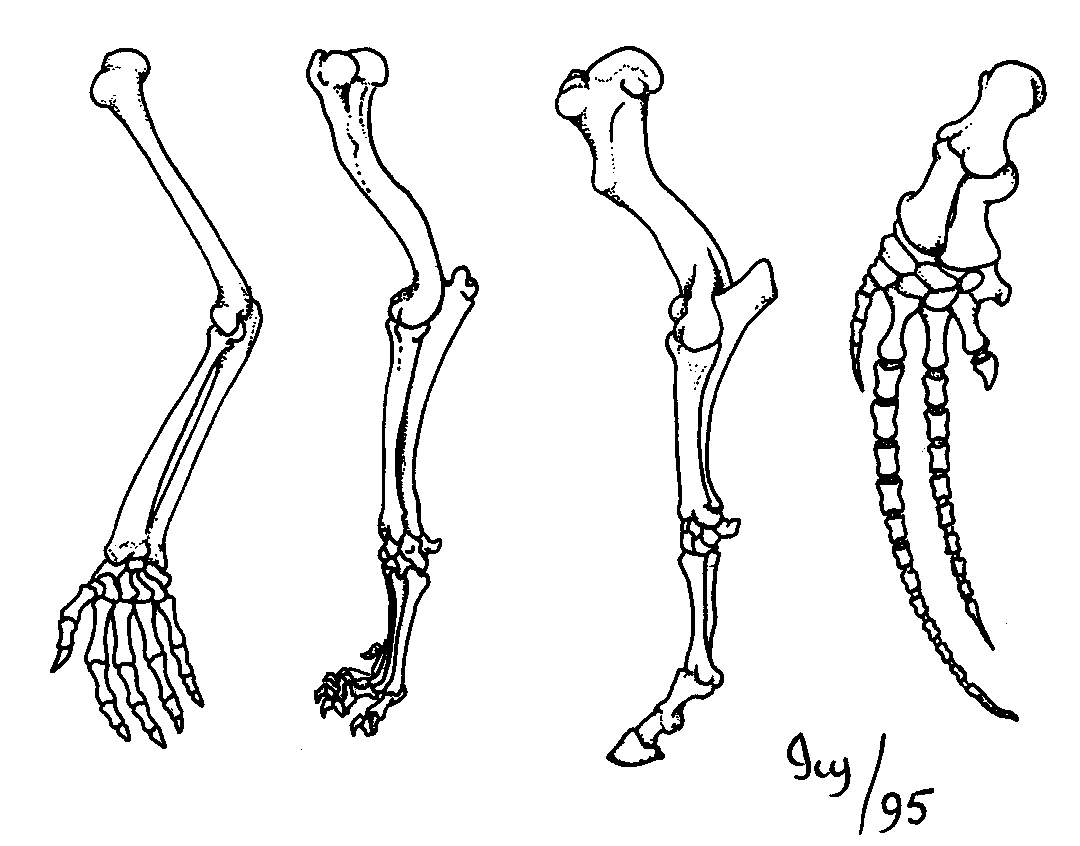
The diagrams below represent homologous structures.  The study of the evolutionary relationships between these structures is known as comparative... 
a)
embryology
b)
anatomy
c)
biochemistry
d)
cytology 
29.
The diagram shows a comparison of base sequences in the DNA of some organisms to those of a human.  According to this diagram, humans and gorillas last shared a common ancestor how many million of years?
a)
5 million years ago
b)
8 million years ago
c)
15 million years ago
d)
the present 
30.
Blood proteins in horses are chemically similar to blood proteins in moneys.  This similarity suggests that horses and monkeys
a)
can interbreed 
b)
evolved at the same time
c)
live in the same habitat
d)
have a common ancestor 
31.
The diagram below represent stages in the embryonic development of four organisms.  The similarities in embryonic development shown in the diagram suggests that these oranisms 
a)
all undergo external development
b)
have adaptations for the same enviroment
c)
are all members of the same species
d)
may have evolved from a common ancestor 
32.
The diagrams show embryos of three different vertebrate species.  According to one theory, similarities in these embryos suggest common ancestry.  As these embryos matures, they will most likely
a)
develop new organs according to the nutritional requirements of each organisms
b)
show no similarities 
c)
continue to closely resemble each other as adults
d)
develop distinctive characteristics of their species 
33.
The Hardy-Weinberg equilibrium equation (p2 + 2pq + q2 = 1) allows geneticists to: 
a)
keep track of changes in phenotype frequencies from generation to generation in small families
b)
keep track of changes in phenotype frequencies from generation to generation in a population 
c)
determine what evolutionary mechanisms are causing changes in a population's gene pool frequencies 
d)
Let Mr. Pennell teach basic algebra to unsuspecting bio students 
34.

What is natural selection?

a)

The process by which organisms intentionally select their offspring's traits.

b)

The process by which organisms randomly produce offspring.

c)

The process by which organisms worse adapted to their environment tend to survive and produce more offspring.

d)

The process by which organisms better adapted to their environment tend to survive and produce more offspring.

35.

What is evolution?

a)

The process of change in only human life over generations

b)

The process of change in all forms of life over a single generation

c)

The process of change in non-living things over generations

d)

The process of change in all forms of life over generations

36.

What is adaptation?

a)

The process by which organisms change their genetic makeup to better fit their environment.

b)

The process by which organisms migrate to a different environment to survive and reproduce.

c)

The process by which organisms become extinct due to changes in their environment.

d)

The process by which organisms adjust to changes in their environment in order to survive and reproduce.

37.

Who is Charles Darwin?

a)

An American inventor known for his work on electricity

b)

An English naturalist, geologist and biologist known for his contributions to the science of evolution.

c)

A French mathematician known for his contributions to calculus

d)

A German philosopher known for his theories on metaphysics

38.

What did Charles Darwin contribute to the field of biology?

a)

Theory of Lamarckian inheritance

b)

Theory of evolution through natural selection

c)

Theory of spontaneous generation

d)

Theory of intelligent design

39.

What is speciation?

a)

The process by which new species are formed from existing ones.

b)

The process by which existing species become extinct

c)

The process by which species evolve into plants

d)

The process by which species migrate to different regions

40.

Which of the following is NOT a mechanism of natural selection?

a)

Genetic drift

b)

Adaptation

c)

Mutation

d)

Gene flow

41.

What is convergent evolution?

a)

The process by which unrelated or distantly related organisms evolve different traits or characteristics in response to different environmental conditions.

b)

The process by which unrelated or distantly related organisms evolve similar traits or characteristics in response to similar environmental conditions.

c)

The process by which closely related organisms evolve different traits or characteristics in response to similar environmental conditions.

d)

The process by which unrelated or distantly related organisms evolve similar traits or characteristics in response to different environmental conditions.

42.

What is divergent evolution?

a)

The process by which species that were once similar to an ancestral species evolve and accumulate differences, resulting in the formation of new species.

b)

The process by which species that were once similar to an ancestral species evolve and accumulate similarities, resulting in the extinction of the species.

c)

The process by which species that were once similar to an ancestral species evolve and accumulate similarities, resulting in the formation of new species.

d)

The process by which species that were once similar to an ancestral species evolve and accumulate differences, resulting in the extinction of the species.

43.

What is coevolution?

a)

The process in which two or more species evolve in the same direction due to environmental factors.

b)

The process in which two or more species evolve through genetic mutation.

c)

The process in which two or more species reciprocally affect each other's evolution through natural selection.

d)

The process in which two or more species evolve independently without any interaction.

44.

What is the main factor influencing natural selection?

a)

Mutation

b)

Environment

c)

Genetic drift

d)

Random chance

45.

Which of the following is an example of an adaptation in a desert environment?

a)

Plants storing water in their leaves or stems

b)

Cacti having thorns to protect against predators

c)

Animals migrating to cooler areas during the day

d)

Plants growing tall to reach sunlight

46.

Which of the following is an example of an adaptation in an aquatic environment?

a)

Wings in insects

b)

Fur in mammals

c)

Gills in fish

d)

Lungs in birds

47.

Which of the following is an example of an adaptation in a cold climate?

a)

Short fur

b)

Thick fur or blubber

c)

Sweating

d)

Hibernation

48.

Which of the following is an example of an adaptation in a forest environment?

a)

Migration

b)

Hibernation

c)

Photosynthesis

d)

Camouflage

49.

Individuals with variations that make them best suited to their environment are, on average, more likely to ________.

a)

evolve

b)

change over time

c)

survive and reproduce

d)

become larger

50.

Natural selection acts on ________, and ________ evolve.

a)

individuals; individuals

b)

individuals; populations

c)

populations; populations

d)

populations; individuals

51.
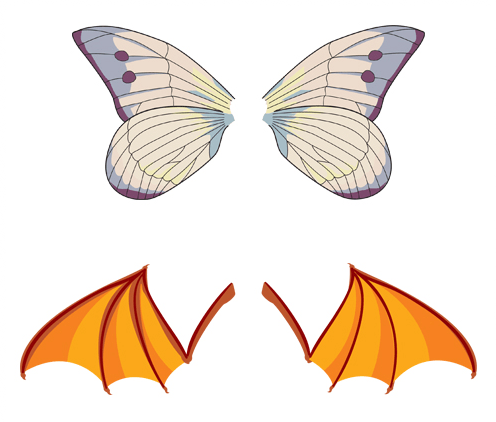
Bird wings and butterfly wings are an example of
a)
Homologous structure
b)
Analogous structure
c)
Mimicry
d)
Camoflague
52.

An anatomical feature that no longer seams to have a purpose in the current form of an organism

a)

Homologous structure

b)

Analogous structure

c)

Vestigial structure

d)

None of the above

53.
a segment of DNA is called a 
a)
gene 
b)
allele 
c)
phenotype
54.

Mutations are

a)

Long Time evolutionary events

b)

Short time evolutionary events

c)

Mistakes in the genetic code

d)

When an organism looks very similar win physical resemblance to other objects

55.

Mimicry is

a)

Long Time evolutionary events

b)

Short time evolutionary events

c)

Mistakes in the genetic code

d)

When an organism looks very similar win physical resemblance to other objects

56.

An example of high fitness (the ability to survive and reproduce) is

a)

A man with 1 child and 10 grandchildren

b)

A man with 10 children ad 80 grandchildren

57.

Natural selection is the process that passes down ____________________ traits.

a)

Same

b)

Old

c)

Useless

d)

Favorable

58.

The process in which an animal cannot reproduce any more and dies out is known as _________________________.

a)

Speciation

b)

Extinction

c)

Evolution

d)

Natural Selection

59.

When there is a difference in population based on genes, it is said to be a _______________.

a)

Mutation

b)

Speciation

c)

Extinction

d)

Genetic Variation

60.
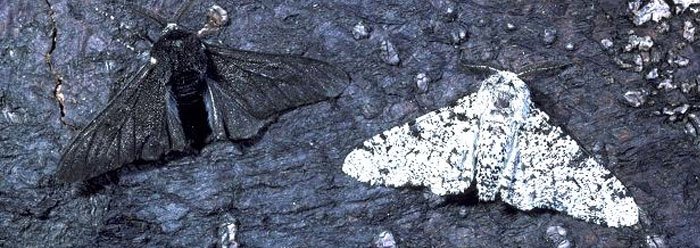
The trees these moths used to live on were white, but have been covered in soot from coal factories. Which moth will be more successful in this environment?
a)
Dark moth
b)
Light moth
c)
Both will be equally successful
d)
Neither will be successful
61.

Which were first on earth?

a)

eurkaryotes

b)

prokaryotes

c)

mammals

d)

reptiles

62.
A well-tested concept that explains a wide range of observations is called a(an):
a)
hypothesis
b)
experiment
c)
cause and effect
d)
scientific theory
63.
The information provided by fossils about the Earth's history.
a)
Fossil Record
b)
Extinction
c)
Evolution
d)
Genetic Variation
64.

Which of the following is the collection of life's remains found in sedimentary rock?

a)

natural selection

b)

homologous structures

c)

Charles Darwin

d)

the fossil record

65.
Which layer is the youngest
a)
1
b)
2
c)
3
d)
4
66.
How do fossils provide evidence that evolution has happened on Earth?
a)
Fossils show how the sizes of certain animals has changed drastically over millions of years
b)
Fossils show that some species have gone extinct
c)
Fossils show how life forms present today are different than those from the past
d)
Different sedimentary rock layers provide evidence for how the environment has changed over time
67.

Similarities in bone arrangements, like those in the picture, support the hypothesis that...

a)

these organisms are not well adapted

b)

these organisms share a common ancestor

c)

these organisms all share the same DNA sequences

d)

these organisms are members of the same species
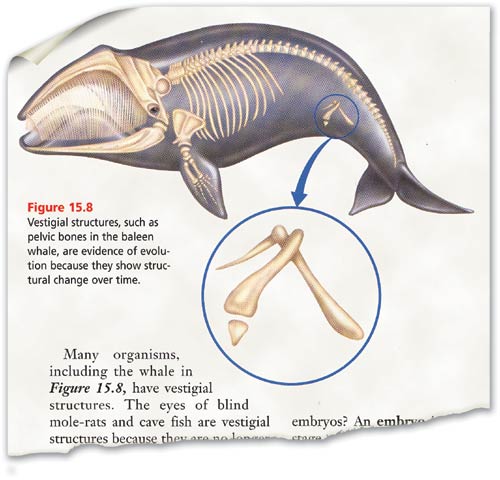
68.
Which of the following is an example of a vestigial structure?
a)
the wings of a red-tailed hawk
b)
the hind limbs of a house cat
c)
the fins of sharks
d)
the tailbone of a human
69.

What is this an example of?

a)

Homologous structure

b)

Analogous structure

c)

Vestigial organs

d)

Functional adaption

70.

The picture shows a/an ___________

a)

homologous structure

b)

vestigial structure

71.
Structures are similar in appearance but not in structure
a)
Vestigial 
b)
Homologous 
c)
Analogous Structures 
d)
Embryonic 
72.
Structures with the same parts have different functions; suggests that organisms share a common ancestry
a)
vestigial structures
b)
homologous structures
c)
adaptive radiation
d)
fossil
73.
Study of embryos of various organisms to show a common ancestor because of similarities in development
a)
natural selection
b)
embryology
c)
speciation
d)
evolution
74.
Two organisms that are closely related would have
a)
very similar DNA sequence
b)
exactly the same DNA sequences
c)
no proteins in common
d)
completely different DNA sequence
75.
What does Darwin's theory of evolution suggest?
a)
species change over time
b)
extinct species are not related to living species
c)
different species can interbreed
d)
animals that look alike are most closely related
76.
Some organisms that share a common ancestor have features that have different functions, but similar structures.  These are known as
a)
vestigial structures
b)
analogous structures
c)
homologous structures
d)
fossil structures
77.
If modern organisms have a lot of homologous structures, what inference might paleontologists make about those organisms?
a)
They are reptiles
b)
One organism evolved from the other.
c)
The organisms have a common ancestor
78.
Which is not evidence for evolution?
a)
many animals have homologous structures due to common ancestry
b)
Many animals have vestigial structures from an ancestor
c)
We can observe changes in life forms by observing the fossil record
d)
All of these are evidence for evolution
79.
What is a structure that is similar across species?
a)
vestigial
b)
homologous
c)
adaptaion
d)
variation
80.
Predict which moth would increase in population
a)
light 
b)
dark
81.
How do fossils provide evidence that evolution has happened on Earth?
a)
Fossils show how the sizes of certain animals has changed drastically over millions of years
b)
Fossils show that some species have gone extinct
c)
Fossils show how life forms present today are different than those from the past
d)
Different sedimentary rock layers provide evidence for how the environment has changed over time
82.
Scientists compare organisms' DNA to support the theory that all species share a common _________________
a)
separation
b)
ancestor
c)
population
d)
environment
83.
The diagram illustrates an embryonic stage of two organisms.

Which of the following can be determined by observing the embryos shown in the diagram
a)
The organisms share a common ancestry.
b)
The organisms belong to the same genus.
c)
The organisms are native to the same geographic areas.
d)
The organisms will grow into anatomically similar adults.
84.

Recently, scientists have been able to use ___________to find common proteins and amino acids to determine how closely related species are.

a)

DNA

b)

Vestigial structures

c)

Fossils

d)

Homologous structures

85.
Structures are similar in appearance but not in structure
a)
Vestigial 
b)
Homologous 
c)
Analogous Structures 
d)
Embryonic 
86.
The changes of species over time
a)
Embryonic 
b)
Natural selection 
c)
Mimicry 
d)
Evolution 
87.
Which layer is the youngest
a)
1
b)
2
c)
3
d)
4
88.
Which layer is the oldest
a)
B
b)
A
c)
E
d)
C
89.
A few deer wander out of their native woods into a completely new park where no deer had ever been before. They go on to create an entirely new population.
a)
Genetic Drift
b)
Natural Selection
c)
Non-random mating
d)
Mutation
90.
Yellow toucan birds seek out one another to make babies together and tend to avoid the green toucan birds.
a)
Genetic Drift
b)
Non-random mating
c)
Gene flow
d)
Mutation
91.

During gestation (pregnancy), a developing male pig had a change in his genetic code. The result was that he to produce less nitrogenous solid waste.

a)

Genetic Drift

b)

Non-random mating

c)

Mutation

d)

Natural Selection

92.
Five hundred years after the deer had established a flourishing population in the park, a few of them venture back to their original woods and have babies with the deer there.
a)
Genetic Drift
b)
Mutations
c)
Non-random mating
d)
Gene flow
93.
Wolves from the Arizona mesa were transferred to the Colorado Rockies after a forest fire destroyed their habitat. They quickly became part of the local pack and had offspring.
a)
Mutation
b)
Natural Selection
c)
Genetic Drift
d)
Gene Flow
94.
7 Wild Mustangs were taken from the prairies of Iowa after a Texan Rancher purchased them and provided them with their own pasture. Those 7 Mustangs eventually became 122.
a)
Genetic Drift (small popultaion)
b)
Non-random mating
c)
Gene flow
d)
Mutations
95.
Which of the following is an example of the bottle neck effect?
a)
Bald Eagles are hunted until near extinction, population recovers.
b)
Small group of iguanas floats to an island, starts a new population.
c)
Red fox pups are more likely to survive in a snowy environment if they are born white.
d)
Farmer chooses seeds from largest apples to plant next year.  This results in larger apples from year to year.
96.

All of the genetic information found in a population.

a)

population

b)

genetic drift

c)

evolution

d)

gene pool

97.
Gene Flow tends to ___________ genetic variation (diversity)
a)
Increase
b)
Decrease
c)
Stabilize
d)
Exaggerate 
98.
Which of the following is an example of the bottleneck effect?
a)
Cheetah populations reach their lowest levels with reduced diversity and as they rebound are so genetically similar they appear to be inbred.
b)
Affected individuals with blue skin can trace their ancestry back to one of the first settlers in the region.
c)
The environment of a fox population changes and over time foxes who are white survive and pass on their genes to their offspring.
d)
Humans choose two dogs they like the characteristics of and breed them together.
99.
Which of the following is NOT an example of natural selection? 
a)
People selectively breeding hamsters.
b)
Insect populations developing resistance to certain pesticides.
c)
Bacteria becoming resistant to antibiotics.
d)
Male birds of certain species developing colorful feathers to attract female mates.
100.
Which of the following is an example of the founder effect?
a)
Bald Eagles are hunted until near extinction, population recovers.
b)
Small group of iguanas floats to an island, starts a new population.
c)
Red fox pups are more likely to survive in a snowy environment if they are born white.
d)
Farmer chooses seeds from largest apples to plant next year.  This results in larger apples from year to year.
101.

Bats are common in Texas, especially in rocky regions. Bats with longer hang claws have demonstrated higher fitness because of their ability to cling to rock while resting. This adaptation is becoming more frequent in the population. What mechanism of evolution is this?

a)

Natural Selection

b)

Non-random mating

c)

Gene Flow

d)

Genetic Drift