
 Worksheets
Bio Sub Work 4/9
Total questions: 117
Worksheet time: 2hrs 4mins
All viruses are different, but what are two parts that a virus must have?
Genetic Information (DNA or RNA)
a lipid membrane
a nucleus
a protein coat

Which of these statements is true?
A virus is unicellular, it has only one cell.
A virus may sometimes be multicellular, have many cells.
A virus has no cells
Which statement is true?
A virus has a nucleus, but no other organelles.
A virus has a nucleus and ribosomes.
A virus has no organelles, because it has no cells, and it is non-living.

A virus is so small that 250,000 viruses could fit inside
a grain of sand
an apple
a basketball

Cell membranes of living organisms are made of a bilayer (2 layers) of
lipids
proteins
carbohydrates
Which sentence is true
All viruses, although they are not living, have a lipid layer that surrounds them.
Many viruses, although they are not living, have a lipid layer that surrounds them. This includes the corona viruses.

The little sticks poking out of the sides of these viruses are called
sugar sticks
spike proteins
covid claws

Which sentence is true about this picture.
It shows a virus being made.
It shows a virus entering the cell of a human or animal.
It shows a virus being destroyed by soap.

At the top left of this picture, you can see the spike protein of a virus fitting perfectly into a receptor site on our cells. Which sentence below is true?
Humans have receptor sites for viruses on our cells because we want viruses to invade our cells.
Humans have receptor sites for viruses on our cells because those receptor sites were made for a different purpose, but viruses evolved to be able to use them.

Once the virus is attached to our cell, the lipid layer of our cell and the lipid layer around the virus can merge because
Lipids attract lipids
Lipids attract proteins
The DNA instructs them to do this.
Which sentence is true?
Soap destroys viruses because it dissolves the DNA or RNA
Soap destroys viruses because it bends the spike proteins
Soap destroys viruses because it breaks up the lipid layer and allows it to be washed away.
Soap destroys viruses because it is acidic.
Once a virus gets into a cell, it
Releases its DNA or RNA into the cell.
It begins to create DNA or RNA in the cell.
It destroys its own DNA and RNA in the cell.

Which of these do living things NOT need for a species to survive?
DNA/RNA
ability to respond to change
ability to make a permanent home
ability to reproduce
ability to use energy

What is the responding variable?
what we are changing or testing
what we are observing or measuring
what we are keeping the same to make the experiment fair
What is the manipulated variable?
what we are changing or testing
what we are observing or measuring
what we keep the same to make the experiment fair
Which of the following is an example of homeostasis?
adapting to your environment
maintaining an appropriate respiration rate
the sum of all of your chemical reactions
being composed of more than one cell
Which of the following is NOT an example of an adaptation?
birds migrating during the winter months
the total sum of all the chemical reactions in your body
humans evolving the ability to digest lactose (sugar in milk)
the ability of dolphins to communicate in aquatic environments
Angel wants to know if the type of soap has an effect on how clean her clothes get. What is the independent variable?
type of soap
how long the laundry takes
Angel wants to know if the type of soap has an effect on how clean her clothes get. What is the dependent variable?
type of soap
how clean the clothes are
Zach wants to determine if the amount of time spent on social media has an effect of grades. What is the independent variable?
time on social media
computer skills
A farmer is trying to increase the yield of his crops. He decides to change the amount of water he gives to the crops each day. This is the one factor that the farmer changes during his experiment. (It affects the results of the experiment).
Controlled Variable
Dependent Variable
Independent Variable
The variable that is measured. It is the result of the experiment.
Controlled Variable
Dependent Variable
Independent Variable
The factors that stay the same throughout the experiment.
Constant
Dependent Variable
Independent Variable
Ben makes five paper helicopters with different wing lengths. He drops them the same way from a height of two meters for five trials each. He records the amount of time it takes for each helicopter to fall to the ground.
What is the independent variable?
Dropping the same way
Wing Length
Amount of time it takes the helicopter to hit the floor
Dropping from the same height
Ben makes five paper helicopters with different wing lengths. He drops them the same way from a height of two meters for five trials each. He records the amount of time it takes for each helicopter to fall to the ground.
What are two CONSTANTS? (Select 2 answers)
Dropping the same way
Wing Length
Amount of time it takes the helicopter to hit the floor
Dropping from the same height
Cindy wanted to find out how the amount of sunlight affects the growth of plants. She placed two tomato plants in 10 inch pots with potting soil and watered them ¼ cup each day. One plant was placed under a cardboard box and one was placed in the sunlight. She measured the growth of the plant each week for three weeks.
What is the independent variable?
Using the same type of plant
Each plant was placed in a 10 inch pot
The growth of the plant
One plant is in the sunlight and the other is under a box

What are observations that are measured or counted called?
qualitative data
quantitative data

Nick is conducting a controlled experiment to test whether music helps daisies grow faster. Below are the steps to Nick's experiment. Which group is the control group?
the green room
the music
flowerpot 2
flowerpot 1
Independent variable
Dependent variable
Conclusion
Thomas tests different types of liquids to see which will grow his plants the most. He has water, soda, milk, and no liquid at all. What is the control group?
the one with water
the one with soda
the one with milk
the one with no liquid
There are 54 players on the Philadelphia Eagles football team.
qualitative
quantitative
The clouds are grey and ground is wet.
qualitative
quantitative

Viruses are bacteria.
True
False
Viruses are made up of cells.
True
False
Viruses are living.
True
False

Which of the following pictures is NOT a example of a virus?
a
b
c
d

Observe the diagram of the two viruses.
Part C is the ______________
Genetic material
Capsid
Ligand
Envelope
Observe the diagram of the two viruses.
Part B is the ______________
Genetic material
Capsid
Ligand
Envelope
All viruses are different, but what are two parts that a virus must have?
Genetic Information (DNA or RNA)
a lipid membrane
a nucleus
a protein coat
Which of these statements is true?
A virus is unicellular, it has only one cell.
A virus may sometimes be multicellular, have many cells.
A virus has no cells
Which statement is true?
A virus has a nucleus, but no other organelles.
A virus has a nucleus and ribosomes.
A virus has no organelles, because it has no cells, and it is non-living.
Which sentence is true
All viruses, although they are not living, have a lipid layer that surrounds them.
Many viruses, although they are not living, have a lipid layer that surrounds them. This includes the corona viruses.
The little sticks poking out of the sides of these viruses are called
sugar sticks
spike proteins
covid claws

Does a virus need to be specific on the type of cell it attaches to?
Yes
No
Which is the smallest out of the following?
eukaryotic cell
prokaryotic cell
viruses
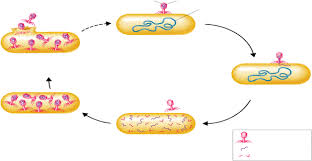
What is the first step to both cycles?
The virus attaches to a host
the virus injects genetic material
the host gets sick
the cell is destroyed
What do viruses need to reproduce?
they need genetic material
They need a host cell
They need bacteria
They need insulin
What part of a virus is the protein capsule that houses the genetic material (DNA/RNA)?
tail
nucleus
capsid
glycoprotein
Which viral life cycle kills its host cell by lysing?
lytic
mitosis
lysogenic
S phase
Which viral life cycle allows viral genetic material to lay dormant while the host cell reproduces?
lytic
mitosis
lysogenic
S phase
Viruses are...
prokaryotic
eukaryotic
non-living
endospores
What do we call a change in a species over time?
Adaptation
Evolution
Extinction
Environmental influences

If a new trait DOES help an organism survive, what may happen to it?
It dies and its DNA is not passed on
It survives and its DNA is passed on
It changes its traits to adapt and survive
If a new trait DOES NOT help an organism survive, what may happen to it?
It dies and its DNA is not passed on
It survives and its DNA is passed on
It changes its traits to adapt and survive
Which type of cell does NOT contain membrane-bound organelles?
plant cells
animal cells
prokaryotic cells
eukaryotic cells
Are eukaryotes multicellular or unicellular?
multicellular
unicellular
both unicellular and multicellular
_____ and _____ are organelles that arose from endosymbiosis
nucleus and cell membrane
mitochondria and chloroplasts
cell wall and chloroplasts
mitochondria and nucleus


What macromolecule makes up the majority of cell membranes?
Proteins
Lipids
Nucleic Acids
Carbohydrates

What type of lipid is shown?
Fatty Acid
Phospholipid
Triglyceride
Cholesterol
What does the term hydrophobic mean?
Dislikes water
Loves water
Uses water to create energy
Positive and negative charge on either end
What does the term hydrophilic mean?
Likes water
Dislikes water
The creation of water molecules
Protein synthesis
What is the function of proteins in the cell membrane? Check all that apply:
Transport ions and other large molecules though the bilayer
Signal receptors to indicate what is on the outside of the cell
Makes up the majority of the membrane
Block unwanted materials from entering the cell
True or False: The phospholipid bilayer forms with the hydrophobic heads facing outwards and the hydrophilic tails facing inwards
True
False
True or False: Because the inner region of the cell membrane is non-polar, any non-polar molecules can pass through the membrane.
True
False
True or False: All molecules that have a charge or are too large cannot pass through the cell membrane easily
True
False
What does it mean to be selectively permeable?
Allows some, but not all molecules to cross
Allows all molecules to cross but still regulates how much goes through
It chooses what day it has a certain hairstyle
Rarely allows molecules to cross without the help of channel proteins

The image represents the fluid mosaic model. Which of the following best describes the fluid mosaic model?
Cell membrane components are able to float and move throughout the membrane surface
Cell membrane components are stuck in place. It is critical to get the placement right
The membrane is not flexible at all and cannot expand
The membrane allows fluids to pass through easily
How is cholesterol important to the cell membrane?
Allows for flexibility in the membrane to expand and contract
Cholesterol is a channel protein that allows substances through
Cholesterol clogs the arteries of the cell
Cholesterol is not a critical component of cell membranes because all cholesterol is bad
What macromolecule is cholesterol?
Lipid
Protein
Nucleic Acid
Carbohydrate
What is the one macromolecule you won't find in the cell membrane?
Nucleic Acids
Proteins
Carbohydrates
Lipids
Click all the cell types that you will find a cell membrane:
Prokaryotes
Bacteria
Fungi
Eukaryotes
What is the purpose of a cladogram?

What most likely caused the finches on the Galapagos Islands to have beaks that were different from the finches on the mainland?
There were different types of predators on the island.
There were different types of food available on the island.
The finches had no water to drink.
The finches on the mainland could not fly high enough.
When looking at two birds of the same species, you notice that one has darker feathers than the other one. You also notice that one has a beak that is just a little longer. These slight differences within members of the same species are called.....
Fossils
Extinction
Meiosis
Variations
What is the study of organisms at the early stages of development?
DNA studies
Comparative Embryology
Extinction
Fossil Record
Genes that are beneficial to the species will....
evolve a new species
will not be passed down to its' offspring
become more common over time
cause the extinction of a species

