
 Worksheets
TCAP Review 1st semester
Total questions: 103
Worksheet time: 2hrs 5mins
Velocity is both ____ and _____.
speed , direction
direction, mass
volume, density
direction, magnitude

Total distance divided by total time is
average speed
constant speed
instantaneous speed
acceleration
Acceleration: is the rate of change in ___________.
speed
distance
velocity
displacement
Changes in our speed, direction or both are called _________.
gravity
changes
acceleration
displacement
What two measurements are necessary for calculating speed?
Mass and time
Temperature and mass
Mass and distance
Distance and time

A ____________ is a push or a pull on an object.
friction
force
magnet
gravity

Forces that have a net force of zero
Balanced force
Unbalanced force

How will this object move?
It won't move.
It will move to the right.
It will move to the left.
It will move in both directions.

A wheeled cart is moving to the right at a constant speed. Two forces of equal magnitude are acting upon the cart. Which of the following best describes the forces and motion of the cart?
Balanced Forces, Constant Speed
Balanced Forces, Acceleration
Unbalanced Forces, Constant Speed
Unbalanced Forces, Acceleration
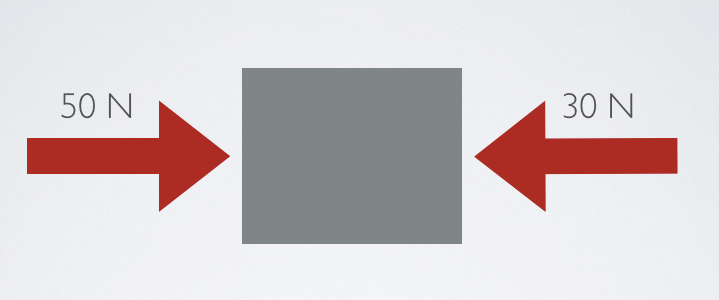
How will this object move?
It won't move.
It will move to the right.
It will move to the left.
It will move up.

What is the net force?
30 N left
25 N right
5 N left
55 N right

What is the net force?
40 N left
0 N Balalnced
400 N right
40 N right
What will cause an object to move?
Unbalanced forces
Balanced forces


What is the magnitude (size) and direction of the net force?
21 N to the Left
3 N to the Left
21 N to the Right
3 N to the Right
A box is being pushed with 20 N of force from the left. Another force is being applied from the right with 10 N of force. How many Newtons of force must be added for the forces acting on the box to be balanced?
10 N left
10 N right
30 N right
30 N left
Friction is a force that acts in an ___________ direction of movement.
similar
opposite
parallel
west
The force of gravity acting on an object is the object's ______.
Mass
Matter
Weight
Terminal velocity
Two factors effecting the magnitude of the force of gravity between 2 objects are...
mass and distance
mass and force
distance and weight
weight and mass
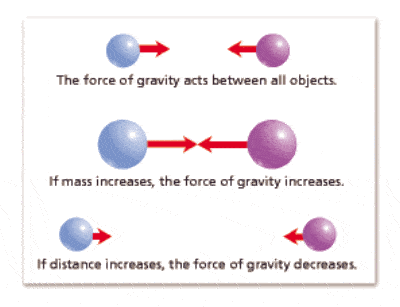
As mass increases, what happens to gravitational force?
increases
decreases
stays the same
i don't know

Which model has greater gravitational attraction (if any)
Model A
Model B
Both Model A and Model B (same gravity)
If the mass of an object is 1000kg on Earth, what is it's mass on the moon?
10kg
100kg
1000kg
10,000kg
If a force of 50 Newton's was applied to an object with a mass of 500 grams, what will the object's acceleration be?
10 m/s^2
.1 m/s^2
100 m/s^2
1 m/s^2
If an object was accelerating at 10 m/s^2, and a force of 10 newtons was required to accelerate it, what was the object's mass?
1 kilogram
10 kilograms
2 kilograms
5 kilograms

"For every action, there is an equal and opposite reaction."
Newton's 1st Law
Newton's 2nd Law
Newton's 3rd Law
Newton's 4th Law

Force = Mass x Acceleration
Newton's 1st Law
Newton's 2nd Law
Newton's 3rd Law
Newton's 4th Law

"An object in motion (or at rest) will to stay in motion (or at rest) until an outside force acts upon it."
Newton's 1st Law
Newton's 2nd Law
Newton's 3rd Law
Newton's 4th Law

A magician pulls a tablecloth out from under dishes and glasses on a table without disturbing them.
Newton's 1st Law
Newton's 2nd Law
Newton's 3rd Law

Pushing a child on a swing is easier than pushing an adult on the same swing, because the adult has more mass and requires more force to accelerate.
Newton's 1st Law
Newton's 2nd Law
Newton's 3rd Law

When you step on a Lego. You push on the Lego and the Lego pushes back on you.
Newton's 1st Law
Newton's 2nd Law
Newton's 3rd Law

This person bought coffee and put it on the seat next to them. If they stopped quickly and the coffee spilled which law would that represent?
Newton's 1st Law
Newton's 2nd Law
Newton's 3rd Law
Which of the following is a contact force?
electric force
friction
magnetism
gravity

Does the image show two like poles or two opposite poles together?
Like poles (North and North or South and South)
Opposite Poles (North and South)
What happens if you cut a bar magnet in half?
You get two North pole magnets
You get two South pole magnets
You get a North pole magnet and a South pole magnet
You get two smaller magnets, each with a North and South pole
A magnet field is strongest:
in between the poles
at the poles
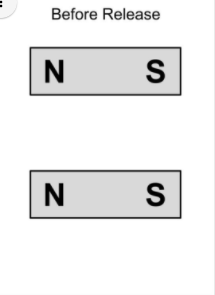
Which way will the magnets move after they are released?
Towards each other
Away from each other
Not enough information

The needle on a compass is attracted to (points to) what?
Treasure
The Atlantic Ocean
The East Coast
The North Pole of the planet Earth
If a substance has a higher number of electrons than protons on its surface, what type of charge does it have?
A positive charge.
A negative charge.
A neutral charge
No charge at all
Magnetic fields go out from the ______ pole and into the ________ pole
north; south
south; north
south; north
The closer together the gravitational field lines.....
the weaker the gravitational field strength
the stronger the gravitational field strength
the more repulsive the gravitational field strength

What is the image representing?
Electromagnet
Solenoid
What happens when you decrease the number of coils in an electromagnet?
Increase the Magnetic Force
Decrease the Magnetic Force
Adjusting the Coils will do nothing.

Objects with like charges repel and unlike charges attract. The girl's hair and the comb have-
unlike charges
like charges
neutral charges
no charges
What is energy?
rate of work
Motion of an object
ability to do work
force over time
What is kinetic energy?
energy of work
energy of motion
energy of gravity
energy of power
If a man runs at a speed of 70 m/s, and has a time of 30 s. What is the distance he ran?
2100 m
0.233 m
2.33 m
300m

What is the formula to calculate speed?
S = t/d
S = d/t
S = d x t
S = t x d

A runner races in the 100 meter dash. It takes her 10 seconds to finish. What is her average speed?
10 m/s
1000 m/s
100 seconds
10 seconds
Which of the following is a unit of speed ?
sec
mi
m/s
min
Which of the following is a unit of force?
Joule
Newton
Watt
Meter per second
The force that pulls objects toward the center of the Earth is called:
Magnetic force
Gravitational force
Electric force
Nuclear force
What is the effect of friction on the motion of objects?
It speeds them up
It slows them down
It changes their direction
It has no effect
Which of the following is true about balanced forces?
They cause an object to start moving
They cause an object to stop moving
They do not change the motion of an object
They always act in the same direction
What happens when forces acting on an object are unbalanced?
The object moves at a constant speed
The object changes its direction
The object remains stationary
The object accelerates
Which unit is used to measure force?
Kilogram
Meter
Newton
Joule

Which type of electromagnetic radiation has the shortest wavelength?
Radio Waves
Visible Light
Microwaves
Gamma Rays

Which type of visible light has the highest energy?
Red
Yellow
Green
Violet

Which of the following types of radiation has the shortest wavelength and the highest frequency?
Radio Waves
Infrared
Visible
X-Rays

What wavelength of light can the human eye perceive?
103
10-6
10-10
1013

Is discrete and not continuous; represented by two values - either on or off
analog signals
digital signals
wireless signals
electric signals
A signal to or from a computer is encoded into _________________, such as the two values - on (1) or off (0).
analog signal
digital signal
binary numbers
electricity
Sound waves travel as _________ waves.
transverse
electromagnetic
longitudinal
surface
Sound is made when a source of energy forces the matter to _________.
shake
vibrate
move
stay still
A back-and-forth motion causing particles to move close together generates a _______.
rarefaction
surface wave
transverse wave
compression
A rarefaction is generated when particles move ______.
together
closer
under
apart
Sound waves cannot travel through which of these ____.
paper
milk
outer space
hydrogen
In which of these types of media will sound travel faster?
solid
liquid
gas
vaccum
Which physical property of a medium is defined by how close the particles of the substance are to each other?
elasticity
temperature
density
amplitude
The ____ of a wave increases with increased energy.
wavelength
amplitude
Frequency of waves is measure in _____.
Hertz
Decibels
Watts
Meters/second
High frequency sounds have ______ pitch.
high
low
sound wave
longitudinal wave that can only travel through matter
compression
when particles in a wave are packed closely together
rarefaction
when particles in a wave are spread apart
pitch
the perception of how high or low a sound seems
echo
when a sound wave is reflected
Materials generally become warmer when light is ___.
reflected
refracted
absorbed
transmitted
The color that you see in an object is the color it is __.
reflecting
absorbing
__ is the change in the direction of a wave that occurs as the wave changes speed when moving from one medium to another.
Refraction
Reflection
Absorption
Transmission

This illusion of the pencil in water is caused by __.
reflection
refraction
transmission
absorption
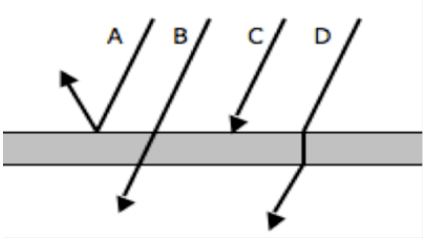
Ray A represents __.
reflection
refraction
transmission
absorption
Ray B represents __.
reflection
refraction
transmission
absorption
Ray C represents __.
reflection
refraction
transmission
absorption
Ray D represents __.
reflection
refraction
transmission
absorption
How are we able to perceive an object as being the color white?
All colors of visible light are absorbed by an object and then reflected into our eye.
All colors of visible light are reflected off an object and then to our eye.
All colors of visible light are absorbed by an object and no light is being reflected into our eye.
How are we able to perceive an object as being the color black?
All colors of visible light are absorbed by an object and then reflected into our eye.
All colors of visible light are reflected off an object and then to our eye.
All colors of visible light are absorbed by an object and no light is being reflected into our eye.
Does light require a medium to transmit from its source to an object?
YES
NO
Which wavelength of visible light is the shortest?
red
yellow
blue
violet
Which wavelength of visible light is the longest?
red
yellow
blue
violet
Light __ travel through a vacuum.
can
cannot

Which wave has the greatest amplitude?
The blue wave
The red wave
The number of waves that passes a point in a certain amount of time.
Amplitude
Frequency
Wavelength
Magnitude

Which letter represents wavelength?
A
B
C
D

Which letter represents the wave crest?
A
B
C
D

Which letter represents the wave trough?
A
B
C
D

Which letter represents amplitude?
A
B
C
D
All waves carry
energy
light
matter
particles
The material in which a wave passes through is called____
radiation
particles
medium
space

____________________ is the number of waves that move past one spot in a second
energy
amplitude
wavelength
frequency

Which letter represents wavelength?
A
B
C
D
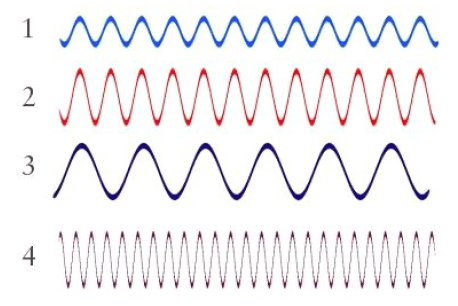
Which wave in the diagram has the greatest wavelength?
1
2
3
4
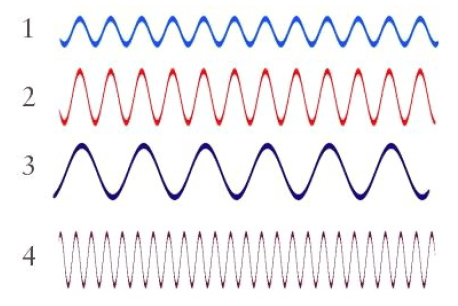
Which wave in the diagram has the greatest frequency?
1
2
3
4

Longitudinal waves must have a __________ to transfer energy
Medium
Formula
Balanced Force
oscillation

In a longitudinal wave, the parts where the coils are close together (A) are called what?
longitudes
rarefactions
compressions
wavelengths

It is the part of the wave where the particles are spread out. It is part B in this picture.
Compression
Rarefaction
Amplitude
Wavelength
The distance between two identical parts on a wave. For example one compression, to the next compression.
Compression
Rarefaction
Amplituide
Wavelength

