
Font size
 Worksheets
Human Vascular System Quiz
Total questions: 83
Worksheet time: 42mins
What do blood vessels form?
An open respiratory system
A closed vascular system
A lymphatic drainage system
An endocrine network
Which vessels carry blood away from the heart?
Veins and venules
Capillaries and capillary beds
Arteries and arterioles
Lymphatic vessels
What is the role of capillary beds in the vascular system?
They carry blood away from the heart.
They return blood toward the heart.
They play a role in exchanges between tissues and blood.
They store blood during low activity.
Which vessels return blood toward the heart?
Arteries and arterioles
Capillaries and capillary beds
Venules and veins
Lymphatic vessels
How many layers (tunics) do blood vessels have?
Two
Three
Four
Five
What is the function of the tunica intima?
It forms a friction-reducing lining
It controls the sympathetic nervous system
It forms a protective outermost covering
It supports and protects the vessel
What does the tunica media consist of?
Endothelium
Fibrous connective tissue
Smooth muscle and elastic tissue
Sympathetic nervous tissue
What is the primary component of the tunica externa?
Endothelium
Smooth muscle
Elastic tissue
Mostly fibrous connective tissue
Which part of the blood vessel is controlled by the sympathetic nervous system?
Tunica intima
Tunica media
Tunica externa
Endothelium
What structural feature of arteries allows them to withstand changes in pressure?
A thinner tunica media
Valves to prevent backflow of blood
A heavier, stronger, stretchier tunica media
A larger lumen than veins
What is the function of valves in veins?
To regulate blood pressure
To prevent backflow of blood
To increase the flow of blood
To reduce the lumen size
Compared to arteries, the lumen of veins is:
Smaller
The same size
Larger
More elastic
How do skeletal muscles contribute to blood circulation in veins?
By creating a pumping action that "milks" blood toward the heart
By expanding the lumen of veins
By closing and opening the valves
By increasing blood pressure in the veins

What is the function of the valves in the veins as shown in the diagram?
To prevent the backflow of blood
To pump blood to the heart
To filter the blood
To supply oxygen to the blood

According to the diagram, what is the role of the contracted skeletal muscle in the operation of the muscular pump?
It closes the valves in the veins.
It helps in the filtration of blood.
It assists in the upward flow of blood.
It provides nutrients to the blood.

What does the diagram illustrate about the direction of blood flow in the veins?
Blood flows in a random direction.
Blood flows directly to the lungs.
Blood flows in a direction opposite to the contraction of muscles.
Blood flows in the same direction as the contraction of muscles.
How thick is the tunica intima of capillaries?
Two cell layers thick
Three cell layers thick
Only one cell layer thick
Four cell layers thick
What is the blood flow through a capillary bed known as?
Capillary dilation
Capillary constriction
Microcirculation
Venous return
What do capillaries allow for?
Transport of red blood cells only
Exchanges between blood and tissue
Connection between arteries and veins
Blood storage
What forms networks called capillary beds?
Arterioles
Venules
Capillaries
Terminal arterioles
What is the correct sequence of blood flow in the microscopic anatomy of blood vessels?
Terminal arteriole → postcapillary venule → exchange vessels of capillary bed
Exchange vessels of capillary bed → terminal arteriole → postcapillary venule
Terminal arteriole → exchange vessels of capillary bed → postcapillary venule
Postcapillary venule → exchange vessels of capillary bed → terminal arteriole
What is the function of precapillary sphincters in the capillary beds of the mesentery?
They regulate blood flow through a capillary bed
They prevent blood flow through a capillary bed
They connect arterioles to venules
They supply blood to the heart
What happens when precapillary sphincters are closed?
Blood flows through the capillaries and exchanges with cells
Blood flows through a vascular shunt and bypasses cells in that region
Blood flow through the capillary bed is completely stopped
Blood is supplied directly to the heart
What is the role of a vascular shunt in the capillary bed?
It regulates the oxygen levels in the blood
It directly connects the arteriole and venule at opposite ends of the bed
It prevents blood from flowing through the capillaries
It supplies nutrients to the capillary cells
What structural differences are found in arteries, veins, and capillaries?
They all have the same structure
Arteries and veins have valves, while capillaries do not
Capillaries have a thicker wall than arteries and veins
Arteries, veins, and capillaries have special capillary beds with precapillary sphincters and a vascular shunt
What is the largest artery in the body?
Pulmonary artery
Brachiocephalic artery
Aorta
Femoral artery
Which artery leaves from the left ventricle of the heart?
Ascending aorta
Superior vena cava
Pulmonary artery
Inferior vena cava
Through which region does the aorta pass after leaving the thorax?
Abdominal aorta
Thoracic aorta
Aortic arch
Ascending aorta
Where does the abdominal aorta pass through to enter the abdominopelvic cavity?
The thorax
The diaphragm
The aortic arch
The left ventricle
Which of the following is an artery?
superior vena cava
jugular
femoral
renal
Which of the following is not a vein?
iliac
saphenous
pulmonary
brachial
What is the name of the large artery that comes directly from the heart?
aorta
carotid
axillary
subclavian
Which vein returns blood to the heart from the lower body?
superior vena cava
inferior vena cava
pulmonary vein
coronary vein
Which artery supplies blood to the upper limbs?
Femoral artery
Subclavian artery
Renal artery
Gonadal artery
What is the name of the artery that runs along the humerus in the arm?
Radial artery
Brachial artery
Ulnar artery
Axillary artery
Which artery is a continuation of the external iliac artery and supplies the lower limb?
Femoral artery
Popliteal artery
Anterior tibial artery
Posterior tibial artery
What is the name of the artery that supplies blood to the kidneys?
Superior mesenteric artery
Renal artery
Gonadal artery
Celiac trunk
Which artery is directly connected to the aortic arch?
Brachiocephalic trunk
Superior mesenteric artery
Inferior mesenteric artery
Internal iliac artery
Which arteries are the arterial branches of the ascending aorta?
Right and left coronary arteries
Right common carotid artery and Right subclavian artery
Left internal and external carotid arteries
Vertebral artery
Into what does the brachiocephalic trunk split?
Left common carotid artery and Left subclavian artery
Right common carotid artery and Right subclavian artery
Vertebral artery and Axillary artery
Radial and ulnar arteries
What does the left common carotid artery split into?
Right common carotid artery and Right subclavian artery
Vertebral artery and Axillary artery
Left internal and external carotid arteries
Radial and ulnar arteries
Which artery becomes the axillary artery in the axilla?
Right subclavian artery
Left subclavian artery
Brachiocephalic trunk
Vertebral artery
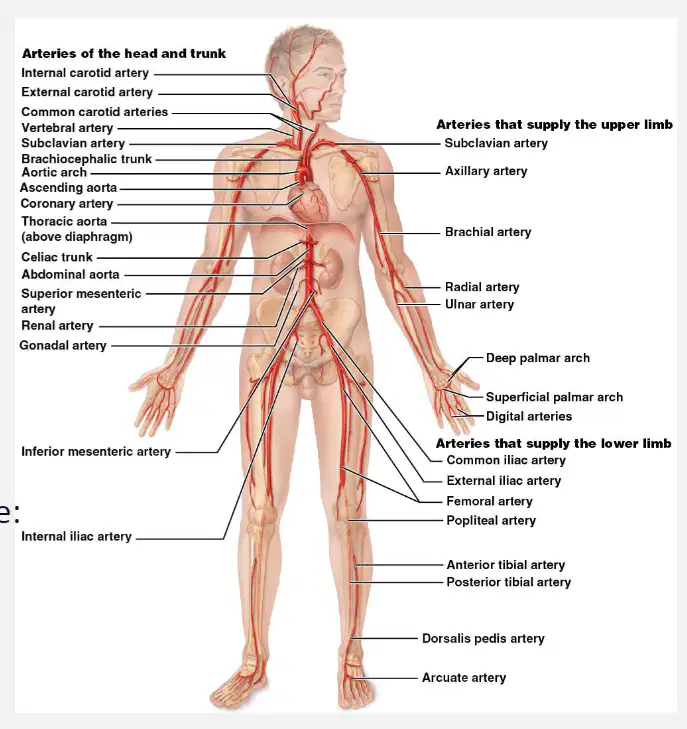
What is the continuation of the subclavian artery in the arm?
Axillary artery
Brachial artery
Radial artery
Ulnar artery
Which arteries supply the muscles of the thorax wall?
Bronchial arteries
Esophageal arteries
Phrenic arteries
Intercostal arteries
What does the thoracic aorta supply to the lungs?
Intercostal arteries
Esophageal arteries
Bronchial arteries
Phrenic arteries
Which artery is not illustrated but supplies the diaphragm?
Intercostal artery
Esophageal artery
Bronchial artery
Phrenic artery
What is the name of the artery that supplies the upper limb?
Femoral artery
Subclavian artery
Inferior mesenteric artery
Gonadal artery
Which artery supplies the lower limb?
Radial artery
Ulnar artery
Femoral artery
Brachial artery
What is the first branch of the abdominal aorta?
Superior mesenteric artery
Common hepatic artery
Splenic artery
Celiac trunk
Which artery supplies most of the small intestine and the first half of the large intestine?
Celiac trunk
Inferior mesenteric artery
Superior mesenteric artery
Renal artery
What are the three branches of the celiac trunk?
Left gastric artery, Splenic artery, Superior mesenteric artery
Left gastric artery, Splenic artery, Common hepatic artery
Left gastric artery, Inferior mesenteric artery, Common hepatic artery
Splenic artery, Superior mesenteric artery, Common hepatic artery
Which artery is not a branch of the celiac trunk?
Left gastric artery
Splenic artery
Superior mesenteric artery
Common hepatic artery
Which arteries are considered the major arteries of systemic circulation that branch from the abdominal aorta?
Lumbar and cervical arteries
Pulmonary and radial arteries
Left and right renal arteries
Coronary and carotid arteries
What do the left and right gonadal arteries serve in females?
The testes
The ovaries
The lumbar region
The kidneys
What do the testicular arteries serve in males?
The ovaries
The kidneys
The testes
The lumbar region
What is the function of the lumbar arteries?
They serve the muscles of the abdomen and trunk
They supply blood to the upper limbs
They are involved in the systemic circulation of the head
They provide blood to the lower limbs
¿Qué arteria sirve la segunda mitad del intestino grueso?
Arteria mesentérica superior
Arteria renal
Arteria mesentérica inferior
Arteria gonadal
Las arterias ilíacas internas sirven a qué parte del cuerpo?
El muslo
Los órganos pélvicos
La parte superior del cuerpo
El intestino grueso
¿En qué se convierten las arterias ilíacas externas al entrar en el muslo?
Arteria radial y arteria ulnar
Arteria femoral y arteria poplítea
Arteria carótida interna y externa
Arteria subclavia y arteria vertebral
¿Cuáles son las ramas finales de la aorta?
Arterias carótidas comunes
Arterias ilíacas comunes izquierda y derecha
Arterias subclavias
Arterias radiales y ulnares
Which artery supplies blood to the upper limb?
Femoral artery
Subclavian artery
Renal artery
Inferior mesenteric artery
What is the name of the artery that branches off the aorta and supplies blood to the stomach, liver, and spleen?
Celiac trunk
Superior mesenteric artery
Gonadal artery
Internal iliac artery
Which artery is a continuation of the external iliac artery and supplies blood to the lower limb?
Femoral artery
Radial artery
Brachial artery
Vertebral artery
What artery runs along the radial side of the forearm and is commonly used to take a pulse?
Ulnar artery
Radial artery
Brachial artery
Axillary artery
Which artery supplies blood to the kidneys?
Renal artery
Gonadal artery
Inferior mesenteric artery
Internal iliac artery
Which two major veins of systemic circulation enter the right atrium of the heart?
Pulmonary veins and aorta
Superior vena cava and inferior vena cava
Pulmonary artery and aorta
Pulmonary veins and pulmonary artery
What does the superior vena cava drain?
The lower body
The head and arms
The right atrium
The left atrium
What does the inferior vena cava drain?
The head and arms
The right atrium
The lower body
The left atrium
Which vein is known for being a common site for venipuncture due to its accessibility in the human body?
Hepatic portal vein
Femoral vein
Median cubital vein
Internal jugular vein
What is the name of the vein that runs along the inner side of the bicep and is often visible through the skin in well-muscled individuals?
Cephalic vein
Basilic vein
Great saphenous vein
Subclavian vein
Which of the following veins is a deep vein in the thigh that is a major pathway for blood to travel back to the heart?
Femoral vein
Great saphenous vein
Popliteal vein
External iliac vein
The superior vena cava is a large vein that carries blood from the upper body to the heart. Which of the following veins does not directly contribute to the flow of blood into the superior vena cava?
Internal jugular vein
Subclavian vein
Renal vein
Axillary vein
Which veins drain into the brachial vein?
Radial and ulnar veins
Cephalic and basilic veins
Superior and inferior mesenteric veins
External and internal iliac veins
Where does the cephalic vein drain?
Into the superior vena cava directly
Into the brachial vein
Into the axillary vein
Into the median cubital vein
What is the drainage area of the basilic vein?
The lateral aspect of the arm
The medial aspect of the arm
The lower limb
The head and trunk
Which veins are joined at the median cubital vein?
Radial and ulnar veins
Superior and inferior mesenteric veins
Basilic and cephalic veins
External and internal iliac veins
Which vein receives venous blood from the arm via the axillary vein?
Internal jugular vein
Vertebral vein
Subclavian vein
Superior vena cava
What does the internal jugular vein drain?
The posterior part of the head
The dural sinuses of the brain
The arm via the axillary vein
The lower limb
Which vein drains the posterior part of the head?
Subclavian vein
Vertebral vein
Internal jugular vein
Hepatic vein
Which veins drain into the superior vena cava?
Subclavian veins, Vertebral veins, Internal jugular veins
Hepatic veins, Splenic vein, Renal vein
External iliac vein, Femoral vein, Great saphenous vein
Posterior tibial vein, Anterior tibial vein, Small saphenous vein
What do the brachiocephalic veins join to form?
The azygos vein
The inferior vena cava
The superior vena cava
The hepatic portal vein
Where does the superior vena cava carry blood to?
The left atrium of the heart
The right atrium of the heart
The left ventricle of the heart
The right ventricle of the heart
Which vein is responsible for draining the thorax?
The brachiocephalic vein
The azygos vein
The hepatic vein
The internal jugular vein

