Wayground logo

Free Printable Worksheets

Font size

S
M
L
XL
Worksheets

Grade 9 Chemistry Revision

Total questions: 94

Worksheet time: 2hrs 6mins

Name
Class
Date
1.

What is a positive ion called?

a)

anion

b)

cation

c)

isotope

d)

covalent

2.

What is a negative ion called?

a)

anion

b)

cation

c)

covalent

d)

isotope

3.

How many electrons would a Nitrogen ion gain/lose? If it has 5 valence electrons.

a)

lose 5

b)

gain 5

c)

lose 3

d)

gain 3

4.

What is the ion formed from Sulfur? If it has 6 valence electrons.

a)

S+2

b)

S-2

c)

S+6

d)

S-6

5.

How many electrons would a Calcium ion gain/lose? If it has 2 valence electrons.

a)

lose 1

b)

gain 1

c)

lose 2

d)

gain 2

6.

If an atom loses electrons, the charge will be positive.

a)

true

b)

false

7.

A Bromine ion gains 1 electron, which of the following is the correct symbol for a Bromine ion?

a)

Br-1

b)

Br+1

c)

Br+7

d)

Br-7

8.
What is the charge of an atom that has lost one electron?
a)
-1
b)
-2
c)
+1
d)
+2
9.

An atom with 2 protons, 3 neutrons, and 4 electrons has a charge of ____.

a)

+2

b)

-2

c)

+3

d)

0

10.

If an element has 3 valence electrons, what charge will likely form on its ion ?

a)

+3

b)

+5

c)

-3

d)

-5

11.
Ions are: 
a)
atoms with a positive or negative charge
b)
atoms with no charge
c)
atoms with ONLY a positive charge
d)
atoms with ONLY a negative charge
12.

Na has 1 valence electron. It will have a charge of _______

a)

+1

b)

+2

c)

-1

d)

-2

13.

Be has 2 valence electron. It will have a charge of _______

a)

+1

b)

+2

c)

-1

d)

-2

14.

Ca has 2 valence electron. It will have a charge of _______

a)

+1

b)

+2

c)

-1

d)

-2

15.

Al has 3 valence electron. It will have a charge of _______

a)

+3

b)

-3

c)

+2

d)

-2

16.

P has 5 valence electron. It will have a charge of _______

a)

+3

b)

-3

c)

+2

d)

-2

17.

S has 6 valence electron. It will have a charge of _______

a)

-2

b)

-1

c)

+1

d)

+2

18.

Iodine has 7 valence electron. It will have a charge of _______

a)

-2

b)

-1

c)

+1

d)

+2

19.

F has 7 valence electron. It will have a charge of _______

a)

-2

b)

-1

c)

+1

d)

+2

20.

Oxygen has 6 valence electron. It will have a charge of _______.

a)

+1

b)

-1

c)

+2

d)

-2

21.
Why are ions formed?
a)
To make our lives difficult
b)
Because atoms want 8 valence electrons
c)
Because atoms have the same number of protons and electrons
d)
Because atoms gained neutrons
22.
What is an ion?
a)
A Charged Atom
b)
A Large Atom
c)
A Small Atom
d)
A Cute Atom
23.
Why are ions formed?
a)
To make our lives difficult
b)
Because atoms want 8 valence electrons
c)
Because atoms have the same number of protons and electrons
d)
Because atoms gained neutrons
24.
An atom becomes _________ when it gains electrons.
a)
Positive
b)
Negative
c)
Neutral
d)
Invinsible
25.

What is the charge of a sodium ion?

a)

+2

b)

+1

c)

-1

d)

-2

26.
Group 17 always has ions with a charge of 
a)
+1
b)
+2
c)
-1
d)
-2
27.
What charge will an Oxygen ion have? 
a)
+1
b)
-1
c)
+2
d)
-2
28.
If an element has 3 valence electrons, what charge will likely form on its ion ?
a)
+3
b)
+5
c)
-3
d)
-5
29.
Which of the following has a -3 charge?
a)
Boron
b)
Fluorine
c)
Nitrogen
d)
Neon
30.
charge of lithium ion
a)
-2
b)
-1
c)
+1
d)
+2
31.
charge of beryllium ion
a)
-2
b)
-1
c)
+1
d)
+2
32.
Which of the following has a -1 charge? 
a)
Aluminum
b)
Bromine
c)
Calcium
d)
Potassium
33.
Elements on the LEFT side of the periodic table will most likely form:
a)
Positive ions
b)
Negative ions
c)
Neutral Ions
d)
None of these
34.
Cations are...
a)
Positive
b)
Negative
c)
Neutral
d)
Purring
35.
Anions are...
a)
Positive
b)
Negative
c)
Neutral
d)
Crying
36.
An atom becomes _______ when it loses electrons.
a)
Positive
b)
Negative
c)
Neutral
d)
Invinsible
37.
Which particles change the charge in atoms when ions are formed?
a)
Protons
b)
Electrons
c)
Neutrons
d)
Kittens
38.
What is the ionic symbol for a Caesium atom?
a)
Cs+
b)
Cs-
c)
Cs+2
d)
Cs-2
39.
Make sure you get enough Potassium in your diet!
a)
Huh?
b)
K
c)
I <3 bananas
d)
Sure
40.

An ion is an atom that has gained or lost _______.

a)

protons

b)

neutrons

c)

electrons

41.

An atom that gains electrons will have a ___ charge.

a)

negative

b)

positive

42.

An atom that loses electrons has a ____ charge.

a)

negative

b)

positive

43.

Cations have a positive charge, which means they have _____ electrons.

a)

gained

b)

lost

44.

An ion that has negative charge has gained electrons, it is called a(n)

a)

anion

b)

cation

45.

Valence electrons are atoms of the outer most energy level, there is a maximum number of eight.

a)

True

b)

False

46.

How many valence electrons does an atom of silicon have?

a)

3

b)

4

c)

5

d)

6

47.

Be, Mg, and Ca have ___ valence electrons.

a)

1

b)

2

c)

3

d)

4

48.

Atoms will gain or lose electrons in order to have a full outer energy level this is called the _____ rule.

a)

valence

b)

cation

c)

octet

d)

anion

49.

Group 2A will _____ electrons, forming an ion with a positive charge.

a)

gain

b)

lose

50.

Group 7A elements _____ electrons, forming a negative charge.

a)

gain

b)

lose

51.

What is the charge on an ion of sodium (Na)?

a)

+1

b)

+2

c)

+3

d)

+4

52.

Aluminum forms an ion with +3 charge, what group is it in?

a)

1A

b)

2A

c)

3A

d)

4A

53.

An atom of Br will form an anion. What will the charge of the anion be?

a)

+1

b)

+2

c)

-1

d)

-2

54.

Phosphorous forms an anion with a charge of -3 what representative group is it part of?

a)

3A

b)

4A

c)

5A

d)

6A

55.
Ions are: 
a)
atoms with a positive or negative charge
b)
atoms with no charge
c)
atoms with ONLY a positive charge
d)
atoms with ONLY a negative charge
56.
When an atom loses a valence electron, it becomes a(n) _____________ ion.
a)
positive
b)
negative
c)
neutral
d)
polyatomic
57.
When an atom gains a valence electron, it becomes a(n) _____________ ion.
a)
positive
b)
negative
c)
neutral
d)
polyatomic
58.
If an element has 3 valence electrons, what charge will likely form on its ion ?  Hint:  It will lose those electrons.  What happens to the charge when it loses 3 electrons?
a)
+3
b)
+5
c)
-3
d)
-5
59.
Nitrogen will ____ valence electrons when forming an ionic bond.
a)
gain 1
b)
lose 1
c)
gain 3
d)
lose 3
60.
Ionic bonds form between two ions that have 
a)
ionic compounds
b)
negative charges
c)
positive charges
d)
opposite charges 
61.
Atoms that gain & lose electrons are called _________
a)
ions
b)
isotopes
c)
radioactive
d)
corrosive
62.
Atoms are most stable when their outer shell is filled with electrons.
a)
true
b)
false
63.
What is the charge of an atom that has lost one electron?
a)
-1
b)
-2
c)
+1
d)
+2
64.
What is the charge of an atom that has gained one electron?
a)
-1
b)
-2
c)
+1
d)
+2
65.
How many atoms of carbon (C) are in C6H12O6?
a)
3
b)
6
c)
12
d)
24
66.
How many Sodium (Na) are in 6NaCl?
a)
1
b)
12
c)
6
67.
How many Aluminum are in Al2O3?
a)
3
b)
2
c)
5
68.
How many Hydrogen are in 4H2O?
a)
6
b)
8
c)
2
d)
4
69.
Which of the following shows the correct way to balance the chemical equation?
Fe + O2 -> Fe2O3
a)
4Fe + 3O2 -> 2Fe2O3
b)
2 Fe + 3O2 -> Fe2O6
c)
4 Fe + O6 -> 2Fe2O3
d)
None of the options are correctly balanced.
70.
Which of the following reactions is balanced?
a)
2CH4 + O2 -> CO2 + H2O
b)
CH4 + 2O2 -> CO2 + H2O
c)
CH4 + 2O2 -> CO2 + 2H2O
d)
None of the chemical equations are balanced.
71.
How many HCl molecules do you need to balance this equation? 
Mg +  __HCl --->  MgCl2 + H2
a)
1
b)
2
c)
3
d)
4
72.
Balance this equation.
_CF4 + _Br2 -- _CBr4 + _F2
a)
2,1,2,1
b)
1,2,2,1
c)
1,2,1,2
d)
2,2,2,2
73.
Balance this equation.
_CH4 + _O2 --> _CO2 + _H2O
a)
1,2,1,1
b)
2,1,2,1
c)
1,2,1,2
d)
0,2,0,2
74.
Balance this equation
_Al +_HCl --> _H2 +_AlCl3
a)
2, 6, 3, 2
b)
it is already balanced
c)
4, 12, 3, 4
d)
2, 1, 4, 5
75.
The substances listed on the right side of a chemical equation are the
a)
Yields
b)
Reactants
c)
Products
d)
Precipitates
76.
The substances listed on the left side of a chemical equation are the
a)
Products
b)
Coefficients
c)
Precipitates
d)
Reactants
77.
In chemical reactions, what does the principle of conservation of mass mean?
a)
Matter is not created or destroyed.
b)
The total mass of the reactants is greater than the total mass of the products.
c)
The total mass of the reactants is less than the total mass of the products.
d)
Matter is not changed.
78.
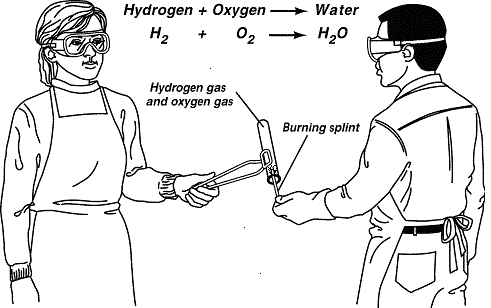
Identify the reactant(s) and product(s) of the reaction.
a)
All three are reactants and none are products.
b)
Hydrogen and water are the reactants, and oxygen is the product.
c)
Water and oxygen are the reactants, and hydrogen is the product.
d)
Hydrogen and oxygen are the reactants, and water is the product.
79.

Which is the Law of Conservation of Matter?

a)

matter cannot be created or destroyed, it only rearranges

b)

matter can be created but it cannot be destroyed, it never rearranges

c)

matter can be destroyed but it cannot be created, it usually just rearranges

d)

matter is an unproven theory created by Hans Geiger

80.
Which one is a compound?
a)
Co
b)
Br
c)
Fe
d)
CO
81.
Which one is an element?
a)
Co
b)
CO
c)
CO2
d)
CO3-2
82.
How many elements are found in the following molecule? Mg(ClO3)2
a)
1
b)
4
c)
3
d)
5
83.
Which number should go in the blank?
_ H2 + O2 -> 2 H2O
a)
1
b)
2
c)
3
d)
0
84.
Which number should go in the blank?
2 Na+ _ Cl2 -> 2 NaCl
a)
1
b)
2
c)
3
d)
0
85.
Which of the following is evidence that a chemical change has taken place? 
a)
change in color
b)
change in size
c)
change in shape
d)
change in energy
86.
When dry ice (solid carbon dioxide) sublimes it goes directly from a solid to a gas. What type of change is occurring? 
a)
Chemical change
b)
Physical change
c)
None of the above 
87.
How many oxygen atoms are present in the following? 
4Ca(OH)2
a)
4
b)
6
c)
8
d)
1
88.
Why must we balance chemical equations? 
a)
Our teacher said so
b)
to abide by the law of conservation of energy
c)
to abide by the law of conservation of mass
89.
What is changed in a chemical reaction like this one? 
NaOH + HCl   
→  NaCl + H2O
a)
the number of atoms is changed
b)
molecules and compounds are changed 
c)
atoms are changed
d)
elements are changed 
90.
Which of the following is true? 
a)
Na is a gas
b)
Cl combusts when put in water
c)
NaCl is very different than Na and Cl
d)
Cl is a metal
91.
How many E atoms are there in this silly formula?
2E2Fg3Hi4
a)
4
b)
2
c)
1
d)
3
92.
Which of the following can be broken apart in a chemical reaction? 
a)
Noble gases
b)
Molecules and compounds
c)
only molecules
d)
only compounds 
93.
 Fill in the blank to balance the chemical equation. 
2KI  +  ____Cl2 →  2KCl  +  I2
a)
1
b)
2
c)
3
d)
4
94.
What coefficient should go in the blank space to balance the chemical equation? 
2Al  +____  HCl   →    2AlCl3  +  3H2
a)
2
b)
4
c)
3
d)
6