
 Worksheets
REVIEW - Tectonic Plate Theory - Chapter 4
Total questions: 73
Worksheet time: 1hrs 13mins


asthenosphere - inner mantle
lithosphere - outer mantle & crust
in addition to the liquid core, which layer contains convection currents?
outer core
inner core
mantle
lithosphere
Oceanic crust is more dense than continental crust.
true
false

Nah, we've only drilled a little bit, like 1/5th of the way through.

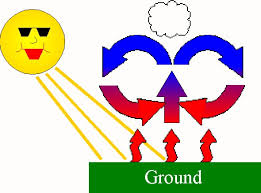
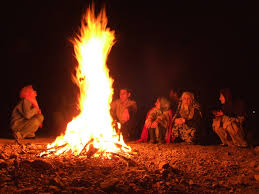


A snowball in your hand is what heat transfer?
Convection
Conduction
Law of Conservation of Energy
Radiation
heat moving through empty space at light speed
Which of the following geologic events would most likely occur where two continental plates converge?
tsunami
earthquake
mountain formation
The interaction of tectonic plate boundaries is associated with which of the following events?
hurricanes
tornados
earthquakes
Where continental plates diverge, what landform will most likely result?
rift valley
river
mountain
Movement between the Pacific plate and the North American plate create the San Andreas Fault in California. What type of motion is occurring?
convergent
divergent
transform
The interaction of two plate boundaries can cause which of the following?
hurricanes and tornadoes
earthquakes and volcanoes
high winds and drought

An image of the relative motion at a tectonic plate boundary is provided. What event will occur at the boundary shown?
mountain formation
an earthquake
volcanic island formation
What event will most likely occur at a divergent plate boundary?
the plates will form a mountain chain
one plate will subduct under the other
the plates will form a mid-ocean ridge
Where two tectonic plates converge and move toward each other, which of the following is likely to result?
mountain range
rift valley
arid desert
The boundary between the Pacific Plate and the Australian Plate is a transform boundary. What event is likely to occur at this boundary?
mountain formation
earthquakes
volcanic eruptions
When two tectonic plates converge, the land above sea level in this area often generates–
mountain ranges
landslides
tsunamis
A boundary formed when two plates move away from each other.
convergent boundary
divergent boundary
transform boundary
Mountains and __________ can be formed at convergent boundaries.
volcanoes
rift valleys
mid-ocean ridges
When plates move past each other, it can result in a volcanic eruption.
true
false
Ridges can be formed by what type of plate boundary?
transform
convergent
divergent
This type of boundary is where plates move toward one another and collide. Such activity can result in the formation of __________.
islands
ridges
rift valleys
A boundary formed when two plates move past each other is called a transform boundary.
true
false
A boundary formed when two plates collide.
convergent
divergent
transform

Describe the most likely relationship between these mountains and nearby tectonic plates.
The mountains are probably formed by earthquakes
The mountains are probably formed by the movement of glaciers
The mountains are probably located near the edge of 2 tectonic plates.
The mountains are probably formed by running water.

Is there a pattern to the locations of earthquakes and volcanoes around the globe?
No, earthquakes and volcanoes are random.
Yes, earthquakes and volcanoes usually occur near the boundaries of tectonic plates.
yes, earthquakes and volcanoes usually occur in the middle of tectonic plates.
No, earthquakes and volcanoes usually occur under water.

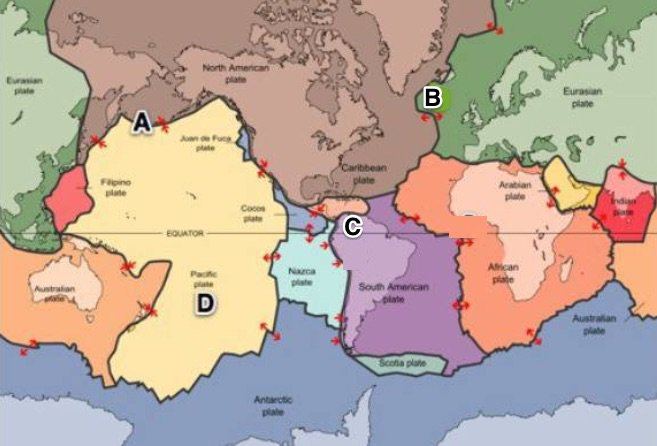
A map is provided that presents information on a certain region of the Earth. Based on the information on the map, at which location are mountains most likely to form?
A
B
C
D

A map is provided that shows the location of the Aleutian Islands in comparison to some of Earth’s tectonic plates is provided. Based on the information provided, which of the following is most likely a feature of the Aleutian Islands?
The climate is getting older.
They were formed by volcanic activity.
These islands are the oldest on Earth.
Earthquakes do not occur there

The Ring of Fire is an area where a large number of earthquakes and volcanic eruptions occur. What claim can be made about the Ring of Fire from this information?
It is the only place on Earth where earthquakes can happen.
The edges of the tectonic plates are moving in this area.
It represents the areas where tectonic plates are the thickest.
It has been getting larger since Earth first formed.

Peru and Chile are part of South America, which sits on the South American tectonic plate. The Nazca plate is moving toward the South American plate. It is pushed downward, which causes it to slide under the South American plate. Based on this information, what feature could we expect to see off the coast of Peru and Chile?
new Continent formation
Poor fishing conditions
Deep ocean trench
Severe tropical storms

A force caused the continents to drift apart over time. Once scientists figured out what that force was, the theory of plate tectonics was born! The image above shows what Geologists think the Earth looked like millions of years ago. What name was given to this land mass.
Plate Tectonics
Oceana
Pangea
North America

Tectonic plates float on top of the ________
Crust
Mantle
Inner Core
Outer Core

We live in an area without many earthquakes because _____
We live near a major fault line
We live near the boundary of 2 tectonic plates
We live near the middle of the North American Plate
We live near the Pacific Plate
In some areas of the world, like California and Japan, earthquakes are a common occurrence. How can this best be explained?
The strong ocean currents are undermining both areas causing earthquakes.
Both areas are located near the edge of the Pacific Ocean, the unstable sand causes earthquakes.
Both areas are subjected to strong ocean wind and waves that causes earthquakes.
Both areas are on the boundary of active plates, the motion of the plates causes earthquakes.
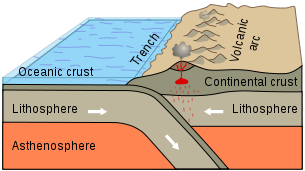
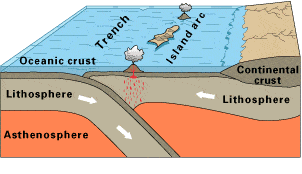
Observe this diagram of a plate boundary. One statement BEST describes what is happening. It is that
the oceanic crust is melting.
the denser ceanic crust is subducting under the less dense oceanic crust
volcanic islands are forming.
the tectonic plates are moving away from each other.
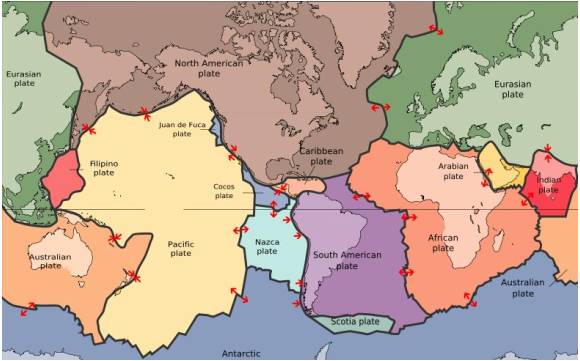
The map in the picture shows tectonic plate boundaries. This map would be useful in predicting the location of future
droughts
hurricanes
earthquakes
tornadoes
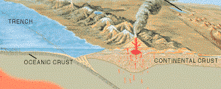
Where would sea floor spreading most likely occur?
At convergent boundaries (oceanic vs. oceanic)
At convergent boundaries (oceanic vs. continental)
At divergent plate boundaries (oceanic vs. oceanic)
At transform plate boundaries
The San Andreas Fault in California is known as an active earthquake area. What type of
boundary is it?
Converging
Diverging
Transform
Sea Floor Spreading
Who discovered the idea of continental drift?
Alfredo
Wegener
Watson
Wilder
Which of these is evidence for continental drift?
there are lots of animals in the world
plants are everywhere
continents can float on oceans
rocks are the same on different continents
Which of these is evidence for continental drift?
there are lots of animals in the world
the same fossils have been found on different continents
continents can float on oceans
rocks are everywhere
Which of these is evidence for continental drift?
warm climate fossils have been found on cold continents
plants can be found on every continent
continents can float on oceans
rocks are everywhere
The oldest seafloor can be found farthest from the oceanic ridge
True
False
The newest seafloor can be found closest to the oceanic ridge
True
False
The force behind seafloor spreading comes from water and magma
True
False

