
 Worksheets
Waves Review
Total questions: 96
Worksheet time: 48mins
Within a vacuum, the property common to all electromagnetic waves is their _______.
amplitude
frequency
wavelength
velocity
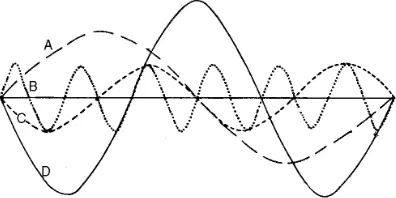
The diagram shown represents four waves traveling to the right in the same transmitting medium. Which type of wave is represented?
elliptical
longitudinal
torsional
transverse
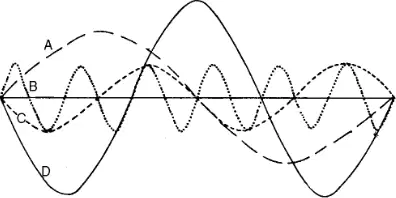
Which wave has the greatest frequency?
A
B
C
D
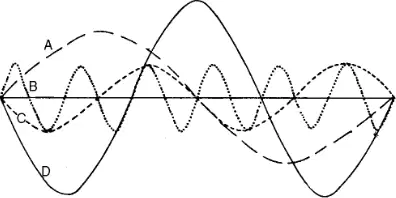
Which wave has the greatest amplitude?
A
B
C
D
Which type of wave is classified as longitudinal?
water
radio
sound
light
As a longitudinal wave travels horizontally, the particles of the medium vibrate _______.
in a circle
in a spiral
vertically
horizontally
If the displacement of particles in a medium is parallel to the direction of travel of the wave, the wave is classified as
electromagnetic
torsional
transverse
longitudinal
If a disturbance is parallel to the direction of travel of a wave, the wave is classified as
longitudinal
electromagnetic
transverse
torsional
Two waves have the same frequency in a medium. The wave with the greater energy has the greater
amplitude
velocity
wavelength
period
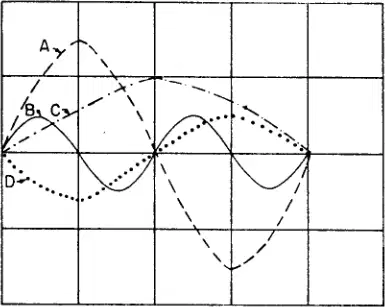
The diagram here represents four waves traveling to the right in the same transmitting medium. Which wave has the greatest frequency?
A
B
C
D
If 12 waves pass a point in 4 seconds, the frequency of vibration is
8 waves/sec
48 waves/sec
3 waves/sec
4 waves/sec
The number of waves passing a point in a unit of time is called
frequency
wavelength
amplitude
period
The number of water waves passing a given point each second is the wave's
frequency
amplitude
wavelength
velocity
The speed of a transverse wave in a string is 12 meters per second. If the frequency of the source producing this wave is 3.0 hertz, what is its wavelength?
0.25 m
2.0 m
36 m
4.0 m
What is the period of a wave with a frequency of 2.0 x 10^2 hertz?
6.0 x 10^-10 s
2.0 x 10^-3 s
5.0 x 10^-3 s
1.5 x 10^6 s
A periodic wave with a frequency of 10 hertz would have a period of
1 s
0.1 s
10 s
100 s
What is the frequency of a wave if its period is 0.25 seconds?
1.0 Hz
0.25 Hz
12 Hz
4.0 Hz
Which graph best represents the relationship between the frequency and period of a wave?
Graph showing frequency increasing as period decreases.
Graph showing frequency constant as period increases.
Graph showing frequency decreasing as period increases.
Graph showing frequency increasing as period increases.
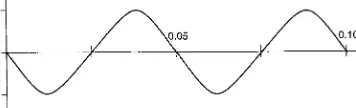
The accompanying graph shows displacement versus time for a particle of a uniform medium as a wave passes through the medium. What is the frequency of the wave?
10 Hz
20 Hz
50 Hz
100 Hz
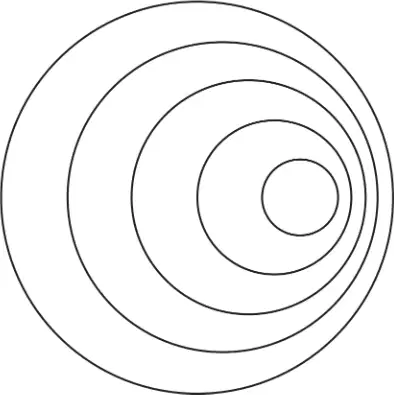
The diagram below represents the wave fronts produced by a point source moving to the right in a uniform medium. Observers are located at points A and B. Compared to the wave frequency and wavelength observed at point A, the wave observed at point B has a:
higher frequency and a shorter wavelength
higher frequency and a longer wavelength
lower frequency and a shorter wavelength
lower frequency and a longer wavelength
Which waves require a medium for transmission?
light waves
radio waves
sound waves
cosmic waves
The loudness of a sound is dependent upon which wave property?
wavelength
amplitude
frequency
pitch
A term often used to describe the frequency of a sound is
amplitude
volume
pitch
tone
The reflection of a sound wave from a wall is called
an echo
a condensation
a rarefaction
the Doppler effect
Increasing the amplitude of a sound wave will make it
louder
have a higher pitch
travel faster
produce beats
Sound is a form of
thermal energy
mechanical energy
radiant energy
electrical energy
Sound can not be transmitted through a
gas
liquid
solid
vacuum
An echo is strong evidence that sound can be
amplified
diffracted
dispersed
reflected
Sound travels as
an electromagnetic wave
a transverse wave
a longitudinal wave
a permanent wave
As the frequency of a sound wave decreases, its pitch
decreases
increases
remains the same
As the temperature of air increases, the speed of sound in air
decreases
increases
remains the same
Light is to brightness as sound is to
color
loudness
period
speed
The amplitude of a sound wave is to its loudness as the amplitude of a light wave is to its
brightness
frequency
color
speed
As a sound wave travels through air, there is a net transfer of
energy, only
mass, only
both mass and energy
neither mass nor energy
What type of wave is sound traveling in water?
torsional
transverse
elliptical
longitudinal
A tuning fork oscillates with a frequency of 256 hertz after being struck by a rubber hammer. Which phrase best describes the sound waves produced by this oscillating tuning fork?
electromagnetic waves that require no medium for transmission
electromagnetic waves that require a medium for transmission
mechanical waves that require no medium for transmission
mechanical waves that require a medium for transmission
Compared to the speed of a sound wave in air, the speed of a radio wave in air is
less
greater
the same
Which type of wave requires a material medium through which to travel?
sound
radio
television
x ray
The energy of a sound wave is most closely related to the wave's
frequency
amplitude
wavelength
speed
A sound wave traveling eastward through air causes the air molecules to
vibrate east and west
vibrate north and south
move eastward, only
move northward, only
Which of the following electromagnetic radiations has the shortest wavelength?
radio
infrared
visible
ultraviolet
Which of the following electromagnetic waves has the lowest frequency?
violet light
green light
yellow light
red light
As the color of light changes from red to yellow, the frequency of the light
decreases
increases
remains the same
Compared to wavelengths of visible light, the wavelengths of ultraviolet light are
shorter
longer
the same
In a vacuum, light with a frequency of 5.0 x 10^14 hertz has a wavelength of
6.0 x 10^-21 m
6.0 x 10^-7 m
1.7 x 10^6 m
1.5 x 10^23 m
A photon of which electromagnetic radiation has the most energy?
ultraviolet
x ray
infrared
microwave
Radio waves and gamma rays traveling in space have the same
frequency
wavelength
period
speed
Which wave characteristic is the same for all types of electromagnetic radiation traveling in a vacuum?
speed
wavelength
period
frequency
What is the speed of a radio wave in a vacuum?
0 m/s
3.31 x 10^2 m/s
1.13 x 10^3 m/s
3.00 x 10^8 m/s
Which list identifies portions of the electromagnetic spectrum in order of increasing frequency?
gamma ray, infrared, visible, ultraviolet
ultraviolet, visible, infrared, gamma ray
infrared, visible, ultraviolet, gamma ray
gamma ray, ultraviolet, visible, infrared
The rate at which a wave travels from one point to another determines the wave's
frequency
period
amplitude
velocity
If the velocity of a constant-frequency wave increases, the wavelength
decreases
increases
remains the same
A sound wave has a wavelength of 2 meters and a frequency of 100 cycles per second. The speed of the wave is
0.02 m/sec
50 m/sec
100 m/sec
200 m/sec
A wave has a frequency of 200 vibrations per second and a speed of 100 meters per second. The wavelength is
1m
2m
3m
0.5m
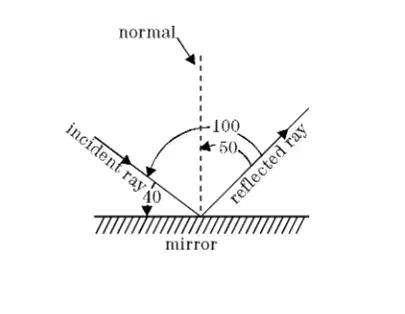
The diagram here represents a light ray being reflected from a plane mirror. From the data given in the diagram, what is the angle of reflection?
10°
40°
50°
100°
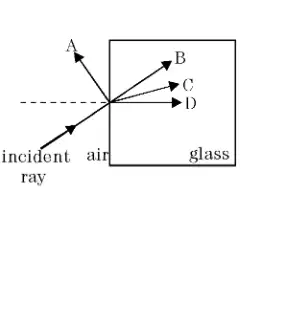
In the diagram here a light ray passes obliquely from air into a glass block. Which path represents the refracted ray of light?
A
B
C
D
If a light ray has an angle of reflection of 10°, the angle of incidence is
5°
10°
20°
80°
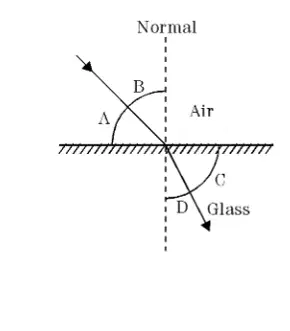
The diagram shows a ray of light being refracted as it passes from air into glass. Which letter represents the angle of refraction for the light ray?
A
B
C
D
The tendency of sound waves to bend when they pass from one medium to a different medium is known as
refraction
reflection
resonance
interference
If the angle of incidence of a light ray is 30°, the angle of reflection is
30°
45°
60°
90°
When a light ray is reflected from a surface, compared to the angle of incidence, the angle of reflection is
less
greater
the same
Refraction of a wave is caused by a change in the wave's
amplitude
frequency
speed
phase
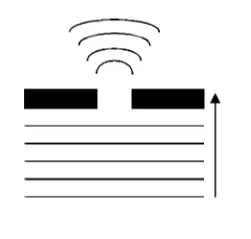
Which wave phenomenon is represented in the diagram here?
refraction
diffraction
reflection
interference
When a ray of light strikes a mirror perpendicular to its surface, the angle of reflection is
0°
45°
60°
90°
The diagram shown represents straight wave fronts approaching an opening in a barrier. Which diagram best represents the shape of the waves after passing through the opening?
Option A showing straight wave fronts
Option B showing curved wave fronts
Option C showing straight wave fronts with different spacing
Option D showing another pattern of wave fronts
The diagram shows two rays of light striking a plane mirror. Which diagram best represents the reflected rays?
Option A
Option B
Option C
Option D
The spreading of a wave into the region behind an obstacle is known as
diffusion
dispersion
refraction
diffraction
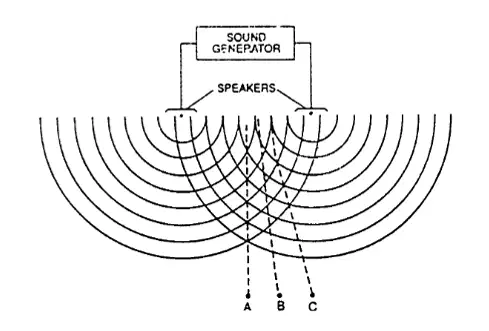
In the diagram, two speakers are connected to a sound generator. The speakers produce a sound pattern of constant frequency such that a listener will hear the sound very well at A and C, but not as well at point B. Which wave phenomenon is illustrated by this experiment?
interference
polarization
reflection
refraction
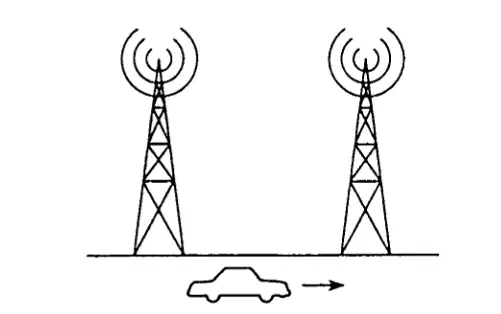
A car radio is tuned to the frequency being emitted from two transmitting towers. As the car moves at constant speed past the towers, as shown in the diagram, the sound from the radio repeatedly fades in and out. This phenomenon can best be explained by
refraction
interference
reflection
resonance
When light rays from an object are incident upon an opaque, rough-textured surface, no reflected image of the object can be seen. This phenomenon occurs because of
regular reflection
diffuse reflection
reflected angles not being equal to incident angles
reflected angles not being equal to refracted angles
Parallel light rays are incident on the surface of a plane mirror. Upon reflection from the mirror, the light rays will
converge
diverge
be parallel
be scattered
Which diagram best represents the reflection of light from an irregular surface?
Diagram A
Diagram B
Diagram C
Diagram D
Which diagram best represents the path of light rays passing through a glass prism?
Diagram A
Diagram B
Diagram C
Diagram D
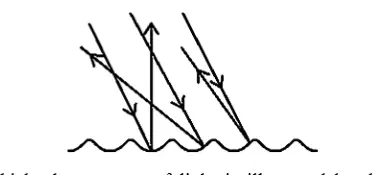
The accompanying diagram shows parallel rays of light incident on an irregular surface. Which phenomenon of light is illustrated by the diagram?
diffraction
refraction
regular reflection
diffuse reflection
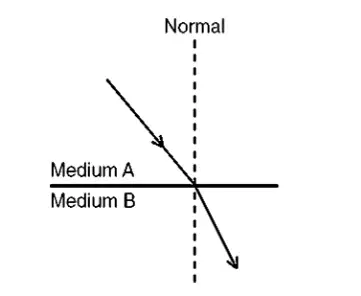
The accompanying diagram shows a ray of light passing through two media. When the wave travels from medium A into medium B, its speed
decreases
increases
remains the same
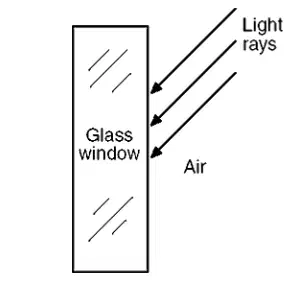
The accompanying diagram shows light rays in air about to strike a glass window. When the rays reach the boundary between the air and the glass, the light is
totally refracted
totally reflected
partially reflected and partially diffracted
partially reflected and partially refracted
A change in the speed of a wave as it enters a new medium produces a change in
frequency
period
wavelength
phase
What happens to the frequency and the speed of an electromagnetic wave as it passes from air into glass?
The frequency decreases and the speed increases.
The frequency increases and the speed decreases.
The frequency remains the same and the speed increases.
The frequency remains the same and the speed decreases.
As a sound wave passes from water, where the speed is 1.49 x 10^3 meters per second, into air, the wave's speed
decreases and its frequency remains the same
increases and its frequency remains the same
remains the same and its frequency decreases
remains the same and its frequency increases
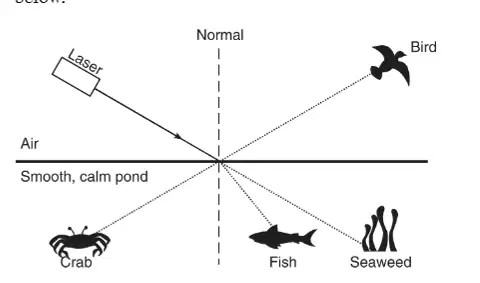
A laser beam is directed at the surface of a smooth, calm pond as represented in the diagram below. Which organisms could be illuminated by the laser light?
the bird and the fish
the bird and the seaweed
the crab and the seaweed
the crab and the fish
A sonar wave is reflected from the ocean floor. For which angles of incidence do the wave's angle of reflection equal its angle of incidence?
angles less than 45°, only
an angle of 45°, only
angles greater than 45°, only
all angles of incidence
When the vibration of one object causes a nearby object to vibrate, the phenomenon is called
reflection
refraction
resonance
diffraction
Two tuning forks are struck at the same time. Their sound is observed to become louder and softer at regular intervals. This is caused by wave
condensation
refraction
interference
amplification
Beats are produced by two sound waves having different
frequencies
amplitudes
loudness
energies
Which of the following is caused by the interference of sound waves?
echoes
pitch
the Doppler effect
standing waves
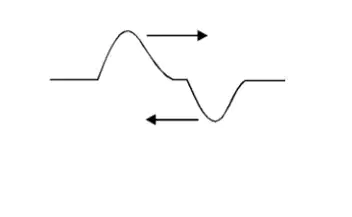
Two pulses are travelling along a string toward each other as represented in the diagram below. Which phenomenon will occur as the pulses meet?
reflection
polarization
interference
refraction
If two identical sound waves arriving at the same point are in phase, compared to the original waves, the resulting wave will have
an increase in speed
an increase in frequency
a larger amplitude
a longer period
When the beams from two coherent light sources are projected on a screen, alternating bright and dark areas are produced. This phenomenon illustrates light
polarization
interference
dispersion
refraction
Which term describes two points on a periodic wave that are moving in the same direction and have the same displacement from their equilibrium positions?
dispersed
refracted
polarized
in phase
An opera singer's voice is able to break a thin crystal glass if the singer's voice and the glass have the same natural ___.
frequency
speed
amplitude
wavelength
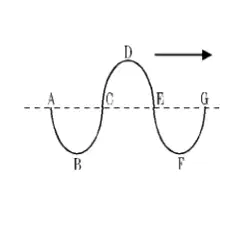
The diagram represents wave movement. Which two points are in phase?
A and G
B and F
C and E
D and F
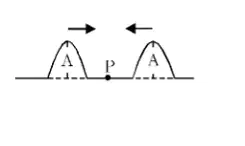
The diagram shown represents a rope along which two pulses of equal amplitude, A, approach point P. When the two pulses meet at P, the vertical displacement of the rope at point P will be ___.
A
2A
0
A/2
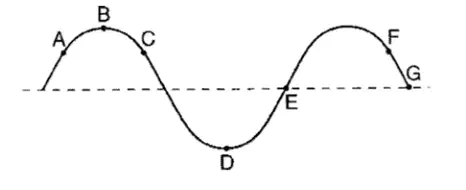
The accompanying diagram shows a periodic wave. Which two points on the wave are in phase?
A and C
B and D
C and F
E and G
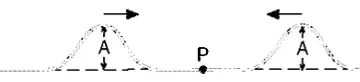
The accompanying diagram represents a rope along which two pulses of equal amplitude, A, approach point P. As the two pulses pass through point P, the maximum vertical displacement of the rope at point P will be ___.
A
2A
0
A/2
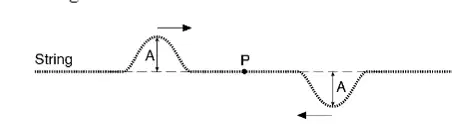
The diagram below shows two pulses of equal amplitude, A, approaching point P along a uniform string. When the two pulses meet at P, the vertical displacement of the string at P will be
A
2A
0
A/2
As two trucks approach each other, the driver of one truck sounds his horn. Compared to the true frequency of the horn when the trucks are stationary, the frequency heard by the other driver will be
lower
higher
the same

