Wayground logo

Free Printable Worksheets

Font size

S
M
L
XL
Worksheets

G8 EOY Practice Exam

Total questions: 67

Worksheet time: 43mins

Name
Class
Date
1.
In chemistry, how many types of subatomic particles are considered to form everything?
a)
two
b)
three
c)
92
d)
billions
2.
The proton is _____
a)
heavy and neutral
b)
heavy and negatively charged
c)
heavy and positively charged
d)
light and negatively charged
3.
The electron is _____
a)
heavy and positively charged
b)
light and positively charged
c)
light and neutral
d)
light and negatively charged
4.

This force holds the nucleus together and is stronger than the repulsion of protons.

a)

Gravity

b)

Strong nuclear force

c)

The electromagnetic force

d)

The weak force

5.

What force exists between the electrons (-) and the protons (+) in an atom?

a)

Gravity

b)

Electromagnetic force

c)

Strong nuclear force

d)

Weak nuclear force

6.

Where are electrons located in an atom?

a)

In the nucleus

b)

Outside the nucleus

c)

There are no electrons in an atom

7.
Where is most of the mass in an atom located?
a)
in the nucleus
b)
in the protons
c)
in the neutrons
d)
in the electrons
8.
The ray of light that strikes a reflecting surface is called ________.
a)
incident ray
b)
reflected ray
c)
normal ray
d)
none of the above
9.
The imaginary line perpendicular to a reflecting surface is called _____.
a)
crooked line
b)
parallel line
c)
angular line
d)
normal line
10.
Why can you see most objects? 
a)
they emit light
b)
light refracts through them
c)
light reflects off them
d)
They absorb light
11.
What is the line MN called in the given diagram
                               
a)
incident ray
b)
reflected ray
c)
reflecting surface
d)
normal
12.
what is the angle between the incident ray and the normal called as
a)
angle of incidence
b)
angle of reflection
c)
angle of convergent
d)
angle of divergent
13.
What does incidence angle equal?
a)
reflection angle
b)
∠C
c)
∠D
d)
all of these
14.

A man looked into a plane mirror and saw the clock as shown. What was the time then?

a)

5 : 20

b)

6 : 40

c)

11 : 50

d)

12 : 10

15.

Diagram shows the condition of a spoon in a glass of water.

What can be observed about the spoon?

a)

The spoon looks bent.

b)

The water is clearer.

c)

The water level rises.

d)

Light is refracted.

16.
Why does the lower part of the child appear so much different in size from the upper part?
a)
The light rays that travel through water and then into air are refracted.
b)
The light rays that travel through water and then into air are enlarged.
c)
The light rays that travel through air and then into water are reflected.
d)
The light rays that travel through air and then into water are reduced.
17.
Glass has a _____________ index of refraction than air.
a)
Equal
b)
Greater
c)
Less
d)
Impossible to say
18.

Why is the component of colour in a rainbow can be seen when light passes through a glass prism?

a)

phenomena of scattering of light

b)

phenomena of dispersion of light

c)

phenomena of reflection of light

d)

phenomena of diffraction of light

19.

Why is the spectrum of light seperated into its components of colour when white light is directed to a prism?

a)

The different colours in the white light bend away from the normal line at different angles when entering prism

b)

The different colours in the white light bend towards the normal line at different angles when entering prism

c)

The different colours in the white light bend away from the normal at same speed to each other when entering prism

d)

The different colours in the white light bend towards the normal at same speed to each other when entering prism

20.

The dispersion of light is the separation of white light into the spectrum of light, namely red, orange, yellow, green,blue,indigo and violet.

a)

True

b)

False

21.

The substance in the sky which is involved in the formation of rainbow

a)

Air particle

b)

Dust

c)

Raindrop

d)

soot

22.

The space around a magnet is called its ____________.

a)

electrical field

b)

baseball field

c)

magnetic field

d)

soccer field

23.

Magnets will only be attracted to objects that have this in them.

a)

silver

b)

copper

c)

gold

d)

iron

24.

What will happen when these magnets are brought close together?

a)

They will attract each other.

b)

They will repel each other.

c)

Both the magnets will turn to the left.

d)

Both the magnets will turn to the right.
25.
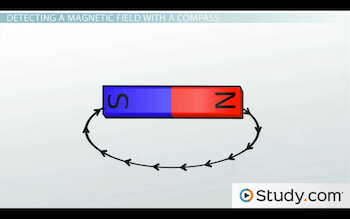
What part of the magnet are the arrows pointing toward?
a)
The poles
b)
The middle
c)
The horseshoe 
d)
The top
26.
These magnets will _____
a)
Attract
b)
Repel
27.

Where is Earth's magnetic field strongest?

a)

Along the outside lines

b)

Along the inside lines on either side

c)

Where the lines are close together at the poles

d)

In the space outside of the lines

28.

How can the strength of an electromagnet be increased? (mark all that apply)

a)

increase the current flowing through the coil

b)

increase the number of coils

c)

add an amplifier to it

d)

put iron core inside the coil

29.
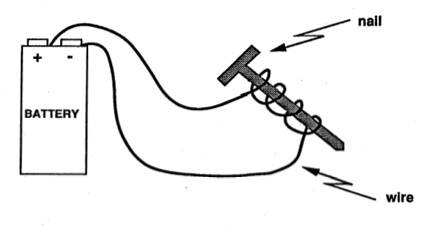
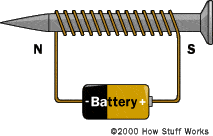
This is a picture of a simple electromagnet. How can the electromagnet be made stronger?
a)
Add more coils of wire to the nail.
b)
Use a smaller battery.
c)
Reverse the poles of the magnet.
d)
Remove all the coils and the nail.
30.
What kind of magnet can be turned on and off?
a)
refridgerator magnet
b)
electromagnet
c)
magnetite
d)
iron
31.
An acid reacts with metal to produce 
a)
Carbon dioxide 
b)
Hydrogen gas
c)
Hydrogen gas and water 
d)
Salt and hydrogen gas 
32.
What type of reaction is the following: 
HCl  + Zn --> ZnCl2 + H2
a)
Neutralisation
b)
Acid and a metal 
c)
Acid and a carbonate 
d)
Ionic 
33.
Complete the following reaction:
Hydrochloric acid + magnesium hydroxide --> 
a)
Magnesium chloride + water 
b)
Magnesium + water
c)
Magnesium chloride + hydrogen gas 
d)
Magnesium chloride + water + carbon dioxide 
34.
Pure water is _______ on the pH scale.
a)
Acid
b)
Base
c)
Neutral
35.

A gas was tested by bringing a glowing/burning splint close to it. A pop sound was heard afterwards. What gas was tested?

a)

Oxygen

b)

Nitrogen

c)

Hydrogen

d)

Carbon dioxide

36.

Gas pressure is caused by

a)

Gas molecules heating up

b)

Gas molecules reacting with other gas molecules

c)

Gas molecules hitting the walls of a container

d)

Gas molecules hitting other gas molecules

37.

The temperature of gas is held constant, while its volume is decreased. The pressure exerted by the gas on the wall of the container increases, because its molecules

a)

Strike the walls with higher velocities

b)

Strike the walls with large farce

c)

Strike the walls more frequently

d)

Are in contact with the walls for a shorter time

38.

Which of these is under greater pressure?

a)
b)
39.
Which container will have lower pressure?
a)
left
b)
right
c)
they both have the same pressure
40.

In the food web shown, who is the secondary consumer?

a)

grass

b)

mouse

c)

rabbit

d)

fox

41.

What does a primary consumer eat?

a)

tertiary consumers

b)

secondary consumers

c)

producers

d)

decomposers

42.
An organism that lives by breaking apart dead organic matter into simpler parts is...
a)
scavenger
b)
consumer
c)
decomposer
d)
carnivore
43.
What does a food web represent?
a)
All connections of energy flow throughout all organisms in a ecosystem.
b)
The specific ways that mutualism is carried out.
c)
A single pathway or energy flow between organisms. 
d)
How carnivores get their food. 
44.

The organism that hunts for food is a

a)

predator

b)

prey

c)

decomposer

d)

producer

45.

What level consumer is the deer?

a)

primary

b)

secondary

c)

tertiary

d)

producer

46.

Which is one is the variable that you change in an experiment?

a)

Independent

b)

Dependent

c)

Constant

d)

Control

47.

I am experimenting with how water effects the growth of a bean plant. Select all that need to remain constant

a)

Sunlight

b)

Type of Soil

c)

Temperature

d)

Amount of water

48.
Research Question: Does the type of gasoline put in a car effect how fast the car can drive. What is the independent variable?
a)
Type of gasoline
b)
which car the gas is put into
c)
how fast the car can drive
d)
how much gas is put into the car
49.
An experiment is performed on plants to see how different liquids affect plant growth. Each plant in the experiment is given a different liquid; water, apple juice, or milk. Each plant has the same amount of soil, sunlight, and listens to the same music. In this investigation, the independent variable is ...
a)
The type of plant
b)
The amount of sunlight
c)
The type of music
d)
The type of liquid
50.
What is the moment acting on the seesaw?
a)
1.6Nm
b)
15Nm
c)
16N
d)
4Nm
51.
Unit of force.
a)
Meter
b)
Centimeter
c)
Newton
52.
The easiest way to open a heavy door  is by applying the force
a)
Near the hinges
b)
In the middle of the door
c)
At the edge of the door far from the hinges
d)
At the top of the door
53.

What is the unit of moment of force?

a)

N

b)

m

c)

Nm

d)

N/m

54.

What is the main organ for human breathing process?

a)

Nose

b)

Trachea

c)

Lungs

d)

Mouth

55.

Blood rich in _____________ flows to the body cells. Blood rich in __________ flows to the lungs.

(a)  

56.

Exhaled air is the atmospheric air, rich in oxygen, that is drawn inside the body through the nostrils or mouth.

a)

True

b)

False

57.

Exhaled air contains 0% oxygen

a)

True

b)

False

58.

The percentage of oxygen in exhaled air is lower than the inhaled air because the body absorbs this gas for respiration.

a)

True

b)

False

59.

The temperature of exhaled air depends on the temperature of the outside environment.

a)

True

b)

False

60.

The body does not use most of the air that is breathed inside the body.

a)

True

b)

False

61.

What is Paper chromatography used for??

a)

Separate colored chemicals

b)

To see the pretty colors

c)

To help you know how to do math

62.

Base your answer to question 82 on the results of an experiment using plant pigments represented below and on your knowledge of biology.

Which phrase could be used to describe this technique?

a)

the use of chromatography to separate molecules in a mixture

b)

the use of cut leaves to observe certain colors

c)

using indicators to determine pH

d)

using dichotomous keys to identify plants

63.
Combination of two or more pure substances that are not chemically combined
a)
compound          
b)
atom
c)
mixture 
d)
element
64.
A pure substance that cannot be broken down into other substances by chemical or physical means. 
a)
compound          
b)
atom
c)
mixture 
d)
element
65.
made up of one kind of matter and has a definite set of properties
a)
compound          
b)
atom
c)
mixture 
d)
pure substance
66.

When making a fruit drink from a powdered mixture, water is the __________

a)

dissolving part

b)

solute

c)

solution

d)

solvent

67.
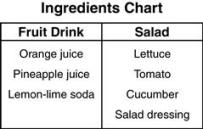
Jorge prepared a drink and salad for dinner. The chart lists the ingredients for both.
Using the information in the chart, which statement is the BEST description of the drink and salad?

a)
The salad and fruit drink are both mixtures.
b)
The salad and the fruit drink are both solutions.
c)
The fruit drink is a mixture because the ingredients can't be separated.
d)
The salad is a solution because the ingredients can't be separated.