
 Worksheets
STAAR Review 2024
Total questions: 120
Worksheet time: 2hrs 45mins
Which statement shows an effect of the First Amendment?
Ministers can preach religious messages to anyone who chooses to listen.
Political leaders can require religious tests in order to hold public office.
Ministers can work together to establish a national religion.
Political leaders can require churches to pay taxes.

Which statement describes a position of the party that agreed with the cartoonist's view of Jackson?
They complained about Jackson's extravagant lifestyle.
They opposed Jackson for his efforts to start a war with Great Britain.
They criticized Jackson as a leader with unrestrained powers.
They objected to Jackson's attempt to reduce the number of Supreme Court justices.
Why was Frederick Douglass significant to the abolitionist movement?
He was elected as a state government official who challenged the system of slavery.
He formed relationships with those who had different views on slavery from his own.
He described his own personal experiences under the system of slavery.
He emphasized that an educational system was the main way to end slavery.
I attended an anti-slavery convention ... at which it was my happiness to become acquainted with Frederick Douglass ...
I shall never forget his first speech at the convention - the powerful impression it created. ...I think I never hated slavery so intensely as at that moment....
... He came forward to the platform with a hesitancy and embarrassment. ... After apologizing for his ignorance, and reminding the audience that slavery was a poor school for the human intellect and heart, he proceeded to narrate some of the facts in his own history as a slave.
-- William Lloyd Garrison, from Narrative of the Life of Frederick Douglass, an American Slave by Frederick Douglass
Based on the excerpt, why was Frederick Douglass significant to the abolitionist movement?
He was elected as a state government official who challenged the system of slavery.
He formed relationships with those who had different views on slavery from his own.
He described his own personal experiences under the system of slavery.
He emphasized that an educational system was the main way to end slavery.
Based on the excerpt, how did the Great Compromise help create this governmental structure?
By settling the issues over voting rights in the North
By settling the issues between Federalists and Anti-Federalists
By settling the issues over taxation
By settling the issues between large and small states
What was the primary economic activity of the New England Colonies in the late 17th century?
Agriculture
Shipbuilding and lumber production
Plantation production
Manufacturing businesses
What type of climate did the New England Colonies have in the late 17th century?
Warm winters; hot, humid summers
Long, cold winters; moderate, short summers
Hot, dry summers; mild winters
Humid all year round
How did the climate of the Southern Colonies influence their economy?
It led to a focus on shipbuilding due to the cold climate.
It supported the development of large urban centers.
It allowed for a long growing season suitable for agriculture.
It encouraged the development of a large rural population.
Which statement best describes the influence of the Southern Colonies' characteristics on life in the colonies?
The New England colonies supported financial growth through high-paying industrial work.
The Southern colonies supported the plantation production of cash crops because of long growing seasons.
The Southern colonies developed large urban centers in order to support increasing manufacturing businesses.
The New England colonies developed large rural populations in order to support increasing agricultural production.
Which European country was motivated to colonize the New World for these reasons: to spread Catholicism through religious missions, to find gold, silver, and other riches, and to gain control of large parts of North and South America?
England
France
Germany
Spain
Which statement shows how the grievance 'He has refused his Assent to Laws, the most wholesome and necessary for the public good' was addressed in the US Constitution?
Congress may override a presidential veto.
Congress may ratify amendments.
The House of Representatives introduces tax bills.
The Senate may vote to turn down treaties.
Based on the excerpt, which group wrote the Lecompton Constitution?
Opponents of westward expansion
Supporters of abolitionism
Anti-slavery Northerners
Pro-slavery Southerners
Which statement explains how physical geography affected the population distribution of the United States in 1790?
The southern states offered fertile farmland, allowing for the development of larger cities.
The Proclamation Line of 1763 prevented settlers from moving away from the East Coast.
The Appalachian Mountains served as a barrier that slowed westward expansion.
The Rocky Mountains posed risks to explorers, leading most people to remain in the East.
Which statement explains an effect of Samuel Slater's mill?
It limited the need for child labor in factories.
It limited the need for interchangeable parts.
It led to expanded regulations on foreign trade.
It led to rapid growth in the textile industry.
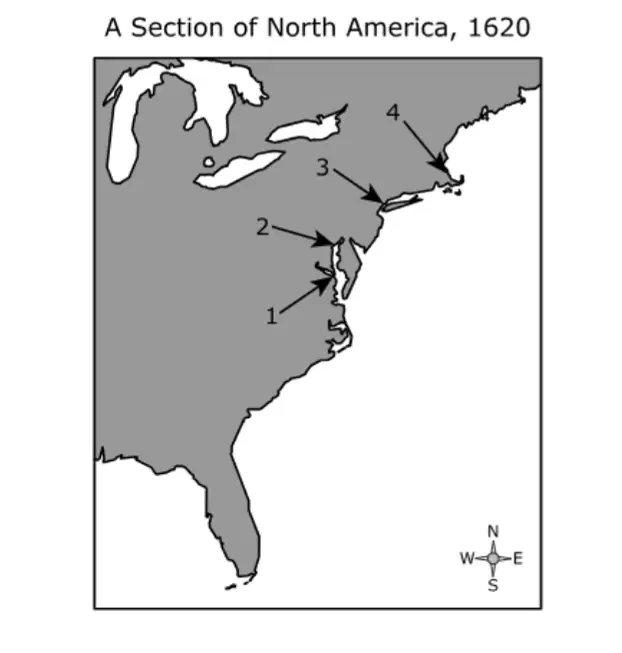
Which numbered arrow represents the area where the Pilgrims landed in 1620?
1
2
3
4
Which weaknesses are associated with the Articles of Confederation?
All states had to approve amendments
The one-house legislature was based on population.
The central government held too much power.
States coined their own money.
Which statement explains the purpose of military government in the South during Reconstruction?
It prevented carpetbaggers from operating former Confederate businesses.
It protected and ensured the rights of newly freed enslaved people.
It provided money and weapons to newly freed enslaved people.
It prohibited African Americans from running for public office.
The First Great Awakening of the 1730s and 1740s focused on the ________.
advancements of the arts
system of slavery
experiences of individuals
technological advances
What was the purpose of the Molasses Act of 1733?
To subsidize the production of molasses in the colonies.
To ban the import of molasses from French colonies.
To impose taxes on molasses imported from any non-English territories.
To impose taxes on French molasses shipped to English colonies.
How did English mercantilist policies influence the Founding Fathers following the Revolutionary War?
The Founders encouraged minimal governmental influence over foreign relations.
The Founders promoted the establishment of governmental authority over citizens.
The Founders promoted the establishment of governmental taxes on the states.
The Founders encouraged minimal governmental regulation of businesses.
Why was the Battle of Vicksburg a strategic victory in the Civil War?
The battle opened the way for a full-scale Union attack on Atlanta.
The battle gave the Union control of the Mississippi River.
The battle prevented a Confederate invasion of the North.
The battle allowed President Lincoln to issue the Emancipation Proclamation.
How did industrialization in the 1800s affect life in the United States?
It led to an increased reliance on imported goods.
It led to increased isolationist views about conflicts in other countries.
It led to nativist feelings against the growing immigrant population.
It led to concerns about the growing population of enslaved people.
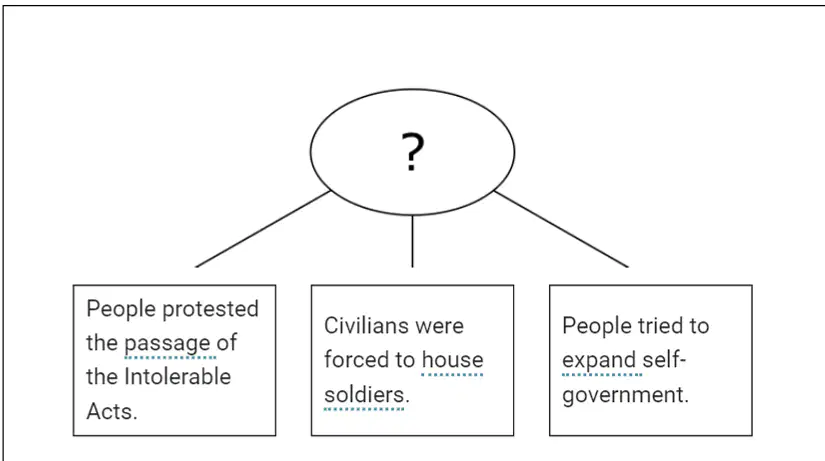
Which era in U.S. history correctly replaces the question mark for the title of this diagram?
Reconstruction
Sectionalism
The Revolutionary Period
The Early Republic
Who worked to improve conditions for the mentally ill?
Harriet Beecher Stowe
Dorothea Dix
Elizabeth Cady Stanton
None of the above
Who led efforts to promote women's right to vote?
Harriet Beecher Stowe
Dorothea Dix
Elizabeth Cady Stanton
None of the above
Who wrote about the hardships of slavery?
Harriet Beecher Stowe
Dorothea Dix
Elizabeth Cady Stanton
None of the above
Why was the Mexican Cession a significant event?
It united different cultural groups living in western areas.
It intensified the debate over the expansion of slavery.
It created a temporary southern border.
It led to the development of canal systems to move goods.
How did the U.S. Supreme Court interpret the Commerce Clause in Gibbons v. Ogden (1824)? Select TWO correct answers.
States may control commerce within their borders that involves foreign countries.
States may be subject to federal regulation in matters of commerce.
States may possess the power to regulate interstate commerce.
States may pass legislation that restricts interstate commerce.
States may regulate commerce within their own borders.
What was the INITIAL reason many European explorers sailed to the Americas?
To find new trade routes to Asia
To form military alliances
To spread Christianity to Africa
To find new sources of cheap labor
What is the significance of the Pilgrims' arrival in America?
A It led to an alliance between the British and the French.
B It led to an early attempt at self-government in the English colonies.
C It caused Puritans to separate from the Church of England.
D It introduced the slave trade to the Atlantic colonies

Which pair of actions best completes this graphic?
F 1-Enslaved native populations
2-Organized utopian societies
G 1-Established Catholic missions 2-Focused primarily on fur trading
H 1-Promoted political freedom
2-Participated in the triangular trade
J 1-Became commercial shipbuilders 2-Created an early system of public schools

The colonies in this list were founded primarily to offer settlers a greater degree of...
A freedom from debts
B religious freedom
C economic freedom
D freedom of speech
Which problem did George Washington encounter when he became president?
Southern states were threatening to secede from the Union.
The United States had large debts from the American Revolution.
Great Britain was refusing to trade with the United States.
The Articles of Confederation needed to be replaced with a stronger constitution
After the end of the Revolutionary War, states were eager to expand into newly available territory. The states of New York, Connecticut, Massachusetts, and Virginia argued over competing claims to land west of the Appalachian Mountains. This conflict was addressed by the —
Missouri Compromise
Wilmot Proviso
Northwest Ordinance
Kansas-Nebraska Act

Which outcome best completes this diagram?
American Revolution
Popular Sovereignty
Manifest Destiny
Civil War

This excerpt supports the conclusion that Jefferson disagreed with —
the congressional power of impeachment
the presidential power to veto bills
the states’ power to amend the Constitution
the Supreme Court’s power of judicial review
How did the Supreme Court decision in Worcester v. Georgia affect American Indians?
The ruling gave the state authority over relations with American Indians.
The state ignored the ruling and distributed Cherokee lands to white settlers.
More American Indian tribes decided to grant licenses to missionaries to live on tribal lands.
Reservation policies were overturned and replaced with land grants to individuals.
According to the Northwest Ordinance, which condition did a U.S. territory have to meet in order to apply for statehood?
Have a population of sixty thousand free settlers
Hold a vote on whether to become a free or slave territory
Establish one public school per district
Have a territorial governor appointed by the president
Which event was one cause of the U.S.-Mexican War?
The United States banned slavery in territories acquired from Mexico
The U.S. Congress debated statehood for New Mexico
U.S. and Mexican soldiers fought over disputed territory north of the Rio Grande
The United States acquired the Mexican Cession
Which statement describes one result of the War of 1812?
Great Britain lost control of Canada
The United States gained control of the Oregon Territory
The United States stopped trading with Britain and France
Great Britain stopped the practice of impressment
Which statement explains an effect of the Missouri Compromise?
The compromise maintained the balance between the number of free states and slave states in the Senate
The compromise allowed slaves to be counted toward a state’s population for representation in Congress
The compromise enabled Southerners to pursue fugitive slaves into the North
The compromise ended the slave trade in Washington, D.C
Why did President Andrew Jackson oppose the Second Bank of the United States?
He believed it was inefficient and poorly managed
He thought it was unconstitutional and favored the wealthy
He considered it an obstacle to industrial progress and expansion
He believed it favored the rights of states over the federal government
Which breakthrough did Hiram Rhodes Revels accomplish during Reconstruction?
He became the first African American to publish literature
He became the first African American to build wealth as a carpetbagger
He became the first African American to win a seat in the U.S. Congress
He became the first African American soldier to serve in an integrated Union Army unit
Which issue was debated in Gibbons v. Ogden?
The status of slaves living in free territories
The regulation of interstate commerce by federal or state laws
The constitutionality of tariffs
The separation of powers among the branches of government

What made the battles at Antietam and Gettysburg different from the other battles illustrated on this map?
They were victories for the Confederacy
They were battles fought in Union territory
They were attempts to keep Virginia in the Union
They were battles defending the Confederate capital
Where was the physical boundary of the Proclamation of 1763?
The Smoky Mountains
The Rocky Mountains
The Appalachian Mountains
The Ohio River Valley
Who helped construct the Transcontinental Railroad?
Irish & Chinese Immigrants
Chinese & German Immigrants
Irish & German Immigrants
German & Japanese Immigrants
Which social movement during the 19th Century sought to end slavery?
Women's Suffrage
Abolitionists Movement
Temperance Movement
Prison/Mental Health Reform
How did southern states respond to the ratification of the Fifteenth Amendment?
By creating a segregated public education system
By shutting down all remaining offices of Freedmen’s Bureau
By imposing requirements designed to deny African Americans the right to vote
By forcing African Americans to work as tenant farmers and sharecroppers

Which political idea was influenced by this provision of the Magna Carta?
Federalism
Due process
A bicameral legislature
The social contract
Which shaded state was the main destination of American Indians forced to relocate as part of the Trail of Tears?


What was one result of the Treaty of Paris of 1783?
Great Britain recognized the United States as an independent country.
Competing Seminole and Spanish claims in West Florida were resolved.
The British navy agreed to stop pressing American sailors into service.
British territory in eastern Canada was ceded to France.
What happened in 1620?
Jamestown was founded
Plymouth was founded
The Declaration of Independence
The Constitution was written
What happened in 1607?
Jamestown was founded
Plymouth was founded
The Magna Carta was written
The Louisiana Purchase
What happened in 1776?
Plymouth was founded
The Declaration of Independence
The Constitution was written
The Civil War
What happened in 1787?
The Declaration of Independence
The Constitution was written
The Louisiana Purchase
The Civil War
When was the Louisiana Purchase?
1787
1803
1812
1860
Which war was fought between 1861 and 1864?
The French and Indian War
The American Revolution
The US-Mexico War
The Civil War
This Supreme court case established judicial review.
Marbury v Madison
Mcculloch v Maryland
Gibbons v Ogden
Dred Scott v Sandford
In 1803, the Supreme Court gave itself the power of Judicial Review in this landmark case, that means the Supreme Court has final say in interpreting the Constitution.
Miranda v. Arizona
McCullough v. Maryland
Marbury v. Madison
Gideon v. Wainwright
DECISION: The Federal government has the power over the states to regulate interstate commerce. Federal ferry license prevails over a State Ferry License (no NY monopoly)
Gideon v Wainwright
McCulloch v Maryland
Marbury v Madison
Gibbons v Ogden
1819 ruling claims a state law cannot interfere with federal law. It confirms right of Congress to set up National Bank under the elastic clause.
Worcester v Georgia
Marbury v. Madison
McCulloch v. Maryland
Gibbons v Ogden
Which precedent was established by the Supreme Court ruling in Marbury v. Madison?
The federal government has the power to regulate trade among the states.
State governments lack the authority to regulate federal bureaus.
Federal courts determine the constitutionality of a law.
State courts lack the authority to hear cases challenging federal law.
Which of these correctly describes an effect of the Compromise of 1850 on escaped slaves and freedmen?
Members of both groups were captured under the Fugitive Slave Law.
Unlike freedmen, escaped slaves were welcome in the gold mines of California.
Members of both groups could be sold in Washington, D.C., slave markets.
Unlike escaped slaves, freedmen could vote in the territories of the Mexican Cession.
What was a major result of the Missouri Compromise?
It increased the number of immigrants settling in northern states.
It provided financing for canal construction.
It rapidly expanded railroad construction in southern states.
It temporarily relieved sectional tensions.
Which of the following correctly describes the Three-Fifths Compromise?
A portion of the slave population was counted for legislative representation.
A federal law enforcing the return of fugitive slaves was passed.
The census bureau was established to help apportion representation.
The election of senators was delegated to state legislatures.

Which of the following should replace the question mark in this diagram below?
Direct democracy
Great Compromise
Checks and balances
Missouri Compromise
Which of the following statements most accurately describes judicial review?
the power to nominate and appoint new judges
the power to reverse the decisions of lower courts
the power to review presidential actions
the power to declare laws unconstitutional
Which Supreme Court Justice oversaw Marbury v Madison, Gibbons v Ogden and McCulloch v Maryland
Thomas Jefferson
James Monroe
John Adams
John Marshall
Discoveries made in California more than doubled the world's supply of which item?
Farmland
Gold
OIl
Water
Which country sold the Louisiana Territory in 1803?
Britain
France
Spain
Italy
Which minority group still maintains a large presence in California due to the Gold Rush?
African Americans
Chinese
Japanese
Cherokee

Which map shows the boundaries of the United States just after the Treaty of Guadalupe Hidalgo?
A
B
C
D


What piece of land was purchased in 1853 in order to build something in the South? What did they want to build?
Mexican Cession/Trails
Louisiana Territory/Canals
transcontinental/Oregon Country
Gadsden Purchase/Railroad
Which group are the New England colonies?
Connecticut, New Hampshire, Rhode Island, Massachusetts
North Carolina, South Carolina, Virginia, Maryland, Georgia
Pennsylvania, Deleware, New York, New Jersey
Illinois, Indiana, Ohio, Wisconsin
Which group are the Middle colonies?
Connecticut, New Hampshire, Rhode Island, Massachuttes
North Carolina, South Carolina, Virginia, Maryland, Georgia
Pennsylvania, Delaware, New York, New Jersey
California, Arizona, New Mexico, Washington
Which group are the Southern colonies?
Connecticut, New Hampshire, Rhode Island, Massachuttes
North Carolina, South Carolina, Virginia, Maryland, Georgia
Pennsylvania, Delaware, New York, New Jersey
Florida, Georgia, Louisiana, Alabama
What is the major industry of the New England Colonies?
Cash Crops
Metalwork
Slavery
Shipbuilding and Fishing
What was the New England economy shaped by?
Rocky soil, long winters
Fertile Soil, short winters
Forest, mild summers
Mountainous land
Why was Georgia formed or established?
As a place for Catholics to practice their religion
Industrial settlement for crafts people
A creative centers for artists
Second chance or safe haven for debtors/poor people and prisoners
Document created in 1215 that made the King follow the Rule of Law and established basic rights for the citizens
Magna Carta
English Bill of Rights
Constitution
Royal Charter
What physical geographic barrier kept the colonist from expanding westward?
Mount St Helens
Rocky Mountains
Appalachian Mountains
Mount Everest
According to John Locke, which agreement did individuals enter into when forming their own society?
constitution
social contract
Mayflower Compact
English Bill of RIghts
According to John Locke: life, liberty and the pursuit of happiness are ...
won in the Revolutionary War
get when they pass a civics exam for citizenship
gain through citizenship
rights that people should have at birth
What was the name of the group of policymakers called who felt that the states should have more power than the federal government?
Thomas Paine
Federalists
Anti-Federalists
House of Representatives
Powers that are shared between the federal government and state governments (Federalism), is addressed in which amendment?
1st Amendment
10th Amendment
8th Amendment
3rd Amendment
The "Bill of Rights" are an example of which constitutional principle?
Separation of powers
Checks and balances
Individual rights
Judical review
Which amendment gives American citizens the right to a speedy and public trial by jury?
First Amendment
Sixth Amendment
Third Amendment
2nd Amendment
An example of a bicameral legislature would be:
House of Representatives and Senate (Great Compromise)
Judicial and Executive Branch (2 Branches)
Divided Government
U.S. Constitution
Disagreements about the strength of the national government and the establishment of a National Bank by Alexander Hamilton led to ....
the Monroe Doctrine
the War of 1812
the development of political parties
the creation of judicial review
Florida & land near Oregon
Which of these best summarizes the Monroe Doctrine?
The immigration of Europeans to the United States must be discouraged.
International peace can be maintained without complicated alliances.
The power to nullify federal laws is necessary to preserve sovereignty.
Further colonization of the Americas by European countries is prohibited.
XYZ Affair
Whiskey Rebellion
Shays' Rebellion
Boston Tea Party
-Adams sends 3 diplomats to negotiate with the French foreign minister
-The French agents demanded a bribe in order for a meeting with the foreign minister
-The American agents refused to pay the bribe
The information in the table above best reflects the --
XYZ Affair
Alien and Sedition Acts
Embargo Acts
Jay Treaty
-Created a Supreme Court with 6 justices
-Established 13 district courts in the states that had ratified the Constitution
-Adopted in the first session of the First United States Congress
The characteristics in the chart above best reflect the---
principle of judicial review
foreign policy of President Washington
Alien and Sedition Acts
Judiciary Act of 1789
-Lengthened the time it took to become a citizen from 5 to 14 years
-Printing, writing, or speaking in a hateful way against the government was a crime
-The President could jail or deport non-citizens who were suspected of causing trouble
The table above best summarizes the--
Nullification Crisis
Virginia and Kentucky Resolution
Alien and Sedition Act
Causes of the American Revolution
How did the War of 1812 affect the U.S. economy?
The use of federal paper currency increased.
Agricultural imports increased.
Imports of raw materials increased.
Manufacturing increased.in the United States
Which action contributed to the beginning of the War of 1812?
impressment of American sailors into the British navy
attacks on American ships by the Barbary Coast pirates
seizure of American ships by the Spanish navy
violations of American fishing rights on the Great Lakes
The Northwest Ordinance is considered a historical milestone because it -
more than doubled the size of the United States
established a method for admitting new states to the Union
encouraged state legislatures to ratify the Constitution
proposed treaties with American Indians to allow the peaceful settlement of new territories.
What is the name of the man-made waterways that were used to increase the amount of goods transported through trade?
rivers
ships
canals
oceans
The largest problem facing Washington when he became president was -
lack of military experience
where to put the national capital
national debt from Revolutionary War
Native Americans
In his farewell address, Washington warned of:
Avoiding entanglement with foreign affair (having allies) and avoid political parties
Avoid political parties, aquiring slaves
Avoiding entanglement with foreign affairs, trading goods
Trading goods, acquiring slaves
The Trail of Tears was a result of which policy?
McCulloch v. Maryland
Indian Removal Act
Gibbons v. Ogden
Worcester v. Georgia
The Nullification Crisis was when:
Sen. Webster voted against expanding slavery to new states
Sen. Clay opposed Jackson's plan to kill the bank of the US
Sen. Calhoun opposed high tariffs and said South Carolina would not obey this law
Chief Osceola refused to sign the Treaty of Moultrie

