
 Worksheets
DR. IMPRINT BY KNT - 6
Total questions: 114
Worksheet time: 57mins
debridement is:
The removal of damaged tissue or foreign objects from a wound.
The inclusion of damaged tissue or foreign objects from a wound.
The cleansing of a wound before care
A pain management technique
These protect wound from injury, prevent introduction and spread of bacteria, reduce discomfort, and speed healing.
Wound Care
Ideal Dressing
Dry Dressing
Bandage
What is the first phase of wound healing?
Maturation/Remodeling
Angiogenesis
Proliferation/Repair
Inflammation and Debridement
Which type of wound closure occurs when a wound heals on its own by forming granulation tissue, epithelializing, and contracting?
Healing by Second Intention
Delayed Primary Closure
Primary Closure
Secondary Closure
What is the goal of treating wounds?
To keep the wound dry at all times
To minimize pain, decrease infection, and promote healing
To cause infection in the wound
Which type of wound is created when a nonsterile organ is entered with little or no spillage of contents or when a minor breach in aseptic technique occurs when treating a clean wound?
Dirty wounds
Contaminated wounds
Clean-contaminated wounds
Clean wounds
What is the most reliable way to achieve the desired pressure for wound flushing?
Using a syringe
Using a 1-L bag of fluids attached to a venoset and a needle
Using a dropper
Using a spray bottle
What is the main goal of the first step in treating wounds?
To cover the wound with a bandage
To evaluate the surrounding tissue for further damage
To remove the hair around the wound
To sedate or anesthetize the patient
Which type of wound closure occurs at least 5 days after injury and after healthy granulation tissue has formed?
Secondary Closure
Delayed Primary Closure
Primary Closure
Healing by Second Intention
What is the phase of wound healing that begins at the time of injury and lasts 3 to 5 days?
Angiogenesis
Inflammation and Debridement
Maturation/Remodeling
Proliferation/Repair
What is the phase of wound healing that occurs 3 to 5 days after injury?
Proliferation/Repair
Angiogenesis
Maturation/Remodeling
Inflammation and Debridement
What is the phase of wound healing that occurs 7 to 14 days after injury?
Inflammation and Debridement
Proliferation/Repair
Maturation/Remodeling
Angiogenesis
What is the main goal of the second phase of wound healing?
To allow for migration of fibroblasts and creation of collagen
To control hemorrhage
To provide hemostasis
What is the main goal of the third phase of wound healing?
To provide hemostasis
To control hemorrhage
To increase wound strength at the fastest rate
To increase blood flow and bring transudates into the wound
What is the main goal of the fourth phase of wound healing?
To increase wound strength at the fastest rate
To increase blood flow and bring transudates into the wound
To provide hemostasis
To control hemorrhage
Which type of wound is created when a sterile organ is entered with significant spillage of contents?
Dirty wounds
Contaminated wounds
Clean-contaminated wounds
Clean wounds
What is the least reliable way to achieve the desired pressure for wound flushing?
Using a syringe
Using a 1-L bag of fluids attached to a venoset and a needle
Using a dropper
Using a spray bottle
Which type of wound closure occurs immediately after injury?
Healing by Second Intention
Delayed Primary Closure
Primary Closure
Secondary Closure
What is the main goal of the inflammation and debridement phase of wound healing?
To increase wound strength at the fastest rate
To control hemorrhage
To remove dead tissue and bacteria from the wound
To increase blood flow and bring transudates into the wound
Which type of wound closure occurs when a wound is left open and allowed to heal from the inside out?
Healing by Second Intention
Delayed Primary Closure
Primary Closure
Secondary Closure
What is the main goal of the maturation/remodeling phase of wound healing?
To increase wound strength at the fastest rate
To control hemorrhage
To provide hemostasis
To reshape and strengthen the new tissue
Which type of wound closure occurs when a wound is sutured immediately after injury?
Healing by Second Intention
Delayed Primary Closure
Primary Closure
Secondary Closure
What is the main goal of the angiogenesis phase of wound healing?
To increase wound strength at the fastest rate
To control hemorrhage
To provide hemostasis
To form new blood vessels in the wound

What's this?
maceration
wound
debridement
dressing
The type of intention healing that includes closures with staples or sutures.
Secondary
Primary
Inflammation
Tertiary
Type of wound healing complication that occurs due to incomplete hemostasis.
Abrasion
Dehiscence
Hematoma
Hemorrhage
Sanguineous drainage can indicate
Infection
Healing
Need for a drain
Active bleeding

The image shows which wound healing complication?
Evisceration
Dehiscence
Laceration
Hematoma

The CDC classifies wounds that include entry to GI, GU, or respiratory tracts as
Class I Clean
Class II Clean-contaminated
Class III Contaminated
Class IV Dirty/infected
A pressure ulcer with partial-thickness loss of dermis, that may appear as a red blister is which stage?
Stage II
Stage IV
Stage I
Stage III
Which stage of pressure ulcer includes muscle damage with possible bone exposure?
Stage IV
Stage I
Stage III
Stage II
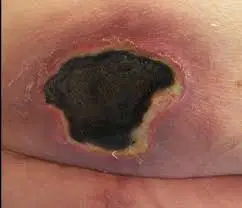
This pressure ulcer is classified as
Stage III
Stage IV
Unstageable
Stage II

Which of the following is not an appropriate nursing intervention for pressure ulcer treatment?
Reposition patient Q 2 hrs
Use a special mattress to reduce pressure
Encourage ambulation
Strict bedrest
Which of the following is not a treatment for stasis ulcers?
Unna boot
Wet-to-dry dressing
hydrocolloid dressing
Compression therapy
Which phase of wound healing includes the formation of fibrin?
Hemostasis
Inflammatory
Reconstruction
Maturation
A wound that cannot be closed requiring a drain is an example of what kind of intention healing?
Tertiary
Primary
Secondary
None of the above

A balanced diet can help assist in wound healing. Foods that are rich in vitamin C may include
seafood
bananas
tomatoes
avocado

Clear, watery drainage from a wound should be documented as
Serosanguineous
Purulent
Sanguineous
Serous
What intervention should be completed 30 minutes prior to a dressing change?
Administer analgesics
Mark the dressing for drainage
Emptying the bladder
Position change

Which type of dressing is air and water tight, keeping the wound moist?
ABD pads
Occlusive
Telfa pads
semiocclusive

Surgical glue is beneficial for all of the following except
Lower rates of infection
Less time in OR
Can be used for diabetic patients
Less scarring

What nursing interventions are appropriate for a stage I pressure ulcer?
Applying a moisture barrier cream
Hydrocolloid dressing
Cleaning with sterile water
debridement

Which is not true of wound VACs?
Change the dressing Q 24-72 hrs
Helping draw together wound edges
Keeps the wound dry and cool
Decreases inflammation

Cavity containing pus that is surrounded by inflamed tissue is considered to be an
Adhesion
Abrasion
Abscess
Evisceration
What is the importance of patient care and safety in nursing?
Patient care and safety only have a minimal impact on patient well-being and recovery.
Patient care and safety are important in nursing because they directly impact patient well-being and recovery.
Patient care and safety are not important in nursing.
Patient care and safety are more important in other healthcare professions than in nursing.
How do effective communication skills contribute to being a good nurse?
Nurses don't need to establish rapport with patients or collaborate with other healthcare professionals.
Effective communication skills have no impact on being a good nurse.
Being a good nurse is solely dependent on medical knowledge and skills, not communication.
Effective communication skills allow nurses to establish rapport with patients, understand their needs and concerns, provide clear instructions and explanations, and collaborate effectively with other healthcare professionals.
Why is critical thinking and problem-solving essential for nurses?
Critical thinking and problem-solving are only important for administrative tasks in nursing.
Critical thinking and problem-solving only apply to certain nursing specialties.
Critical thinking and problem-solving are essential for nurses because they enable them to assess and analyze complex situations, make informed decisions, and provide effective patient care.
Critical thinking and problem-solving are not essential for nurses.
Explain the role of empathy and compassion in nursing.
Empathy and compassion have no role in nursing.
Empathy and compassion are only important for doctors, not nurses.
Nurses should prioritize technical skills over empathy and compassion.
Empathy and compassion help nurses connect with patients on an emotional level and provide holistic care.
Why is attention to detail crucial for nurses?
Attention to detail is not crucial for nurses as they can rely on their intuition.
Attention to detail is only important for doctors, not nurses.
Nurses don't need to pay attention to detail because they have other staff members to do that for them.
Attention to detail is crucial for nurses because it helps them identify and prevent potential errors in patient care.
What are some ways nurses can ensure patient safety?
Not washing hands regularly
Regularly washing hands, following proper infection control protocols, accurately documenting patient information, administering medications correctly, monitoring patients closely, and effectively communicating with the healthcare team.
Not accurately documenting patient information
Not following proper infection control protocols
How can nurses improve their communication skills?
By actively listening, using clear language, practicing empathy, and utilizing non-verbal communication techniques.
By interrupting the patient while they are speaking and not allowing them to finish their thoughts.
By avoiding eye contact and not paying attention to the patient's concerns.
By using complex medical jargon that the patient may not understand.
Give an example of a critical thinking scenario that a nurse may encounter.
Administering medication based on patient's preference
Prioritizing patient symptoms based on urgency and condition
Performing routine check-ups on patients
Assisting patients with daily activities
How can nurses show empathy and compassion towards their patients?
By showing indifference and lack of concern towards the patient's well-being.
By rushing through appointments and not taking the time to listen to the patient.
By actively listening, showing genuine concern, providing emotional support, and being present in the moment.
By ignoring the patient's emotions and focusing solely on their medical needs.
What are some common areas where attention to detail is important in nursing?
patient communication, time management, teamwork, and infection control
medication administration, patient assessments, wound care, documentation, and infection control
patient communication, time management, teamwork, and wound care
patient communication, time management, teamwork, and physical assessments
What is abrasion?
Skin scraped against a rough surface
Several layers of skin are torn loose or totally removed
Usually more painful than deeper wound
ALL of the Above
Usually more painful lang deeper wound because of exposure of Millions of _
(a)
Abrasion can be covered or uncovered;
depending on the comfort of the patient
TRUE
FALSE
What is the first name of your SME?
(a)
It is OK not to do hand washing/hygiene before and after wound dressing as long as you are using a pair of gloves.
TRUE
FALSE
What can be a sign of infected wound. (2 answers)
Red and swelling
Presence of Pus
Dry and intact skin
Itchy wound
What is the proper way on applying antiseptics?
Clean in a systematic manner
Clean in a circular motion starting from the centre going out.
You can Blow the antiseptic to make it dry
Use aseptic non-touch technique
Skin is the largest organ of our body.
TRUE
FALSE
Skin is waterproof.
True
False
Which is NOT a SKIN Layer?
Dermis
Epidermis
Fat Layer
Liver
These protect wound from injury, prevent introduction and spread of bacteria, reduce discomfort, and speed healing.
Wound Care
Ideal Dressing
Dry Dressing
Bandage
An ideal dressing is, except:
Able to absorb or contain exudates
Acceptable in appearance
Easily removed with damage to the healing surface
Flexible but durable
These are clear and watery plasma wound drainage.
Serous
Purulent
Sanguineous
Serosanguineous
These are thick and either yellow, green, tan or brown wound drainage.
Serous
Purulent
Sanguineous
Serosanguineous
These are bright red wound drainage.
Serous
Purulent
Sanguineous
Serosanguineous
These are pale red and watery wound drainages.
Serous
Purulent
Sanguineous
Serosanguineous
This nutrient repairs the body from wear and tear, builds new tissue and contributes to numerous essential body functions.
Protein
Carbohydrate
Fat
Sugar

The health care provider on duty is dressing the wound of an incised wound. He/she knows that the concept "least to most contaminated" must be followed. How will dress he/she wound?
In a circular motion starting from the center of the wound going towards the outside part in one swab.
In a circular motion starting from the outside of the wound going towards the inside part in one swab.
Start cleaning, in one swab, from one end of the incision to the other end. Then, use another swab to clean one side of the incision in one swabbing motion. And repeat to the other side with another cotton ball.
Start cleaning on one side of the incision and end on the same side in one circular motion.
MT Elias is a newly hired health care provider in their barangay. Upon checking, he found out that that the health center has no gloves available. He is not worried because he knows he can use these when dressing clients' wounds.
Clean Gloves
Bare Hands
Cleaned Forceps
Sterilized Forceps
When inspecting the wound, what should we check to monitor the status of healing? (Give one.)
(a)
MT Bob is assessing an 8-year old crying patient with a burn wound. He sweetly introduced himself and explained to the client what he will do. When asking for the pain rating of the patient. He asked the client to rate his pain in a scale of 0 to 10. The client answered 0. How did MT Bob do?
Good. MT Bob did the correct assessment.
Bad. MT Bob should have asked the client the reason for crying.
Bad. MT Bob should have established trust and rapport more.
Bad. MT Bob should have presented the emoji icon level to the client.
Handwashing is done to remove microorganisms on the skins and the hands.
True
False
A sanguineous wound drainage indicates active bleeding.
True
False


In terms of preparing small dirty wound bed with necrotic tissue and slough , the best preparation would be
Daily dressing of the wound and IV antibiotic
Daily dressing with bed site surgical debridement
Daily dressing with gel
Before you open your dressing pack you must?
Prepare/Clean your work surface
Wash your hands
Select your dressing
All of the above
In what sphase of the healing process is the wound is fresh and also include warmth, redness, pain, and edema.
Reconstruction Phase
First Intention Phase
Maturation Phase
Inflammatory Phase
The type of intention healing that includes closures with staples or sutures.
Secondary
Primary
Inflammation
Tertiary
Type of wound healing complication that occurs due to incomplete hemostasis.
Abrasion
Dehiscence
Hematoma
Hemorrhage
Sanguineous drainage can indicate
Infection
Healing
Need for a drain
Active bleeding
The image shows which wound healing complication?
Evisceration
Dehiscence
Laceration
Hematoma
The CDC classifies wounds that include entry to GI, GU, or respiratory tracts as
Class I Clean
Class II Clean-contaminated
Class III Contaminated
Class IV Dirty/infected
A pressure ulcer with partial-thickness loss of dermis, that may appear as a red blister is which stage?
Stage II
Stage IV
Stage I
Stage III
Which stage of pressure ulcer includes muscle damage with possible bone exposure?
Stage IV
Stage I
Stage III
Stage II
This pressure ulcer is classified as
Stage III
Stage IV
Unstageable
Stage II
Which of the following is not an appropriate nursing intervention for pressure ulcer treatment?
Reposition patient Q 2 hrs
Use a special mattress to reduce pressure
Encourage ambulation
Strict bedrest
Which of the following is not a treatment for stasis ulcers?
Unna boot
Wet-to-dry dressing
hydrocolloid dressing
Compression therapy
Which phase of wound healing includes the formation of fibrin?
Hemostasis
Inflammatory
Reconstruction
Maturation
A wound that cannot be closed requiring a drain is an example of what kind of intention healing?
Tertiary
Primary
Secondary
None of the above
A balanced diet can help assist in wound healing. Foods that are rich in vitamin C may include
seafood
bananas
tomatoes
avocado
Clear, watery drainage from a wound should be documented as
Serosanguineous
Purulent
Sanguineous
Serous
What intervention should be completed 30 minutes prior to a dressing change?
Administer analgesics
Mark the dressing for drainage
Emptying the bladder
Position change
Which type of dressing is air and water tight, keeping the wound moist?
ABD pads
Occlusive
Telfa pads
semiocclusive
Surgical glue is beneficial for all of the following except
Lower rates of infection
Less time in OR
Can be used for diabetic patients
Less scarring
What nursing interventions are appropriate for a stage I pressure ulcer?
Applying a moisture barrier cream
Hydrocolloid dressing
Cleaning with sterile water
debridement
Which is not true of wound VACs?
Change the dressing Q 24-72 hrs
Helping draw together wound edges
Keeps the wound dry and cool
Decreases inflammation
Cavity containing pus that is surrounded by inflamed tissue is considered to be an
Adhesion
Abrasion
Abscess
Evisceration
What is healing by secondary intention?
The wound edges are pulled together and secured with sutures.
The wound is left to heal spontaneously and occurs by granulation, contraction and epithelisation.
The wound closure is delayed and later closed with sutures.
What is purulent exudate?
Thin, clear and watery drainage
Fresh blood
Thick, milky, gray/green/yellow drainage
Thin, watery, pink/red drainage

Assess the wound edge and select the term?
Healthy
Raised
Callused
Rolled
What does the S stand for in the PQRST pain assessment?
Severity
Source
Situation
Suffering

Assess the wound bed. Select the predominant type of tissue in the wound bed.
Epithelisation
Granulation
Slough
Infected
Necrotic

Assess the wound bed. Select the predominant type of tissue in the wound bed.
Epithelisation
Granulation
Slough
Infected
Necrotic

Assess the wound bed. Select the predominant type of tissue in the wound bed.
Epithelisation
Granulation
Slough
Infected
Necrotic

Assess the wound bed. Select the predominant type of tissue in the wound bed.
Epithelisation
Granulation
Slough
Infected
Necrotic

Assess the wound bed. Select the predominant type of tissue in the wound bed.
Epithelisation
Granulation
Slough
Infected
Necrotic

Assess the wound bed. Select the predominant type of tissue in the wound bed.
Epithelisation
Granulation
Slough
Infected
Necrotic

Select the mode of healing.
Fourth intention
Third intention
Secondary intention
Primary intention

Select the mode of healing.
Delayed primary intention
First intention
Secondary intention
Primary intention
Third intention

