
 Worksheets
ESS Unit 4
Total questions: 71
Worksheet time: 39mins
One type of natural resource is water. We can use water to make electricity. This is called .......
Hydro power
Wind power
Nuclear power
Coal power
Sustainable energy................
is clean
can be used over a long period of time
both (a) and (b)
None of the above
What is resource depletion?
Where humans use a resource at a rate that is not sustainable because it cannot be replenished fast enough.
Where humans use a resource at a rate that maintains the supply of the resource.
Where humans use a resource at a rate that is not sustainable because of the changes in the behavior of wildlife.
The use of any resource by humans.
Which of the following is a source of non-renewable energy?
Solar
Methane
Hydroelectric
Coal
What are the primary goals of sustainability?
The end of poverty and hunger
Better standards of education and healthcare - particularly as it pertains to water quality and better sanitation
Sustainable economic growth while promoting jobs and stronger economies
All of the above
Burning of which of the following fuels produces the least amount of carbon dioxide per unit of energy?
Coal
Oil
Natural gas
All of these produce the same amount of carbon dioxide
Which of the following is NOT an example of sustainable consumption?
Developing alternative fuel sources, such as biofuels.
Practicing subsistence farming.
Using environmentally-friendly cleaning products.
Using solar power.
Why is there a lack of enthusiasm from consumers for sustainable consumption?
Because people simply are not aware of the environmental cost of the products they buy and the services they use.
Because the majority of people see the environment as something to be exploited.
Because biodegradable products make up over half of the products on the market, people have an understanding that sustainable consumption is already successful.
Because solar and wind power are leading sources of electricity generation around the world, sustainable consumption of products is seen as less important.
Why are consumption patterns in most industrialised and developed nations considered unsustainable?
They may need to exploit their natural resources to meet their basic living needs.
Their products and services rely on too many natural resources and create harmful emissions when consumed.
They rely heavily on wind power, which is an unsustainable energy source.
They rely heavily on solar power, which is an unsustainable energy source.

How many targets are there?
17
51
169
200
What is SDG #11?
Clean Water & Sanitation
Sustainable Cities & Communities
Life Below Water
Partnerships for the Goals
1. Transport - assess your situation
1. Not sustainable at all
2. Moderatly sustainable
3. Not sustainable enough
4. Sustainable
5. Extremely sustainable
Plants release LESS greenhouse gases because:
They use less land.
They use less water.
They use less energy.
They are more tasty.
Economic growth must be inclusive to provide sustainable jobs ands promote equality.
No poverty
Gender equality
Decent work and economic growth
Reduce inequalities
The future we want includes cities of opportunities for all with access to basic services.
Industry, innovation and infrastructure
Life in land
Sustainable cities and communities
Climate action
Many efforts are needed to fully eradicate diseases and emerging health issues
Zero hunger
Good health and well being
Clean water and sanitation
Reduce inequalities
Climate change is a global challenge that does not respect borders
Partnerships for the goals
Affordable and clean energy
Zero hunger
Climate action
Providing women and girls with equal access to education health care and decent work.
Quality education
Gender quality
Reduce inequalities
Peace, justice and strong institutions
Peaceful and inclusive societies for sustainable development
Affordable and clean energy
Life on land
Reduce inequalities
Peace, justice and strong institutions
Partnerships between governments, the private sector and civil society.
Life below water
Industry, innovation and infrastructure
Zero hunger
Partnerships for the goals
Aims at doing more and better with less
Responsible consumption and production
Life on land
Industry, innovation and infrastructure
Reduce inequialities
If the rate of deforestation is less than the annual growth of the forest, then the forest removal is unsustainable. True or false
True
False
Environmental indicators and ecological footprints can be used to assess what factor.
Carbon Foot print
Carbon Waste
None of these
An example of an international summit or conference addressing environmental issues is the Kyoto Protocol. True or false.
True
False
Examples of non-renewable capital include fossil fuels and mineral.
Soil
Ozone
Mineral
EIA stands for
(a)
What is sustainable development?
Sustainable development is the development that disregards the impact on future generations.
Sustainable development is the development that only focuses on the needs of the present generation.
Sustainable development is the development that prioritizes profits over environmental concerns.
Sustainable development is the development that meets the needs of the present without compromising the ability of future generations to meet their own needs.
Why is sustainable development important for the environment?
Sustainable development has no impact on the environment
Sustainable development only benefits the current generation
The environment does not need protection
Sustainable development helps to protect the environment for future generations.
What are the three pillars of sustainable development?
Financial, Legal, and Medical
Economic, Social, and Environmental
Political, Cultural, and Technological
Educational, Agricultural, and Industrial
How can individuals contribute to sustainable development in their daily lives?
By reducing energy consumption, using public transportation, recycling, conserving water, and supporting sustainable businesses.
By increasing energy consumption and using private transportation
By supporting unsustainable businesses
By not recycling and wasting water
What are some examples of sustainable development projects around the world?
Solar power initiatives in India, reforestation projects in Brazil, sustainable agriculture in Kenya
Oil drilling in the Arctic
Industrial pollution in China
Deforestation in the Amazon
What are the challenges in achieving sustainable development goals?
Complexity of interrelated issues and lack of resources
Simplicity of isolated issues
Overabundance of resources and support
Lack of interest and motivation
How does sustainable development impact economic growth?
Sustainable development has no impact on economic growth
Sustainable development can positively impact economic growth.
Sustainable development only impacts social aspects, not economic growth
Sustainable development negatively impacts economic growth
What role does renewable energy play in sustainable development?
Renewable energy helps in reducing greenhouse gas emissions, promoting energy independence, and creating jobs.
Renewable energy is not reliable enough to meet energy needs
Renewable energy has no impact on sustainable development
Renewable energy is too expensive to be a viable option
How can communities work together to promote sustainable development?
By promoting unsustainable policies and practices
By implementing eco-friendly practices, supporting local businesses, organizing clean-up events, and advocating for sustainable policies.
By ignoring the needs of local businesses
By increasing pollution and waste production
2025Sustainable Development Goals and targets are to be achieved by-
2020
2025
2030
2050
In which year did the word ‘sustainable development’ come into existence?
1978
1992
1980
1987
When the consumption of natural resources are equal to
nature’s
ability to replenish then sustainability is
not sustainable
steady state economy
environmentally sustainable
none of the above
As per United Nations, following is (are) the broader issue(s) of human development
education
public health
standard of living
all of the above
Sustainable development can be thought of in terms of three spheres i.e.
environment, economy and society
environment, economy and equity
environment, ecology and society
environment, economy and ecology
Which household waste has excellent recycling potential ?
Rubber
Metal
Plastic
Vegetable Scrap
Which of the following 'do not' form a part of a strategy of
sustainable development ?
Relying more on Organic Farming
Not compromising on the needs of present needs with respect to future generations
Reducing the use of private vehicles and promoting public transport
Safeguarding the habitats of indigenous communities, flora & fauna
Which of the following are to be managed for Sustainable Development ?
Resources
Crops
Industries
Forests
At the Central Government level which 'Agency' was assigned the role of
implementation of the Sustainable Development Goals (SDGs).
The Energy Research Institute (TERI)
Center for Environmental & Sustainable Development of India (CESDI)
National Institution for Transforming India (NITI) Aayog
The Comptroller and Auditor General of India (CAG)
When the consumption of natural resources are equal to nature's ability
to replenish then "Sustainability" is _____
Not Sustainable
Environmentally Sustainable
Steady State Economy
None of them
The technology that meets the sustainable development needs is
often referred to as _____
Appropriate Technology
Advanced Technology
Sustainable Technology
Adaptive Technology
Which of the following is correct when we achieve two out of the three
pillars of Sustainable Development ?
Social + Economic Sustainability = Equitable
Social + Environmental Sustainability = Bearable
Economic + Environmental Sustainability = Viable
All of them

17. Strengthen the means of implementation and revitalize the global partnership for sustainable (a) .
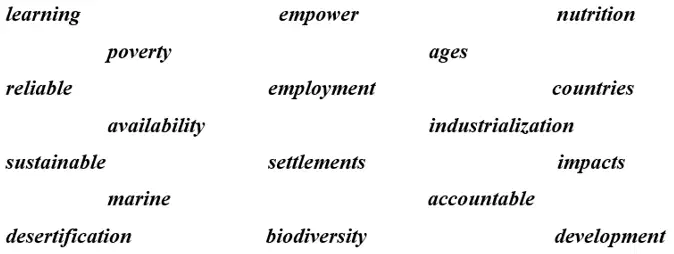
SHARE YOUR ANSWERS FOR THE 2ND BLANK.
Protect, restore and promote sustainable use of terrestrial ecosystems, sustainably manage forests, combat (1)__________, and halt and reverse land degradation and halt (2)__________ loss.
(a)
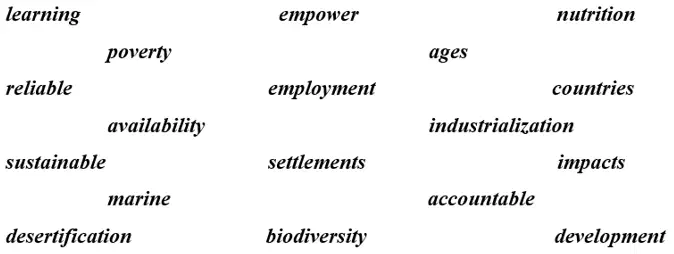
14. Conserve and sustainably use the oceans, seas and (a) resources for sustainable development.

12. Ensure (a) consumption and production patterns.

11. Make cities and human (a) inclusive, safe, resilient and sustainable.
A sensible consumer...
consume based on their needs but not desires.
consume based on their desires but not needs
follow friends' suggestions and trends blindly.
always bargain no matter what.
As consumers, we should avoid__________________ that leads to _________________.
excessive consumption; waste
bringing our own bags; a shortage of plastic bags we can get from shops
bargaining; shops making less money
buying fake goods; the closing down of fake good shops
Which one below is not a focus of green consumption?
Energy saving
Environmental protection
Sustainable consumption
Materialistic consumption
Which of the following is not part of the Sustainable Development Goals?
Access to sustainable energy for all
Availability of water and sanitation for all
Provision of internet services for all
Promotion of decent jobs for all
Global emissions of carbon dioxide (CO2) have increased by almost 80 per cent since 1990
True
False
What is the main greenhouse gas responsible for global warming?
oxygen
carbon dioxide
nitrogen
hydrogen
What does the term "carbon footprint" refer to?
The mark left by walking on a beach
The amount of carbon in a person's diet
The total greenhouse gas emissions associated with an individual or organization
The number of trees planted in a forest
Which of the following is an example of a sustainable practice?
Using single-use plastic bags
Leaving lights on when not needed
Recycling paper and glass
Using fossil fuels exclusively for energy
What is the term for the practice of planting trees to restore or create forests?
Which of the following is a non-renewable energy source?
How does sustainable consumption contribute to environmental conservation?/Como o consumo sustentável contribui para a preservação do meio ambiente?
What are the main types of fossil fuels?
Coal
Oil
Natural Gas
Hydroelectricity
Which sustainable energy source is derived from renewable sources such as plants and algae?
Biofuels
Hydrogen
Natural Gas
Electricity
What is the focus of the passage 'Exploring Sustainable Energy Sources'?
Synthetic Materials: Investigating their role in sustainable energy production
Environmental Impact: Assessing the effects of synthetic materials on the environment
Importance of Sustainability: Understanding the need for sustainable energy sources
Renewable Energy: Exploring natural sources of sustainable energy

