wayground logo

Free Printable Worksheets

Font size

S
M
L
XL
Worksheets

3rd Term Nine Weeks Test

Total questions: 50

Worksheet time: 4hrs 45mins

Name
Class
Date
1.

What do all waves transfer?

a)

Matter

b)

Heat

c)

Electricity

d)

Energy

2.

What are the two types of waves?

a)

longitudinal and transverse

b)

sound and light

3.

What is the number of complete waves passing a fixed point in a given amount of time?

a)

Amplitude

b)

Intensity

c)

Wavelength

d)

Frequency

4.

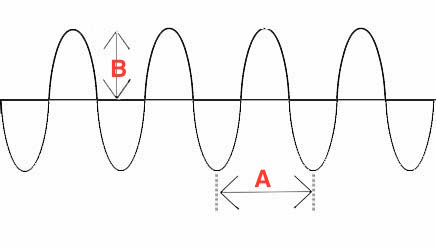
What is the frequency of this wave? You must count the number of complete waves.

a)

1 Hz

b)

5 Hz

c)

10 Hz

5.

What is frequency measured in?

a)

Milliseconds

b)

Miles

c)

Hertz

d)

Kilograms

6.

Which type of waves have the longest wavelength?

a)

Visible light

b)

Radio waves

c)

X-rays

d)

Gamma-Rays

7.

Wavelengths are usually measured in ....

a)

seconds

b)

Hz

c)

inches

d)

meters

8.

Shorter wave lengths can carry more energy. Which of these probably carries the MOST energy:

a)

Infrared light

b)

Visible light

c)

X-rays

d)

UV light

9.

What is the distance between the calm sea and the highest wave called?

a)

Wave

b)

Frequency

c)

Amplitude

d)

Magnitude

10.

What does #1 represent?

a)

Period

b)

Frequency

c)

Wavelength

d)

Amplitude

11.

What does #2 represent?

a)

Period

b)

Frequency

c)

Wavelength

d)

Amplitude

12.

What do all waves transfer?

(a)  

13.

What does #3 represent?

a)

Period

b)

Frequency

c)

Wavelength

d)

Amplitude

14.
What property of this wave is represented by the letter "A"
a)
amplitude
b)
crest
c)
trough
d)
wavelength
15.
The highest point on a wave is:
a)
the crest
b)
the trough
c)
the top
d)
the coast 
16.
The lowest point on a wave is the:
a)
Amplitude
b)
Crest
c)
Trough
d)
Wavelength
17.
The type of waves that require medium to pass:
a)
Mechanical Waves
b)
Electromagnetic Waves
18.
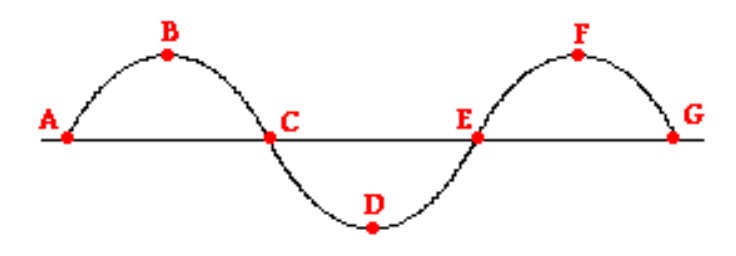
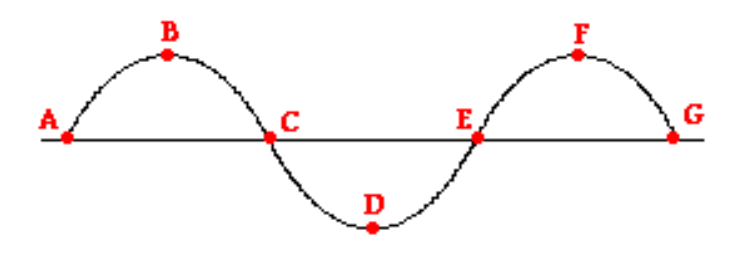
Which letter(s) represent the trough of the wave?
a)
A
b)
B & D
c)
D
d)
C & G
19.
Which letter(s) represent the crest of the wave?
a)
A
b)
B & D
c)
B & F
d)
F
20.
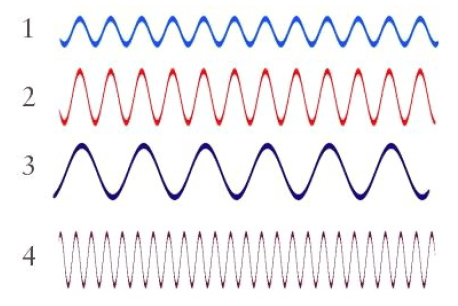
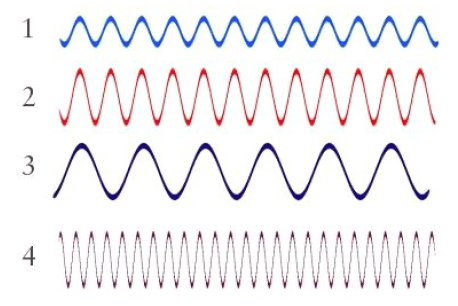
Which wave in the diagram has the greatest frequency?
a)
1
b)
2
c)
3
d)
4
21.
Which wave in the diagram has the greatest wavelength?
a)
1
b)
2
c)
3
d)
4
22.
Which of the following can sound travel through?
a)
solid
b)
liquid
c)
gas
d)
all of the above
23.
crest to crest or trough to trough
a)
crest
b)
trough
c)
amplitude
d)
wavelength
24.
regular disturbances that carry energy through matter or space
a)
crest
b)
energy
c)
wave
d)
trough
25.
which material does sound travel the fastest?
a)
solid 
b)
liquid 
c)
gases
26.
When a wave strikes and object and bounces off. (example echo)
a)
medium
b)
refraction
c)
reflection
d)
interference
27.

A wave that can travel through matter and empty space is a:

a)

electromagnetic wave

b)

longitudinal wavy

c)

transverse wave

28.
Longitudinal waves are ______.
a)
Parallel
b)
Perpendicular
c)
Crazy
29.
Transverse waves are ___.
a)
Parallel
b)
Perpendicular
c)
Weird
30.
What kind of wave is pictured below?
a)
compressional wave
b)
transverse wave
c)
sound wave
d)
mechanical wave
31.

You can't hear sounds in outer space because there is no

a)

medium

b)

light

c)

energy

d)

heat

32.
In longitudinal waves, the parts where the coils are spread apart are called what?
a)
rarefactions
b)
compressions
c)
mechanicals
d)
longitudes
33.
In a longitudinal wave, the parts where the coils are close together are called what?
a)
longitudes
b)
rarefactions
c)
compressions
d)
contractions
34.
Which travels faster, light or sound?
a)
light
b)
sound
35.
What type of wave move a slinky back and forth?
a)
longitudinal
b)
transverse
36.
What kind of wave is pictured?
a)
Transverse
b)
Longitudinal
c)
surface
d)
none of the above
37.

A wave that can travel through matter and empty space is a:

a)

electromagnetic wave

b)

longitudinal wavy

c)

transverse wave

38.

_____ waves have vibrations that run parallel to the direction the wave travels, and _____ waves have vibrations that run perpendicular to the direction the wave travels.

a)

transverse, longitudinal

b)

longitudinal, transverse

39.

In a longitudinal wave, a ____ is an area where the particles are spread apart and a ____ is an area where the particles are close together.

a)

crest, trough

b)

compression, rarefaction

c)

rarefaction, compression

d)

trough, crest

40.

Examples of ________ waves include visible light, xrays, ultraviolet, and radio waves.

a)

transverse

b)

longitudinal

41.
In a longitudinal wave, the particles move...?
a)
back and forth
b)
up and down
c)
vertically
d)
in the direction of the hertz
42.

The number of wave cycles in a unit of time is the ...

a)

Wave Speed

b)

Frequency

c)

Wavelength

d)

Amplitude

e)

Period

43.

The time for one cycle is the ...

a)

Wave speed

b)

Frequency

c)

Wavelength

d)

Amplitude

e)

Period

44.

What is the purpose of a wave?

a)

To confuse people.

b)

To transfer energy from one point to another.

c)

To transfer matter from one point to another.

d)

To alter the medium it travels through.

45.

Electromagnetic waves cannot travel through a medium.

a)

True

b)

False

46.

Waves with a higher frequency have a ...

a)

longer wavelength

b)

shorter wavelength

c)

higher amplitude

d)

shorter amplitude

47.

A wave has a wavelength of 15m and a frequency of 10Hz. What is the wave speed?

a)

1.5 m/s

b)

1.5m/s2

c)

150 m/s

d)

150 m/s2

48.
What is the name given to the effect shown in the photo above?
a)
Refraction
b)
Diffraction
c)
Reflection
d)
Standing wave
49.
When two waves combine to form a new wave with a smaller amplitude, it is called 
a)
Refraction
b)
Constructive Interference
c)
Resonance
d)
Destructive Interference
50.
crest match with crest and trough match with trough is called
a)
constructive interference
b)
destructive interference 
c)
monochromotic
d)
interference